




Introduction
Building an early-stage startup is an exercise in managing chaos. Founders and engineering leaders face immense pressure to ship features quickly, find product-market fit, and outpace competitors. In this high-stakes race, software development teams often prioritize speed over architectural discipline. Code is written rapidly, and software deployments are frequently handled manually by a handful of overwhelmed developers.
While manual processes might work when you have one or two developers and a few dozen users, they quickly become a liability as your user base grows. Imagine an engineering team spending hours manually copying files via SSH, running bespoke scripts on live production servers, and manually configuring environment variables. This creates a fragile, error-prone ecosystem where a single typo can result in catastrophic system downtime.
For an early-stage company, system downtime means lost revenue, degraded customer trust, and wasted engineering hours spent firefighting bugs instead of building value. This is where a modern startup DevOps strategy becomes essential. DevOps bridges the traditional gap between writing software and operating it. It replaces fragile, manual processes with robust, automated systems.
Adopting DevOps for Startups early in your lifecycle is not about copying the complex, multi-layered workflows of large tech enterprises. Instead, it is about instilling a culture of automation, consistency, and clear communication. By establishing automated pipelines and standardizing environments early, small teams can move faster with significantly less risk.
For teams looking to master these engineering principles, platforms like DevOpsSchool offer comprehensive training programs designed to demystify continuous integration, deployment pipelines, and cloud systems. Investing in the right operational foundation ensures that your product remains stable and highly responsive to market changes as you scale.
What Is DevOps for Startups?
At its core, DevOps is a cultural and technical philosophy that unites software development and IT operations. Instead of treating developers and infrastructure administrators as separate teams, DevOps brings them together under a shared goal: delivering reliable software continuously. For a young company, beginner DevOps for startups means creating a clean, repeatable assembly line for your product.
To understand this concept clearly, let us use a beginner-friendly analogy. Imagine you are opening an artisanal burger joint. In the beginning, one chef handles everything: taking orders, grilling meat, adding toppings, wrapping the burger, and handing it to the customer. When there are only two customers in line, this manual approach works fine.
However, if fifty customers suddenly arrive at once, the single chef becomes overwhelmed. Orders get mixed up, burgers are undercooked, toppings are forgotten, and customers leave frustrated. To handle the crowd, the restaurant needs a systematic kitchen line. One station prepares the buns, another grills the meat to exact specifications, and a third packages the meal according to a standardized checklist.
DevOps is that organized kitchen assembly line for your software. The code written by your engineering team is the raw ingredient. The DevOps pipeline acts as the automated kitchen that automatically tests the code, verifies its quality, packages it into a standard container, and delivers it to production safely. This system ensures that every release is identical, reliable, and delivered without manual intervention.
Why Startups Need DevOps Early
Many early-stage founders believe that implementing a structured startup DevOps strategy should be postponed until a company achieves significant scale or raises major funding. This is a costly misconception. Adopting automated workflows early saves hundreds of engineering hours down the line.
[Developer Writes Code]
          │
          ▼
[Automated Git Push]
          │
          ▼
[CI/CD Build & Automatic Testing]
          │
          ▼
[Automated Cloud Deployment] ──► [Live Production Environment]
Startups operate in environments with highly limited resources. In a small team, engineers wear multiple hats simultaneously. A single individual might write backend code, design database schemas, configure cloud servers, and answer customer support tickets. If that engineer spends half their week manually configuring environments and debugging broken server setups, product development slows to a crawl.
Implementing a DevOps implementation for startups early solves this bottleneck. When infrastructure creation and software deployments are automated, developers can focus entirely on writing high-quality features. Furthermore, early automation allows for rapid, low-risk product validation. When releasing code requires only a simple git push, your team can gather customer feedback, iterate, and deploy improvements multiple times per day.
Problems Startups Face Without DevOps
Operating an engineering group without standard DevOps methodologies leads to predictable organizational friction. The table below outlines the core problems small teams encounter and the direct impact these challenges have on business growth.
| Problem | Startup Impact |
| Manual Server Deployments | High human error rates, inconsistent application configurations across environments, and lengthy release cycles. |
| Frequent Production Downtime | Severe loss of customer trust, negative brand reputation, and missed revenue opportunities during peak hours. |
| Slow and Painful Bug Fixing | Lack of automated testing means bugs are discovered by users, requiring chaotic, manual patching under pressure. |
| Poor Cloud Scalability | Servers break under sudden traffic spikes because infrastructure cannot auto-scale to meet real-time user demands. |
| Severe Team Bottlenecks | Only one person knows how to deploy the application, creating a dangerous single point of failure for the company. |
| Wasted Infrastructure Spend | Unused, unmonitored development cloud servers remain active indefinitely, inflating monthly infrastructure bills. |
How DevOps Supports Startup Growth
Adopting a clear startup DevOps guide framework introduces stability across every dimension of your technical operations. The overview table below outlines how specific DevOps pillars translate directly into tangible operational benefits.
| DevOps Area | Startup Benefit |
| CI/CD Automation | Eliminates manual code integration errors and runs comprehensive test suites on every single code change. |
| Faster Deployments | Lowers product time-to-market, allowing teams to deliver updates and features to users within minutes. |
| Cloud Scalability | Leverages elastic cloud computing resources to automatically handle growth in daily active users. |
| Monitoring and Reliability | Catches infrastructure anomalies and errors before they impact the end-user experience. |
| Better Collaboration | Standardizes environments so code behaves identically on a developer’s laptop and a production server. |
| Cost Efficiency | Automates the shutdown of non-essential development resources, saving critical runway capital. |
| Faster Experimentation | Empowers product managers to rapidly deploy small feature updates to run precise A/B market testing. |
Area #1: CI/CD Automation
Continuous Integration and Continuous Deployment (CI/CD) form the backbone of modern startup automation. Continuous Integration ensures that whenever a developer pushes new code to a shared repository, that code is instantly built and verified via automated test scripts. Continuous Deployment takes that validated code and automatically pushes it to your staging or production environments.
Consider a mobile app startup where three developers build different application components simultaneously. Without CI/CD, they would wait until Friday to manually merge their work. This often leads to merge conflicts, broken functionality, and chaotic weekend debugging sessions. With CI/CD, every time a developer commits code, the automated system runs the test suite. If a bug is introduced, the build fails immediately, allowing the team to fix the issue within minutes.
Area #2: Faster Deployments
In a traditional development model, deploying a new version of an application is a high-stress, multi-hour event that typically happens late at night to minimize user disruption. Engineers must manually turn off servers, upload new files, run database migrations, change system configurations, and restart the processes.
DevOps implementation for startups transforms this manual process into a non-event. By utilizing blue-green deployment or rolling update workflows, code is deployed systematically. The automated pipeline creates a parallel server cluster with the new application version, routes a small fraction of user traffic to it, verifies system health, and then gracefully tears down the old servers. This eliminates release delays entirely.
Area #3: Cloud Scalability
Startups regularly experience unpredictable traffic patterns. A sudden feature on a major tech news site, a viral social media post, or a successful marketing campaign can send thousands of concurrent users to your website within minutes. If your infrastructure relies on a single fixed-size server, your platform will quickly crash under the load.
A mature startup DevOps strategy utilizes Infrastructure as Code (IaC) tools to define servers, networks, and databases programmatically. When cloud environments are defined as code, teams can set up automated scaling policies. For instance, if your server cluster’s CPU utilization exceeds 70% for more than three minutes, the cloud provider automatically provisions additional server instances to balance the load, scaling down seamlessly when traffic subsides.
Area #4: Monitoring and Reliability
You cannot fix what you do not measure. In an unmonitored startup infrastructure, engineering teams only discover application outages when angry customers email support or post complaints on social networks. This reactive operational stance damages user retention.
Implementing automated monitoring and alerting workflows changes this dynamic entirely. By embedding lightweight telemetry agents inside your cloud servers and application containers, you gain real-time visibility into system health. If database memory usage spikes abnormally or error response rates cross a specific threshold, automated alerting systems instantly notify the engineering team via chat tools, allowing them to remediate the issue before users notice a service degradation.
Area #5: Better Collaboration
A frequent source of frustration in engineering groups is the classic phrase: “Well, it worked fine on my local machine.” This occurs because a developer’s laptop has different software versions, operating system patches, and configuration files than the staging or production servers.
DevOps for small teams mitigates this friction by utilizing containerization technologies like Docker. Containers package the application code alongside its exact runtime environment, system libraries, and configurations into a single, immutable unit. This guarantees that the exact same artifact tested on a developer’s laptop runs in production, eliminating environmental discrepancies and fostering better engineering collaboration.
Area #6: Cost Efficiency
Every dollar matters when a young company is working to extend its operational runway. When non-technical founders or inexperienced developers spin up cloud resources manually, they often select oversized server instances or forget to terminate testing environments after a project concludes.
Through automated DevOps practices, startups can configure governance scripts that monitor cloud resource usage. For example, you can write an automation routine that checks for development and testing servers that are idle after 7:00 PM and automatically shuts them down for the night. This ensures your company only pays for active infrastructure, drastically reducing unnecessary cloud spend.
Area #7: Faster Experimentation
Finding product-market fit requires constant iteration based on objective user data. Startups need to try out new product hypotheses, feature layouts, and pricing models rapidly to see what resonates with their audience.
DevOps pipelines enable this high-velocity experimentation through the use of feature flags and automated feature branch deployments. If a product manager wants to test a new checkout flow, the engineering team can deploy the feature behind a conditional flag. The system can then safely expose this new code to just 5% of your user base, allowing you to monitor conversion metrics and system stability before rolling out the change globally.
Real-World Example: Startup Without DevOps
To clearly visualize the tangible differences these paradigms make, let us analyze a fictional SaaS startup named FinTrack, an application helping users manage their personal finances.
FinTrack consists of three backend developers. They do not have an automated CI/CD pipeline or a standardized startup DevOps strategy. Instead, they write code on their laptops, run manual checks, and use basic scripts to push updates.
[Developer Laptop] ──► (Manual ZIP/SSH Upload) ──► [Production Server]
                                                           │
                                             (Typo in config / Crash!)
                                                           │
                                                           ▼
                                            [3-Hour Outage & Lost Users]
One afternoon, a developer finishes a high-priority feature designed to fix a data synchronization bug. Eager to get it live, the developer opens an SSH connection to the live production server, stops the running application process, copies a manual ZIP archive of the new code, updates an environment configuration file by hand, and restarts the service.
Unfortunately, the developer makes a minor syntax typo in the configuration file while editing it live on the server. The application crashes instantly upon startup. Because there is no automated monitoring setup, the team remains unaware of the failure for forty minutes, until customer support receives dozens of complaints from users unable to log in.
The developer tries to roll back the change, but because the deployment was done manually without version-controlled artifacts, they must troubleshoot the code directly on the live server under intense stress. The platform remains offline for three full hours, leading to a wave of user uninstalls and lost subscriptions.
Real-World Example: Startup Using DevOps
Now, let us examine the exact same scenario with FinTrack after they implemented a robust, beginner DevOps for startups framework.
The team containerizes their financial application using Docker and configures an automated CI/CD pipeline. All cloud infrastructure is declared using structured code configurations stored safely in a central Git repository.
[Developer Push to Git]
          │
          ▼
[Automated CI/CD Pipeline]
  ├── Runs Unit Tests (Passed)
  ├── Builds Docker Image
  └── Deploys to Blue Server Cluster
          │
          ▼
[Automated Smoke Tests Fail (Bad Config)]
          │
          ▼
[Instant Auto-Rollback to Green Cluster] ──► [Zero Downtime for Users]
The developer finishes the data synchronization feature and pushes the code to the main Git repository. This action automatically triggers the CI/CD pipeline. The pipeline pulls the code, builds a new Docker container image, and runs a suite of automated unit tests to verify security and calculation logic.
Next, the automated system attempts to deploy the container to a staging cluster. During the automated smoke test phase, the system detects that the application fails to initialize properly due to an invalid configuration parameter. The pipeline halts the deployment instantly and sends a detailed failure notification to the team’s internal chat channel.
Throughout this entire automated process, the live production environment continues running the older, stable version of the application without a single millisecond of interruption. The developer reviews the automated logs, corrects the configuration file error on their local machine, and pushes the fix. The pipeline runs again, passes all checks, and deploys the update seamlessly to users with zero downtime.
Benefits of DevOps for Startups
Transitioning from manual workflows to structured automation delivers measurable competitive advantages to an early-stage company across four distinct metrics.
Speed
By automating the build, test, and release cycles, your engineering group can shorten the loop between writing a line of code and seeing that code deliver real value to customers. Features that used to take weeks to plan and deploy manually can be safely pushed to production multiple times a day.
Reliability
Human beings are inherently prone to error when executing repetitive, manual tasks under tight deadlines. By shifting server setups, database migrations, and code deployment procedures to automated scripts, you ensure that every operation is executed identically every single time, drastically reducing human error.
Scalability
A startup DevOps guide emphasizes decoupling applications from specific underlying hardware servers. By packaging services into lightweight containers and leveraging cloud orchestrators, your infrastructure can seamlessly scale up or down dynamically in response to user demand spikes.
Better Product Quality
When code testing is fully integrated directly into the developer’s standard daily workflow, software bugs are detected and remediated immediately within the development cycle. This prevents technical debt from accumulating and ensures that the final product delivered to users remains highly polished and stable.
Challenges of Startup DevOps Adoption
While the long-term benefits are clear, modern DevOps adoption does come with a set of realistic, practical hurdles that startup teams must navigate carefully.
- Highly Limited Budgets: Early companies must prioritize spending on immediate product survival, making it challenging to allocate funds for premium, enterprise-grade third-party DevOps tooling and platform licenses.
- Small Team Constraints: When an engineering department consists of only a few individuals, finding dedicated time to build automation infrastructure without delaying core product feature delivery requires careful balance.
- Acute Skill Gaps: Software developers are experts at writing feature logic but often lack deep, specialized knowledge regarding cloud networking, security hardiness, automated pipeline design, and infrastructure orchestration.
To overcome these roadblocks smoothly, teams should avoid chasing overly complex, enterprise-grade infrastructure architectures on day one. Focus instead on lightweight open-source tools, native cloud provider automation options, and building a foundational baseline of simple continuous integration before introducing advanced layers.
Common Startup DevOps Mistakes
In their eagerness to implement modern engineering practices, small engineering teams frequently fall into predictable operational traps. Review the checklist below to see if your team is making these common errors:
- Overengineering Infrastructure Too EarlyBuilding a highly complex, multi-region microservices cluster using advanced orchestration tools for a simple application with fewer than a thousand users is unnecessary. This introduces massive, unneeded operational complexity. Start with a clean, simple setup.
- Adopting Too Many Tools SimultaneouslyFlooding a small team with a disjointed array of monitoring agents, deployment tools, security scanners, and secret management utilities leads to operational fatigue. Choose a unified, simple toolset that satisfies your immediate delivery needs.
- Ignoring System Monitoring and AlertsFocusing exclusively on writing CI/CD deployment automation while failing to configure basic log collection and infrastructure resource alerts leaves your team blind to post-deployment runtime errors.
- Lacking a Clear Automation StrategyWriting disjointed, brittle automation scripts that are scattered across different developer laptops instead of being centralized and version-controlled inside a shared repository creates new operational bottlenecks.
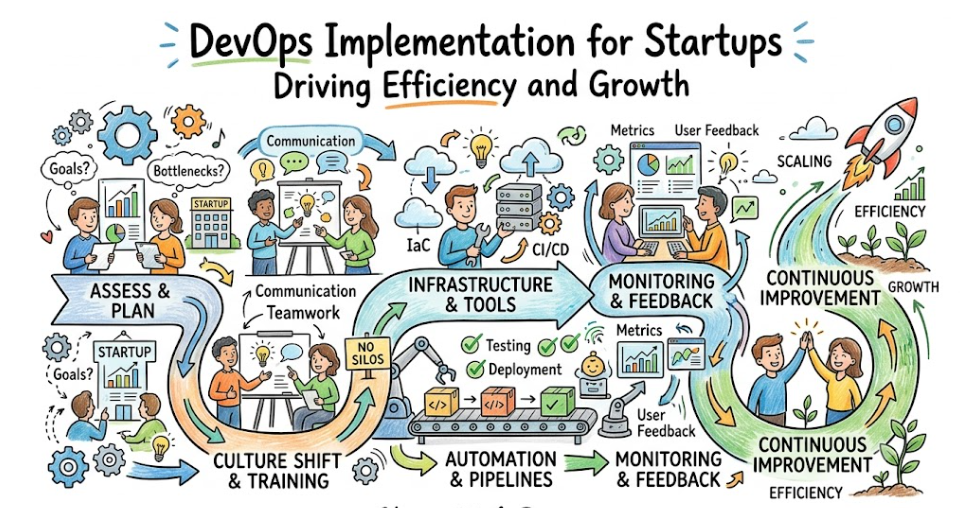
Practical Roadmap for Startup DevOps Adoption
Implementing DevOps implementation for startups does not require a massive, disruptive organizational overhaul. You can systematically mature your engineering practices by following a pragmatic, step-by-step progressive roadmap.
┌────────────────────────────────────────┐
│ Phase 1: Git Version Control           │
└───────────────────┬────────────────────┘
                    │
                    ▼
┌────────────────────────────────────────┐
│ Phase 2: Simple CI Automation          │
└───────────────────┬────────────────────┘
                    │
                    ▼
┌────────────────────────────────────────┐
│ Phase 3: Containerization & Cloud      │
└───────────────────┬────────────────────┘
                    │
                    ▼
┌────────────────────────────────────────┐
│ Phase 4: Basic Monitoring & Metrics    │
└───────────────────┬────────────────────┘
                    │
                    ▼
┌────────────────────────────────────────┐
│ Phase 5: Continuous Optimization      │
└────────────────────────────────────────┘
Phase 1: Establish Strict Git Version Control
Ensure that every line of application code, database migration script, and environment configuration file is stored in a centralized version control system like Git. Establish clean branch management workflows where code updates are reviewed via pull requests before being merged.
Phase 2: Implement Simple CI Automation
Configure a basic, lightweight continuous integration workflow using native repository tools. Set it up to trigger on every pull request to automatically install dependencies, run code linter checks, and execute basic unit tests. Do not proceed to deployment automation until your build pipeline is completely stable.
Phase 3: Introduce Containerization and Cloud Hosting
Package your application components into clean Docker containers to eliminate local development environment discrepancies. Deploy these containers to manageable, managed cloud platform services that handle the underlying infrastructure complexities automatically, allowing you to focus on the application layer.
Phase 4: Integrate Basic System Monitoring
Set up basic monitoring dashboards and log aggregation paths using simple cloud-native utilities. Configure simple notification alerts for fundamental metrics like disk space exhaustion, high CPU utilization, and sustained HTTP server error spikes so your team is notified of failures instantly.
Phase 5: Optimize and Iterate Gradually
Once your foundational pipeline runs reliably, begin progressively automating more complex areas. This includes integrating Infrastructure as Code templates, setting up automated staging environments, and refining your auto-scaling parameters based on historical usage data.
Role of DevOpsSchool in Learning Startup DevOps
Navigating the vast ecosystem of modern infrastructure technologies can feel overwhelming for founders, developers, and beginners trying to establish a reliable operational foundation. Mastering these concepts requires a practical, hands-on learning methodology that moves away from pure theoretical concepts and focuses instead on real-world engineering workflows.
This is where specialized educational frameworks from providers like DevOpsSchool add immense value to an engineering team. Rather than focusing simply on tool syntax, their curriculum emphasizes building a cloud-native mindset and mastering practical automation implementation.
Learners gain direct exposure to designing reliable CI/CD pipelines from scratch, managing version-controlled infrastructure layouts, and configuring cloud environments that adapt dynamically to traffic loads. For startup teams and developers, this practical training cuts through the industry hype. It equips engineers with the exact skills needed to eliminate manual deployment errors, optimize infrastructure spending, and construct dependable software assembly lines right from the start.
Career Importance of Startup DevOps Skills
As early-stage companies globally recognize that operational stability directly influences market survival, professionals possessing specialized automation and systems skills are seeing a dramatic surge in industry demand. The table below outlines key technical roles and their foundational skill expectations within the startup ecosystem.
| Engineering Role | Startup Skill Expectations |
| DevOps Engineer | Architecting end-to-end continuous delivery pipelines, managing container lifecycles, and standardizing development environments. |
| Cloud Engineer | Designing resilient, cost-optimized cloud network architectures, managing identity access, and overseeing resource provisioning. |
| SRE Engineer | Maximizing system uptime, defining objective reliability metrics, and building automated self-healing infrastructure patterns. |
| Platform Engineer | Creating internal developer portals and templates that empower software engineers to spin up resources safely without friction. |
| Startup Infrastructure Engineer | Generalist systems thinker specializing in lean, budget-conscious infrastructure management and rapid environment setup. |
Industries Where Startup DevOps Matters
While automation benefits every software-driven company, certain business verticals operate with regulatory demands and transaction patterns that make DevOps an absolute operational necessity.
SaaS Platforms
Software-as-a-Service startups face intense user pressure to ship feature updates continuously without introducing unexpected bugs or service interruptions. Automated deployment strategies allow SaaS companies to maintain this rapid pace safely.
FinTech Startups
Financial technology platforms operate under stringent data security compliance, strict financial audit tracking, and absolute accuracy mandates. Fully automated, version-controlled pipelines ensure that every code change is fully traceable, thoroughly audited, and securely verified before reaching users.
HealthTech Companies
Startups in the medical and healthcare space handle highly sensitive patient diagnostics and private records. Automated DevOps frameworks help enforce rigid regulatory compliance guidelines, manage data encryption standards uniformly, and guarantee high availability for critical care applications.
E-Commerce Operations
Digital retail platforms experience massive, highly volatile seasonal traffic fluctuations during major holiday sales and promotional events. Elastic cloud infrastructure scaling ensures the online storefront remains highly responsive under heavy transactional loads, preventing lost sales revenue.
EdTech Startups
Educational technology applications must seamlessly accommodate massive numbers of concurrent users during specific daytime school hours while scaling down resource usage to near-zero during nights and school holiday periods to optimize operational costs.
Telecom Startups
Modern telecommunication and networking startups manage decentralized cloud edges and heavy real-time data flows. Automated deployment structures allow them to push firmware updates, micro-service patches, and configuration tweaks across distributed nodes with zero human friction.
Future of DevOps for Startups
The discipline of software operations continues to evolve rapidly. For early-stage companies looking to maintain a competitive technical edge over the next few years, keeping an eye on emerging operational paradigms is vital.
One major shifting trend is the progressive rise of AI-assisted operations. Modern monitoring and logging tools are embedding intelligent anomaly detection models that can parse thousands of system logs in real time, identify unusual patterns, and suggest precise optimization paths before a system failure actually manifests.
Additionally, Platform Engineering is increasingly replacing unstructured DevOps implementations. Instead of requiring every software developer to become an expert in complex cloud networking, companies are building unified internal developer platforms. These platforms allow engineers to self-serve secure, pre-configured infrastructure templates through simple command-line tools.
Finally, security is shifting aggressively to the absolute beginning of the development cycle—a paradigm known as DevSecOps. Rather than verifying application security right before a major production release, automated vulnerability scanning, dependency checking, and secret detection tools are being integrated directly into the initial git push code phase, ensuring security compliance from day one.
FAQs
Why do startups need DevOps?
Startups need to adopt automated practices to eliminate slow manual tasks, reduce human error during product updates, and ensure their platforms remain stable for users. It allows small engineering teams to focus their energy on writing product features rather than fixing server problems.
Is DevOps expensive for startups to implement?
No, implementing core automation does not require a large budget. Most foundational tools for version control, continuous integration, and container management offer highly generous free tiers for small teams, allowing startups to build robust pipelines using very little capital.
Can very small engineering teams use DevOps practices?
Yes, small groups benefit immensely from automation. When a team has only two or three developers, they lack the time to handle manual system operations. Automating the build, test, and release cycles frees up hours of development time.
What basic tools should an early startup begin with?
A lean startup should start with Git for code tracking, a simple native cloud pipeline tool for continuous integration, Docker for application packaging, and basic cloud-native services for application hosting and logging.
Is cloud computing mandatory for startup DevOps?
While not strictly mandatory in a theoretical sense, cloud platforms provide the underlying APIs, elastic scaling resources, and managed services that make infrastructure automation, programmatic creation, and flexible scaling practical for a growing company.
How does a CI/CD pipeline help a startup move faster?
A CI/CD pipeline automatically runs test suites and configuration checks the moment code is updated. This allows developers to discover errors immediately, patch them quickly, and push working features to customers multiple times a day without manual risk.
Should an early-stage startup hire a full-time DevOps engineer?
In the very early stages, it is often better to foster a shared culture of automation among your existing developers. As the engineering team grows past eight to ten developers and infrastructure complexity increases, hiring a dedicated operations specialist becomes highly beneficial.
Can beginners learn startup DevOps methodologies easily?
Yes, anyone with basic software development or IT operations knowledge can learn these practices. By focusing systematically on foundational building blocks like version control and simple automation pipelines, beginners can steadily master the entire modern cloud ecosystem.
What is the difference between agile and DevOps for startups?
Agile is a product management methodology focused on breaking down project requirements into small, iterative steps and managing team workflows. DevOps is the technical and cultural practice focused on automating and optimizing the software build, test, and release infrastructure.
How does containerization improve startup engineering?
Containerization packages application code alongside its exact system dependencies and configurations. This ensures that the application executes identically across a developer’s laptop, a testing environment, and a production server, eliminating environmental bugs completely.
What is Infrastructure as Code (IaC) and why does it matter?
Infrastructure as Code is the practice of defining servers, networks, and databases using structured configuration files rather than manual point-and-click cloud dashboards. This allows teams to version-control, replicate, and deploy entire environments instantly.
How can DevOps help a startup save cloud costs?
Automation workflows can be configured to continuously track infrastructure utilization. They can automatically turn off unneeded development environments during weekends, remove orphaned storage discs, and scale down server clusters during low-traffic night hours.
What is a rollback and how is it automated?
A rollback is the process of reverting an application back to its previous stable version after a new release fails. DevOps pipelines automate this by continuously running health checks on new deployments; if a failure is detected, traffic is instantly rerouted to the older stable cluster.
Does adopting DevOps slow down early feature development?
While setting up an initial automated pipeline requires a small up-front time investment, it prevents massive development delays later on. The minor time spent configuring basic CI/CD early prevents hundreds of future hours spent manually troubleshooting production deployment failures.
How do we measure the success of our startup DevOps strategy?
Success can be measured using four standard metrics: deployment frequency, lead time for changes (how fast code goes from commit to production), mean time to recovery (how fast the team fixes a production outage), and change failure rate.
Final Thoughts
Implementing a structured startup DevOps strategy is not an expensive luxury reserved solely for enterprise tech companies with massive engineering departments. For an early-stage startup, embracing automation early is a foundational business strategy that directly supports long-term survival, agility, and scaling potential.
By moving away from fragile, manual server setups and embracing clean, automated software assembly lines, you protect your team from operational friction and costly production outages. This predictable operational stability builds deep customer trust and ensures that your engineering resources are consistently channeled into creating genuine product value rather than firefighting systems issues.
Remember that you do not need to build a flawless, highly complex infrastructure on day one. Start small, focus on automating your immediate bottlenecks, ensure your code version tracking is clean, and systematically improve your deployment and monitoring pipelines as your user base scales.