




The technology landscape has shifted from “software is eating the world” to “automation is running the world.” For any engineer or manager today, staying relevant means moving beyond isolated skills and embracing an integrated lifecycle. The wall between “those who build” and “those who run” has crumbled, replaced by a high-velocity culture known as DevOps.
If you are a software engineer in India looking for a career jump, or a global engineering manager aiming to optimize delivery pipelines, understanding the DevOps Certified Professional (DCP) ecosystem is no longer optional—it is a necessity. This guide provides a comprehensive roadmap to mastering this domain, achieving certification, and navigating the various specialized tracks that define modern IT.
The Foundation: DevOps Certified Professional (DCP)
The DevOps Certified Professional (DCP) is widely recognized as the entry point for anyone serious about mastering the modern software delivery lifecycle. It serves as the “anchor” certification because it provides the fundamental skills required to move a product from a developer’s laptop to a production environment at scale.
In the industry, we often see engineers who know one tool—like Git or Docker—but struggle to connect them. The DCP is designed to solve that problem by building a cohesive, automated workflow.
What it is
The DCP is an intensive training and certification program designed to transform traditional IT professionals into high-performing DevOps engineers. It covers the entire spectrum of the DevOps lifecycle—from Plan and Code to Monitor and Operate—using the most in-demand industry tools.
Who should take it
This program is specifically designed for:
- Software Engineers wanting to master the deployment and infrastructure side.
- System Administrators moving toward Infrastructure as Code (IaC).
- QA/Testing Professionals looking to automate the testing pipeline (DevTestOps).
- Technical Managers who need to oversee modern automation teams.
Skills you’ll gain
- Version Control Mastery: Expert-level Git and branching strategies.
- CI/CD Pipeline Construction: Building automated flows using Jenkins, GitLab CI, or GitHub Actions.
- Containerization: Mastering Docker for consistent environments.
- Orchestration: Deploying and scaling microservices with Kubernetes.
- Infrastructure as Code (IaC): Automating cloud provisioning with Terraform and Ansible.
- Site Reliability & Observability: Setting up monitoring with Prometheus and Grafana.
Real-world projects you should be able to do after it
- Automated Microservices Pipeline: Create a CI/CD flow that automatically builds, tests, and deploys a microservice to a Kubernetes cluster upon every code commit.
- Immutable Infrastructure Setup: Use Terraform to provision a multi-tier AWS or Azure environment and Ansible to configure the internal software layers automatically.
- Self-Healing Monitoring System: Configure an observability stack that detects high latency and automatically scales the application pods to maintain performance.
- Centralized Logging Architecture: Implement an ELK (Elasticsearch, Logstash, Kibana) stack to aggregate logs from hundreds of distributed containers.
Preparation plan
- 7–14 Days (The Intensive Review): Best for those already working in DevOps. Focus on filling gaps in specific tools (e.g., if you know Jenkins but not Kubernetes). Dedicate 4 hours daily to hands-on labs.
- 30 Days (The Professional Track): The ideal path for software engineers. Spend 2 hours a day. Focus on one pillar per week: CI/CD, then Containers, then IaC, then Monitoring.
- 60 Days (The Career Transition): Recommended for managers or beginners. Spend the first 20 days mastering Linux fundamentals and Shell scripting before moving into the automation tools.
Common mistakes to avoid
- Focusing on Tools over Culture: Tools change every year, but the philosophy of collaboration and fast feedback is what makes DevOps work.
- Neglecting Linux Basics: You cannot master Kubernetes or Docker if you are uncomfortable with the Linux command line.
- Manual Hotfixes: In a DevOps environment, never fix things manually on a server. If it isn’t in the code/script, it doesn’t exist.
- Overcomplicating the Pipeline: Start simple. A small, reliable pipeline is better than a massive, fragile one that breaks every day.
Best next certification after this
After completing the DCP, the logical progression is the Certified DevOps Architect (CDA). This moves you from the “how” of implementation to the “why” of system design and global scaling.
Master Certification Table: Choosing Your Track
| Track | Level | Who it’s for | Prerequisites | Skills Covered | Recommended Order |
| DevOps (DCP) | Professional | Working Engineers | Basic Linux/Git | CI/CD, K8s, Terraform, Docker | 1 |
| SRE | Professional | Reliability Engineers | DCP or Admin Exp | SLOs, Error Budgets, Incident Mgmt | 2 |
| DevSecOps | Professional | Security/Cloud Eng | DevOps Basics | Vulnerability Scanning, Vault, Compliance | 2 |
| AIOps/MLOps | Professional | Data/ML Engineers | Python Basics | ML Pipelines, Model Versioning, AI Ops | 3 |
| DataOps | Professional | Data Engineers | SQL, ETL basics | Data Pipelines, Quality Automation | 3 |
| FinOps | Professional | Managers/Cloud Eng | Cloud Concepts | Cost Optimization, Governance | 3 |
| DevOps Architect | Expert | Senior Engineers | 5+ Yrs Tech Exp | Enterprise Scaling, Multi-Cloud | 4 |
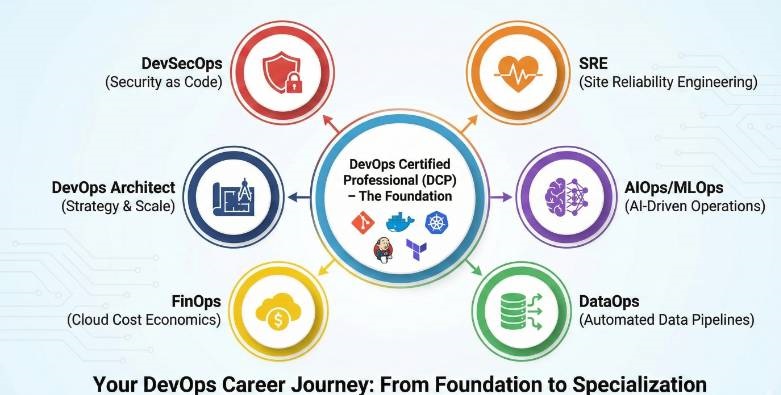
Choose Your Path: 6 Specialized Learning Journeys
Engineering careers are no longer linear. Depending on your interest, you should follow one of these specialized paths:
1. The DevOps Path
The classic generalist route. You become the bridge between development and operations. Your goal is to ensure that code flows from a developer’s laptop to production as fast and safely as possible.
2. The DevSecOps Path
The “Security as Code” expert. You integrate security checks (SAST, DAST) directly into the CI/CD pipeline. You ensure that speed doesn’t come at the cost of vulnerability.
3. The SRE Path
Modeled after Google’s approach. You treat operations as a software engineering problem. You focus on reliability, scalability, and “Error Budgets” to balance stability with new feature releases.
4. The AIOps/MLOps Path
The intersection of Data Science and DevOps. You build the infrastructure that allows Machine Learning models to be deployed, monitored, and retrained automatically in production environments.
5. The DataOps Path
Focused on the data supply chain. You apply DevOps principles to data pipelines, ensuring that data is high-quality, accessible, and automated from source to warehouse.
6. The FinOps Path
The “Economics of Cloud.” You manage the financial accountability of cloud spending. You ensure the organization gets the most business value for every dollar spent on AWS, Azure, or GCP.
Role → Recommended Certifications Mapping
Align your learning with your career goals using this mapping:
- DevOps Engineer: DevOps Certified Professional (DCP) → Certified DevOps Architect.
- Site Reliability Engineer (SRE): DCP → Certified Site Reliability Professional.
- Platform Engineer: DCP → Kubernetes Expert → Infrastructure Architect.
- Cloud Engineer: DCP → AWS/Azure/GCP Solutions Architect.
- Security Engineer: DCP → Certified DevSecOps Professional.
- Data Engineer: DataOps Certified Professional → MLOps Professional.
- FinOps Practitioner: Certified FinOps Professional → DevOps Manager.
- Engineering Manager: Certified DevOps Manager → Certified FinOps Professional.
Top Institutions for DevOps Training & Certification
When seeking professional training for the DevOps Certified Professional (DCP), these institutions stand out for their curriculum depth and community support:
- DevOpsSchool: The primary authority for the DCP program. They offer extensive hands-on labs, a massive library of video content, and live instructor-led sessions tailored for working professionals.
- Cotocus: A premium consulting and training organization that focuses on high-end enterprise DevOps tools. They are known for their deep technical expertise and corporate-style workshops.
- Scmgalaxy: One of the oldest and most respected communities in the DevOps space. They provide a wealth of free resources, tutorials, and specialized training sessions for SCM and Build-Release engineers.
- BestDevOps: Focuses on intensive, result-oriented training. Their programs are designed to get students “job-ready” by focusing on the most critical tools and interview preparation.
- DevSecOpsSchool: A dedicated platform for security-focused automation. They specialize in shifting security to the left and mastering tools like Vault, SonarQube, and Aqua Security.
- SRESchool: This institution focuses exclusively on the SRE discipline, teaching engineers how to manage high-availability systems and modern incident response.
- AIOpsSchool: Leading the charge in the AI-driven future, this school provides specialized tracks for MLOps and using AI to enhance operational efficiency.
- DataOpsSchool: Focused on the data engineering community, they teach how to automate data pipelines and ensure data integrity at scale.
- FinOpsSchool: The go-to destination for cloud financial management training, helping professionals master the art of cloud cost optimization and governance.
Next Certifications to Take: Growing Beyond DCP
Once you have mastered the Professional level, you must decide how to evolve. Based on industry trends, here are your three best options:
- Same-Track (Vertical Growth): Certified DevOps Architect (CDA). This is for those who want to remain deeply technical but move into leadership roles where they design the overall system architecture.
- Cross-Track (Horizontal Growth): Certified DevSecOps Professional. Adding security to your DevOps skill set makes you a “T-shaped” professional, greatly increasing your market value.
- Leadership Track (Management Growth): Certified DevOps Manager. Ideal for those looking to move into people and project management while maintaining a strong grasp of the underlying technology stack.
General FAQs (Working Engineers & Managers)
1. How difficult is the DCP certification?
It is moderately difficult because it is practical. You must demonstrate that you can actually use the tools, not just define them.
2. Is there a specific sequence I should follow?
Always start with the DCP. It provides the foundation of Git, CI/CD, and Containers that every other specialized track (SRE, DevSecOps, etc.) builds upon.
3. Do these certifications help in getting jobs in the US or Europe?
Yes, these certifications are global. The tools covered (Kubernetes, Terraform, Jenkins) are the standard across the worldwide tech industry.
4. Can I transition from QA to DevOps using this?
Absolutely. QA professionals often have the best mindset for DevOps because they already focus on quality and automation.
5. How much coding is required?
You don’t need to be a C++ or Java expert, but you must be comfortable with YAML (for K8s/Ansible) and basic Python or Bash for scripting.
6. Is Kubernetes really necessary?
Yes. In the current market, “DevOps” and “Kubernetes” are almost synonymous. You cannot be a professional in this field without it.
7. How long is the DCP certificate valid?
The certificate is generally valid for two to three years, after which a refresher or a higher-level certification is recommended.
8. Is this suitable for Project Managers?
Yes. Managers need the “Certified DevOps Manager” track to understand how to lead these technical teams effectively.
9. What is the average time to prepare?
For a working engineer, 30 to 45 days is the sweet spot for thorough preparation.
10. Do I need a high-end laptop for labs?
Most training provides cloud-based labs, so a standard laptop with a good internet connection is usually enough.
11. Is cloud experience a prerequisite?
Basic knowledge of AWS or Azure is helpful, but the DCP course usually includes the necessary cloud fundamentals.
12. What is the value of this certification compared to free online courses?
The value lies in the structure, the mentor support, and the recognized “Certified” status which carries weight during background checks and HR screening.
Specific FAQs: DevOps Certified Professional (DCP)
1. What makes the DCP unique?
It is built by practitioners for practitioners. The curriculum is updated every quarter to reflect the latest versions of tools like Kubernetes and Terraform.
2. Who provides the official training for DCP?
DevOpsSchool is the primary and official provider of the DCP program.
3. Is there a lab exam involved?
Yes, the certification includes practical assessments where you must solve real-world automation problems.
4. Can I take the exam without the training?
While possible for very experienced engineers, the training is highly recommended because it covers the specific “production-standard” ways of using the tools.
5. Does the DCP cover Cloud providers?
Yes, it typically covers multi-cloud concepts, showing you how to deploy the same tools on AWS, Azure, and Google Cloud.
6. Is there a community for DCP holders?
Yes, you gain access to an exclusive alumni network and community forums where jobs and technical solutions are shared.
7. How does DCP help in a career hike?
DCP holders are often eligible for “Senior DevOps” or “Lead Engineer” roles, which typically offer significantly higher compensation than generalist software roles.
8. What happens if I fail the exam?
Most providers offer a retake option. You are encouraged to review the lab recordings and documentation before attempting the retake.
Conclusion
The journey to becoming a DevOps Certified Professional (DCP) is one of the most rewarding paths a technical professional can take today. It is more than just a list of tools; it is a mindset of continuous improvement, automation, and efficiency.
Whether you choose to specialize in Security, Reliability, or Cloud Economics, the foundation starts with a solid understanding of the DevOps lifecycle. By choosing the right path and the right institution, you are not just earning a certificate—you are future-proofing your career in an increasingly automated world.
The industry is moving fast. The only question is: are you ready to lead the charge? Start your journey today at DevOpsSchool.