




In the rapidly evolving world of software delivery, standing still is equivalent to moving backward. Over the decades, I have watched the industry transition from manual server racking and “over-the-wall” deployments to the sophisticated, automated, and intelligent ecosystems we see today. If you are a software engineer or a manager looking to stay relevant in 2026, the traditional DevOps label is no longer enough. You need to transition into a Master in DevOps Engineering (MDE).
This guide is designed to be your career compass. Whether you are navigating the complexities of cloud-native architectures in Bangalore or managing global engineering teams from San Francisco, mastering the MDE track is the most direct path to becoming an indispensable architect of modern systems.
Why “Master in DevOps Engineering” (MDE)?
The “Master in DevOps Engineering” isn’t just a fancy title; it represents a holistic fusion of three critical pillars: DevOps, DevSecOps, and Site Reliability Engineering (SRE).
Initially, DevOps was about breaking down silos. Then, security became a non-negotiable integrated step (DevSecOps). Finally, the industry realized that speed without reliability is a recipe for disaster, bringing SRE to the forefront. The MDE program is the only curriculum that merges these disciplines into a single, cohesive mastery track. It is designed for those who don’t just want to use tools, but want to design the very systems that govern how software is built, secured, and scaled.
Choose Your Path: 6 Specialized Learning Tracks
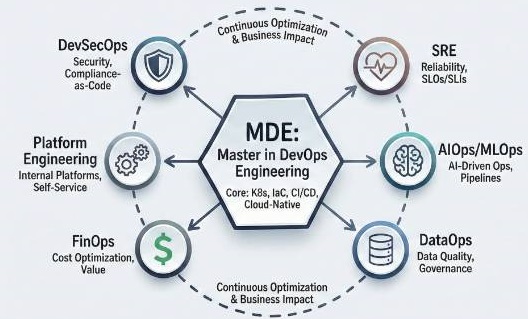
Before diving into the MDE certification, you must identify where your passion and career goals align. The modern “Ops” landscape has branched into six distinct specialized paths:
- DevOps Path: Focuses on the core lifecycle—CI/CD, automation, and culture.
- DevSecOps Path: Prioritizes “shifting left,” integrating security scanning, and compliance into every pipeline.
- SRE Path: Focuses on scalability, reliability, SLOs/SLIs, and reducing “toil” through software engineering.
- AIOps / MLOps Path: The frontier of 2026. Automating the lifecycle of Machine Learning models and using AI to manage IT operations.
- DataOps Path: Streamlining data delivery and ensuring the quality and speed of data pipelines for analytics.
- FinOps Path: The “Cloud Financial Management” track—aligning cloud spending with business value and optimizing infrastructure costs.
Deep Dive: Master in DevOps Engineering (MDE) Certification
If you are looking for a “one-stop” validation of your expertise, the Master in DevOps Engineering (MDE) is the gold standard.
What it is
The MDE is a comprehensive, industry-recognized program that transforms a practitioner into a high-level architect. It covers the end-to-end lifecycle, including advanced CI/CD, container orchestration (Kubernetes), infrastructure as code (Terraform), and the principles of SRE and DevSecOps.
Who should take it
- Software Engineers looking to transition into architectural roles.
- System Administrators aiming to modernize their skill set.
- Technical Managers who need to oversee complex cloud-native projects.
- DevOps Practitioners who want to validate their skills with a formal “Master” level credential.
Skills you’ll gain
- Mastery of CI/CD/CM (Continuous Integration, Deployment, and Monitoring).
- Expertise in Kubernetes and Docker for production-grade orchestration.
- Proficiency in Infrastructure as Code (IaC) using Terraform and Ansible.
- Ability to implement Security-as-Code and automated compliance.
- Understanding of SRE metrics (SLOs, SLIs, and Error Budgets).
Real-world projects you should be able to do
- Architect a multi-cloud, high-availability CI/CD pipeline with automated rollbacks.
- Deploy a secure microservices architecture on EKS/GKE with integrated service mesh (Istio).
- Build a centralized logging and observability stack using Prometheus, Grafana, and ELK.
- Automate cloud cost optimization and tagging governance across enterprise accounts.
Preparation plan
- 7–14 days: Intensive review for experienced practitioners who already manage production clusters.
- 30 days: The “Sweet Spot”—ideal for engineers with 2-3 years of experience. Spend 2 hours daily on labs.
- 60 days: Recommended for career switchers or junior engineers. Focus on building 3-5 real-world portfolio projects.
Common mistakes
- Tool Obsession: Learning “how” to use a tool without understanding “why” it fits the architecture.
- Ignoring Security: Treating security as an afterthought rather than integrating it into the initial pipeline design.
- Manual Over-Engineering: Building complex scripts for tasks that should be handled by standard IaC modules.
- Passive Learning: Watching videos without actually breaking (and fixing) a Kubernetes cluster.
Best next certification after this
After completing the MDE, the best progression is to specialize.
- Same Track: Master in Observability Engineering (MOE).
- Cross-Track: DevSecOps Certified Professional (DSOCP).
- Leadership: Certified DevOps Manager (CDM).
Complete Master Certification Table
This table summarizes the core certifications provided across the various specialized tracks. Use this to plan your journey from Foundation to Expert.
| Track | Certification Name | Level | Who it’s for | Prerequisites | Skills Covered | Recommended Order |
| MDE | Master in DevOps Engineering | Master | Sr. Engineers, Architects | Basic Linux & Cloud | DevOps, SRE, DevSecOps | 1st (Mastery) |
| DevOps | Certified DevOps Engineer (CDE) | Foundation | New Engineers, QA | Basic Scripting | Git, Jenkins, Docker | 1 (Core) |
| DevOps | Certified DevOps Professional (CDP) | Professional | Engineers (2+ yrs) | CDE or equivalent | K8s, Terraform, CI/CD | 2 (Core) |
| Security | DevSecOps Certified Professional | Professional | Security/DevOps Eng | DevOps basics | Vault, SonarQube, SCA | 1 (Specialist) |
| SRE | Certified SRE Professional | Professional | SREs, Ops Engineers | Linux, Monitoring | SLOs, SLIs, Toil reduction | 1 (Specialist) |
| AI/ML | MLOps Certified Professional | Professional | ML/Data Engineers | Python, DevOps | ML Pipelines, MLflow | 1 (Specialist) |
| AI/ML | AIOps Certified Professional | Professional | Ops, SREs | Monitoring basics | AI in Ops, Log Analysis | 1 (Specialist) |
| Data | DataOps Certified Professional | Professional | Data Engineers | SQL, ETL basics | Data Pipelines, Git | 1 (Specialist) |
| FinOps | Certified FinOps Professional | Professional | Cloud Eng, Managers | Cloud Architecture | Cost Optimization | 1 (Specialist) |
Role → Recommended Certifications
One of the most frequent questions I get is, “What should I take for my specific job?” Here is the mapping:
- DevOps Engineer: CDE → CDP → Master in DevOps Engineering (MDE).
- SRE: Certified SRE Professional → Master in Observability Engineering.
- Platform Engineer: MDE → Certified Kubernetes Administrator (CKA).
- Cloud Engineer: CDP → GCP/AWS/Azure Professional Cloud DevOps Engineer.
- Security Engineer: DevSecOps Certified Professional → CKS (Certified Kubernetes Security).
- Data Engineer: DataOps Certified Professional → MLOps Certified Professional.
- FinOps Practitioner: Certified FinOps Professional → Cloud Architect Certs.
- Engineering Manager: Certified DevOps Manager (CDM) → FinOps Architect.
Top Training & Certification Providers
When choosing a partner for your MDE journey, look for institutions that prioritize hands-on labs and real-world scenarios. Here are the leading platforms specializing in these domains:
DevOpsSchool As a primary leader in the space, DevOpsSchool offers the most comprehensive MDE program. With over 15 years of industry experience, their training is heavily focused on real-world projects and instructor-led live sessions. They are widely recognized for bridging the gap between theoretical knowledge and the technical mastery required by top-tier global tech companies.
Cotocus Cotocus is a specialized consulting and training powerhouse that focuses on high-end software engineering and “Ops” disciplines. They provide deeply technical bootcamps in DevOps, SRE, and DevSecOps, tailored for professionals who need to implement complex architectures in production environments. Their curriculum is designed to align with Industry 4.0 principles, making it a favorite for corporate upskilling.
Scmgalaxy Known as a community hub for Software Configuration Management (SCM) and CI/CD experts, Scmgalaxy provides high-quality technical content and training. They specialize in build and release automation, version control, and infrastructure orchestration. Their trainers are subject matter experts who bring a decade of field experience into the classroom, ensuring learners understand the “how” and “why” of every tool.
BestDevOps BestDevOps focuses on making engineers “job-ready” through intensive, result-oriented training programs. Their courses are curated to cover the most in-demand tools and methodologies currently used by Fortune 500 companies. They emphasize practical laboratory work, helping students build a robust portfolio of projects that demonstrate their readiness for senior DevOps and Platform Engineering roles.
DevSecOpsSchool This institution is dedicated entirely to the “Security” aspect of the DevOps lifecycle. They provide specialized training on shifting security left, covering vulnerability management, container security, and automated compliance. For engineers aiming to become DevSecOps experts, this school offers the specialized labs needed to master tools like Vault, SonarQube, and Checkmarx.
SRESchool SRESchool focuses exclusively on Site Reliability Engineering, providing a deep dive into scalability, reliability, and resilience. Their curriculum covers critical SRE metrics like SLOs, SLIs, and Error Budgets, alongside chaos engineering and advanced observability. It is the go-to destination for engineers who want to specialize in keeping complex, distributed systems running at 99.99% uptime.
AIOpsSchool At the intersection of AI and Operations, AIOpsSchool prepares engineers for the future of automated IT. They focus on using machine learning algorithms to analyze logs, detect anomalies, and automate incident responses. Their training is essential for SREs and Ops managers who want to reduce noise and scale their operations through intelligent automation.
DataOpsSchool DataOpsSchool addresses the unique challenges of data delivery and lifecycle management. They provide structured training on building agile data pipelines, ensuring data quality, and integrating DevOps practices into data engineering. This provider is ideal for Data Engineers and Architects looking to streamline the flow of data from source to analytics with high speed and reliability.
FinOpsSchool FinOpsSchool specializes in the growing field of Cloud Financial Management. Their programs teach engineers and managers how to align cloud spending with business value through culture, tools, and processes. They provide the technical and financial framework needed to optimize cloud costs and drive accountability across engineering teams in large-scale organizations.
Next Certifications to Take
Once you have your Master in DevOps Engineering (MDE) under your belt, don’t stop. The industry keeps moving. Here are three logical next steps:
- Same Track Progression: Master in Observability Engineering (MOE). Dive deeper into the telemetry, tracing, and advanced debugging of distributed systems.
- Cross-Track Expansion: MLOps Certified Professional. With the AI boom, being the engineer who can actually deploy and scale LLMs is a superpower.
- Leadership Track: Certified DevOps Manager (CDM). If you want to move into management, this cert validates your ability to lead culture shifts and manage technical debt at scale.
FAQs: General DevOps Career & Growth
1. How difficult is the MDE certification? It is a “Master” level program, so expect it to be challenging. It requires a solid grasp of Linux, Cloud, and at least one programming language. However, with the 120-hour curriculum, it is structured to guide you from basic to advanced.
2. How much time does it take to get certified? Most working professionals complete the training and exam within 3 to 4 months. If you are studying full-time, you can achieve it in 60 days.
3. What are the prerequisites? A basic understanding of the Software Development Life Cycle (SDLC) and comfort with the command line. Prior experience as a Software Engineer or SysAdmin is highly recommended.
4. In what sequence should I take these? Start with the Certified DevOps Engineer (CDE) for foundations, move to Professional (CDP), and culminate with the Master (MDE).
5. Is this certification valued globally? Yes. Organizations in India, the US, and Europe specifically look for practitioners who understand the “Master” curriculum (DevOps + SRE + Security) because it reduces the need for three separate hires.
6. Can a manager take the MDE? Absolutely. It helps managers understand the technical bottlenecks their teams face, allowing for better capacity planning and roadmap design.
7. Do I need to know coding? You don’t need to be a senior developer, but you must be comfortable with Python or Shell scripting to automate tasks.
8. What is the career outcome after MDE? Graduates typically move into Senior DevOps Engineer, SRE, or DevOps Architect roles with a significant salary hike.
9. Does the certification expire? Certifications from DevOpsSchool are generally valid for lifetime, but the industry recommends “refreshing” your skills every 2-3 years.
10. How do these certs compare to Cloud Provider certs (AWS/Azure)? Cloud certs teach you their tools. MDE teaches you the methodology and open-source tools (like K8s/Terraform) that work across all clouds.
11. Is there a lab component? Yes, the MDE program is 70% hands-on. You cannot pass without successfully completing the real-world projects.
12. What if I fail the exam? Most providers allow a retake after a cooling-off period. Focused study on the lab portions usually ensures success on the second attempt.
FAQs: Master in DevOps Engineering (MDE) Specifics
1. What makes MDE different from a standard DevOps course? MDE is a “comprehensive architect” program. While a standard course might just teach you Jenkins, MDE integrates SRE and DevSecOps into the core workflow.
2. Who is the provider of the MDE certification? The program is provided by DevOpsSchool, a global leader in “Ops” training.
3. Where can I find the official syllabus? You can access the full curriculum at the official MDE page.
4. Does MDE cover Cloud platforms? Yes, it typically includes hands-on work with AWS, Azure, or GCP, focusing on how to deploy DevOps tools on these platforms.
5. How many projects are included in the training? The MDE program includes at least 3 major real-time scenario projects that simulate an enterprise environment.
6. Is the exam online or offline? The exam is an online-proctored format, allowing you to take it from anywhere in the world.
7. Can I transition from a Non-IT role using MDE? While MDE is advanced, many professionals transition by starting with the “Foundation” level training provided by the same institutions.
8. What is the passing rate for the MDE exam? Due to the rigorous training and mock tests provided, the passing rate is exceptionally high—around 99% for those who complete the full lab curriculum.
Final Thoughts
In my time, I’ve seen tools come and go. I’ve seen Docker replace Vagrant and Kubernetes become the “Operating System” of the cloud. The one thing that remains constant is the value of an engineer who understands the Full Stack of Operations.
Don’t just collect badges. Build things. Break things. And use the Master in DevOps Engineering (MDE) as the framework to turn your curiosity into a world-class career.