




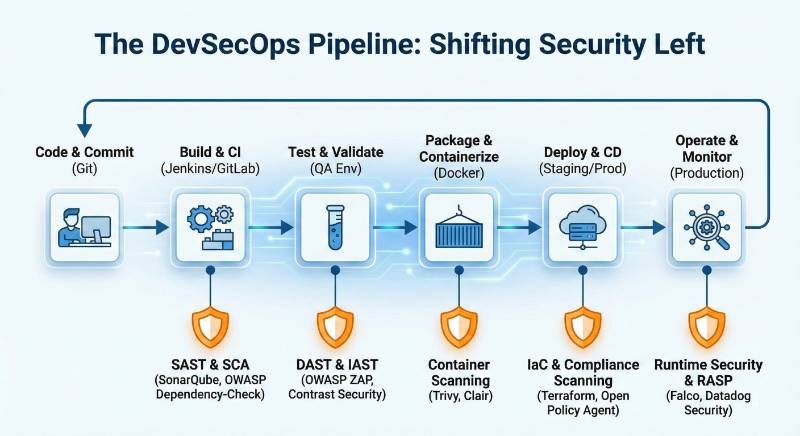
The software world has changed. Years ago, we built software, threw it over a wall to operations, and hoped security teams would catch issues before a hack happened. That model is dead. Today, speed is the currency of business. But speed without safety is just a faster way to crash.
This shift has created the single most urgent role in modern tech: DevSecOps.
As a career mentor who has guided thousands of engineers through the evolution of the “Ops” landscape, I can tell you that integrating security into the DevOps pipeline is no longer optional. It is the standard. Whether you are a fresh engineer or a seasoned manager, the ability to “shift security left”—to fix vulnerabilities before code ever leaves a developer’s machine—is a superpower.
This guide is your complete roadmap to the DevSecOps Certified Professional Online Training, the gold-standard program designed to turn you into that expert.
Master Certification Reference
Below is the quick-reference details for the certification covered in this guide.
| Certification | Track | Level | Who it’s for | Prerequisites | Skills Covered | Recommended Order |
| DevSecOps Certified Professional (DSOCP) | DevSecOps | Professional | DevOps Engineers, SREs, Security Leads | Basic Linux, CI/CD, & Cloud knowledge | Secure CI/CD, SAST/DAST, Container Sec, Compliance | After DevOps Foundation |
DevSecOps Certified Professional (DSOCP)
What it is
The DSOCP is a hands-on, 72-hour intensive training program. It is not just about watching videos; it is about doing. The course is designed to teach you exactly how to embed security controls into every stage of the software delivery lifecycle. It moves beyond theory to cover the actual tools (like SonarQube, OWASP, Docker Bench) used in production environments to secure pipelines, containers, and clouds.
Who should take it
- DevOps Engineers: Who need to stop being the bottleneck for security teams.
- Security Professionals: Who need to understand how to automate their audits in a CI/CD world.
- Software Engineers: Who want to write secure code and understand how their applications are attacked.
- Engineering Managers: Who need to lead teams toward a “Security-by-Design” culture.
Skills you’ll gain
- Automated Security Testing: Implementing Static (SAST) and Dynamic (DAST) analysis in Jenkins/GitLab.
- Container Hardening: Securing Docker images and registries against vulnerabilities.
- Infrastructure as Code Security: Scanning Terraform and Ansible scripts for misconfigurations.
- Compliance Automation: treating audit requirements as code.
- Vulnerability Management: Identifying, triaging, and patching risks without stopping the release train.
- Cloud Security: IAM management and network security in AWS/Azure.
Real-world projects you should be able to do after it
After finishing this training, you should be able to walk into any company and deliver:
- The “Golden” Pipeline: A fully automated CI/CD pipeline that blocks builds if they contain high-severity vulnerabilities or leaked secrets.
- Zero-Trust Container Setup: A Docker/Kubernetes environment where no container runs as “root” and all images are signed and scanned.
- Automated Compliance Dashboard: A real-time report showing the security posture of your infrastructure, generated automatically by your tools.
Preparation plan
To master this, you need a schedule. Choose the one that fits your life:
- 7–14 Days (The Sprint):
- Focus: 100% Hands-on.
- Daily: 6 hours.
- Strategy: Skip the theory videos initially. Go straight to the “Projects” and “Lab” sections. Setup the tools locally. Break things and fix them.
- 30 Days (The Standard):
- Focus: Balanced.
- Daily: 2 hours.
- Strategy: Week 1 for Core Concepts (Culture, SDLC). Week 2 for Tool Installation (SonarQube, Jenkins). Week 3 for Integration (Connecting tools). Week 4 for Capstone Projects.
- 60 Days (The Career Switcher):
- Focus: Deep Dive.
- Daily: 1 hour.
- Strategy: Take time to read the documentation of every tool mentioned. Set up a personal lab on AWS Free Tier. Replicate the course demos from scratch without looking at the guides.
Common mistakes
- Buying Tools First: Thinking that buying an expensive scanner makes you secure. (Process comes first).
- Gatekeeping: setting the pipeline to “Fail” on every minor warning. (This makes developers hate you; start with “Warn”).
- Ignoring Culture: Forgetting that DevSecOps is about people working together, not just scripts running alone.
Best next certification after this
- Same Track: Certified Kubernetes Security Specialist (CKS) – to master the runtime layer.
- Leadership: Certified DevOps Architect – to manage the entire lifecycle.
Choose Your Path: The Ops Ecosystem
The industry is full of buzzwords. Here is what they actually mean so you can choose the right path for your career.
- DevOps: The union of people, process, and products to enable continuous delivery of value to end users. Focus: Speed.
- DevSecOps: The same as DevOps, but with security integrated from the start. Focus: Safe Speed.
- SRE (Site Reliability Engineering): Treating operations as a software problem. Focus: Reliability & Uptime.
- AIOps / MLOps: Applying DevOps principles to AI/ML models (MLOps) or using AI to fix Ops problems (AIOps). Focus: Intelligence.
- DataOps: Agile approaches to designing, implementing, and maintaining a distributed data architecture. Focus: Data Flow.
- FinOps: The practice of bringing financial accountability to the variable spend model of cloud. Focus: Cost Control.
Role → Recommended Certifications
Not sure if the DSOCP is for you? Find your current or desired role below.
- DevOps Engineer → DevSecOps Certified Professional. (This is your natural next step).
- SRE → Certified SRE Professional. (Focus on stability first, then security).
- Platform Engineer → Certified Kubernetes Administrator (CKA) + DSOCP. (You need both platform and security skills).
- Cloud Engineer → AWS/Azure Security Specialty + DSOCP. (Combine vendor specific skills with process knowledge).
- Security Engineer → DSOCP. (You know security; you need to learn the “Dev” and “Ops” parts).
- Data Engineer → DataOps Certified Professional. (Focus on your domain first).
- FinOps Practitioner → FinOps Certified Practitioner. (Focus on cost).
- Engineering Manager → Master in DevOps Engineering. (Get the broad view).
Training & Certification Support Institutions
Finding the right mentor or institution is as important as the content itself. Here are the top players who can help you achieve this certification:
The official provider of the DSOCP. They are famous for their “learning by doing” approach. Their trainers are working professionals, so you get real-world war stories, not just textbook theories. They provide excellent lab access and post-training support.
Cotocus
A giant in the consultancy space. Cotocus is great if you are looking for corporate-level training where the focus is on transforming entire teams rather than just individuals. They bring a lot of enterprise case studies to the table.
Scmgalaxy
One of the oldest communities in this space. Scmgalaxy is perfect if you are self-driven and want a lot of reference material, tutorials, and community support. They focus heavily on the tools and scripting side of things.
BestDevOps
True to their name, they curate the best practices. They are a good resource if you want to understand the “strategy” behind the tools. They help bridge the gap between technical execution and business goals.
devsecopsschool
A niche provider laser-focused on security. If you want to go beyond the general DSOCP and dive into advanced topics like ethical hacking within CI/CD or advanced threat modeling, this is the place.
sreschool
The go-to spot for Site Reliability Engineering. If your goal is to master error budgets, SLOs, and observability along with security, their curriculum complements the DSOCP well.
aiopsschool
Focused on the cutting edge. As AI begins to write code and manage infrastructure, this school focuses on securing and operationalizing those AI agents and workflows.
dataopsschool
Specializes in the data pipeline. They teach you how to apply DevSecOps principles specifically to Big Data, ETL jobs, and data lakes, which is a massive growing field.
finopsschool
They focus on the money. Security breaches cost money, but so does inefficient infrastructure. They teach you how to optimize cloud spend while maintaining a secure posture.
General Certification FAQs
Here are the most common questions I get from professionals looking to take this course.
1. Is the DSOCP difficult for a beginner?
It is intermediate level. If you have zero IT experience, start with a Linux or Cloud basics course first. If you have 6 months of IT experience, you can do it, but you will need to study the “Prep Plan” hard.
2. How much time does it take to complete?
The training is roughly 72 hours. If you study 2 hours a day, you can finish in about 6 weeks comfortably.
3. Do I need to know how to code in Python or Java?
You do not need to be a developer. However, you need to be able to read code to understand vulnerabilities, and you should be comfortable with basic scripting (like YAML for pipelines or simple Bash scripts).
4. What is the sequence I should follow?
The best path is: Linux Basics → Cloud Basics (AWS/Azure) → DevOps Certified Professional → DevSecOps Certified Professional.
5. Does this certification have value in the market?
Yes. Companies are terrified of ransomware and data breaches. Having “DevSecOps” on your resume signals that you are a solution to that fear. It is a high-value differentiator.
6. Can I take this if I am a Manager?
Absolutely. Managers take the DSOCP to understand the workflow. You might skip the deep coding labs, but understanding the architecture is vital for leading the team.
7. What are the prerequisites?
A laptop with internet, a free-tier AWS account, and an open mind. Technically, familiarity with the command line and basic Git concepts is highly recommended.
8. What happens if I get stuck during the projects?
Since this is a practical course, getting stuck is part of learning! However, providers like DevOpsSchool typically offer trainer support and community forums to help unblock you.
9. Is the exam multiple choice or practical?
Modern certifications are moving toward practical assessments. Expect to answer scenario-based questions that test your ability to solve problems, not just memorize definitions.
10. How long is the certification valid?
Most tech certifications are valid for 2-3 years. Check the official link for the specific policy, but plan to recertify as tools change rapidly.
11. Does this cover Kubernetes security?
Yes. As Kubernetes is the modern operating system of the cloud, a significant portion of the course is dedicated to securing clusters and pods.
12. What is the salary impact?
DevSecOps professionals generally command a 20-30% higher salary than standard DevOps engineers because the role combines two high-skill disciplines: Operations and Security.
Next Certifications to Take
Once you have the DSOCP, where do you go?
- Same Track (Specialist): Certified Kubernetes Security Specialist (CKS). This drills down deep into the runtime security of K8s.
- Cross-Track (Broaden): Certified Site Reliability Engineer (CSRE). This helps you balance your new security controls with system uptime and performance.
- Leadership (Managerial): Master in DevOps Engineering. This covers the full spectrum of the SDLC and prepares you for Head of Engineering or CTO roles.
FAQs: DevSecOps Certified Professional Online Training
1. What is the DevSecOps Certified Professional (DSOCP) training? It is a practical course that teaches you how to automate security controls directly into software delivery pipelines, ensuring speed without sacrificing safety.
2. What are the prerequisites? You need a solid grasp of Linux command line, DevOps fundamentals (CI/CD concepts), and basic familiarity with a cloud platform like AWS or Azure.
3. Do I need to be a coder? No, you don’t need to be a developer. However, you must be comfortable reading code and writing basic scripts (like YAML or Bash) to automate tools.
4. How is this different from standard DevOps? Standard DevOps focuses on deployment speed. DevSecOps focuses on safe speed by adding automated security checks (SAST/DAST) to the process.
5. How long is the training? The comprehensive program covers approximately 72 hours of instruction, plus recommended time for hands-on labs and projects.
6. What tools will I learn? You will master industry-standard tools including SonarQube (code quality), Trivy (container scanning), OWASP ZAP (dynamic testing), and Jenkins.
7. Will this increase my salary? Yes. DevSecOps professionals are in high demand and typically command a 20–30% higher salary than general DevOps engineers due to their specialized skill set.
8. Is the exam theoretical or practical? Modern exams are scenario-based. You will be tested on your ability to solve real-world security problems, not just your memory of definitions.
Conclusion
The gap between “We want to be secure” and “We are secure” is filled by talent. Tools alone cannot fix vulnerabilities; only people who know how to use those tools can.
The DevSecOps Certified Professional Online Training is your bridge to that talent gap. It is a rigorous, practical, and highly relevant program that does more than just add a badge to your LinkedIn profile—it upgrades your entire way of thinking about software delivery.