




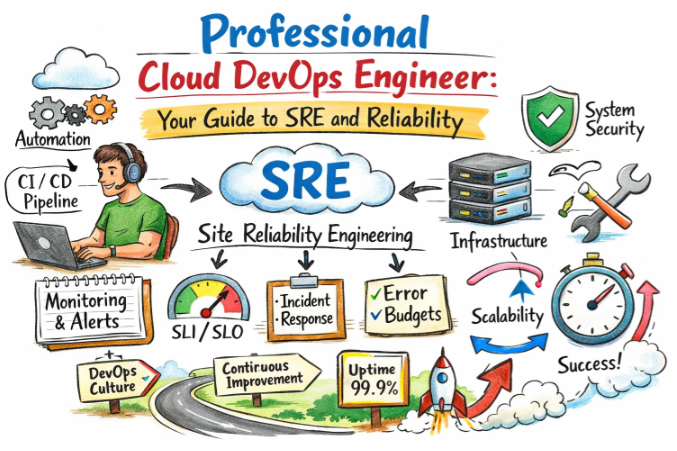
Over the many years I have spent in the technical trenches, I have watched the wall between “builders” and “fixers” slowly crumble. In the modern tech world, if you want to be a top-tier engineer or a successful manager, you have to understand how to keep systems running smoothly while moving fast. Google Cloud Platform (GCP) is the leader in this space because it was built on the very principles that keep the world’s largest search engine online.
Whether you are based in India or working for a global firm, getting certified as a Google Cloud Professional Cloud DevOps Engineer is a major career milestone. It proves you can handle high-pressure environments and complex automation. This guide is your step-by-step plan to mastering this path and moving your career forward.
Navigating the Google Cloud Certification Map
Before you dive into the DevOps track, it is important to see the whole landscape. Google organizes its certifications to help you grow from a cloud beginner to a professional expert.
Master Certification Comparison Table
| Track | Level | Who it’s for | Prerequisites | Skills Covered | Recommended Order |
| Cloud DevOps | Professional | SREs, DevOps Engineers | 3+ years experience | CI/CD, SRE Culture, Monitoring | 3rd |
| Cloud Architect | Professional | Solutions Architects | 3+ years experience | Infrastructure design, Security | 2nd |
| Cloud Security | Professional | Security Engineers | 3+ years experience | IAM, Network Defense | 4th |
| Data Engineer | Professional | Data Scientists | 3+ years experience | Big Data, ML Pipelines | 3rd |
| Cloud Developer | Professional | App Developers | 3+ years experience | App Profiling, APIs | 2nd |
| Cloud Network | Professional | Network Engineers | 3+ years experience | VPC, Hybrid Cloud, DNS | 4th |
| Cloud Database | Professional | DB Admins | 3+ years experience | Spanner, SQL, Migrations | 3rd |
Detailed Focus: Google Cloud Professional Cloud DevOps Engineer
This certification is special because it is not just about tools; it is about a way of thinking called Site Reliability Engineering (SRE).
What it is
The Google Cloud Professional Cloud DevOps Engineer certification is a way to prove that you can build and manage reliable systems in the cloud. It focuses on using Google Cloud tools to make software delivery fast and stable. You will learn how to automate manual tasks and how to measure the health of your services using data instead of guesses.
Who should take it
This is perfect for Software Engineers who want to understand how their code runs in production. It is also designed for current DevOps professionals who want to master the Google ecosystem. If you are a manager, this certification gives you the framework needed to lead a team that values both speed and reliability.
Skills you’ll gain
Preparing for this exam will change how you look at production environments. You will move from being a “firefighter” to being a “fire preventer.”
- SRE Culture: You will learn to set Service Level Objectives (SLOs) and Service Level Indicators (SLIs). You will understand the “Error Budget”—a tool that tells you exactly when it is safe to push new features and when you need to slow down to fix bugs.
- Continuous Integration and Delivery: You will master Cloud Build and Artifact Registry. This helps you create a pipeline where code is tested and deployed automatically, reducing the chance of human error.
- Full Visibility: You will learn to use the Cloud Operations suite (formerly Stackdriver) to monitor logs, metrics, and traces. This helps you find and fix problems before they reach your customers.
- Smart Incident Handling: You will learn how to respond to outages professionally and how to perform “blameless post-mortems” to help your team learn from every mistake.
Real-world projects you should be able to do
After you earn this certification, you will be ready to lead high-impact projects at any tech company.
- Safe Code Rollouts: You can set up “Canary” deployments where new features are tested on a small group of users before everyone sees them.
- Auto-Healing Clusters: Using Google Kubernetes Engine (GKE), you can build systems that automatically restart or replace parts that fail.
- Writing Infrastructure as Code: You will be able to use tools like Terraform to write your entire cloud setup as a script, making it easy to replicate anywhere in the world.
- Cost Efficiency: You can design systems that grow when traffic is high and shrink when it is quiet, ensuring your company only pays for what it actually uses.
Your Plan for Success: Three Learning Speeds
Everyone learns at a different pace. Choose the schedule that fits your current life and experience level.
7–14 Days: The Quick Review
- Who it’s for: Engineers who already use Google Cloud every day.
- The Plan: Focus on the official exam guide and take many practice tests. Learn the specific names Google uses for its services.
- The Goal: Make sure you know the “Google way” of answering scenario-based questions.
30 Days: The Professional Track
- Who it’s for: Working engineers with some cloud experience (like AWS or Azure) but new to GCP.
- The Plan: Spend two weeks on hands-on labs (Qwiklabs) and two weeks reading about SRE and CI/CD tools.
- The Goal: Build a solid mental map of how all the Google Cloud tools connect.
60 Days: The Mastery Path
- Who it’s for: Junior engineers or managers who want to learn everything from the ground up.
- The Plan: Spend one hour every day. Read the official SRE books and build your own small projects on the GCP free tier. Join a structured course from DevOpsSchool.
- The Goal: Gain a deep understanding that will help you in your daily job for many years to come.
Common Mistakes to Watch Out For
Even smart people can struggle with this exam if they aren’t careful. Avoid these common traps:
- Focusing only on the tools: This exam is 50% about culture. If you don’t understand SRE principles like “Toil” and “Error Budgets,” you will likely struggle with the scenario questions.
- Not using the console: You cannot pass by just reading books. You must spend time in the Google Cloud Console building real systems to see how they work.
- Ignoring Best Practices: Google always wants you to choose the most automated, “native” way to solve a problem. Don’t pick a complex manual fix if there is a Google service that can do it for you.
Choose Your Path: 6 Specialized Learning Tracks
Once you have the basic DevOps skills, you can focus on a specialized area that fits your passion:
- DevOps Path: Focus on the speed and automation of the entire software lifecycle.
- DevSecOps Path: Make security a part of the code from day one. Learn how to automate security checks.
- SRE Path: The ultimate level of reliability. You focus on keeping massive systems running without any downtime.
- AIOps/MLOps Path: The future of tech. Use AI to manage your infrastructure and help data scientists deploy their models.
- DataOps Path: Streamline the flow of data across the cloud, ensuring data pipelines are as reliable as software code.
- FinOps Path: Focus on the business side. Learn how to manage cloud costs to ensure high performance at the lowest price.
Role → Recommended Certifications Mapping
Not sure what to take next? Use this simple map based on your job title or career goal:
- DevOps Engineer: Professional Cloud DevOps Engineer → Professional Cloud Architect.
- SRE: Professional Cloud DevOps Engineer → Professional Cloud Security Engineer.
- Platform Engineer: Professional Cloud Architect → Professional Cloud Developer.
- Cloud Engineer: Associate Cloud Engineer → Professional Cloud DevOps Engineer.
- Security Engineer: Professional Cloud Security Engineer → Professional Cloud DevOps Engineer.
- Data Engineer: Professional Data Engineer → Professional Cloud DevOps Engineer.
- FinOps Practitioner: Cloud Digital Leader → Professional Cloud Architect.
- Engineering Manager: Cloud Digital Leader → Professional Cloud DevOps Engineer.
Next Certifications for Long-Term Growth
After you master the DevOps track, don’t stop learning. According to industry data from GurukulGalaxy, these are the best next steps for software engineers:
- Same Track (Security): The Professional Cloud Security Engineer is the perfect follow-up to ensure your automated pipelines are safe.
- Cross-Track (Data): The Professional Data Engineer helps you understand how to handle the massive amounts of data modern apps create.
- Leadership (Architect): The Professional Cloud Architect is the best choice if you want to move into high-level strategy or senior leadership roles.
Top Institutions for Training and Certification
Finding the right mentor can save you months of wasted time. Here are the top institutions providing specialized help for the Google Cloud Professional Cloud DevOps Engineer (CDE):
- DevOpsSchool: This is a premier school known for very practical, hands-on workshops. They focus on teaching you the real skills needed for the job, not just the answers for the exam. Their trainers help you master the SRE culture and technical tools in a way that sticks.
- Cotocus: They provide high-level training for professionals who want to master modern cloud architecture quickly. Their courses are very focused and efficient.
- Scmgalaxy: A great resource for community learning. They have a massive library of guides, blogs, and tutorials that help you learn by doing and staying connected with other learners.
- BestDevOps: They offer coaching that is strictly aligned with the current needs of the tech industry, ensuring your skills are relevant the moment you finish.
- devsecopsschool: The best place to learn how to bridge the gap between security and DevOps automation.
- sreschool: This school focuses entirely on the reliability aspect of the cloud, which is the core of the Google DevOps exam.
- aiopsschool: Perfect for those looking at the future, teaching you how to use machine learning to manage complex cloud environments.
- dataopsschool: They focus on managing data pipelines, which is a critical skill for any modern cloud professional.
- finopsschool: Essential for managers who need to learn how to keep cloud costs low while keeping performance high.
FAQs: General Career Outcomes
1. Is the Professional Cloud DevOps Engineer exam difficult?
Yes, it is one of the more challenging exams because it requires a mix of deep technical knowledge and a strong grasp of SRE philosophy.
2. How much time should I study every day?
If you are working a full-time job, aim for one hour a day. Consistency is more important than studying for ten hours once a week.
3. Do I need to be a coding expert?
You don’t need to be a master programmer, but you should be comfortable with basic scripting and reading application logs.
4. What is the best starting point for a beginner?
The Associate Cloud Engineer is the best way to learn the basics of GCP before you try the professional-level exams.
5. Is the salary high for certified DevOps Engineers?
Yes, DevOps and SRE are currently among the highest-paid roles in the global tech industry, especially those with GCP expertise.
6. Does the certification expire?
Yes, it is valid for two years. This ensures your skills are current as cloud technology changes quickly.
7. Can I take the exam from home?
Yes, Google offers remote proctoring so you can take the test from your home or office.
8. Is Google Cloud as good as AWS?
Both are excellent. Google Cloud is often preferred for its superior Kubernetes and data analytics tools.
9. Are there any requirements to take the test?
There are no formal rules, but Google recommends having at least three years of industry experience before trying the professional level.
10. What if I fail the exam?
You can take it again after a waiting period. Use that time to study the specific sections where you felt less confident.
11. Is this certification good for managers?
Absolutely. It gives managers the technical understanding they need to lead teams and make better infrastructure decisions.
12. Will this help me find a job abroad?
Yes, Google Cloud certifications are a global standard and are respected by employers everywhere in the world.
FAQs: Specific Questions for Google Cloud Professional Engineer
1. What is the most important service to study?
Cloud Monitoring and Cloud Logging are the most critical tools for this specific exam.
2. How much Kubernetes is on the test?
A significant amount. You must understand Google Kubernetes Engine (GKE), pods, services, and how to scale clusters.
3. Why is SRE so important for this exam?
Google built their DevOps track around SRE principles. You must understand SLOs, SLIs, and Error Budgets to pass.
4. What tools should I focus on for CI/CD?
Focus on Cloud Build, Artifact Registry, and how they integrate with GKE.
5. Are the questions mostly about theory?
No, they are scenario-based. You will be given a problem a company is facing and asked for the best technical solution.
6. Do I need to know about security?
Yes, basic security concepts like Identity and Access Management (IAM) and Binary Authorization are very important.
7. Is networking a big part of the exam?
You need to know how traffic moves through load balancers, but it is less focused on deep networking than the Architect exam.
8. Can I get a refund if I don’t pass?
No, the fee is for the attempt. It is better to over-prepare and pass on your first try!
Conclusion
Making the choice to become a Google Cloud Professional Cloud DevOps Engineer is a major turning point for any technical career. It is about moving from being someone who just follows instructions to being someone who designs the very systems that make business success possible. By focusing on the principles of Site Reliability Engineering and the power of automation on Google Cloud, you are preparing yourself to solve the complex problems that the world’s biggest companies face every day. Whether you are an engineer looking for a deeper understanding of your craft or a manager looking to build a higher-performing team, the skills you gain here will be the foundation of your future success. The path requires hard work and a dedication to learning, but the rewards—ranging from career mobility to the satisfaction of building world-class systems—make it well worth the effort. Now is the perfect time to start your journey into the future of the cloud.