




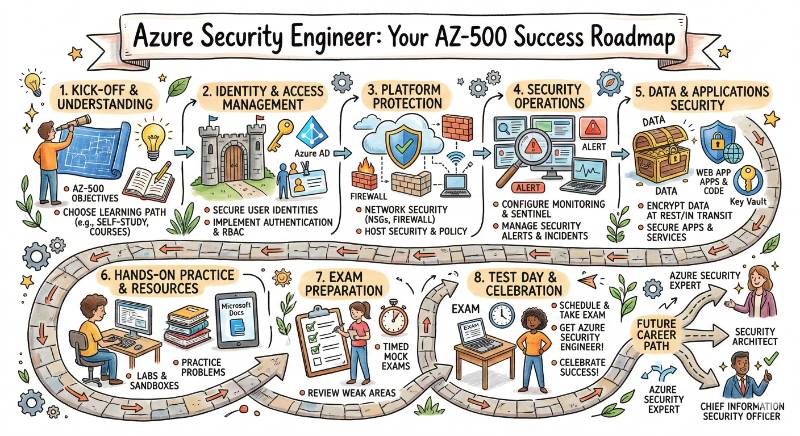
In the world of modern cloud computing, we can no longer afford to treat security as a final check before a product goes live. It must be the very first thing we think about. Having spent a significant portion of my life helping organizations move their data and applications to the cloud, I have seen that the most resilient systems are those where the engineers understand security just as well as they understand code.
The Microsoft Azure Security Technologies (AZ-500) certification is not just a test of what you know; it is a validation of your ability to defend a digital business. This guide is written for the engineers who build these systems and the managers who lead them. We will explore why this certification is a career-changer and how you can master it.
Mastering the AZ-500: Essential Overview
This certification focuses on the practical implementation of security controls across the entire Azure platform. Below is a quick breakdown of the program.
| Track | Level | Who it’s for | Prerequisites | Skills Covered | Recommended Order |
| Azure Security | Associate | Software Engineers, SREs, DevOps, Cloud Architects, IT Managers | Azure Administration (AZ-104) knowledge + Basic Networking | Identity, Platform Protection, Data Security, Security Operations | AZ-900 → AZ-104 → AZ-500 |
Deep Dive into the Microsoft Azure Security Technologies (AZ-500)
What it is
The AZ-500 is a specialized certification that proves you have the technical skills to implement security controls in Azure. It goes beyond simple passwords and looks at how to protect every layer of the cloud—from the user identity down to the storage disks. It is about building a “Zero Trust” environment where nothing is trusted by default and every access request is verified.
Who should take it
This path is ideal for professionals who handle day-to-day operations in the cloud.
- Software Engineers: To learn how to build apps that are safe from hackers.
- DevOps and Cloud Engineers: To automate security checks in the deployment pipeline.
- Site Reliability Engineers (SREs): To ensure that security issues don’t cause system outages.
- IT Managers: To understand the risks their teams are managing and make better technical decisions.
Skills you’ll gain
Achieving this certification transforms you from a generalist to a specialist. You will gain the ability to spot gaps in a system before they are exploited. You will learn to think like a defender, ensuring that even if one part of your system is attacked, the rest remains safe.
- Identity Management: Mastering tools like Microsoft Entra ID (Azure AD), Multi-Factor Authentication (MFA), and Privileged Identity Management (PIM).
- Network Security: Building digital walls using Azure Firewall, Network Security Groups (NSGs), and Web Application Firewalls (WAF).
- Data Protection: Learning how to use Azure Key Vault for secrets and how to encrypt data so it is useless to unauthorized eyes.
- Security Operations: Using Microsoft Sentinel and Defender for Cloud to watch for threats and respond to them automatically.
Real-world projects you should be able to do after it
Knowledge is only useful when you can put it to work. After this certification, you will have the confidence to lead high-stakes security projects that protect your organization’s reputation.
- Implement a Zero-Trust Model: Designing a system where every user and device must prove who they are before getting access.
- Secure a Multi-Tier Application: Setting up a web app where the database is completely hidden from the internet and the front end is protected from attacks.
- Automate Threat Hunting: Creating custom rules in Microsoft Sentinel to find suspicious activity patterns across thousands of logs.
- Enforce Governance: Using Azure Policy to make sure that no one in the company can accidentally create a resource that isn’t secure.
Preparation plan
The best way to prepare is to balance reading with actual practice. Here are three plans based on your current workload.
- 7–14 days (The Sprint): This is for experienced engineers who use Azure every day. Spend 80% of your time on practice exams. Focus on identifying the areas where you are weakest and read the official documentation for those specific tools.
- 30 days (The Standard Path): Ideal for most working professionals. Spend one hour every morning on concepts and two hours on weekends for hands-on labs in the Azure portal.
- 60 days (The Deep Learning Path): Best for managers or those new to security. Take your time to build every lab twice. The first time, follow the guide; the second time, try to do it from memory.
Common mistakes
I have seen many talented people fail because they treated this like a basic exam. It is a technical hurdle that requires specific attention to detail.
- Over-Memorizing Terms: The exam tests implementation. If you haven’t actually configured a firewall or a key vault, you will struggle with the “how-to” questions.
- Ignoring Networking: Many people focus on passwords but forget that network isolation is a massive part of security. Master your subnets and firewalls.
- Skipping the Labs: You cannot pass by just reading books. You must navigate the Azure portal and see where the settings live.
- Poor Time Management: The exam often includes long case studies. If you spend too much time on the easy questions, you won’t have enough time for the complex scenarios.
Choose Your Path: The 6 Learning Journeys
Security is the thread that runs through every part of modern IT. Depending on your interest, here is how you can use the AZ-500:
- DevOps Path: Focus on “Policy as Code.” Use your AZ-500 knowledge to ensure that every server you deploy is automatically secured from the moment it is created.
- DevSecOps Path: This is the most direct application. You become the person who integrates security tests directly into the development cycle, ensuring speed doesn’t compromise safety.
- SRE Path: Focus on system stability. Use security monitoring tools to catch errors or attacks that could cause a system outage.
- AIOps/MLOps Path: Secure your machine learning models. Ensure that the data used for training is encrypted and that only authorized users can access the models.
- DataOps Path: Focus on data sovereignty. Use Azure’s advanced encryption and masking tools to ensure that sensitive data is only seen by those with a “need to know.”
- FinOps Path: Secure your budget. Use Azure Policy to prevent the creation of expensive, high-end resources that aren’t needed, protecting the company from financial waste.
Role → Recommended Certifications Mapping
| Your Current Role | The Best Learning Sequence |
| DevOps Engineer | AZ-104 → AZ-500 → AZ-400 |
| SRE | AZ-104 → AZ-500 → AZ-700 |
| Platform Engineer | AZ-104 → AZ-500 → AZ-305 |
| Cloud Engineer | AZ-900 → AZ-104 → AZ-500 |
| Security Engineer | AZ-500 → SC-200 → SC-300 |
| Data Engineer | DP-203 → AZ-500 |
| FinOps Practitioner | AZ-900 → AZ-500 |
| Engineering Manager | AZ-900 → AZ-500 |
Next Certifications to Take
After you have mastered the AZ-500, your next move depends on where you want your career to go. Based on data from top industry sources, here are your best options:
- Same Track (Specialization): SC-100 (Microsoft Cybersecurity Architect) – This is the ultimate goal for security professionals looking to design global security strategies for entire organizations.
- Cross-Track (Broadening): AZ-400 (Designing and Implementing Microsoft DevOps Solutions) – This is the best choice if you want to lead a DevSecOps team and master automation.
- Leadership Path: AZ-305 (Designing Microsoft Azure Infrastructure Solutions) – Perfect for moving into an Architect role where you design the overall systems that engineers build.
Institutions for Training & Certification
Finding the right place to learn is just as important as the certification itself. Here are the top institutions that provide expert training for the AZ-500:
- DevOpsSchool: A leading institution known for its deep, hands-on labs and expert-led sessions. They focus on real-world scenarios rather than just exam theory, making it perfect for working professionals who need to apply skills immediately.
- Cotocus: They specialize in high-end cloud architecture and security training. Their courses are designed for teams who need to understand the complex side of cloud governance and advanced security configurations.
- Scmgalaxy: A vibrant technical community and resource hub. They provide a unique blend of formal training and peer-to-peer learning through blogs, forums, and technical deep-dives.
- BestDevOps: Known for their streamlined and efficient training modules. They focus on the most critical skills needed in the modern market, helping professionals get certified and job-ready quickly.
- DevSecOpsSchool: The go-to source for integrating security into the development lifecycle. They provide specialized training that connects AZ-500 concepts with modern automation and CI/CD tools.
- Sreschool: Focuses on the intersection of security and reliability. Their training helps you understand how to use security monitoring to ensure maximum uptime and system stability.
- Aiopsschool: Teaches you how to leverage artificial intelligence in your security operations. This is the future of threat detection, and their courses prepare you for that shift.
- Dataopsschool: Dedicated to the security of the data pipeline. They help data professionals understand how to apply Azure security technologies to protect data lakes and analytical workloads.
- Finopsschool: Provides a unique look at how security policies can be used to manage cloud costs. They teach you how to protect your organization’s financial health while maintaining a strong security posture.
FAQs: Career & Strategy
- Is the AZ-500 exam very difficult? Yes, it is considered one of the tougher associate exams because it covers a very wide range of complex services and requires hands-on knowledge.
- How much time should I dedicate to studying? For a working engineer, 30 to 45 days is the standard time needed to feel confident.
- Should I take AZ-104 first? Highly recommended. Knowing how to manage Azure (AZ-104) makes it much easier to understand how to secure it (AZ-500).
- What kind of jobs can I get? Roles like Cloud Security Engineer, Azure Security Analyst, and Senior DevOps Engineer are common for those with this cert.
- Is this certification valued in India? Extremely. India has a huge demand for cloud security experts, and major IT firms prioritize candidates with the AZ-500.
- Does it expire? It is valid for one year, but you can renew it for free through a short online assessment on the Microsoft site.
- Is there coding in the exam? You don’t need to be a developer, but you should be comfortable with basic scripting (PowerShell/CLI) and reading JSON files.
- What is the passing score? You need a 700 out of 1000 to pass.
- Are there labs in the exam? Sometimes. Microsoft occasionally includes labs where you have to perform tasks in a real portal. Be prepared for them.
- Can a manager benefit from this? Yes. It gives you the technical understanding to lead your security team and make better risk decisions for the business.
- How much does the exam cost? Usually around $165 USD, but prices vary by region. Check the official site for local pricing.
- What if I fail the first time? You can retake it after 24 hours. If you fail again, the wait time increases significantly. Don’t let it discourage you; many experts fail their first time.
FAQs: Technical Details
- What is the focus of the Identity section? It is about managing users and groups in Entra ID (Azure AD), setting up MFA, and managing admin rights with PIM.
- Do I need to know about networking? Yes. You must understand how to configure Virtual Networks, Firewalls, and Network Security Groups to control traffic.
- What is Microsoft Sentinel? It is a “Cloud Native SIEM”—a tool that collects logs from everywhere to find and automatically respond to security threats.
- What is the difference between a Key and a Secret in Key Vault? Keys are for encryption/decryption; Secrets are for storing strings like passwords or connection tokens.
- What is Defender for Cloud? It is a tool that scans your cloud resources to find security gaps and gives you a “Security Score” to help you improve.
- Do I need to know about Container security? Yes, basic security for AKS (Azure Kubernetes Service) and container registry is part of the curriculum.
- How do I manage security at scale? Using Azure Policy to automatically enforce security rules across all your subscriptions.
- Does the exam cover Hybrid Cloud? Yes. You need to know how to securely connect your office to the Azure cloud using VPNs or ExpressRoute.
Conclusion
Mastering Microsoft Azure Security Technologies is more than just a career move; it is a commitment to building a safer digital world. Throughout my years of helping organizations navigate the cloud, I have seen that the most respected engineers are the ones who can protect what they build. The AZ-500 certification provides you with the technical precision and the strategic mindset required to handle the sophisticated threats of today’s landscape. It bridges the gap between general IT management and high-level defensive architecture. By following this guide, leveraging the expertise of top training institutions, and committing to hands-on practice, you are doing more than just earning a certificate—you are securing your place as a leader in the next generation of cloud technology. The cloud is evolving, and with the AZ-500, you will be the one ready to defend it.