




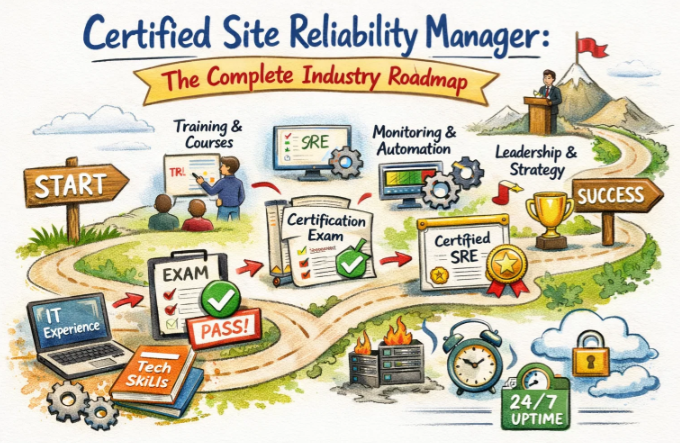
Introduction
The Certified Site Reliability Manager program is a specialized track designed for those who navigate the complex intersection of software engineering, operations, and leadership. This guide is crafted for professionals who are looking to move beyond individual contributor roles into strategic management positions within the reliability domain. It matters today because as systems grow in complexity, the need for leaders who understand both the technical debt and the business impact of downtime has never been higher.
Positioning yourself within the DevOps, cloud-native, and platform engineering landscape requires more than just knowing how to configure a pipeline. It requires the ability to manage teams, set realistic service level objectives, and foster a culture of blamelessness. This guide helps professionals make better career decisions by breaking down the specific competencies required to lead SRE teams effectively. By the end of this article, you will understand how this certification aligns with modern engineering requirements and whether it is the right move for your professional trajectory.
Navigating the transition from a technical lead to a site reliability manager at SREschool involves understanding how to balance the “ops” load with “dev” innovation. This guide serves as a roadmap for that transition, ensuring you invest your time in skills that offer long-term career resilience. Whether you are in India or working for a global enterprise, the principles of reliability management remain a universal currency in the modern tech economy.
What is the Certified Site Reliability Manager?
The Certified Site Reliability Manager represents a paradigm shift in how organizations approach the management of distributed systems. It exists because the industry realized that managing an SRE team is fundamentally different from managing a traditional software development or operations team. While a standard manager might focus on feature delivery or ticket resolution, a Site Reliability Manager focuses on the sustainable balance between velocity and stability.
This certification emphasizes real-world, production-focused learning over abstract theory. It pushes candidates to think about incident command, error budget negotiation, and the cognitive load of their engineers. Instead of just learning about tools, you learn the philosophy of how to use those tools to meet business goals. It aligns with modern engineering workflows by integrating the feedback loops necessary for continuous improvement and enterprise-scale operations.
In the context of enterprise practices, being a Certified Site Reliability Manager means you are equipped to handle the high-stakes environment of “always-on” services. It validates your ability to manage the technical and human elements of a production environment. For organizations, this certification provides a benchmark for hiring leaders who can build resilient systems and the high-performing teams that support them.
Who Should Pursue Certified Site Reliability Manager?
The roles that benefit most from the Certified Site Reliability Manager designation include senior software engineers, current SREs, and cloud architects who are looking to step into leadership. It is particularly valuable for platform engineers who are responsible for the internal tools that other developers use. Security and data professionals who find themselves managing large-scale infrastructure also find that these management principles apply directly to their domains.
For beginners, this certification provides a clear target for what senior leadership in the reliability space looks like, even if they need a few more years of hands-on experience first. Experienced engineers will find it helps formalize their intuitive knowledge into a structured management framework. Managers who have transitioned from traditional IT backgrounds can use this to modernize their approach and align with cloud-native methodologies.
There is a significant global and India-specific relevance to this role. In the Indian tech market, many large-scale service providers and product startups are rapidly adopting SRE models to compete globally. Having a formal certification in management specifically for SRE allows professionals to stand out in a crowded market. It signals to international stakeholders that the manager understands the nuances of global uptime requirements and modern incident response.
Why Certified Site Reliability Manager is Valuable and Beyond
The demand for reliability management is driven by the fact that downtime is increasingly expensive and public. As more enterprises migrate to the cloud, the complexity of managing those environments scales non-linearly. The Certified Site Reliability Manager certification provides the longevity needed to survive shifts in the tech stack because it focuses on principles like SLOs and SLIs rather than specific cloud provider features.
Enterprise adoption of SRE practices is no longer optional for companies at scale. By becoming a certified manager, you position yourself as a key player in the digital transformation of an organization. This helps professionals stay relevant even as AI and automation change how we interact with infrastructure. A manager who knows how to govern these automated systems is far more valuable than one who only knows how to manually fix them.
The return on time and career investment for this certification is substantial. Managers in this field often command higher salaries and have access to more influential roles within the corporate structure. Because it bridges the gap between the C-suite and the engineering floor, a Site Reliability Manager is often seen as a strategic partner in the business. This certification acts as a catalyst for that career growth, providing both the credentials and the knowledge to lead.
Certified Site Reliability Manager Certification Overview
The Certified Site Reliability Manager program is delivered via the official platform at https://sreschool.com/certifications/certified-site-reliability-manager.html and is hosted on the SREschool.com website. The program is designed to be rigorous and reflective of the actual challenges faced by SRE leaders. It moves away from simple multiple-choice questions toward a more holistic assessment of a candidate’s ability to manage reliability.
The certification structure includes various levels of depth, starting from foundational principles and moving into advanced organizational strategy. It is owned and maintained by industry experts who ensure the content stays fresh and relevant to current market trends. The assessment approach often includes case studies and scenario-based evaluations that require a deep understanding of incident management and risk assessment.
In practical terms, the certification is structured to be accessible to working professionals while maintaining a high standard of quality. It covers everything from the technical aspects of monitoring and observability to the soft skills of team building and stakeholder management. By completing this program, you demonstrate a comprehensive understanding of the entire reliability lifecycle within a modern enterprise.
Certified Site Reliability Manager Certification Tracks & Levels
The certification is divided into Foundation, Professional, and Advanced levels to cater to different stages of a career. The Foundation level introduces the core vocabulary of SRE management, focusing on the basic concepts of error budgets and incident response. It is ideal for those who are new to the management aspect of reliability but have a technical background.
The Professional level dives deeper into the operational aspects, such as capacity planning, toil reduction, and multi-team coordination. This is where most mid-career professionals will find the most value, as it aligns directly with the day-to-day tasks of an SRE lead or manager. It covers the specialization tracks like DevOps and FinOps, showing how reliability management intersects with cost and deployment speed.
The Advanced level is focused on organizational leadership and the strategic implementation of SRE across a whole company. At this level, the certification validates your ability to influence culture, manage large-scale budgets, and drive long-term reliability roadmaps. These levels align with a natural career progression from a Senior SRE to a Director of Reliability or a VP of Infrastructure.
Complete Certified Site Reliability Manager Certification Table
| Track | Level | Who it’s for | Prerequisites | Skills Covered | Recommended Order |
| Management | Foundation | Aspiring SRE Leads | 3+ years in Ops/Dev | SLO/SLI, Error Budgets | 1 |
| Management | Professional | Current SRE Managers | 5+ years experience | Toil, On-call, Mentoring | 2 |
| Management | Advanced | Directors/Heads of SRE | 10+ years experience | Culture, Strategic ROI | 3 |
| Technical | SRE-Tech | Senior SREs | Strong Coding/Linux | Observability, Scaling | Optional |
| Financial | FinOps-Rel | FinOps Managers | Cost Management | Cloud Economics, Budgeting | Parallel |
Detailed Guide for Each Certified Site Reliability Manager Certification
What it is
This certification validates the candidate’s understanding of the core tenets of SRE management and their ability to speak the language of reliability. It covers the basic metrics and organizational structures needed to start an SRE journey.
Who should take it
Senior engineers, junior team leads, or project managers who are transitioning into a more technical reliability management role. It is for those who need a solid ground in the “why” and “how” of SRE leadership.
Skills you’ll gain
- Defining and negotiating Service Level Objectives (SLOs).
- Understanding the concept of Error Budgets and how to enforce them.
- Basic incident management and post-mortem facilitation.
- Identifying toil within a technical team.
Real-world projects you should be able to do
- Create a reliability dashboard for a single microservice.
- Lead a blameless post-mortem after a minor outage.
- Negotiate a basic error budget with a product owner.
Preparation plan
- 7–14 days: Focus on the SRE Handbook and core definitions.
- 30 days: Engage in mock incident drills and review existing case studies.
- 60 days: Implement a basic SLO framework in a test environment.
Common mistakes
- Focusing too much on specific tools rather than the underlying management principles.
- Neglecting the cultural aspect of blamelessness in favor of technical metrics.
Best next certification after this
- Same-track: Certified Site Reliability Manager – Professional
- Cross-track: Certified DevSecOps Professional
- Leadership: Certified Cloud Business Lead
Choose Your Learning Path
DevOps Path
The DevOps learning path for a manager focuses on the integration of reliability into the CI/CD pipeline. It emphasizes the “Shift Left” mentality where reliability is treated as a feature from the very start of the development lifecycle. A manager on this path will learn how to build teams that bridge the gap between code and production. This path is essential for organizations that value rapid delivery without sacrificing the stability of their environments.
DevSecOps Path
The DevSecOps path integrates security into the core responsibilities of a site reliability manager. It focuses on building resilient systems that are not just stable, but also secure against modern threats. Managers learn how to manage security incidents with the same rigor as operational incidents. This path is critical for industries like finance and healthcare where reliability and security are inextricably linked and non-negotiable.
SRE Path
The pure SRE path is the most direct route for those focused on system uptime and performance. It focuses heavily on the technical management of distributed systems, observability, and the mathematical modeling of reliability. Managers on this path are the ones who define what “available” means for their organization and build the teams to ensure it. This is the foundation for any modern cloud-native engineering organization.
AIOps Path
The AIOps path is for managers who are looking at the future of automated operations. It focuses on using machine learning and data science to predict and resolve incidents before they affect the user. Managers learn how to oversee AI-driven systems and ensure that the automation itself remains reliable. This is a growing field as systems become too large for humans to monitor manually without intelligent assistance.
MLOps Path
The MLOps path is specialized for those managing the reliability of machine learning models in production. It addresses the unique challenges of model drift, data integrity, and the computational costs of AI. A manager on this path ensures that the infrastructure supporting ML is as robust as the software services it powers. This path is vital for companies whose core business value is driven by production-grade AI.
DataOps Path
The DataOps path applies SRE principles to the world of data engineering and analytics. It focuses on the reliability of data pipelines, ensuring that the flow of information is accurate and timely. Managers learn how to manage the “uptime” of data, which is just as important as the uptime of an application in a data-driven enterprise. This path helps data teams move from reactive fixes to a proactive reliability model.
FinOps Path
The FinOps path is for managers who need to balance the cost of the cloud with the performance of their systems. It focuses on cloud economics and the financial accountability of the engineering team. A manager on this path understands that a reliable system is also an efficient one that doesn’t waste resources. This path is becoming mandatory for any leader managing large-scale cloud budgets in a competitive market.
Role → Recommended Certified Site Reliability Manager Certifications
| Role | Recommended Certifications |
| DevOps Engineer | CSRM Foundation, DevSecOps Professional |
| SRE | CSRM Professional, AIOps Specialist |
| Platform Engineer | CSRM Professional, Platform Excellence Cert |
| Cloud Engineer | CSRM Foundation, Cloud Architect Professional |
| Security Engineer | CSRM Foundation, DevSecOps Expert |
| Data Engineer | CSRM Foundation, DataOps Professional |
| FinOps Practitioner | CSRM Foundation, FinOps Certified |
| Engineering Manager | CSRM Professional, CSRM Advanced |
Next Certifications to Take After Certified Site Reliability Manager
Same Track Progression
Once you have completed the management levels, the next step is often to specialize in a specific niche of reliability management. This might include deep-diving into Disaster Recovery Planning or High-Availability Architecture. Deep specialization allows a manager to become a consultant or a high-level architect within their organization. It ensures that you remain the go-to person for the most critical reliability challenges that the company faces.
Cross-Track Expansion
Broadening your skills into other “Ops” domains makes you a more versatile leader. Taking a FinOps or DevSecOps certification after your SRE management training allows you to see the bigger picture of enterprise technology. This cross-pollination of skills is what separates a good manager from a great one. It enables you to communicate effectively with finance, security, and product teams, making you a more effective advocate for your own SRE team.
Leadership & Management Track
For those looking to move into the C-suite, the next step is certifications focused on executive leadership and business strategy. This involves learning about organizational design, change management, and corporate finance. Transitioning to leadership means shifting your focus from managing systems to managing the organization that builds the systems. This track prepares you for roles such as CTO or VP of Engineering, where reliability is just one of many strategic pillars you oversee.
Training & Certification Support Providers for Certified Site Reliability Manager
DevOpsSchool
DevOpsSchool provides a comprehensive ecosystem for learning reliability and automation. They offer extensive lab-based training that is designed to simulate real-world production issues. Their curriculum is updated frequently to reflect the latest changes in the DevOps landscape. For a manager, they provide the technical depth needed to understand what their engineers are doing daily. Their community support is strong, particularly in the Indian market, providing a network of peers for long-term growth.
Cotocus
Cotocus focuses on specialized training for high-end technology stacks and SRE practices. They are known for their hands-on approach and their focus on enterprise-scale challenges. Their instructors often come from senior engineering backgrounds, bringing practical wisdom to the classroom. For those pursuing management certifications, Cotocus provides a bridge between high-level theory and the gritty reality of the server room. They are a solid choice for teams looking to upskill quickly on specific cloud-native tools.
Scmgalaxy
Scmgalaxy is one of the oldest and most respected communities in the configuration management and DevOps space. They provide a wealth of free resources alongside their professional training programs. Their focus is often on the lifecycle of software and how reliability is baked into the build process. As a support provider, they offer a deep well of knowledge that managers can use to train their own teams. Their focus on the “galaxy” of tools ensures you are never locked into a single vendor.
BestDevOps
BestDevOps focuses on curated learning paths that help professionals reach their career goals with minimal wasted effort. They emphasize the most critical skills needed in the current job market, making them a very efficient choice for busy managers. Their training materials are designed to be concise and high-impact. For those looking to get certified quickly without sacrificing quality, BestDevOps offers a streamlined path that focuses on the most relevant parts of the SRE management curriculum.
devsecopsschool.com
DevSecOpsSchool is the primary destination for integrating security into the SRE and DevOps lifecycle. They provide specialized courses that teach managers how to oversee the security posture of their reliability teams. Their focus is on automated security and “Compliance as Code,” which are essential for modern managers. In an era of constant cyber threats, the support provided by this school is invaluable for any manager responsible for production systems.
sreschool.com
SREschool.com is the primary authority for site reliability engineering education. They host the official certifications and provide the most direct and accurate curriculum for the CSRM program. Their focus is entirely on reliability, ensuring that every piece of content is aligned with SRE best practices. For a manager, this is the definitive source of truth for their education. Their platform is designed to be interactive and supportive of a professional’s career journey from start to finish.
aiopsschool.com
AIOpsSchool is at the forefront of the movement toward automated, intelligent operations. They provide the training necessary for managers to understand and implement AI and ML in their operational workflows. Their curriculum covers data science basics for engineers and the management of algorithmic decision-making. As systems become more complex, the knowledge provided by AIOpsSchool will become a standard requirement for any senior reliability leader looking to scale their impact.
dataopsschool.com
DataOpsSchool addresses the growing need for reliability in data-intensive environments. They offer specialized training for managers who are responsible for the health of data pipelines and analytics platforms. Their focus is on applying the rigors of SRE to the often-messy world of data engineering. For managers in data-driven companies, this school provides the framework needed to ensure that data is always available, accurate, and ready for business use.
finopsschool.com
FinOpsSchool focuses on the financial side of cloud management, which is a critical skill for any modern manager. They teach the principles of cloud cost optimization and financial accountability. For a site reliability manager, understanding the cost of reliability is essential for negotiating budgets with executives. FinOpsSchool provides the tools and the language needed to ensure that an organization’s cloud spend is as optimized as its system performance.
Frequently Asked Questions (General)
- How difficult is it to get certified in reliability management?
The difficulty is moderate to high, as it requires both technical knowledge and management intuition. It is not just about memorizing facts but about applying them to scenarios. - How much time does it take to prepare?
Most professionals find that 30 to 60 days of consistent study is sufficient, depending on their existing experience level. - What are the prerequisites for the management track?
Generally, a few years of experience in a technical role like DevOps or SRE is required to understand the context of the management decisions. - Is the ROI worth the cost of the certification?
Yes, as certified managers often see significant salary increases and access to more senior roles in the industry. - Do I need to be a coding expert to be a Site Reliability Manager?
You don’t need to be a primary developer, but you must be able to read code and understand the architectural implications of software changes. - What is the difference between an SRE Manager and a DevOps Manager?
SRE Managers focus specifically on system reliability and performance metrics, while DevOps Managers often have a broader focus on the entire delivery pipeline. - Does this certification help in getting jobs in India?
Absolutely, the Indian tech market is heavily investing in SRE roles, and formal certification is a major differentiator for candidates. - Are there recertification requirements?
Yes, most professional certifications require periodic renewal or continuing education to ensure your skills stay current. - Can I take the exam online?
Yes, the certification is designed to be accessible globally through online proctored platforms. - How does this align with ITIL or other frameworks?
CSRM is more modern and cloud-native than traditional ITIL, though they share some goals regarding service management. - What tools should I know?
While the certification is tool-agnostic, familiarity with Prometheus, Kubernetes, and Terraform is highly beneficial. - Is there a community for certified managers?
Yes, platforms like SREschool.com provide access to a global network of certified professionals for networking and support.
FAQs on Certified Site Reliability Manager
- What makes the CSRM unique compared to other management certs?
It is specifically tailored to the unique culture and technical requirements of Site Reliability Engineering, focusing on things like error budgets that general management certs ignore. - How does CSRM handle the “Human Factors” of SRE?
A large portion of the curriculum is dedicated to managing on-call stress, preventing burnout, and fostering a healthy, blameless culture within the team. - Is the CSRM recognized by major cloud providers?
While it is an independent certification, the principles it teaches are the same ones practiced by Google, AWS, and Azure in their own operations. - Does the certification cover incident command systems?
Yes, learning how to structure an incident response team and act as an incident commander is a core part of the professional and advanced levels. - Can a Project Manager transition to a CSRM role?
It is possible if the Project Manager has a strong technical background and understands the underlying infrastructure of the projects they manage. - How does CSRM approach toil reduction?
It teaches managers how to identify, measure, and prioritize the elimination of manual, repetitive tasks that don’t provide long-term value. - What is the focus of the CSRM Advanced level?
The focus is on organizational transformation, influencing the C-suite, and building a reliability-first culture across multiple departments. - How are the exams structured?
They usually consist of a mix of scenario-based questions and case study analysis to test the candidate’s practical decision-making abilities.
Final Thoughts: Is Certified Site Reliability Manager Worth It?
From the perspective of a mentor who has seen the evolution of operations over the last two decades, the Certified Site Reliability Manager is a highly valuable asset. It is not just another piece of paper; it is a signal that you understand how to lead in a high-pressure, high-complexity environment. The shift from “keeping the lights on” to “strategically managing reliability” is the most important career move a technical leader can make today.
If you are looking for a way to formalize your experience and prepare for the next level of leadership, this is the path to take. The investment in these skills will pay dividends for years to come, as the core principles of SRE are here to stay regardless of what the next hot technology might be. My advice is to focus on the principles, build a strong community of peers, and use this certification as a springboard to a more influential and rewarding career.