




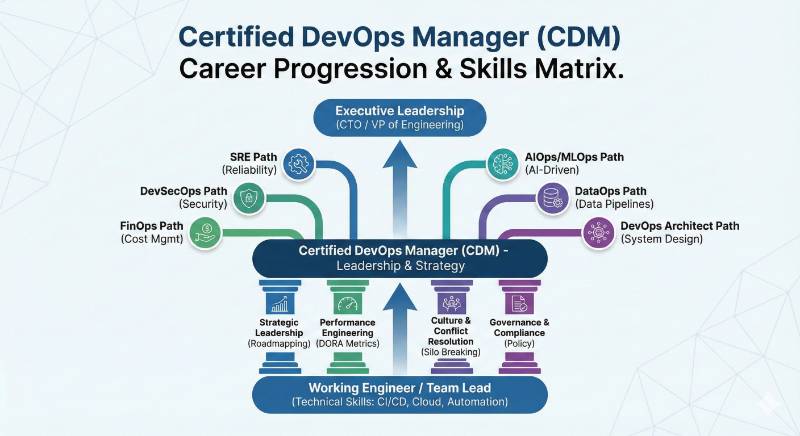
The shift from being a technical contributor to a leadership role is one of the most significant milestones in a software professional’s career. While coding and automation are the foundation, managing people, processes, and budgets requires a entirely different mindset.
This guide focuses on the Certified DevOps Manager program—a certification designed to turn high-performing engineers into strategic leaders. Whether you are based in India or working globally, understanding how to navigate the “Ops” landscape at a management level is the key to long-term career growth.
Why Management Certification Matters Today
In the current market, organizations are no longer looking for managers who just “assign tasks.” They need leaders who understand the technical nuances of CI/CD, cloud costs, and security compliance.
The transition from a Senior Engineer or Lead to a DevOps Manager often feels like a gap too wide to cross. This is where structured certification programs come in. They provide a blueprint for governance, team building, and driving ROI through DevOps practices.
Master Certification Table: Top Tracks for Software Engineers
Based on industry standards and top career roadmaps, here is a comprehensive list of certifications that help software engineers and managers level up.
| Track | Level | Who it’s for | Prerequisites | Skills Covered | Recommended Order |
| DevOps | Associate | Software Engineers | Basic Linux/Cloud | Git, Docker, CI/CD | 1 |
| Management | Expert | Leads & Managers | 5+ Years IT Exp | Leadership, KPIs, ROI | 2 |
| Architecture | Advanced | Architects | CDE/CDM Found. | System Design, Scaling | 3 |
| Security | Specialist | Security Leads | DevOps Basics | DevSecOps, Compliance | Specialized |
| Reliability | Specialist | SREs, Ops Leads | Automation Exp | SLOs, SLIs, Uptime | Specialized |
| AIOps | Specialist | Data/Ops Leads | Python/ML Basics | AI-driven Ops, ML Ops | Specialized |
| FinOps | Management | Finance/Eng Leads | Cloud Knowledge | Cloud Cost, Budgeting | Specialized |
Deep Dive: Certified DevOps Manager (CDM)
What it is
The Certified DevOps Manager (CDM) is a high-level leadership program. It focuses on the strategic implementation of DevOps within an organization, emphasizing culture, measurement, and organizational structure rather than just tool configurations.
Who should take it: Provider Deep Intro
This certification is offered by DevOpsSchool, one of the most recognized names in the DevOps training space. The curriculum is curated by industry veteran Rajesh Kumar, who brings decades of hands-on experience in managing large-scale engineering teams.
The program is ideal for:
- Project and Program Managers.
- Senior Software Engineers looking to move into management.
- Team Leads and Delivery Managers.
- IT Directors overseeing digital transformation.
Skills you’ll gain
- Strategic Leadership: Learn to design a roadmap for DevOps adoption across multiple departments.
- Performance Engineering: Mastering the use of DORA metrics to measure team velocity and stability.
- Conflict Resolution: Learning how to break the “wall of confusion” between development and operations.
- Resource Management: Managing cloud budgets, tool licensing, and hiring for DevOps roles.
- Governance & Compliance: Ensuring that automation doesn’t bypass security and regulatory requirements.
Real-world projects you should be able to do after it
- Build a complete “Value Stream Map” for a product to identify bottlenecks.
- Implement a “Chargeback” model in a cloud environment to track costs per department.
- Lead a migration from legacy monolithic deployments to a containerized microservices architecture.
- Design a hiring and training plan to upskill an existing team into a modern SRE/DevOps unit.
Preparation Plan
- 7–14 Days (Fast Track): For experienced Leads. Focus on the CDM syllabus, management frameworks, and mock exams provided by DevOpsSchool.
- 30 Days (Standard): Ideal for Senior Engineers. Spend 1 hour daily on theoretical concepts and 1 hour on case studies.
- 60 Days (Comprehensive): For those new to the DevOps philosophy. Includes attending live sessions, participating in forums, and completing all hands-on leadership labs.
Common Mistakes
- Treating it as a Technical Exam: Many candidates focus too much on specific tool commands. This is a management exam; focus on the process and people.
- Ignoring the “Culture” Aspect: DevOps is 80% culture. Candidates often overlook the soft skills and organizational change management sections.
- Underestimating ROI: Managers must be able to prove the value of DevOps in dollars and cents. Don’t skip the financial and metrics sections.
Best next certification after this
- Same Track: Master in DevOps Engineering (MDE).
- Cross-Track: Certified DevSecOps Professional (to lead secure teams).
- Leadership: Certified DevOps Architect (to lead technical design).
Choose Your Path: 6 Learning Tracks
Depending on your career goals, you can specialize in these modern “Ops” tracks:
- DevOps Path: Focuses on general automation, CI/CD, and the core culture of collaboration.
- DevSecOps Path: Integrates security at every stage. Essential for managers in banking, fintech, or healthcare.
- SRE (Site Reliability Engineering) Path: Focuses on system uptime and scalability. This is the Google-pioneered way of doing Operations.
- AIOps/MLOps Path: The future of Ops. Using Artificial Intelligence to predict system failures and managing the lifecycle of Machine Learning models.
- DataOps Path: Streamlining data flows. Crucial for organizations that rely heavily on Big Data and analytics.
- FinOps Path: The art of cloud cost management. Learning how to keep cloud bills low while maintaining performance.
Role → Recommended Certifications Mapping
To help you decide your next move, here is a mapping of current roles to the certifications that provide the most value:
- DevOps Engineer: Certified DevOps Engineer (CDE).
- SRE (Site Reliability Engineer): Certified SRE Professional.
- Platform Engineer: Certified DevOps Architect.
- Cloud Engineer: Certified DevOps Engineer + Cloud-Specific Professional Certs.
- Security Engineer: Certified DevSecOps Professional.
- Data Engineer: Certified DataOps Professional.
- FinOps Practitioner: Certified FinOps Professional.
- Engineering Manager: Certified DevOps Manager (CDM).
Next Certifications to Take (3 Options)
Once you have mastered the Manager level, you should look toward these three directions:
- Same Track (Specialization): Master in DevOps Engineering (MDE). This is the highest level of mastery in the DevOps domain.
- Cross-Track (Broadening): Certified DevSecOps Professional. As a manager, knowing how to lead “Secure by Design” teams is a massive advantage.
- Leadership (Executive): Certified DevOps Architect. This moves you from managing people to designing the entire technical ecosystem of a company.
Top Institutions for Training and Certification
Selecting the right partner for your certification journey is vital. These institutions provide specialized support, expert trainers like Rajesh Kumar, and industry-recognized credentials.
- DevOpsSchool: The primary leader in DevOps education. They offer comprehensive, hands-on training for the CDM program with 24/7 support and a massive library of resources.
- Cotocus: A premium consulting and training organization that focuses on industrial-grade practicals. They are known for grooming engineers for high-end corporate roles.
- Scmgalaxy: A community-driven platform that provides deep technical insights, blogs, and tutorials. It is an excellent resource for those who want to stay updated with the latest in SCM and DevOps.
- BestDevOps: Focuses on making complex DevOps concepts easy to understand. Their training programs are highly recommended for those who prefer a simplified, step-by-step learning approach.
- DevSecOpsSchool / SRESchool: Specialized portals that focus exclusively on Security and Reliability engineering. These are the go-to places for niche specializations.
- AIOpsSchool / DataOpsSchool / FinOpsSchool: Dedicated institutions for the emerging fields of AI, Data, and Financial operations, providing tailored certifications for each.
General FAQs for Software Professionals
1. How difficult are these certifications?
The difficulty depends on your experience. Associate levels are manageable with 2-4 weeks of study, while Manager and Architect levels require deep conceptual understanding and practical experience.
2. How much time should I dedicate daily?
For a working professional, 1-2 hours a day is sufficient to complete most programs within 30 to 60 days.
3. Are there any prerequisites for the Manager track?
While not mandatory for all, having 3-5 years of IT experience and a basic understanding of Agile/DevOps is highly recommended.
4. What is the recommended sequence for a beginner?
Start with Certified DevOps Engineer (CDE), move to Certified DevOps Manager (CDM), and finally, Certified DevOps Architect (CDA).
5. Do these certifications hold value in the global market?
Yes. Companies in the US, Europe, and UAE specifically look for certified managers to lead their digital transformation projects.
6. Will this help me transition from a developer role?
Absolutely. It provides the “Ops” and “Management” knowledge that developers often lack, making you a “Full Stack” leader.
7. Can I take these exams online?
Yes, all programs mentioned through DevOpsSchool and its affiliates offer online proctored exams.
8. What happens if I don’t pass on the first try?
Most providers offer a retake policy. The focus should be on reviewing the areas where you scored low in the first attempt.
9. Is training mandatory, or can I self-study?
While self-study is possible, expert-led training from places like DevOpsSchool significantly increases your chances of passing and provides real-world context.
10. How long is the certificate valid?
Most of these certifications come with lifetime validity, though staying updated with the latest tools is expected in the industry.
11. What is the average salary hike after getting CDM certified?
In India and globally, certified DevOps Managers often see a 30% to 50% increase in their total compensation package.
12. Does it cover cloud platforms like AWS or Azure?
The CDM program is cloud-agnostic, meaning it teaches you principles that apply to any cloud provider.
FAQs Specific to Certified DevOps Manager
1. Is the CDM certification focused on tools like Jenkins or Terraform?
No. While it touches on tools, the primary focus is on how to manage the use of these tools, set up workflows, and measure team success.
2. Is there a coding requirement for the CDM exam?
No coding is required. You need to understand how code flows through a pipeline, but you won’t be asked to write scripts.
3. Who is the lead trainer for this program?
The program is often led by Rajesh Kumar, an expert with over two decades of experience in the industry.
4. Does the program include Value Stream Mapping?
Yes, VSM is a core part of the CDM curriculum, helping you visualize and optimize the delivery process.
5. How does this differ from a standard PMP certification?
PMP is general project management. CDM is specifically for the high-velocity, automated world of software delivery and DevOps.
6. Can a Senior QA or Testing Lead take this?
Yes. QA leads are often the best candidates for DevOps management because they already understand the importance of quality and process.
7. What are DORA metrics, and are they covered?
DORA metrics (Deployment Frequency, Lead Time, Mean Time to Recover, and Change Failure Rate) are central to the CDM program.
8. Is there a community for CDM holders?
Yes, becoming certified through DevOpsSchool gives you access to an alumni network and professional groups on platforms like Scmgalaxy.
Conclusion
The demand for leaders who can navigate the complexities of modern software delivery is at an all-time high. The Certified DevOps Manager certification is more than just a credential; it is a transformation of your professional identity. By shifting your focus from “how to build” to “how to lead,” you open doors to executive roles and high-impact projects.
Don’t just be a part of the team—be the person who builds the team.
Would you like me to help you create a personalized 30-day study schedule based on your current role?