




Introduction
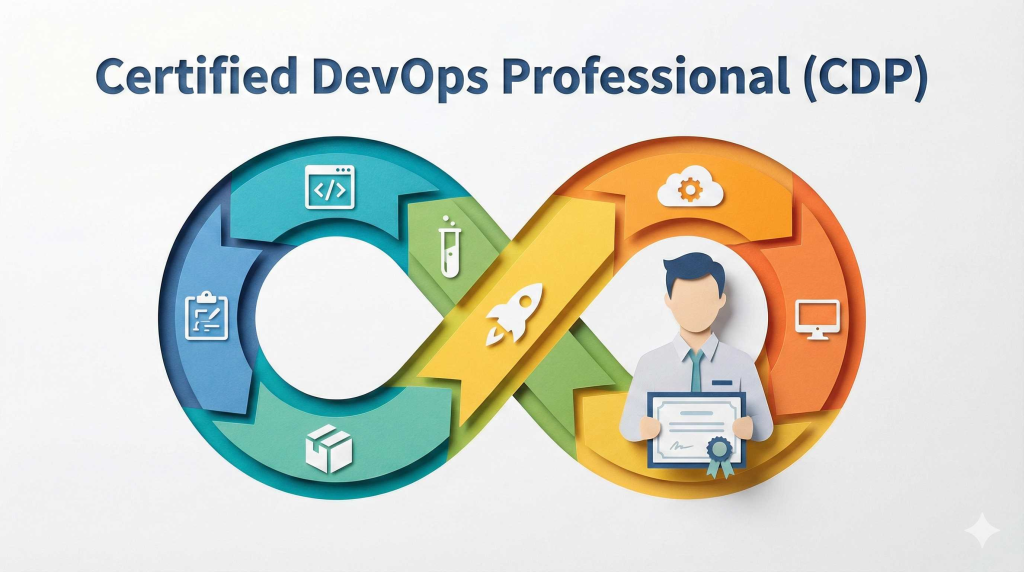
The Certified DevOps Professional (CDP) certification is one of the most highly regarded certifications in the field of DevOps. It is ideal for those looking to solidify their DevOps expertise and advance their careers. This comprehensive guide will help you understand what the Certified DevOps Professional is, who should take it, and how it can significantly boost your career. With my 20+ years of experience in the field, I’ll also provide insights into real-world applications, preparation plans, and potential career paths after certification.
What is the Certified DevOps Professional?
The Certified DevOps Professional certification is a specialized credential that validates an individual’s understanding of the principles and practices of DevOps. It covers key areas such as continuous integration (CI), continuous deployment (CD), automation, infrastructure as code (IaC), and monitoring. The certification is aimed at professionals who want to demonstrate their skills in integrating DevOps practices into their organization’s software delivery pipelines.
Through this certification, individuals gain hands-on experience with the tools and technologies that make DevOps work, including Jenkins, Docker, Kubernetes, Terraform, and AWS. As more companies embrace DevOps, professionals with this certification are in high demand to help optimize workflows and drive organizational success.
Who Should Take the Certified DevOps Professional Certification?
The Certified DevOps Professional certification is ideal for a wide range of professionals looking to build their skills in DevOps practices:
- DevOps Engineers: Professionals responsible for the automation of software delivery and infrastructure management.
- Cloud Engineers: Those working with cloud platforms and managing cloud infrastructure.
- Software Engineers: Developers who want to understand how to integrate DevOps principles into their development lifecycle.
- Platform Engineers: Engineers who manage the underlying infrastructure platforms that support software applications.
- System Administrators: IT professionals looking to expand their skills into automation and DevOps practices.
- Engineering Managers: Managers responsible for leading DevOps teams and implementing DevOps strategies across the organization.
This certification is valuable for anyone looking to transition into a DevOps role or to enhance their expertise in modern software development practices.
Skills You’ll Gain from the Certified DevOps Professional Certification
After completing the Certified DevOps Professional certification, you’ll gain the following key skills:
- Automation of deployment pipelines and infrastructure
- Continuous Integration (CI) and Continuous Deployment (CD)
- Monitoring and logging to ensure performance and troubleshoot issues
- Version control with tools like Git
- Infrastructure as Code (IaC) using tools like Terraform and Ansible
- Collaboration between development, operations, and other departments
- Cloud platform expertise with services like AWS, Azure, and Google Cloud
- Security integration in DevOps (DevSecOps)
Real-World Projects You Should Be Able to Do After Completing the Certification
Upon earning the Certified DevOps Professional certification, you will be able to:
- Automate CI/CD pipelines using Jenkins, GitLab, or CircleCI
- Implement Infrastructure as Code (IaC) with Terraform and Ansible
- Deploy and manage containers using Docker and Kubernetes
- Integrate security into your CI/CD pipeline (DevSecOps)
- Monitor and troubleshoot applications using monitoring tools like Prometheus and Grafana
- Manage cloud infrastructure with platforms like AWS, Azure, and GCP
Preparation Plan
7-14 Days Preparation Plan
- Focus on understanding DevOps fundamentals, including automation, CI/CD, and cloud services.
- Begin hands-on labs with Git, Docker, Jenkins, and basic cloud tools.
- Practice by setting up a simple pipeline and automating a deployment.
30 Days Preparation Plan
- Deep dive into IaC tools (Terraform, Ansible).
- Implement real-world CI/CD pipelines and integrate monitoring solutions.
- Learn about DevSecOps practices for secure automation.
- Prepare for the exam with mock tests and sample questions.
60 Days Preparation Plan
- Complete multiple projects integrating all core DevOps tools and practices.
- Simulate end-to-end pipelines, including monitoring, testing, deployment, and troubleshooting.
- Dive deeper into advanced topics such as Kubernetes, Docker Swarm, and cloud security.
Common Mistakes to Avoid
When preparing for the Certified DevOps Professional certification, there are some common mistakes to avoid to ensure a smooth and successful learning process:
- Neglecting Hands-on Practice: DevOps is all about practical implementation. Focusing solely on theory without practicing the tools and techniques can lead to poor performance during the exam.
- Skipping Core Concepts: While it might seem tempting to dive directly into advanced topics, ensure you have a solid understanding of the basics of DevOps, such as version control, CI/CD, and monitoring.
- Overlooking Security: Security should be integrated into DevOps practices (DevSecOps). Failing to learn about security practices and how they fit into CI/CD pipelines can lead to significant gaps in your knowledge.
- Rushing the Preparation: DevOps is a broad field that requires a deep understanding of various tools and techniques. Rushing through the preparation can result in missing key concepts. Take your time to master each topic.
- Ignoring Real-World Projects: DevOps is a practical discipline. Make sure to work on real-world projects or simulations to apply the knowledge you have gained and ensure you’re ready for the exam and the workplace.
Best Next Certification After Certified DevOps Professional
- Same Track: Certified DevOps Architect (CDA) – Dive deeper into the architecture and implementation of large-scale systems.
- Cross Track: Certified Kubernetes Administrator (CKA) – Specialize in container orchestration and management.
- Leadership: Certified DevOps Leader (CDL) – Focus on team management and leadership in DevOps environments.
Choose Your Path: Learning Paths
The Certified DevOps Professional can open doors to various paths in the field of IT operations and software development. Here are the learning paths you can consider:
- DevOps: Focuses on the entire DevOps lifecycle, automation, and cloud computing.
- DevSecOps: Combines DevOps and security to build more secure pipelines.
- SRE (Site Reliability Engineering): Focuses on the reliability and scalability of systems.
- AIOps/MLOps: Combines AI and machine learning with DevOps practices.
- DataOps: Focuses on automating data engineering workflows.
- FinOps: Manages cloud financial operations in a DevOps environment.
Role → Recommended Certifications
| Role | Recommended Certifications |
|---|---|
| DevOps Engineer | Certified DevOps Professional, Certified Kubernetes Administrator |
| SRE | Certified DevOps Professional, Certified Site Reliability Engineer |
| Platform Engineer | Certified DevOps Professional, Certified Cloud Architect |
| Cloud Engineer | Certified DevOps Professional, AWS Certified Solutions Architect |
| Security Engineer | Certified DevOps Professional, Certified DevSecOps Practitioner |
| Data Engineer | Certified DevOps Professional, DataOps Certified Professional |
| FinOps Practitioner | Certified DevOps Professional, FinOps Certified Practitioner |
| Engineering Manager | Certified DevOps Professional, Certified DevOps Leader |
Training & Certification Providers
Several top institutions offer training and certification for the Certified DevOps Professional:
- DevOpsSchool: Offers comprehensive training with hands-on labs, real-world projects, and career support.
- Cotocus: Known for its flexible learning options and expert-led training programs.
- ScmGalaxy: Provides expert training in DevOps with a focus on practical applications and certifications.
- BestDevOps: Specializes in DevOps and cloud services, offering industry-recognized certifications.
- DevSecOpsSchool: Focuses on integrating security into DevOps pipelines with practical training.
- SRESchool: Provides a deep dive into SRE practices, combined with DevOps skills.
- AIOpsSchool: Integrates AI and automation with DevOps training for advanced professionals.
- DataOpsSchool: Specializes in automating data workflows in DevOps environments.
- FinOpsSchool: Offers training on managing cloud financial operations in DevOps.
FAQs on Certified DevOps Professional
- What is the difficulty level of the Certified DevOps Professional exam?
- The exam is of intermediate to advanced difficulty, focusing on practical skills and knowledge.
- How much time is required for preparation?
- Typically, 30-60 days of focused preparation is recommended to pass the exam.
- What are the prerequisites for taking this certification?
- A basic understanding of Linux, cloud platforms, and software development is helpful.
- What sequence of certifications should I follow?
- Start with Certified DevOps Professional, followed by specialized certifications like Certified Kubernetes Administrator.
- What value does this certification provide to my career?
- It validates your expertise in DevOps practices and automation, enhancing your job prospects.
- How will this certification help in my current job?
- It will help you improve your team’s efficiency through better automation, monitoring, and collaboration.
- Can I take this certification online?
- Yes, DevOpsSchool and other providers offer online training and certification exams.
- How much does the certification cost?
- The cost varies, but DevOpsSchool offers competitive pricing with various payment options.
Conclusion
The Certified DevOps Professional certification is an excellent opportunity for individuals looking to advance their careers in the world of DevOps. By acquiring this certification, you gain expertise in automation, continuous integration, and infrastructure management, which are critical in today’s software development lifecycle. Whether you’re a DevOps Engineer, Cloud Engineer, or an Engineering Manager, this certification will help you stay ahead of the curve and demonstrate your proficiency in DevOps practices.
By following the right preparation plan, avoiding common mistakes, and continuing your learning journey, you can achieve success and take your career to new heights. With the demand for DevOps professionals continuing to rise, the Certified DevOps Professional certification will ensure that you are well-equipped for the opportunities that lie ahead.
FAQs – Certified DevOps Professional
1. Why was the Certified DevOps Professional certification created?
It was created to validate a professional’s ability to apply DevOps practices in real software environments, including automation, continuous delivery, cloud usage, containerization, and system operations.
2. Who benefits most from this certification?
This certification is useful for software developers, DevOps and cloud engineers, SREs, platform engineers, and technical leaders responsible for building or maintaining applications.
3. Is this certification suitable for people with full-time jobs?
Yes. The learning approach is flexible and focuses on practical skills that can be applied alongside regular work responsibilities.
4. Do I need strong DevOps experience before attempting CDP?
No strict experience is required. Basic knowledge of Linux, Git, and application deployment is enough to get started.
5. How demanding is the Certified DevOps Professional exam?
The exam is practical and realistic. It checks how well you understand DevOps processes and problem-solving, rather than testing memorized facts.
6. How long does it usually take to prepare?
Preparation time varies:
- Experienced professionals: a few weeks
- Mid-level learners: around one month
- New learners: up to two months
7. Does the certification concentrate on tools or overall practices?
It focuses mainly on DevOps practices and workflows, while tools are used only to support those concepts.
8. Is this certification useful for international roles?
Yes. DevOps methods are similar worldwide, making this certification relevant for global job opportunities.
9. Can this certification help me move into a DevOps role?
Yes. It supports role transitions and strengthens your profile for DevOps and platform-related positions.
10. Is hands-on experience important for success?
Hands-on experience is not mandatory, but it makes learning easier and improves your understanding of real DevOps situations.
11. Should engineering managers consider this certification?
Yes. Managers gain insight into DevOps systems, automation strategies, and how modern engineering teams operate.
12. What should I do after completing Certified DevOps Professional?
After CDP, you can specialize further in SRE, DevSecOps, cloud architecture, AIOps, DataOps, FinOps, or move toward leadership roles.