




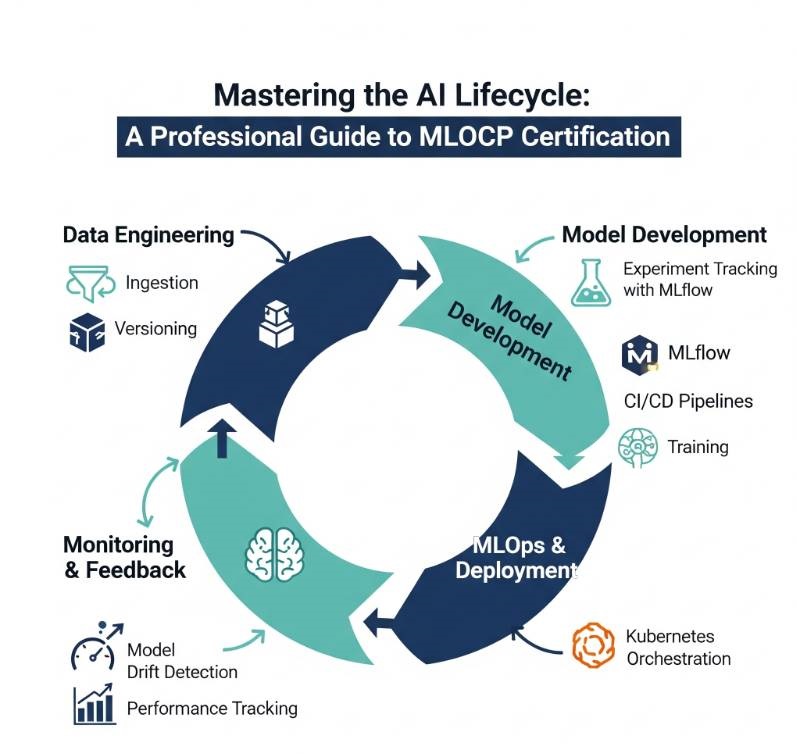
Machine Learning is no longer just a research experiment hidden in a lab. Today, it is the engine driving global businesses. However, building a great model is only 10% of the battle. The real challenge is moving that model into a production environment where it stays reliable, scalable, and secure. This is where MLOps (Machine Learning Operations) comes in. As someone who has navigated the shifts from manual deployments to fully automated cloud-native ecosystems, I have seen how the gap between Data Science and IT Operations can sink even the best AI projects. The MLOps Certified Professional (MLOCP) program is designed to bridge this exact gap. It turns software engineers and data scientists into “Production-Ready” experts.
The MLOps Certification Landscape
Before we dive deep into the MLOCP, let’s look at how certifications are structured in the industry. Whether you are starting out or aiming for leadership, there is a clear path to follow.
Master Certification Track Table
| Track | Level | Who it’s for | Prerequisites | Skills Covered | Recommended Order |
| MLOps | Foundation | Beginners, Students | Basic Python | ML Lifecycle, DevOps Basics | 1st |
| MLOps | Engineer | Working Engineers | Basic Docker/Git | CI/CD for ML, Containers | 2nd |
| MLOps | Professional | Lead Engineers/SREs | ML Foundations | Full ML Lifecycle, Monitoring | 3rd (Current Guide) |
| MLOps | Architect | Senior Architects | Pro-level MLOps | Scaling, System Design | 4th |
| MLOps | Manager | Product Managers | Team Lead experience | Governance, ROI, Strategy | 5th |
Deep Dive: MLOps Certified Professional (MLOCP)
What it is
The MLOps Certified Professional (MLOCP) is an advanced, practitioner-level certification. It focuses on the automation of machine learning workflows. It isn’t just about writing code; it’s about building “pipelines” that allow models to retrain, deploy, and monitor themselves with minimal human intervention.
Who should take it
This program is perfect for:
- Software Engineers who want to specialize in AI infrastructure.
- Data Scientists who are tired of their models staying “stuck” on their laptops.
- DevOps Engineers looking to manage the unique needs of ML (like data drift).
- SREs responsible for the uptime of AI-powered applications.
Skills you’ll gain
- Automated CI/CD for ML: Building pipelines that test both code and data quality.
- Containerization: Mastering Docker and Kubernetes specifically for ML workloads.
- Model Monitoring: Learning to catch “Model Drift” before it affects your business.
- Experiment Tracking: Using tools like MLflow to keep track of every model version.
- Orchestration: Managing complex workflows using Apache Airflow or Kubeflow.
- Security in ML: Understanding how to protect your data and models from attacks.
Real-world projects you should be able to do
- End-to-End Pipeline: Create a system that automatically retrains a model when new data arrives.
- Fraud Detection System: Deploy a deep learning model that monitors transactions in real-time.
- Dashboard Implementation: Build a Grafana dashboard to track the health of a live AI model.
- Scale on Kubernetes: Deploy an image recognition API that autoscales based on user demand.
Preparation plan
- 30-Day Intensive Path:
- Week 1: Review ML fundamentals and Python scripting.
- Week 2: Master Docker and Kubernetes basics.
- Week 3: Focus on MLflow, Airflow, and CI/CD tools.
- Week 4: Hands-on labs and Mock Exams.
- 60-Day Professional Path: Recommended if you are balancing a full-time job. Focus on one tool per week (Git, Docker, Jenkins, MLflow, etc.).
Common mistakes
- Ignoring the Data: Many engineers focus only on the code. In MLOps, data quality is just as important as code quality.
- Over-Engineering: Don’t build a complex Kubernetes cluster if a simple API deployment works for your current scale.
- Skipping Monitoring: A model that works today might fail tomorrow due to changing trends. Never skip the monitoring phase.
Best next certification after this
Once you have mastered the Professional level, the Certified MLOps Architect is the logical next step to learn how to design massive, enterprise-scale AI systems.
Choose Your Path: 6 Learning Journeys
Career growth in the “X-Ops” world is not a straight line. Depending on your interest, you can pivot into different specializations.
- DevOps Path: Focuses on the general speed and quality of software delivery.
- DevSecOps Path: The “Security-First” route. You ensure that every piece of code is safe before it goes live.
- SRE Path: Focuses on reliability. You become the “Doctor” for digital systems, ensuring they never go down.
- AIOps/MLOps Path: The intersection of AI and Operations. You automate the life of an AI model.
- DataOps Path: Focuses on the “pipes” that move data. You ensure data is clean, fast, and available.
- FinOps Path: The “Cloud Finance” route. You help companies save money on their cloud bills.
Role → Recommended Certifications
| Current Role | Recommended Certification(s) |
| DevOps Engineer | DevOps Certified Professional (DCP) |
| SRE | Site Reliability Engineering Certified Professional (SRECP) |
| Platform Engineer | Certified Kubernetes Administrator (CKA) |
| Cloud Engineer | AWS/Azure Solutions Architect |
| Security Engineer | DevSecOps Certified Professional (DSOCP) |
| Data Engineer | DataOps Certified Professional (DOCP) |
| FinOps Practitioner | Certified FinOps Professional |
| Engineering Manager | Certified MLOps Manager / DevOps Manager |
Next Certifications to Take
After completing your MLOCP, you should consider your next move based on your career goals. According to recent trends from Gurukul Galaxy, these are the top choices:
- Same Track (Specialization): AIOps Certified Professional. This allows you to apply machine learning to the infrastructure itself, predicting outages before they happen.
- Cross-Track (Versatility): DevSecOps Certified Professional. With ML models becoming targets for hackers, security is the next major hurdle for MLOps.
- Leadership (Strategy): Site Reliability Engineering (SRE) Professional. This moves you into a high-level architectural role, designing global-scale resilient systems.
Top Institutions for MLOCP Training
Choosing the right partner for your certification is critical. Here are the top institutions that provide help in training and certification for the MLOps Certified Professional (MLOCP):
- DevOpsSchool: One of the most recognized names globally. They provide deep, hands-on labs and instructor-led training that focuses on real-world scenarios rather than just theory.
- Cotocus: Known for their boutique training style. They offer specialized sessions for MLOps that are highly practical and tailored for working professionals.
- Scmgalaxy: A massive community-driven platform. They provide extensive resources, blogs, and technical guides that support your journey toward MLOCP.
- BestDevOps: This institution focuses purely on the “best practices” of the industry. Their MLOps curriculum is updated frequently to include the latest tools like LLMOps.
- DevSecOpsSchool: If you want to add a security twist to your MLOps journey, this is the place. They specialize in the intersection of security and automation.
- SRESchool: Perfect for engineers who want to ensure their ML models are highly reliable. They focus on the “SRE for ML” mindset.
- AIOpsSchool: Focuses on the future of operations. They help you transition from traditional MLOps to the world of Artificial Intelligence for Operations.
- DataOpsSchool: Since MLOps is nothing without good data, this school provides the foundational data engineering skills needed to succeed.
- FinOpsSchool: Helps you manage the high costs associated with training ML models in the cloud. A must-visit for managers and senior engineers.
Frequently Asked Questions (General)
- How difficult is the MLOCP exam? It is intermediate to advanced. You need a good grasp of both ML concepts and DevOps tools like Docker.
- How long does it take to get certified? Most professionals complete the training and exam in 30 to 60 days.
- Are there any prerequisites? Basic knowledge of Python and some experience with Linux or Git is highly recommended.
- Is this certification recognized globally? Yes, DevOpsSchool certifications are recognized by top MNCs in India, the US, Europe, and beyond.
- Should I do DevOps before MLOps? It helps to know the basics of DevOps (CI/CD), but the MLOCP course covers the necessary foundations.
- What is the value of MLOCP in the job market? MLOps is one of the highest-paying roles in 2026. This certification validates your “Production-Ready” status.
- What is the sequence of certifications? Start with Foundation, move to Engineer, then Professional (MLOCP), then Architect.
- Will I get hands-on experience? Yes, the program requires completing real-world projects to earn the certification.
- Can a manager take this course? Yes, but the “Certified MLOps Manager” track is usually a better fit unless they want to stay technical.
- What tools will I learn? You will master Git, Docker, Kubernetes, Jenkins/GitHub Actions, MLflow, and Prometheus.
- Does the certification expire? Most certifications require a refresh every few years to stay updated with new tools.
- What are the career outcomes? Graduates typically move into roles like MLOps Engineer, AI Infrastructure Lead, or Senior DevOps Engineer.
FAQs specifically for MLOps Certified Professional (MLOCP)
- What makes MLOCP different from a standard ML course? Standard courses teach you how to build a model. MLOCP teaches you how to operate it in the real world at scale.
- Does MLOCP cover Generative AI (LLMOps)? Yes, the 2026 curriculum includes how to manage and deploy Large Language Models.
- Is coding required for the exam? You don’t need to be a software developer, but you must be able to read and write Python scripts for automation.
- How are the exams delivered? They are typically online-proctored, meaning you can take them from your home or office.
- What is the passing score? The passing score is usually 70% or higher, depending on the specific track.
- Do I get a certificate immediately? After passing the exam and project review, digital certificates are usually issued within 7-10 days.
- Is there a community for MLOCP holders? Yes, you get access to alumni groups and technical forums for lifelong networking.
- Can I upgrade my certification later? Absolutely. You can move up to the Architect or Manager levels once you gain more experience.
Conclusion
The shift toward MLOps represents a fundamental change in how we think about Artificial Intelligence. We are moving away from the era of “Experimental AI” and into the era of “Industrialized AI.” For the working engineer or manager, staying relevant means moving beyond just understanding algorithms; it means understanding how to manage those algorithms at scale. The MLOps Certified Professional (MLOCP) program is more than just a credential—it is a rigorous training ground. It provides the technical depth required to handle data drift, model decay, and complex orchestration while maintaining the humanized perspective needed to lead teams. Whether you are looking to advance your career in India’s booming tech hubs or on the global stage, mastering these “Ops” disciplines is the most secure investment you can make in your professional future. The tools will change, and the models will evolve, but the principles of automation, reliability, and security will always remain at the heart of successful engineering.