




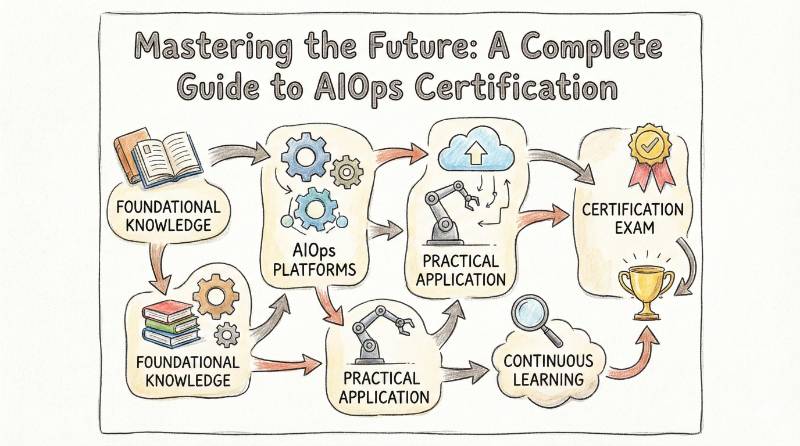
The world of software operations is changing fast. Today, systems are so complex that humans alone cannot manage them. This is where AIOps (Artificial Intelligence for IT Operations) comes in. It uses AI and Machine Learning to help IT teams work smarter, not harder.
If you are a working engineer or a manager, understanding AIOps is no longer optional. It is the next big step in the evolution of DevOps and SRE. In this guide, we will explore everything you need to know about the AIOps Certification Training Course and how it can transform your career.
Understanding the Shift to AIOps
Managing modern cloud environments feels like trying to fix a plane while it is flying. You have thousands of logs, endless alerts, and hidden patterns that cause downtime. Traditional monitoring tools tell you what is broken, but AIOps tells you why and how to fix it before users even notice.
AIOps combines “Big Data” and “Machine Learning” to automate tasks like event correlation, anomaly detection, and causality analysis. By mastering this, you become the bridge between data science and IT operations.
Detailed View: AIOps Certification Training Course (AIOps)
The AIOps Certification Training Course is designed to turn traditional engineers into AI-driven operations experts. It bridges the gap between manual troubleshooting and automated, intelligent recovery.
What it is
This certification is a comprehensive program that teaches you how to apply AI/ML models to IT operations data. It focuses on using data-driven insights to automate monitoring, logging, and incident response.
Who should take it
- DevOps and SRE Professionals looking to automate complex incident management.
- IT Managers who want to reduce “noise” in their alerting systems.
- Software Engineers interested in the intersection of AI and Infrastructure.
- Data Engineers wanting to apply their skills to IT Ops.
Skills you’ll gain
- Mastery of AIOps architecture and its core pillars.
- Ability to implement anomaly detection using Machine Learning.
- Expertise in automated root cause analysis (RCA).
- Knowledge of integrating AI tools with existing DevOps pipelines.
- Skills in managing large-scale data lakes for IT operations.
Real-world projects you should be able to do
- Automated Alert Suppression: Build a system that filters out 90% of “noise” alerts so teams only see real issues.
- Predictive Scaling: Create a model that predicts traffic spikes and scales infrastructure before the load hits.
- Smart Log Analysis: Develop a pipeline that identifies “first-seen” errors in logs across thousands of microservices.
Preparation plan
- 7–14 days: Understand the basics of AI/ML terminology and AIOps architecture.
- 30 days: Deep dive into data collection, cleaning, and model selection for IT metrics.
- 60 days: Hands-on practice with AIOps tools and completing a capstone project on incident automation.
Common mistakes
- Ignoring Data Quality: Trying to run AI on messy or incomplete log data.
- Over-Automation: Automating fixes without proper human-in-the-loop checks.
- Tool Obsession: Focusing only on specific software instead of the underlying AIOps principles.
Best next certification after this
After completing this, the Master in DevOps Engineering (MDE) is an excellent choice to round out your architectural leadership skills.
AIOps Certification Matrix
| Track | Level | Who it’s for | Prerequisites | Skills Covered | Recommended Order |
| AIOps | Professional | Engineers/Managers | Basic DevOps/SRE | ML for Ops, Automation | 1st |
| DevOps | Foundation | Beginners | Basic Linux | CI/CD, Scripting | 2nd |
| SRE | Advanced | SRE/Ops | DevOps Knowledge | SLOs, Error Budgets | 3rd |
Choose Your Path: 6 Learning Tracks
Depending on your career goals, you can follow these specialized paths. Each one is designed to make you a specialist in a specific modern tech domain.
- DevOps Path: Focuses on the culture of collaboration and the automation of software delivery.
- DevSecOps Path: Integrates security into every stage of the DevOps lifecycle.
- SRE Path: Focuses on reliability, scalability, and using software engineering to solve operations problems.
- AIOps/MLOps Path: Combines AI and Machine Learning with operations to create self-healing systems.
- DataOps Path: Streamlines the delivery of data and improves data quality across the organization.
- FinOps Path: Bridges the gap between finance, engineering, and business to manage cloud costs effectively.
Role → Recommended Certifications Mapping
| Current Role | Recommended Certification Path |
| DevOps Engineer | CDE → DevSecOps → AIOps |
| SRE | SRE Certified Professional → AIOps → MDE |
| Platform Engineer | CKA → CDE → AIOps |
| Cloud Engineer | Cloud Provider Certs → CDE → FinOps |
| Security Engineer | DevSecOps Certified Professional → SRE |
| Data Engineer | DataOps → MLOps → AIOps |
| FinOps Practitioner | FinOps Certified → AIOps |
| Engineering Manager | AIOps → FinOps → MDE |
Why Choose DevOpsSchool?
Choosing where to learn is as important as what you learn. DevOpsSchool is a leader in technical training because they focus on real-world outcomes. Their programs are not just about passing an exam; they are about gaining the confidence to lead high-stakes projects.
They provide a balanced mix of theory and lab-based practice. You get access to industry-standard tools and a community of experts who help you navigate complex technical challenges. For anyone serious about AIOps, it is a trusted partner in career growth.
Top Training & Certification Support Institutions
If you are looking for the best places to get trained for the AIOps Certification Training Course, these institutions are highly recommended:
- DevOpsSchool: A premier destination for DevOps and AIOps training. They provide deep-dive sessions, lab access, and certification support with a focus on humanized learning.
- AIOpsSchool: Specialized specifically in AI-driven operations. They offer niche courses that focus on the data science side of IT management.
- Cotocus: Known for their hands-on approach and corporate training programs that help teams transition to modern engineering practices.
- Scmgalaxy: A massive community-driven platform that provides extensive resources, blogs, and tutorials for every DevOps-related track.
- DataOpsSchool: Focuses on the intersection of data management and operations, perfect for those moving from AIOps into broader data roles.
- FinOpsSchool: The go-to place for learning cloud cost optimization, often taken alongside AIOps to manage the cost of AI workloads.
Next Certifications to Take
Once you have mastered AIOps, you should consider these three directions to further your career:
- Same Track (Specialization): MLOps Certified Professional. This helps you manage the entire lifecycle of machine learning models.
- Cross-Track (Broadening): DevSecOps Certified Professional. Learn to secure the AI pipelines you just built.
- Leadership (Growth): Master in DevOps Engineering (MDE). This is for those who want to lead entire engineering departments and define global tech strategies.
Testimonials from the Field
“The AIOps training changed how I look at our monitoring dashboard. I used to spend hours chasing ghosts; now I build models that do it for me. It’s a total game-changer for any SRE.”
— Arjun Mehta, Senior SRE
“As a manager, I needed to know how to reduce our MTTR. The AIOps course gave me the framework to implement intelligent automation that actually works. Our team is much happier now.”
— Sarah Jenkins, Engineering Manager
FAQs about AIOps Certification Training Course
1. How difficult is the AIOps certification?
It is moderately difficult. It requires a solid understanding of IT operations and a willingness to learn basic data science concepts.
2. How long does it take to complete the training?
Most professionals complete the training and certification within 30 to 60 days of part-time study.
3. Are there any prerequisites for this course?
While not mandatory, having a basic understanding of DevOps or SRE practices and some familiarity with Python is very helpful.
4. In what order should I take these certifications?
It is best to start with a foundation in DevOps (CDE), then move to SRE, and finally take AIOps to master advanced automation.
5. What is the value of this certification in the job market?
AIOps is one of the highest-paying niches in tech today. Companies are desperate for engineers who can manage complex, AI-driven cloud environments.
6. Does the course include hands-on labs?
Yes, the program at DevOpsSchool includes extensive lab work where you apply ML models to real-world IT datasets.
7. Can this certification help me move into a Management role?
Absolutely. It demonstrates that you understand high-level strategy and how to use modern technology to solve business problems like downtime and cost.
8. What happens if I fail the exam?
Most providers offer a retake policy. The focus should be on revisiting the lab exercises and understanding the data flow within AIOps.
9. Is this certification recognized globally?
Yes, AIOps is a global trend, and certifications from recognized providers like DevOpsSchool are valued by international tech firms.
10. How much coding is required for AIOps?
You don’t need to be a software developer, but being comfortable with Python or R for data manipulation is a big advantage.
11. Will AIOps replace my job?
No, AIOps is a tool to make you better. It replaces the “boring” parts of your job (like manual log checking) so you can focus on high-value architecture.
12. What are the career outcomes after this?
Typical roles include AIOps Architect, Senior SRE, Automation Lead, and MLOps Engineer.
FAQs: AIOps Certification Training Course | AIOps
1. What makes the DevOpsSchool program different? They focus on “Project-Based Learning.” You build real AIOps systems during the course, not just watch slides.
2. Do I need to be a Data Scientist? No. You need to be an engineer who understands how to apply Data Science to operations.
3. Will I get help with the labs? Yes, top-tier schools provide 24/7 technical support for their lab environments.
4. Is there a certificate of completion? Yes, you receive a professional certification after passing the evaluation.
5. Can this be done alongside a full-time job? Yes, the schedules are designed for working professionals with weekend and evening batches.
6. What kind of salary hike can I expect? AIOps specialists often see a 20-40% increase in compensation compared to traditional DevOps roles.
7. Is Python mandatory? While not mandatory to start, you will learn the Python necessary for AIOps during the training.
8. How do I enroll? Visit the Official Provider website to find the next available batch and registration details.
Conclusion
The transition from manual operations to AIOps is a journey every modern engineer must take. It is about moving from being a “firefighter” to being a “fire-preventer.” By earning your AIOps Certification Training Course | AIOps, you are proving to the world that you are ready for the future of IT.
Whether you are in India or working globally, the demand for intelligent automation is skyrocketing. Start your journey today, choose the right path, and build a career that is not just relevant, but indispensable.