




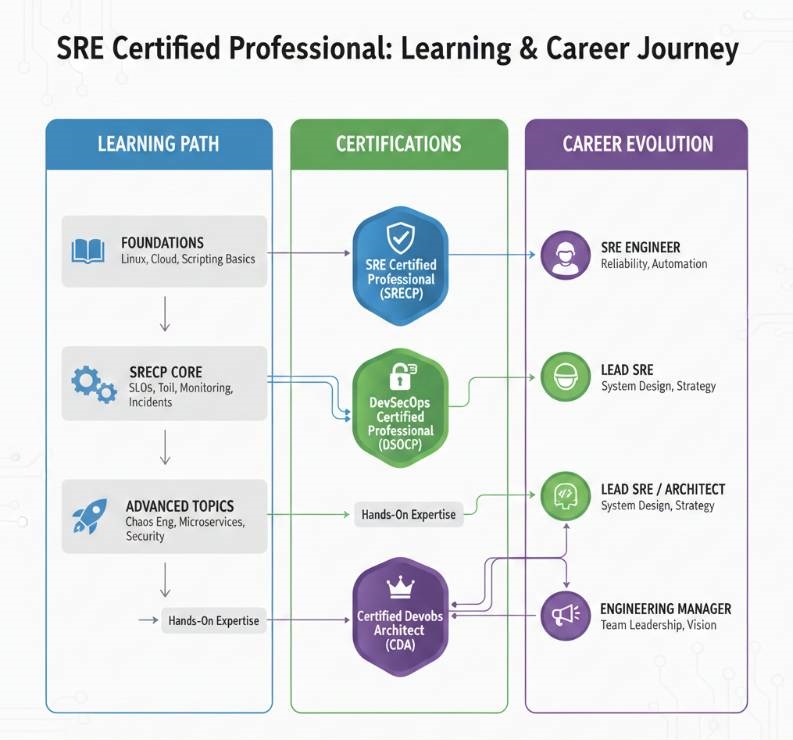
In the fast-paced world of modern software delivery, achieving “five nines” of availability is no longer just a goal—it is a business requirement. As systems become more distributed and complex, traditional operations methods often fail to keep up, leading to burnout and frequent outages. Site Reliability Engineering (SRE) solves this by applying a software engineering mindset to system stability. The SRE Certified Professional (SRECP) program is the definitive path for engineers and managers to master this discipline. This guide explores how the certification equips you with the tools to balance rapid innovation with rock-solid reliability, ensuring your career remains at the cutting edge of the industry.
What is SRE Certified Professional (SRECP)?
The SRE Certified Professional (SRECP) is a specialized program that validates your expertise in building and maintaining reliable, scalable, and efficient software systems. It is rooted in the principles popularized by Google, focusing on mathematical and engineering approaches to uptime rather than just “hope.”
1. What it is
SRECP is a professional certification that teaches you how to apply software engineering discipline to IT operations. It focuses on critical concepts like SLIs, SLOs, Error Budgets, and the reduction of “Toil” to create a sustainable engineering culture.
2. Who should take it
- DevOps & Platform Engineers: Those who want to specialize in high-availability and incident management.
- Software Engineers: Developers who want to understand how their code behaves at scale and how to design for failure.
- System Administrators: Traditional Ops professionals looking to transition into a code-first, automated environment.
- Engineering Managers: Leaders who need to manage the trade-offs between delivery speed and system reliability.
3. Skills you’ll gain
- Service Level Management: Defining and measuring Service Level Indicators (SLIs) and Service Level Objectives (SLOs).
- Error Budgeting: Learning how to use “failure” as a tool to decide when to freeze or accelerate releases.
- Observability Mastery: Implementing advanced monitoring, logging, and distributed tracing.
- Automation of Toil: Identifying repetitive manual tasks and eliminating them through Python, Go, or Shell scripting.
- Incident Response & Postmortems: Managing high-pressure outages and conducting blameless reviews to prevent recurrence.
4. Real-world projects you should be able to do
- Design a Reliability Dashboard: Build a Grafana/Prometheus system that tracks real-time SLO compliance.
- Automated Incident Escalation: Script a workflow that automatically alerts the right team and provides context during a failure.
- Chaos Engineering Experiment: Conduct a controlled “Game Day” to test how your system handles a regional cloud outage.
- Self-Healing Infrastructure: Use Kubernetes and Terraform to create a cluster that automatically repairs failed nodes without human intervention.
5. Preparation plan
- 7–14 Days (The Intensive Path): Best if you already have DevOps experience. Focus on SRE terminology (Toil, Error Budgets) and the official DevOpsSchool study materials.
- 30 Days (The Standard Path): Dedicate 1 hour a day to hands-on labs. Practice setting up monitoring stacks and writing postmortem reports.
- 60 Days (The Career Transition Path): For those new to SRE. Start with Linux and Cloud fundamentals before moving into advanced SRE automation and architecture.
6. Common mistakes
- Setting 100% SLOs: Aiming for perfect uptime is a mistake. It is too expensive and slows down innovation.
- Ignoring the Culture: Focusing only on tools like Prometheus while ignoring the “Blameless” culture required for SRE success.
- Manual Scaling: Relying on humans to add capacity instead of building auto-scaling logic.
7. Best next certification after this
The DevSecOps Certified Professional (DSOCP) is the logical next step. Once you can make a system reliable, you must ensure it is secure against modern threats.
Master Certification Table
| Track | Level | Who it’s for | Prerequisites | Skills Covered | Recommended Order |
| SRE | Professional | SREs, Ops, Devs | Linux/Cloud basics | SLOs, Toil, Monitoring | 1 |
| DevOps | Engineer | Junior/Mid Engineers | Programming basics | CI/CD, Git, Docker | 2 |
| DevSecOps | Professional | Security/Ops | DevOps Knowledge | SAST, DAST, Secrets | 3 |
| MLOps | Professional | Data/DevOps | Python/ML basics | Model Pipelines, Data Drift | 4 |
| FinOps | Practitioner | Managers/Architects | Cloud usage | Cost Visibility, Tagging | 5 |
Choose Your Path: 6 Learning Paths
1. DevOps Path
The foundation of modern delivery. You focus on the speed of the pipeline—getting code from a developer’s machine to production using CI/CD tools like Jenkins and GitLab.
2. DevSecOps Path
The security-first approach. Here, you integrate security checks into every stage of the pipeline so that vulnerabilities are caught before they reach the user.
3. SRE Path
The reliability track. Your goal is to ensure the production environment stays up and performs well. You bridge the gap between development speed and operational stability.
4. AIOps / MLOps Path
The intelligence track. You manage the lifecycle of Machine Learning models, ensuring they are deployed, monitored, and retrained in a repeatable way.
5. DataOps Path
Focused on data integrity. You apply DevOps principles to data pipelines to ensure that analysts and data scientists have high-quality data they can trust.
6. FinOps Path
The cloud economics track. You manage the cloud bill by optimizing costs, rightsizing resources, and ensuring the business gets the most value for its cloud spend.
Role → Recommended Certifications Mapping
- DevOps Engineer: Certified DevOps Professional (CDP) + SRE Certified Professional (SRECP).
- SRE: SRE Certified Professional (SRECP) + Kubernetes Certified Administrator (CKA).
- Platform Engineer: Certified DevOps Architect (CDA) + Master in DevOps Engineering.
- Cloud Engineer: AWS/Azure/GCP Cloud Architect + SRECP.
- Security Engineer: DevSecOps Certified Professional (DSOCP) + SRECP.
- Data Engineer: DataOps Certified Professional (DOCP) + MLOps Certified Professional.
- FinOps Practitioner: Certified FinOps Professional + CDA.
- Engineering Manager: Certified DevOps Manager + SRECP.
Next Certifications to Take
To continue your growth, consider these three paths based on your career goals:
- Same Track (Specialization): Certified Site Reliability Architect (CSRA). This allows you to move from managing single services to designing global, multi-region reliable architectures.
- Cross-Track (Broadening): DevSecOps Certified Professional (DSOCP). Reliability and security are two sides of the same coin. Understanding how to secure your reliable systems is a powerful combination.
- Leadership (Growth): Certified DevOps Manager (CDM). Perfect for those looking to lead SRE teams and implement reliability-centered cultures at an organizational level.
Training & Certification Support Institutions
DevOpsSchool
DevOpsSchool is positioned as a training and certification provider with structured programs and practical learning formats. It is listed as the provider on the site and also shows multiple certification offerings in its ecosystem.
It suits learners who want step-by-step skill building with projects and a certification-aligned path.
Cotocus
Cotocus is often mentioned in the same learning ecosystem as a support option for training and implementation guidance. It can be useful for learners who want hands-on help and practical execution thinking, especially when applying DevSecOps in real delivery setups.
Scmgalaxy
Scmgalaxy is commonly associated with structured training support across engineering topics. It fits learners who prefer guided learning, practical examples, and a clear progression approach while preparing for certification-style outcomes.
BestDevOps
BestDevOps is useful when you want career-focused guidance and skill mapping support. It aligns well with learners who want to understand how certifications connect with real job expectations and how to present skills clearly.
devsecopsschool
devsecopsschool is track-focused around DevSecOps learning. It fits people who want security-first delivery thinking and want a direct identity around DevSecOps skills and progression.
sreschool
sreschool is best for reliability-focused learners. It supports people who want incident readiness, SLO mindset, and operational excellence to match modern platform demands.
aiopsschool
aiopsschool supports learning for operations automation and intelligence. It fits teams dealing with alert fatigue and looking for smarter monitoring and triage practices.
dataopsschool
dataopsschool supports DataOps thinking: pipeline discipline, quality checks, governance, and reliability for data systems. It is useful for data engineering teams that want predictable and auditable pipelines.
finopsschool
finopsschool supports FinOps learning: cost visibility, governance habits, and optimization workflows. It fits cloud teams and managers who want controlled cloud spend without blocking innovation.
FAQs (General Career & Value)
1. How difficult is the SRECP exam? It is considered moderate to advanced. It tests practical knowledge of SRE principles and your ability to apply them to real scenarios, not just memorizing terms.
2. Is there a prerequisite for this certification? While there are no hard requirements, having a basic understanding of Linux, Shell Scripting, and Cloud (AWS/Azure) is highly recommended.
3. How long does the certification stay valid? The certification typically remains valid for two years, after which a refresher or advanced certification is recommended to stay current.
4. Does the course cover specific tools? Yes, you will work with industry-standard tools like Kubernetes, Prometheus, Grafana, Terraform, and PagerDuty.
5. How much time should I dedicate to preparation? For most working professionals, 30 to 60 days of consistent study (1-2 hours daily) is sufficient to pass and gain real skills.
6. What is the sequence of learning? We recommend starting with SRE principles (SLOs/SLIs), then moving to Observability tools, followed by Incident Management and Toil reduction.
7. Is this certification recognized globally? Yes, the SRECP from DevOpsSchool is recognized by major tech firms across India, the US, Europe, and the Middle East.
8. What is the career outcome after SRECP? Graduates often see a 30-50% salary hike and transition into roles like SRE Engineer, Site Reliability Architect, or Lead DevOps Engineer.
9. Can a manager take this course? Absolutely. Managers gain the vocabulary and framework needed to lead high-performing, reliable engineering teams.
10. Is there a hands-on project included? Yes, the program includes a real-world live project where you implement SRE practices on a microservices-based application.
11. How does SRE differ from traditional DevOps? DevOps is a philosophy of collaboration, while SRE is a specific way of implementing that philosophy using software engineering practices.
12. What is the value of this certification in 2026? As cloud costs rise and system complexity grows, the demand for engineers who can ensure reliability while controlling “Toil” is at an all-time high.
FAQs Specific to SRE Certified Professional (SRECP)
1. How difficult is the SRECP certification? It is considered a professional-level exam. It is not just about tools; it tests your understanding of SRE concepts like SLOs and incident management.
2. How long does the preparation take? Most working engineers find that 30 days of consistent study (about 1 hour per day) is enough to feel confident.
3. Are there any prerequisites for SRECP? There are no formal prerequisites, but a basic understanding of Linux commands and how cloud environments work will help you move faster.
4. What is the best sequence to take these certifications? We generally recommend starting with SRECP to understand reliability, then moving to DSOCP for security, and finally a Master’s program for architecture.
5. How much value does this add to my career? SRE is one of the highest-paying roles in the industry today. This certification proves you have the skills to handle high-stakes production environments.
6. Can I take this exam if I am a manager? Yes. Managers find this certification helpful for learning how to set realistic expectations (SLOs) and how to support their teams during incidents.
7. Does the certification focus on a specific cloud? No, SRECP teaches principles that apply to AWS, Azure, Google Cloud, and even on-premise data centers.
8. What happens if I fail the exam? Most providers, including DevOpsSchool, offer a retake policy. You should review your weak areas and attempt the exam again after further study.
Conclusion
Mastering Site Reliability Engineering is more than just learning a new set of tools; it is about adopting a culture that values stability, data-driven decisions, and continuous improvement. The SRE Certified Professional (SRECP) certification serves as a powerful validation of your ability to manage complex systems and drive operational excellence. By moving from reactive firefighting to proactive engineering, you ensure that your organization can scale without compromise. Whether you are looking to advance your technical skills or lead a high-performing engineering team, this certification provides the framework and credibility needed to thrive in the modern cloud era. Now is the time to invest in your reliability journey and become the engineer that businesses trust with their most critical services.