




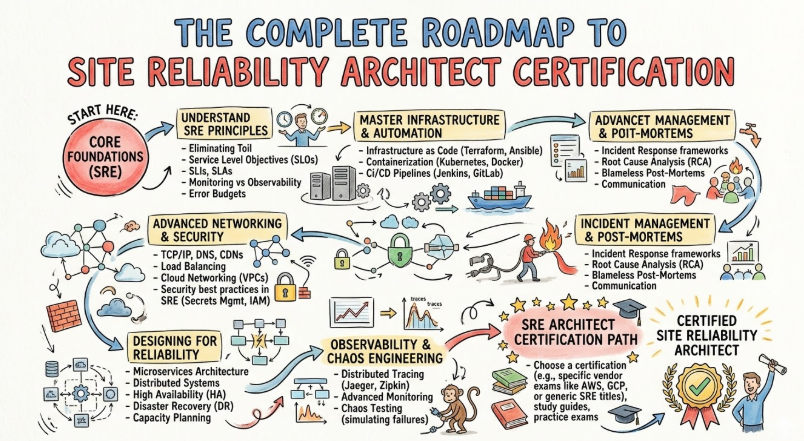
Introduction
Modern technology stacks demand more than just uptime; they require resilient, scalable, and self-healing architectures. The Certified Site Reliability Architect program is designed to bridge the gap between traditional operations and advanced software engineering. This guide is written for professionals who want to master the art of balancing feature velocity with system stability in a cloud-native world.
As engineering landscapes shift toward platform engineering and automated operations, understanding these principles is no longer optional. This guide provides a clear roadmap for engineers and managers to navigate the complexities of modern reliability. By exploring this path at SREschool, professionals can make informed decisions about their career trajectory and technical focus.
What is the Certified Site Reliability Architect?
The Certified Site Reliability Architect represents the pinnacle of reliability engineering expertise, focusing on the design and governance of large-scale distributed systems. Unlike certifications that focus purely on a single cloud provider’s tools, this program emphasizes universal architectural principles and production-readiness standards. It exists to validate an engineer’s ability to build systems that are not just functional, but inherently observable and resilient.
In the real world, theory often fails when traffic spikes or regional outages occur. This certification prioritizes production-focused learning, teaching engineers how to implement Error Budgets, Service Level Objectives, and automated incident response. It aligns with modern enterprise practices where the “you build it, you run it” philosophy requires a deep understanding of both code and infrastructure.
Who Should Pursue Certified Site Reliability Architect?
This certification is tailored for mid-to-senior level professionals who are responsible for the health of production environments. Software engineers looking to move into platform roles and DevOps practitioners seeking to formalize their reliability skills will find immense value here. Cloud architects and security professionals also benefit by learning how to bake reliability into the initial design phase of a project.
Even for engineering managers and technical leaders, this path offers the vocabulary and framework needed to manage high-performing SRE teams. In regions like India, where the tech sector is rapidly moving toward high-scale product engineering, these skills are in high demand. Whether you are a beginner looking for a structured path or a veteran wanting to validate your experience, this architectural focus provides a clear direction.
Why Certified Site Reliability Architect is Valuable Today and Beyond
The demand for reliability expertise is skyrocketing as every business becomes a software business. Enterprise adoption of microservices and Kubernetes has increased system complexity, making the role of an architect more critical than ever. This certification provides a longevity that transcends specific tool cycles, focusing on the mindset and methodology of reliability.
Investing time in this program offers a significant return on career investment by positioning you as a high-value asset in any organization. It helps professionals stay relevant even as AI and automation change how we manage infrastructure. By mastering architectural reliability, you move from being a “firefighter” to an engineer who builds systems that rarely catch fire in the first place.
Certified Site Reliability Architect Certification Overview
The program is delivered via sreschool.com and hosted on SREschool.com. It is structured as a comprehensive journey that moves from foundational principles to advanced architectural patterns. The assessment approach is practical, often involving case studies and real-world scenarios rather than simple rote memorization of facts.
Ownership of the learning process remains with the candidate, while the platform provides the necessary resources and structure to succeed. The certification levels are designed to reflect the natural progression of an engineer’s career, ensuring that each step adds tangible value. By focusing on vendor-neutral practices, the program ensures that the skills learned are applicable across AWS, Azure, Google Cloud, or on-premises environments.
Certified Site Reliability Architect Certification Tracks & Levels
The certification is divided into Foundation, Professional, and Advanced levels to cater to different stages of professional growth. The Foundation level introduces core SRE terminology and the cultural shifts required for success. Professional levels dive deeper into implementation details, while the Advanced level focuses on global-scale architecture and organizational leadership.
Specialization tracks allow professionals to align their certification with their specific domain, such as DevOps, FinOps, or Security. This tiered approach ensures that a professional can demonstrate continuous improvement and deepening expertise over time. It provides a clear roadmap for career progression, helping engineers move from individual contributors to strategic architectural roles.
Complete Certified Site Reliability Architect Certification Table
| Track | Level | Who it’s for | Prerequisites | Skills Covered | Recommended Order |
| Core SRE | Foundation | Beginners/Associates | Basic Linux/Cloud | SLIs, SLOs, Error Budgets | 1 |
| Engineering | Professional | SREs/DevOps | Foundation Level | Automation, Observability | 2 |
| Architecture | Advanced | Senior Architects | Professional Level | Distributed Systems, Scalability | 3 |
| Operations | Professional | Cloud Engineers | Foundation Level | Incident Management, On-call | 2 |
| Governance | Advanced | Managers/Leads | Core Experience | Reliability Economics, Culture | 3 |
Detailed Guide for Each Certified Site Reliability Architect Certification
What it is
This certification validates a candidate’s understanding of the core principles that define Site Reliability Engineering. It ensures the professional speaks the language of SRE and understands how to balance reliability with the speed of software delivery.
Who should take it
It is ideal for software engineers, junior SREs, and IT managers who need to understand the cultural and technical foundations of the SRE movement. It is also suitable for students or career changers entering the DevOps space.
Skills you’ll gain
- Defining and measuring Service Level Indicators (SLIs).
- Establishing meaningful Service Level Objectives (SLOs).
- Managing Error Budgets to balance risk and innovation.
- Understanding the reduction of “Toil” through automation.
- Basic principles of observability and monitoring.
Real-world projects you should be able to do
- Create an SRE roadmap for a small-to-medium application.
- Draft an Error Budget policy for a development team.
- Identify and document repetitive manual tasks (Toil) in a workflow.
- Set up basic health checks and alerts based on user-centric metrics.
Preparation plan
- 7–14 days: Intensive study of the SRE Book principles and core terminology definitions.
- 30 days: Reviewing case studies, participating in community forums, and practicing metric definitions.
- 60 days: Deep dive into implementation strategies and taking multiple mock assessments to ensure readiness.
Common mistakes
- Focusing too much on specific tools rather than the underlying principles.
- Underestimating the cultural and organizational change aspect of SRE.
- Confusing standard monitoring with true observability.
Best next certification after this
- Same-track option: Certified Site Reliability Engineer – Professional.
- Cross-track option: Certified DevSecOps Professional.
- Leadership option: Engineering Management Certification.
Choose Your Learning Path
DevOps Path
This path focuses on integrating reliability into the CI/CD pipeline and the developer experience. It emphasizes the “Shift Left” philosophy, ensuring that reliability is considered during the coding phase rather than as an afterthought. Engineers on this path will learn how to automate the deployment of resilient infrastructure and manage configuration at scale.
DevSecOps Path
The DevSecOps path layers security onto the foundation of reliability, treating security vulnerabilities as a form of system unreliability. It focuses on automated security scanning, identity management, and compliance as code. This path is essential for engineers working in regulated industries who must maintain high uptime while ensuring data integrity.
SRE Path
This is the “pure” reliability path, focusing deeply on the operational health of production systems. It covers advanced topics like chaos engineering, complex incident response, and capacity planning. Professionals here are the guardians of the production environment, specializing in making systems robust against unpredictable failures.
AIOps Path
AIOps focuses on using machine learning and data science to improve system operations and incident management. It teaches engineers how to handle the massive volumes of telemetry data generated by modern systems. This path is ideal for those looking to automate root cause analysis and predictive maintenance.
MLOps Path
The MLOps path addresses the unique reliability challenges of deploying and maintaining machine learning models in production. It covers model versioning, data drift monitoring, and the scalability of inference engines. This is a critical path for data engineers and ML practitioners who need to ensure their models perform reliably under load.
DataOps Path
DataOps focuses on the reliability of data pipelines and the quality of data flowing through an organization. It applies SRE principles to data engineering, ensuring that data is available, accurate, and delivered on time. This path is vital for organizations that rely on real-time analytics for decision-making.
FinOps Path
The FinOps path blends reliability engineering with financial accountability in the cloud. It teaches engineers how to optimize cloud spend without sacrificing performance or stability. Professionals on this path learn to treat cloud costs as a technical metric, similar to latency or throughput.
Role → Recommended Certified Site Reliability Architect Certifications
| Role | Recommended Certifications |
| DevOps Engineer | SRE Foundation, DevSecOps Professional |
| SRE | SRE Foundation, SRE Professional, SRE Architect |
| Platform Engineer | SRE Foundation, Cloud Architecture tracks |
| Cloud Engineer | SRE Foundation, Infrastructure as Code specialist |
| Security Engineer | SRE Foundation, DevSecOps Professional |
| Data Engineer | SRE Foundation, DataOps Specialist |
| FinOps Practitioner | SRE Foundation, FinOps Professional |
| Engineering Manager | SRE Foundation, Leadership and Culture tracks |
Next Certifications to Take After Certified Site Reliability Architect
Same Track Progression
After achieving the Architect level, professionals should focus on deep specialization in specific domains like advanced Kubernetes orchestration or global traffic management. Continuing education in this track involves staying updated with the latest research in distributed systems. This ensures that the architect remains at the cutting edge of high-scale system design.
Cross-Track Expansion
Expanding into related fields like Security or Data Management can make a Reliability Architect even more versatile. Understanding the security implications of architectural decisions allows for more holistic system design. Cross-training in DataOps ensures that the backend systems and the data they process are equally reliable.
Leadership & Management Track
For those looking to move into people management, certifications in engineering leadership and strategic planning are the logical next steps. This transition involves moving from managing systems to managing the teams that build and operate them. Understanding the business value of SRE is key to succeeding as a CTO or VP of Engineering.
Training & Certification Support Providers for Certified Site Reliability Architect
DevOpsSchool
DevOpsSchool provides a robust ecosystem for professionals looking to master SRE and DevOps methodologies. Their training approach combines deep theoretical knowledge with extensive practical lab sessions that simulate real-world production environments. They offer a variety of formats, including live instructor-led sessions and self-paced learning, making it accessible for working professionals. The instructors are industry veterans who bring years of hands-on experience to the classroom, ensuring that students learn more than just the basics. Their curriculum is constantly updated to reflect the latest trends and toolsets in the industry. This provider is particularly well-regarded for its community support and post-training assistance, helping students transition their skills into their daily work.
Cotocus
Cotocus is a leading provider of specialized technical training, focusing on high-end technologies like SRE, Cloud, and Automation. They are known for their customized corporate training programs that help organizations upskill their entire engineering teams simultaneously. Their methodology focuses on “learning by doing,” with a heavy emphasis on architectural design and problem-solving. Cotocus provides a mentored learning environment where candidates can get their doubts resolved by experts in real-time. Their course materials are comprehensive, covering everything from foundational concepts to advanced production strategies. They have a strong reputation for helping candidates prepare for rigorous certification exams through targeted mock tests and review sessions. This provider is a great choice for those seeking a structured and intensive learning experience.
Scmgalaxy
Scmgalaxy has been a cornerstone of the DevOps and SRE community for years, providing a wealth of resources for self-driven learners. They offer a mix of free and premium content, including tutorials, blogs, and structured certification courses. Their approach is very practitioner-oriented, focusing on the tools and workflows that engineers use every day in production. Scmgalaxy excels at breaking down complex architectural concepts into manageable, easy-to-understand lessons. They also host a vibrant community forum where professionals can share experiences and seek advice on technical challenges. For anyone looking for a provider that stays deeply connected to the pulse of the engineering community, this is an excellent resource. Their training programs are designed to be practical and immediate, focusing on the skills that have the most impact.
BestDevOps
BestDevOps focuses on providing premium training content that is specifically designed for the modern cloud-native landscape. Their courses are curated by top-tier architects who understand what it takes to run systems at global scale. They prioritize quality over quantity, ensuring that every module adds significant value to the learner’s career. Their platform is user-friendly and offers a seamless learning experience across different devices. BestDevOps is known for its focus on the “architectural mindset,” teaching students how to think about systems holistically rather than just focusing on individual components. They provide excellent support for certification preparation, including detailed study guides and strategy sessions. This provider is ideal for professionals who want a high-quality, streamlined path to achieving their certification goals.
devsecopsschool.com
DevSecOpsSchool is the primary destination for engineers who want to integrate security deeply into their reliability practices. They recognize that in the modern era, security and reliability are two sides of the same coin. Their training covers a wide range of topics, including automated security testing, container security, and compliance as code. The curriculum is designed to help SREs and DevOps engineers become security-aware, and for security professionals to become more engineering-focused. They use a hands-on approach with real-world scenarios to teach how to build secure, resilient delivery pipelines. Their certifications are highly respected in the industry for their focus on practical, actionable security skills. This provider is essential for anyone looking to specialize in the intersection of security and operations.
sreschool.com
SREschool.com is a dedicated platform focusing exclusively on the discipline of Site Reliability Engineering. By concentrating on this single niche, they provide a depth of knowledge that is hard to find elsewhere. Their courses are built around the core pillars of SRE as defined by industry leaders, covering everything from SLIs and SLOs to chaos engineering. The platform offers a clear, tiered certification path that helps engineers track their progress from foundation to architect levels. They provide access to high-quality labs and simulations that allow students to practice incident response and system design in a safe environment. SREschool.com is the go-to resource for anyone serious about making SRE their primary career focus. Their content is authoritative, vendor-neutral, and deeply rooted in production reality.
aiopsschool.com
AIOpsSchool addresses the growing need for intelligence and automation in system operations. As systems become too complex for humans to manage alone, this provider teaches how to leverage AI and machine learning to maintain reliability. Their courses cover data collection, anomaly detection, and automated root cause analysis. They bridge the gap between data science and systems engineering, making AI accessible to operational professionals. The training is focused on practical applications, showing how AIOps tools can reduce noise and improve incident response times. For architects looking to future-proof their careers, AIOpsSchool provides the necessary skills to manage the next generation of autonomous systems. Their certifications validate an engineer’s ability to handle the scale and complexity of modern data-driven infrastructure.
dataopsschool.com
DataOpsSchool is dedicated to the emerging field of data reliability and pipeline engineering. They apply the principles of SRE to the world of big data, focusing on ensuring the continuous delivery of high-quality data. Their curriculum covers data versioning, automated testing of data pipelines, and monitoring data health. They help data engineers and architects build systems that are as resilient as the software applications they support. The training emphasizes collaboration between data producers and consumers, reducing the friction in data delivery. As organizations become increasingly data-dependent, the skills taught here are becoming vital for maintaining business continuity. DataOpsSchool provides the frameworks and tools needed to treat data as a first-class citizen in the reliability ecosystem.
finopsschool.com
FinOpsSchool focuses on the critical intersection of cloud architecture and financial management. In a world where cloud costs can spiral out of control, they teach engineers how to build cost-effective and reliable systems. Their training covers cloud billing mechanics, cost allocation, and optimization strategies that don’t compromise on performance. They promote a culture of financial accountability among engineering teams, helping them understand the business impact of their architectural choices. The certifications from FinOpsSchool are valuable for anyone responsible for cloud budgets or large-scale infrastructure. They provide a practical roadmap for implementing FinOps practices within any organization. This provider is the leader in helping engineers balance the technical requirements of reliability with the economic realities of the cloud.
Frequently Asked Questions (General)
- What is the typical difficulty level of these certifications?
The difficulty ranges from moderate for Foundation levels to very challenging for Architect levels. They are designed to test real understanding rather than just memory. - How long does it take to prepare for an SRE certification?
A Foundation level can take 2-4 weeks, while the Architect level may require 3-6 months of dedicated study and practical experience. - Are there any mandatory prerequisites?
While Foundation levels are open to all, higher levels usually require passing the previous level or demonstrating equivalent industry experience. - What is the return on investment for these certifications?
Professionals often see significant salary increases and access to more senior roles in high-growth companies and major enterprises. - Is there a specific order I should follow?
Yes, it is highly recommended to start with the Foundation level to build a solid vocabulary before moving to Professional or Architect tracks. - Do these certifications expire?
Most certifications in this field are valid for two to three years, after which recertification or continuing education is required to stay current. - Are the exams multiple-choice or practical?
Most exams use a combination of scenario-based multiple-choice questions and practical case study evaluations to test applied knowledge. - Can I take the training and exams online?
Yes, all the mentioned providers offer online learning platforms and remote proctored exams for global accessibility. - How do these certifications compare to cloud-specific ones?
These are vendor-neutral and focus on architectural principles that apply across all clouds, making them more versatile than provider-specific certs. - Is coding knowledge required for SRE certifications?
Yes, a basic to intermediate understanding of coding (Python, Go, or Bash) is essential as automation is a core pillar of SRE. - Do these certifications help in getting a job in India?
Absolutely, the Indian tech market has a massive demand for SREs and architects, and these certs provide a significant advantage during hiring. - Are there community groups for candidates?
Yes, most providers host dedicated forums or Slack channels where candidates can collaborate and share study resources.
FAQs on Certified Site Reliability Architect
- What makes the Architect level different from the Professional level?
The Architect level focuses on system-wide design, governance, and long-term strategy, whereas the Professional level focuses on implementation and execution. - Do I need to be a manager to become a Certified Site Reliability Architect?
No, it is a technical leadership role. While it involves strategy, it remains deeply rooted in engineering and architectural design. - How does this certification address multi-cloud environments?
It teaches universal patterns for resilience and observability that are designed to work across multiple cloud providers and hybrid setups. - Is Chaos Engineering covered in the Architect track?
Yes, it is a key component, focusing on how to design experiments that validate the resilience of complex, distributed architectures. - What is the focus on Error Budgets at this level?
At the Architect level, the focus shifts to how Error Budgets are negotiated between business stakeholders and engineering teams at scale. - How does this certification handle legacy systems?
It provides frameworks for applying SRE principles to monolithic and legacy systems to gradually improve their reliability and observability. - Is there a focus on incident management for architects?
Yes, but from a structural perspective—designing the processes and systems that make incident response faster and more effective. - How relevant is this for a small startup?
While designed for scale, the principles of building reliable systems from day one are vital for startups to prevent technical debt from slowing them down.
Final Thoughts: Is Certified Site Reliability Architect Worth It?
If you are looking for a way to distinguish yourself in a crowded market, focusing on architectural reliability is one of the smartest moves you can make. The industry is moving away from manual operations toward automated, self-healing systems, and those who can design these systems will always be in demand. This certification isn’t just a badge; it’s a rigorous process that changes how you think about software and infrastructure.
As a mentor, my advice is simple: don’t chase the certificate for the sake of the paper. Chase the knowledge and the mindset. The true value lies in your ability to go back to your team and build systems that are significantly more stable and easier to manage. If you are committed to the path of engineering excellence, the Certified Site Reliability Architect is an investment that will pay dividends throughout your entire career.