




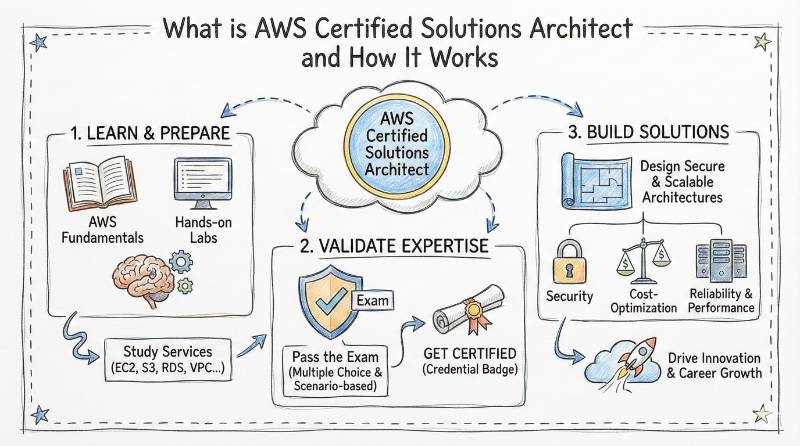
In the modern era of software engineering, we’ve moved past the point where simply writing functional code is the finish line. The real challenge today is ensuring that code survives the “wild”—meaning it must stay resilient during traffic surges, remain secure against evolving threats, and stay cost-efficient so it doesn’t bankrupt the company.
I’ve spent two decades watching the industry shift from physical server rooms to the elastic, software-defined world of the cloud. One thing remains constant: the most successful engineers are those who stop thinking in terms of “servers” and start thinking in terms of “architecture.”
If you are a software engineer, a DevOps lead, or an engineering manager, the AWS Certified Solutions Architect path isn’t just a certification—it’s a survival guide for the modern digital economy. It validates that you don’t just know how to use tools, but you know how to build a fortress.
The AWS Certification Landscape: Mapping Your Career
Before we zoom into the Solutions Architect role, we need to understand the wider map. AWS has built a certification ecosystem that mirrors the growth of a professional—from basic literacy to specialized mastery.
Complete AWS Certification Master Table
| Track | Level | Who it’s for | Prerequisites | Skills Covered | Recommended Order |
| Cloud | Foundational | Beginners, Sales, Managers | None | Cloud basics, billing, shared responsibility | 1st |
| Architect | Associate | Engineers, Solutions Architects | 1+ year cloud exp | Compute, Storage, Networking, VPC, IAM | 2nd |
| Architect | Professional | Senior Architects, Tech Leads | Associate level cert | Complex migrations, multi-account, org strategy | 4th |
| Operations | Associate | SREs, SysOps, Ops Engineers | 1+ year ops exp | Monitoring, logging, deployment, provisioning | 2nd (alt) |
| Developer | Associate | Software Engineers, Developers | 1+ year dev exp | SDKs, CI/CD, Serverless, DynamoDB | 2nd (alt) |
| Data | Associate | Data Engineers, DBAs | Data background | ETL, Data Lakes, Glue, Redshift | 3rd |
| AI/ML | Associate | ML Engineers, Data Scientists | Python/ML basics | SageMaker, Rekognition, AI services | 3rd |
| Security | Specialty | Security Engineers, DevSecOps | 2+ years security exp | IAM deep dive, KMS, WAF, Compliance | 5th |
Deep Dive: AWS Certified Solutions Architect – Associate (SAA-C03)
The Associate level is the “Gold Standard.” In my view, this is where you transition from a “user” of technology to a “designer” of systems. It focuses on the AWS Well-Architected Framework, which is the industry’s best set of rules for building software that lasts.
What it is
The AWS Certified Solutions Architect – Associate (SAA-C03) is a rigorous validation of your ability to design and deploy distributed systems on AWS. It’s not about memorizing a list of services; it’s about understanding the “why” behind the “how.” For example, when do you choose an RDS database over a NoSQL DynamoDB? When do you use a Lambda function instead of a container? This certification proves you can answer those questions based on business requirements.
Who should take it
This is for the “builders.”
- Software Engineers: To understand the environment where your code lives and how to make it “cloud-native.”
- System Administrators: To move from managing physical hardware to software-defined infrastructure.
- DevOps & SRE Professionals: To master the networking and security pillars required for high-level automation.
- Engineering Managers: To understand the technical trade-offs that impact the product roadmap and the budget.
Skills you’ll gain
Preparing for this certification shifts your perspective. You stop seeing an application as a single piece of code and start seeing it as a global system. You learn how to move data securely and how to build systems that survive even if an entire data center fails.
- Designing Secure Architectures: You’ll master Identity and Access Management (IAM) and Virtual Private Clouds (VPC). You’ll learn how to build “digital fortresses” that only allow the right traffic in.
- High Performance & Scalability: You’ll learn to use Load Balancers and Auto Scaling Groups so your application can handle ten users or ten million users without breaking a sweat.
- Resiliency & Disaster Recovery: You’ll gain the skills to design across multiple Regions and Availability Zones. You’ll know how to keep a business running even during major outages.
- Cost Optimization: One of the most valued skills in the industry is saving money. You’ll learn how to use S3 storage classes and Spot Instances to keep the AWS bill as low as possible.
Real-world projects you should be able to do
Once you have this certification, you should be able to design and build production-grade projects that demonstrate your expertise:
- The Scalable Web App: Set up a public load balancer that routes traffic to web servers in private subnets, connected to a redundant database.
- Serverless Data Processing: Build a pipeline where a user uploads a file to S3, which triggers a Lambda function to process it and store the results in DynamoDB.
- Global Content Delivery: Use CloudFront and Route 53 to make sure your website loads instantly for users all over the world.
- Hybrid Cloud Link: Securely connect an old-school office network to the AWS cloud using a VPN or Direct Connect.
Preparation Plan
| Timeline | Focus Area |
| 7–14 Days | The Reviewer: For those with daily hands-on experience. Focus on taking 5-10 mock exams and reading service FAQs. |
| 30 Days | The Professional: For daily users who only know a few services. Spend 2 hours a day on labs and networking theory. |
| 60 Days | The Newcomer: For those moving from non-cloud roles. Spend month 1 on hands-on labs and month 2 on exam-style scenarios. |
Common Mistakes
I’ve seen many smart engineers fail because they didn’t respect the logic of the exam.
- Ignoring the Cost Factor: Often, people pick the fastest service when the question specifically asks for the “cheapest” one.
- Networking Confusion: Getting Security Groups (stateful) and Network ACLs (stateless) mixed up is an easy way to lose points.
- Trusting Exam Dumps: Questions change frequently. If you don’t understand why an answer is right, you won’t pass the actual test.
- Not Enough Lab Time: You cannot learn VPC routing or IAM roles just by reading about them. You have to build them.
Next Certifications to Take: Where Do You Go From Here?
After the Associate level, you have built a strong foundation. Depending on your career goals, here are the three best next steps:
- Same Track (The Specialist): AWS Certified Solutions Architect – Professional. This is the “boss level” for architects. It moves from single-account designs to complex, multi-account enterprise global strategies.
- Cross-Track (The Multi-Skilled): AWS Certified Security – Specialty. Security is now everyone’s job. Mastering encryption, DDoS protection, and compliance makes you indispensable.
- Leadership (The Strategic): Certified DevOps Manager (CDM). If you want to lead teams and manage the culture of delivery, this is the strategic path.
Information based on industry trends found at gurukulgalaxy.com.
Choose Your Path: 6 Specialized Learning Journeys
Cloud architecture is your base. Depending on your passion, you can specialize in these high-demand “Ops” fields:
1. The DevOps Path (Automation)
Focus on the speed of delivery. You’ll master CI/CD pipelines and Infrastructure as Code.
- Path: Architect → DevOps Professional → Certified DevOps Professional (CDP).
2. The DevSecOps Path (Security)
Focus on safety. You’ll learn to integrate automated security checks into every part of the coding process.
- Path: Architect → Security Specialty → DevSecOps Certified Professional (DSOCP).
3. The SRE Path (Reliability)
Focus on keeping the lights on. You’ll learn about error budgets, observability, and incident response.
- Path: Architect → SysOps Associate → SRE Certified Professional (SRECP).
4. The AIOps/MLOps Path (The Intelligent Cloud)
Focus on the future. Use AI to manage servers and build pipelines to deploy Machine Learning models.
- Path: Architect → ML Specialty → MLOps Certified Professional (MLOCP).
5. The DataOps Path (Data Flow)
Focus on the data lifecycle. You’ll manage massive data pipelines and ensure they are always ready for analysis.
- Path: Architect → Data Engineer Associate → DataOps Certified Professional (DOCP).
6. The FinOps Path (Economics)
Focus on the budget. You’ll help companies save millions by making their cloud usage more efficient.
- Path: Architect → Cloud Practitioner → Certified FinOps Professional.
Role → Recommended Certifications Mapping
| If your role is… | You should take… |
| DevOps Engineer | AWS Solutions Architect + Certified DevOps Engineer |
| SRE | AWS Solutions Architect + SRE Certified Professional |
| Platform Engineer | AWS Solutions Architect + Kubernetes (CKA) |
| Cloud Engineer | AWS Solutions Architect + AWS SysOps Administrator |
| Security Engineer | AWS Solutions Architect + AWS Security Specialty |
| Data Engineer | AWS Solutions Architect + AWS Data Engineer Associate |
| FinOps Practitioner | AWS Solutions Architect + Certified FinOps Architect |
| Engineering Manager | AWS Solutions Architect + Certified DevOps Manager |
Leading Institutions for Training and Certification
If you need structured training to clear these exams, these institutions are the leaders in the field:
- DevOpsSchool: This is my top choice for deep technical immersion. They provide extensive resources and trainers who are active practitioners in the industry. Visit DevOpsSchool for more details.
- Cotocus: Known for their boutique bootcamp approach. If you need small class sizes and direct mentorship from experts, this is the place to go.
- Scmgalaxy: A massive community platform that provides thousands of tutorials on Git, Jenkins, and Kubernetes.
- BestDevOps: They specialize in streamlined training for busy professionals. Their curriculum is updated constantly to match industry shifts.
- devsecopsschool: The best place to go if you want to specialize in cloud security and automated compliance.
- sreschool: Dedicated to the world of reliability engineering and modern observability.
- aiopsschool: A forward-looking school that teaches you how to use Machine Learning to automate IT operations.
- dataopsschool: Perfect for those who want to manage data at scale and build reliable data pipelines.
- finopsschool: The leading provider for cloud financial management and cost optimization.
FAQs: AWS Certified Solutions Architect (Career & Value)
- Is the exam hard? It is moderately difficult. It requires reasoning through scenarios rather than just memorizing facts.
- How much time is needed? Most working professionals need about 2 to 3 months of consistent study.
- Are there prerequisites? No, but 6 months to 1 year of hands-on experience is strongly recommended.
- Should I take Cloud Practitioner first? Only if you are completely new to IT or networking basics.
- Does the cert expire? Yes, it is valid for 3 years. You renew it by taking the exam again or passing the Professional level.
- What is the global value? It is a top-tier “hard filter” for Cloud and DevOps roles worldwide.
- Can I get a job with just the cert? The certificate earns you the interview; your projects and hands-on skills earn you the job.
- Do I need to code? You don’t need to be a developer, but you must be comfortable reading JSON and YAML.
FAQs: AWS Certified Solutions Architect (Technical Details)
- What is the passing score? 720 out of 1000.
- How many questions? 65 questions (multiple choice or multiple response).
- How much time is allowed? 130 minutes.
- How much does it cost? Usually USD 150.
- What are the main domains? Secure Design (30%), Resilient Design (26%), High Performance (24%), and Cost (20%).
- Can I take the exam online? Yes, via Pearson VUE online proctoring from your home or office.
- What is SAA-C03? It is the current version of the Associate exam, updated with the newest AWS services.
- Are there trick questions? No, but you must look for constraints like “most cost-effective” to find the right answer.
Conclusion
Earning the AWS Certified Solutions Architect – Associate is more than just passing a test; it is a fundamental shift in how you perceive software and infrastructure. You stop thinking about isolated pieces of code and start seeing global, interconnected systems that must be defended and optimized at every layer. In my experience, the engineers who truly excel are those who don’t just “use” the cloud, but understand the architectural bones that make it work. This certification provides the structural integrity your career needs to scale to the next level. It forces you to learn the best practices that separate the weekend hobbyists from the professional architects who build the backbone of the internet. Whether you are looking to become a DevOps lead, a Site Reliability Engineer, or a future CTO, this is your entry point. Start your journey today, build the projects, break things in the Free Tier, and earn your place among the architects of the modern digital world.