




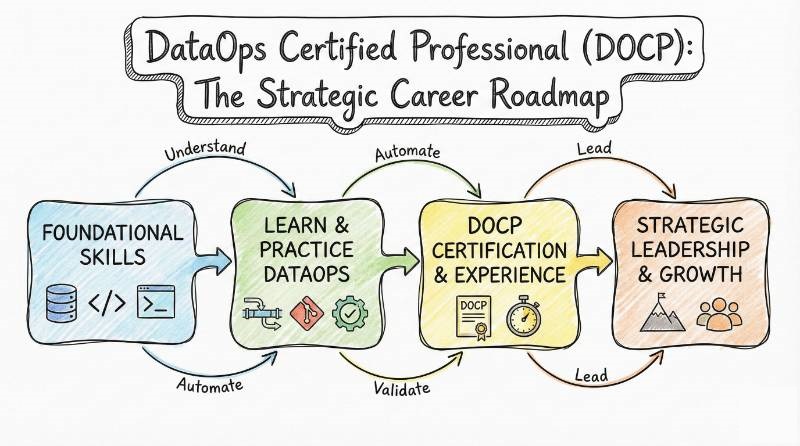
The technological landscape is moving at a breakneck pace, and nowhere is this more visible than in the realm of data management. In the past, data was often treated as a static resource that sat quietly in a warehouse until someone needed a report. However, today’s digital world demands that data flows constantly, much like a high-speed nervous system for the modern enterprise. Consequently, the old manual methods of data processing are failing, and a new discipline known as DataOps has arrived to save the day.
If you are a software engineer or a technical manager, you likely feel the pressure to deliver results faster without sacrificing the quality of your insights. This is precisely why the DataOps Certified Professional (DOCP) has become such a vital credential. By earning this certification, you prove that you have the skills to build automated, reliable, and secure data pipelines. This guide is designed to act as your mentor, walking you through every step of this career-defining journey.
Choose Your Path: 6 Specialized Career Tracks
Before we dive into the specifics of DataOps, it is important to understand how it sits within the broader engineering ecosystem. Depending on your interests and strengths, you might find yourself drawn to one of these six primary learning paths.
1. The DevOps Path
This is the fundamental track that started the automation revolution. It focuses on breaking down the barriers between software developers and IT operations teams. By prioritizing Continuous Integration and Continuous Deployment (CI/CD), this path ensures that software is delivered at high speed. Furthermore, it serves as the essential baseline for almost every other specialization in this list.
2. The DevSecOps Path
Security can no longer be a final “check-box” at the end of a project. Instead, this path teaches you how to integrate security measures directly into every phase of the development lifecycle. Specifically, you will learn to automate security testing and vulnerability scanning. Consequently, the final product is not only fast but also incredibly resilient to external threats.
3. The SRE (Site Reliability Engineering) Path
Site Reliability Engineering is a discipline that applies software engineering mindsets to operations problems. SREs are the guardians of uptime and scalability, ensuring that massive systems stay running even under heavy load. If you enjoy solving complex infrastructure puzzles and using code to automate systems management, this is a highly rewarding track.
4. The AIOps / MLOps Path
This path represents the future of intelligent automation. MLOps is specifically focused on the lifecycle of machine learning models, ensuring they move from a data scientist’s notebook to a production environment smoothly. Simultaneously, AIOps uses artificial intelligence to monitor IT environments and fix issues before they even happen. It is an ideal track for those fascinated by the intersection of data science and operations.
5. The DataOps Path
This is our primary focus for today. DataOps is essentially DevOps specifically tailored for data engineering. It focuses on the automated flow, quality, and governance of data throughout its entire lifecycle. By mastering this track, you bridge the gap between those who collect data and those who need it to make business decisions.
6. The FinOps Path
As more companies move to the cloud, managing costs has become a major challenge. FinOps practitioners bring financial accountability to the variable spend model of the cloud. They ensure that every dollar spent on cloud resources is optimized for maximum business value. This is a critical role for managers who want to align technical spending with corporate goals.
Role → Recommended Certifications Mapping
To help you decide which certification to pursue first, I have mapped out several common roles to their most logical certification path.
| Your Current Role | Recommended Certification Journey |
| DevOps Engineer | Certified DevOps Professional (CDP) |
| SRE / Systems Engineer | SRE Certified Professional (SREC) |
| Platform Engineer | Certified DevOps Architect (CDA) |
| Cloud Engineer | AWS or Azure Certified DevOps Master |
| Security Engineer | DevSecOps Certified Professional (DSOCP) |
| Data Engineer | DataOps Certified Professional (DOCP) |
| FinOps Practitioner | Certified FinOps Professional |
| Engineering Manager | Certified DevOps Manager (CDM) |
Complete Certification Master Table
The following table provides a high-level view of the top certifications available through DevOpsSchool and its associated training partners.
| Track | Level | Who it’s for | Prerequisites | Skills Covered | Order |
| DevOps | Foundation | Beginners | Basic Linux | Git, Docker, CI/CD | 1st |
| DevOps | Professional | Engineers | 2+ yrs Exp | Kubernetes, Terraform | 2nd |
| DataOps | Professional | Data Pros | SQL & Python | Airflow, Kafka, dbt | Specialist |
| SRE | Professional | Ops Experts | DevOps basics | Observability, SLAs | Advanced |
| DevSecOps | Professional | Security Pros | CI/CD basics | Vault, SonarQube | Advanced |
| MLOps | Professional | Data Scientists | Python, ML | Model CI/CD, MLFlow | Specialist |
| AIOps | Professional | SREs/Managers | Ops knowledge | ELK, Prometheus, AI | Specialist |
Deep Dive: DataOps Certified Professional (DOCP)
What it is
The DataOps Certified Professional (DOCP) is a practitioner-focused program that validates your technical mastery of data lifecycles. It confirms your ability to build, automate, and monitor complex data pipelines in modern, cloud-native environments.
Who should take it
This certification is perfect for Data Engineers, Database Administrators, and Software Developers who want to specialize in high-velocity data projects. Additionally, Technical Managers will find it highly beneficial for understanding how to lead and scale high-performing data teams.
Skills you’ll gain
- Workflow Orchestration: You will learn to use Apache Airflow to manage and schedule intricate data dependencies.
- Real-Time Data Processing: You will master the use of Apache Kafka for high-speed, real-time data ingestion.
- Automated Data Quality: You will implement automated testing to ensure that data is accurate and reliable before it reaches consumers.
- Infrastructure as Code: You will gain proficiency in deploying data environments using Docker, Kubernetes, and Terraform.
- Governance and Security: You will learn how to maintain data lineage and compliance in a highly regulated digital landscape.
Real-world projects you should be able to do
- Design and implement a fully automated ETL pipeline from a raw API source to a cloud data warehouse.
- Create a live observability dashboard that monitors pipeline health and alerts the team to failures.
- Build a scalable data lake architecture that supports both batch processing and real-time streaming.
- Implement a “Data-as-Code” versioning system for your organization’s data schemas.
The DOCP Preparation Plan
Depending on your current experience level, you can choose from these three structured timelines to get ready for your exam.
Option 1: The Accelerated Path (7–14 days)
If you are already working in a DevOps or Data Engineering role, this fast-track plan is ideal. First, dedicate several hours a day to mastering the specific syntax of Airflow and Kafka. Next, focus heavily on practice labs that simulate real-world pipeline failures. Ultimately, your goal is to quickly apply your existing automation knowledge to the unique challenges of the data world.
Option 2: The Deep Dive Path (30 days)
This is the most popular choice for working professionals who need to balance study with a full-time job. Start by spending the first two weeks focusing on data transformation and storage concepts. Moreover, use the final two weeks to master orchestration and monitoring. By building one small project every weekend, you will ensure the concepts are firmly rooted in your mind.
Option 3: The Mastery Roadmap (60 days)
If you are transitioning from a non-automated background or moving into a leadership role, choose this 60-day plan. In addition to the technical labs, you must spend significant time studying the DataOps Manifesto and governance frameworks. Furthermore, focus on understanding the “why” behind each tool. Consequently, you will be prepared not just for the exam, but to lead a transformation within your company.
Common Mistakes to Avoid
- Treating DataOps like regular DevOps: Data has “state” and “quality” issues that simple code deployments don’t have; don’t ignore them.
- Manual Overrides in Production: If you are still manually fixing data in a database, you aren’t practicing DataOps. Everything should be automated.
- Over-Engineering Pipelines: Do not build a complex real-time streaming system if a simple daily batch process meets the business requirement.
- Ignoring Observability: A pipeline is only good if you know it is working. Always build automated alerts and monitoring from the start.
What Comes After DOCP? Next Certifications
Once you have mastered the professional level, you should continue your education to stay ahead of the curve. Here are three recommended paths:
- Same Track (Advanced Mastery): Pursue the Certified DataOps Architect to learn how to design complex, enterprise-wide data strategies.
- Cross-Track (Broadening Expertise): Take the MLOps Certified Professional to bridge the gap between raw data pipelines and artificial intelligence.
- Leadership (Career Growth): Enroll in the Certified DevOps Manager (CDM) to learn how to lead high-performing teams and manage technical budgets effectively.
Top Institutions for Training and Certification Support
Choosing the right partner for your education is critical. These institutions are the world leaders in providing help for the DataOps Certified Professional (DOCP).
- DevOpsSchool: This is a globally recognized leader in technical training, offering immersive, tool-centric courses with lifetime access to resources. Their curriculum is heavily focused on hands-on labs and real-world project scenarios, making it the top choice for working professionals.
- Cotocus: Known for its boutique training approach, Cotocus provides high-quality lab environments that simulate complex enterprise challenges. Their instructors are industry veterans who focus on practical application over theoretical knowledge.
- Scmgalaxy: This is a massive, community-driven platform that provides thousands of tutorials and resources for DevOps and SCM professionals. They offer extensive support for students, including expert-led webinars and community forums.
- BestDevOps: If you are looking for an intensive bootcamp experience, BestDevOps is an excellent option. Their courses are designed to take an engineer from a beginner to an expert level in a very short amount of time.
- devsecopsschool: While their primary focus is security, they offer world-class integration modules for DataOps. They teach you how to build pipelines that are not only fast but also completely secure.
- sreschool: This school focuses on the reliability aspect of the pipeline. They are the go-to choice for learning how to make your DataOps systems self-healing and highly available.
- aiopsschool: As data and AI become inseparable, this institution helps you understand the intersection. They provide specialized training on using AI to monitor and optimize your data workflows.
- dataopsschool: A dedicated branch that focuses exclusively on the entire data lifecycle. Their curriculum is deep and covers everything from data governance to advanced pipeline orchestration.
- finopsschool: For those interested in the financial side of the cloud, this school is essential. They teach you how to maintain high-performance data systems while keeping cloud costs under strict control.
General Career & Sequence FAQs
- Is DataOps just a new name for Data Engineering?Not exactly. While Data Engineering is about building, DataOps is about the automation, quality, and speed of that entire process.
- How much coding is required for this?You don’t need to be a software architect, but a solid understanding of SQL and Python is highly recommended for success.
- How long is the certification valid?Most professional certifications in this field recommend a refresh every 2–3 years to stay updated with new tools and practices.
- Can a manager benefit from taking the DOCP?Absolutely. It helps managers understand the technical hurdles and resource needs of their teams, leading to better decision-making.
- Is there a specific order I should take these in?It is generally best to start with a “DevOps Foundation” before specializing in the “DataOps Professional” track.
- Will this certification help with a salary hike?Yes, DataOps is a high-demand niche; certified professionals often see significant increases in their market value.
- Do I need a high-end computer for the labs?No, most of the training is conducted in cloud-based lab environments, so a standard laptop with internet access is sufficient.
- Is the exam purely multiple-choice?Most programs include a mix of conceptual questions and practical, hands-on lab assessments to verify your technical skill.
- What is the DataOps Manifesto?It is a set of 18 guiding principles that prioritize things like “Value Data over Tools” and “Continuous Improvement” in data workflows.
- Can I pass this through self-study?It is possible, but structured training from an institution provides the lab environments and mentor support that are hard to find on your own.
- How does this relate to Big Data?DataOps provides the automated engine that makes big data usable. Without it, big data projects often become slow and unreliable.
- Is there a community for DOCP holders?Yes, institutions like Scmgalaxy and DevOpsSchool provide access to alumni networks for ongoing networking and job opportunities.
FAQs: DataOps Certified Professional (DOCP)
- What is the primary goal of the DOCP certification?The goal is to produce experts who can reduce the time it takes to deliver high-quality, reliable data to the business.
- Which specific tools are covered in the DOCP?You will primarily work with industry standards such as Apache Airflow, Apache Kafka, Docker, Kubernetes, and dbt.
- Is the DOCP certification recognized in India?Yes, it is highly respected in Indian tech hubs like Bangalore, Hyderabad, and Pune, as well as by global enterprises.
- How difficult is the DOCP certification exam?It is a professional-level exam, meaning it is challenging but very achievable with consistent study and hands-on practice.
- Does the course include Data Governance?Yes, a significant portion of the curriculum is dedicated to ensuring data security, privacy, and compliance throughout the pipeline.
- Can I take the exam online?Yes, most training providers offer remote proctored exams so you can get certified from your home or office.
- What job roles can I apply for after getting certified?Common roles include DataOps Engineer, Senior Data Pipeline Engineer, and Data Platform Architect.
- Does the course cover cloud-native architectures?Absolutely. The program focuses heavily on deploying and managing data pipelines across major cloud providers like AWS and Azure.
Conclusion
The era of manual, slow-moving data management is officially coming to a close. As organizations race to become “AI-first,” the demand for professionals who can build reliable and automated data foundations has reached an all-time high. The DataOps Certified Professional (DOCP) is more than just a credential; it is a commitment to a modern, high-quality way of working.
Whether you are an engineer looking to future-proof your career or a manager trying to bring order to your team’s data chaos, mastering DataOps is the single most strategic move you can make today.