




Introduction
Austria is consistently ranked among the best places to live in the world. With its stunning Alpine landscapes, world-class healthcare, safe cities, and a booming economy, it is no wonder why professionals from all over the globe are looking toward Central Europe for their next career move. If you are an IT professional, engineer, or healthcare specialist, Austria offers more than just a job; it offers a lifestyle defined by stability and growth.
However, moving to a new country can feel like navigating a maze. This is where the Austria PR Points Calculator becomes your most valuable asset. Before you pack your bags or resign from your current role, you need to understand where you stand in the eyes of Austrian immigration authorities.
This guide is designed to strip away the confusion. We are going to walk through the points-based system, explain how the Red-White-Red Card actually works, and provide you with a clear, actionable strategy to improve your eligibility. Whether you are a student transitioning into the workforce or a seasoned professional seeking a new challenge, this breakdown will help you plan your immigration journey with confidence.
What Is an Austria PR Points Calculator?
At its core, the Austria PR Points Calculator is a diagnostic tool. It acts as a mirror, reflecting your professional profile against the specific requirements set by the Austrian government.
Austria uses a points-based system to manage labor migration. Instead of a “first-come, first-served” approach, the government assesses candidates based on objective criteria that predict their success and contribution to the Austrian economy.
Why Does Austria Use This System?
The primary purpose is to fill labor shortages. When the local labor market cannot provide enough specialists in fields like engineering, software development, or nursing, Austria opens its doors to international talent. The calculator helps the government identify candidates who are most likely to integrate quickly and contribute effectively.
Is the Calculator the Same as the Visa?
No. This is a common misunderstanding. Using the calculator gives you an estimate of your eligibility score. It is a tool for your internal planning. The actual visa—the Red-White-Red Card—is a formal application process. Think of the calculator as your “mock exam” and the RWR Card application as the “final test.”
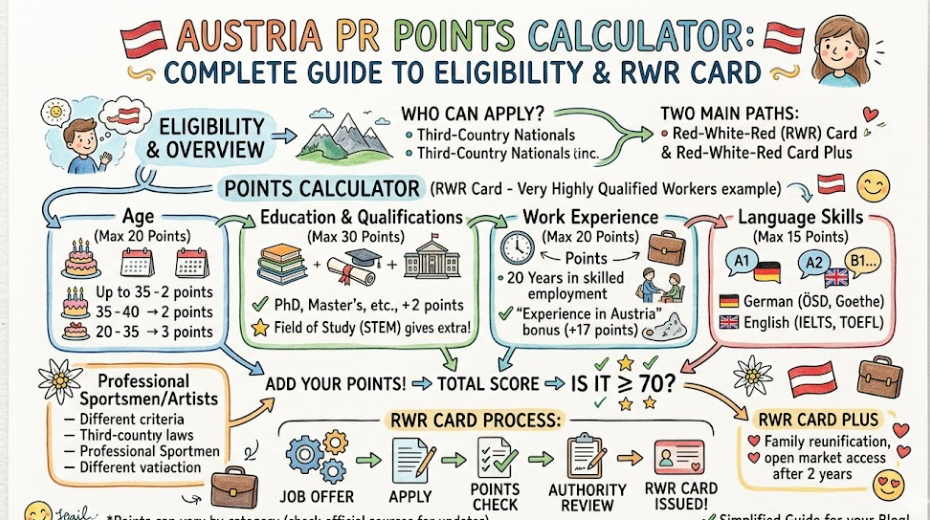
How Austria Immigration Points System Works
The points system is modular. You earn points in specific categories. To succeed, you generally need to meet a minimum threshold. Let’s break down the main pillars.
1. Age Points
Austria prioritizes a balanced demographic. Younger professionals, who are likely to remain in the workforce for a longer duration, often receive higher scores, though there is a sweet spot.
2. Education Points
Your academic background is a major differentiator.
- Bachelor’s Degree: A standard foundation for most skilled roles.
- Master’s Degree: Shows advanced specialization.
- PhD/Doctorate: Highly valued in research and academia.
- Relevant Degrees: Points are often weighted higher if your degree aligns directly with your intended occupation.
3. Language Skills
Communication is vital for integration.
- English: Crucial for international companies and IT sectors.
- German: A game-changer. Even basic German proficiency can significantly boost your score and your chances of a successful visa application.
4. Work Experience
Experience is not just about time; it is about relevance.
- Local Experience: Time spent working in the field.
- International Experience: Shows adaptability and global expertise.
- Shortage Occupation: If your experience is in a sector where Austria has a labor shortage, your points in this category are often multiplied or prioritized.
5. Salary & Job Offer
A binding job offer is the gold standard. It guarantees your employment and your contribution to the tax system. Your proposed salary relative to Austrian standards is also analyzed.
Austria Red-White-Red Card Explained
The Red-White-Red Card is not just one visa; it is a system of pathways. Depending on your background, you may fall into different categories.
Very Highly Qualified Workers
This is for the elite—individuals with top-tier academic qualifications and significant achievements. These applicants can often enter Austria to seek a job, provided they meet high point thresholds.
Skilled Workers in Shortage Occupations
This is the most common path for IT professionals and engineers. If your profession is on the official “shortage list,” you have a clearer pathway, provided you have a job offer that meets the minimum salary requirements.
Key Workers
For those who do not fall into the shortage category but have a high-value job offer from an Austrian employer.
Graduates from Austrian Universities
If you studied in Austria, you have a streamlined path to convert your student status into a work permit.
Austria PR Points Calculator Breakdown
To get a clear picture of your standing, look at how the points are generally distributed across the critical factors.
| Factor | Description | Weight |
| Age | Points awarded based on age brackets. | Moderate |
| Education | Based on university degrees and training. | High |
| Language Skills | German and English proficiency levels. | High |
| Work Experience | Years of experience in the relevant field. | High |
| Job Offer | Valid contract in a skilled field. | Critical |
Note: The exact point values can shift based on government policy changes, which is why using an updated Austria PR points calculator is vital before applying.
Step-by-Step Example of Austria PR Score Calculation
Let’s look at three hypothetical profiles to illustrate how these scores are calculated.
Example 1: Software Engineer
- Age: 30
- Education: Bachelor’s in Computer Science
- Work Experience: 5 years in backend development
- Language: B2 English, A2 German
- Outcome: Highly likely to qualify. The shortage of IT specialists makes this profile very attractive.
Example 2: Nurse/Healthcare Worker
- Age: 35
- Education: Bachelor’s in Nursing
- Work Experience: 7 years in clinical settings
- Language: B2 German (Crucial for patient interaction)
- Outcome: Strong eligibility. Healthcare professionals are in high demand across the country.
Example 3: Recent Graduate
- Education: Master’s from an Austrian University
- Experience: Internship during studies
- Language: Fluent German and English
- Outcome: Strong path. Graduates from Austrian universities often benefit from easier transition rules.
Austria PR Eligibility Requirements
To qualify, you need more than just points. You must meet the administrative floor.
- Educational Qualifications: Must be recognized by the Austrian recognition agency (ENIC NARIC).
- Job Contract: A formal offer from a company based in Austria.
- Salary Threshold: Your salary must meet the minimum level for the specific RWR category.
- Proof of Funds: You must demonstrate that you can support yourself during the initial transition.
- Health Insurance: Proof of comprehensive health insurance cover.
Benefits of Using an Austria PR Points Calculator
- Fast Diagnostics: Get an instant check of your eligibility.
- Strategic Planning: If you are short on points, you know exactly where to improve (e.g., taking a German course).
- Reduced Risk: Avoid the emotional and financial cost of rejected applications.
- Clarity: It demystifies the bureaucratic language of immigration.
Step-by-Step Guide to Calculate Austria PR Points
- Gather Documents: Collect your degree certificates and employment letters.
- Verify Degrees: Ensure your education is recognized.
- Language Test: Obtain an official certificate (e.g., IELTS, Goethe-Zertifikat).
- Calculate Experience: List your years of relevant work.
- Use the Calculator: Input your data into a reliable Austria PR points calculator.
- Analyze the Results: Identify if you meet the minimum requirement.
How to Increase Austria PR Score
If your score is currently below the threshold, do not lose heart. Immigration is a long game.
- Learn German: This is the single biggest factor for most applicants. Moving from A1 to B1 level can add valuable points.
- Gain Experience: Keep working in your field. Every year of relevant experience adds to your score.
- Upskill: Obtain professional certifications relevant to your industry.
- Secure a Job: A firm job offer from an Austrian employer acts as a significant multiplier.
Common Mistakes to Avoid
- Ignoring Language Requirements: Assuming English is enough.
- Underestimating Document Verification: Ensure your academic papers are translated and apostilled.
- Choosing the Wrong Stream: Misclassifying yourself can lead to immediate rejection.
- Outdated Information: Always rely on the latest government guidelines.
Real-Life Case Studies
1. The IT Professional
A developer had excellent skills but a low score due to lack of German. By taking an intensive 6-month German course, they raised their language score and became eligible for the shortage occupation list.
2. The Married Couple
They calculated their scores separately. Realizing one partner had a much higher potential score, they focused their application on that partner as the primary applicant, ensuring a higher probability of success.
3. The Healthcare Specialist
Initially rejected due to a lack of recognized credentials. They spent time getting their qualifications officially recognized by Austrian authorities and subsequently gained approval.
FAQs
1. What is the Austria PR points calculator?
It is a tool used to estimate your eligibility for the Red-White-Red Card based on factors like age, education, and language skills.
2. How many points are needed for Austria PR?
The threshold varies based on the specific visa category (e.g., Very Highly Qualified vs. Skilled Worker). Always check the current requirements.
3. What is the Red-White-Red Card?
It is the standard residence and work permit for skilled workers from non-EU countries in Austria.
4. Is German language mandatory?
While not mandatory for all categories, it is highly recommended and often provides a significant boost to your points.
5. Can I move to Austria without a job offer?
Some categories, like “Very Highly Qualified Workers,” allow for a job-seeker visa, but the requirements are very high.
6. Does age affect eligibility?
Yes, age is a factor in the point calculation.
7. Can students settle permanently in Austria?
Yes, graduates from Austrian universities have a streamlined path to work permits.
8. How accurate are online calculators?
They are accurate for self-assessment, but they are not official government decisions.
9. What is a “shortage occupation”?
A role where Austria has a high demand for labor, such as IT, Engineering, or Healthcare.
10. How long does the process take?
Processing times vary based on the consulate and the specific application volume.
11. Do I need a lawyer?
Not necessarily, if your case is straightforward, but professional guidance can help for complex situations.
12. Can I bring my family?
Yes, the Red-White-Red Card generally allows for family reunification.
Conclusion
The path to living in Austria is clear, provided you are prepared. By using the Austria PR points calculator, you are taking the first step toward a structured and strategic immigration plan. Remember, the points system is not a hurdle; it is a roadmap. Focus on improving your language skills, gaining relevant experience, and ensuring your documentation is perfect. Your future in Austria starts with the preparation you do today.