




Introduction
In modern software development, the pressure to deliver features faster and deploy updates continuously has never been higher, yet many organizations find their release cycles sluggish despite adopting cloud-native tools. These bottlenecks rarely stem from poor coding; rather, they result from isolated team silos, manual approval gates, and a lack of end-to-end workflow visibility. Value Stream Mapping (VSM) solves this by visualizing every step required to deliver software, measuring elapsed times, and pinpointing precisely where waste occurs. By combining Lean principles with modern DevOps practices, teams can transition from reactive release cycles to streamlined, predictable value delivery. For organizations looking to master these concepts and scale engineering efficiency, structured training programs provided by DevOpsSchool offer hands-on guidance on implementing Lean workflows and continuous improvement models.
What Is Value Stream Mapping?
Value Stream Mapping is a Lean management method used to visualize, analyze, and improve the steps required to deliver a product or service to a customer. Originating from manufacturing process improvement frameworks, VSM focuses on tracking two main elements across an entire workflow:
- Process Time: The actual time spent working on a task to add value.
- Lead Time: The total elapsed time it takes for work to travel all the way from the initial request to final delivery to the end user.
Unlike traditional process mapping, which often simply documents who does what in an organization, Value Stream Mapping specifically highlights the delays, waiting times, handoffs, and inventory build-ups that slow down production. It provides a holistic, end-to-end view of operations so that teams can focus on optimizing the entire system rather than just isolated departments.
What Is Value Stream Mapping in DevOps?
When applied to software engineering, Value Stream Mapping takes the core concepts of Lean and adapts them to the software delivery lifecycle (SDLC). Value Stream Mapping in DevOps is the practice of visualizing and analyzing the entire journey of code, features, and fixes from the moment an idea is conceived in a backlog to the moment it is deployed and running in a production environment.
Software delivery is unique because digital products are intangible. Code moves through code repositories, CI/CD pipelines, automated tests, security scans, and staging environments. Without a map, it is easy for work to get lost in transit or stalled by manual verification steps. VSM helps DevOps teams trace this digital journey step-by-step, identifying where code gets blocked, where manual interventions slow things down, and where automation can replace human toil.
By mapping the DevOps workflow, teams can align development, quality assurance, security, and operations around a single source of truth, improving cross-functional collaboration and eliminating communication gaps.
Why DevOps Teams Need Value Stream Mapping
Many DevOps teams adopt automation tools like Jenkins, Docker, and Kubernetes, expecting immediate speed gains. However, if an underlying process is broken or inefficient, automation simply helps bad processes happen faster. Value Stream Mapping gives DevOps teams the deep visibility they need to solve systemic issues:
- Finding Bottlenecks: VSM pinpoints exact stages—such as manual security audits or environment provisioning—that cause work to pile up.
- Reducing Unnecessary Steps: Teams can identify redundant approvals, duplicate testing phases, and bureaucratic paperwork that add zero value to the customer.
- Improving Deployment Speed: By reducing lead times and wait states, code moves from commit to production much faster.
- Increasing Transparency: A shared map ensures that developers, testers, and operations engineers all understand the constraints and realities of the delivery pipeline.
- Improving Customer Value Delivery: Faster feedback loops and shorter release cycles mean that customer needs and feature requests are addressed in days rather than months.
Relationship Between Lean Principles and DevOps
DevOps shares its foundational philosophy with Lean manufacturing and Agile software development. Both disciplines share a common goal: maximizing customer value while minimizing waste, delays, and resource consumption.
| Lean Principle | DevOps Implementation |
| Eliminating Waste | Removing manual handoffs, unused code, and idle waiting times in CI/CD pipelines. |
| Building Quality in | Integrating automated unit tests, static code analysis, and security scans early in the pipeline. |
| Creating Flow | Ensuring code moves smoothly through build, test, and deployment stages without blockages. |
| Pull Systems | Triggering deployments and infrastructure provisioning based on actual demand rather than batch pushes. |
| Continuous Improvement | Regularly reviewing metrics, conducting retrospectives, and optimizing workflows based on data. |
Components of a DevOps Value Stream
A typical DevOps value stream consists of several interconnected stages. Understanding each stage helps teams identify where inefficiencies typically hide.
| Stage | Activities | Common Challenges |
| Planning | Creating user stories, prioritizing backlogs, defining feature scopes. | Vague requirements, shifting priorities, poor stakeholder alignment. |
| Development | Writing code, local testing, committing changes to version control. | Complex codebase, lack of local test environments, merge conflicts. |
| Testing | Running unit tests, integration tests, and regression tests. | Slow test execution, flaky tests, reliance on manual testing. |
| Security | Performing vulnerability scans, license checks, and compliance audits. | Late-stage security reviews, manual approvals, rigid gatekeeping. |
| Deployment | Provisioning infrastructure, releasing code to staging and production. | Manual deployments, configuration drift, fear of deployment failures. |
| Monitoring | Tracking application performance, system health, and error logs. | Siloed monitoring tools, high alert noise, lack of observability. |
| Feedback | Gathering user analytics, incident reports, and team retrospectives. | Slow feedback loops, ignored user insights, lack of post-mortem reviews. |
Understanding Current State Value Stream Mapping
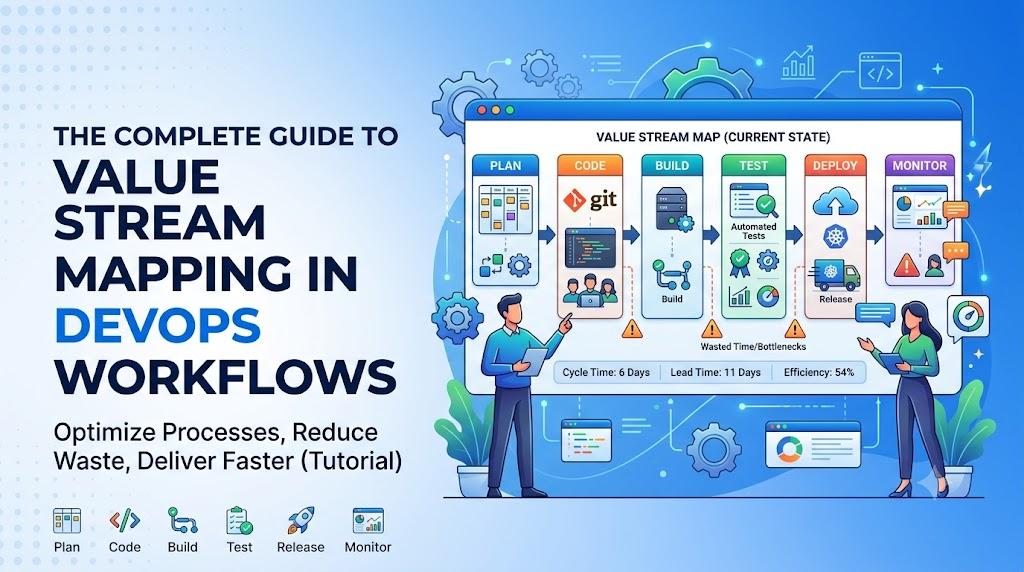
Before you can improve your software delivery process, you must understand how work is actually done today—not how documentation says it is done. Current State Value Stream Mapping involves gathering the team and walking through the existing workflow step by step to capture the reality of your releases.
During this exercise, teams document every handoff, waiting period, and manual intervention. Common issues uncovered during current state mapping include:
- Waiting Time: Code sitting idle in a review queue or staging environment waiting for manual action.
- Handoffs: Passing work between siloed teams (such as developers handing off code to a dedicated release management team), which frequently leads to context loss and misunderstandings.
- Manual Approvals: Waiting for change advisory board (CAB) meetings or manager sign-offs before pushing code to production.
- Rework: Bugs found late in the testing or security phase that require developers to rewrite code and restart the pipeline.
- Deployment Delays: Complex, error-prone release procedures that require weekend maintenance windows and manual intervention.
Understanding Future State Value Stream Mapping
Once the current state is mapped and bottlenecks are clearly identified, the next step is designing a Future State Value Stream Map. The future state represents an optimized, highly efficient workflow that removes waste, increases automation, and streamlines the flow of value to the customer.
Designing a future state involves asking critical engineering questions:
- Can we replace this manual approval gate with automated policy checks?
- How can we shift security testing earlier in the development cycle (Shift-Left)?
- Can we automate environment provisioning using Infrastructure as Code?
- How can we reduce batch sizes by deploying smaller, more frequent updates?
By visualizing this ideal future workflow, the team creates a clear roadmap for engineering improvements, guiding investments in automation and tool adoption.
Steps to Create a Value Stream Map for DevOps Teams
Creating a value stream map is a collaborative, structured exercise. Follow these steps to map your DevOps workflow effectively:
Step 1: Identify the Value Stream
Select a specific software product, service, or feature path to map. Trying to map an entire enterprise IT portfolio all at once is too complex. Start with a single representative application or microservice delivery pipeline.
Step 2: Gather Cross-Functional Teams
Bring together representatives from every part of the delivery lifecycle. Include software developers, QA engineers, SREs, security specialists, infrastructure engineers, product managers, and business stakeholders. Everyone brings a different piece of the puzzle.
Step 3: Map Current Workflow
Document every step required to take code from version control to production. Record the process time (how long the actual work takes) and lead time (how long work waits between steps) for each stage.
Step 4: Identify Bottlenecks
Analyze the map to find where work piles up. Look for large inventory queues (such as hundreds of unmerged pull requests or pending test cases) and excessive wait times between handoffs.
Step 5: Design Improvement Opportunities
Brainstorm technical and process solutions to eliminate the identified bottlenecks. Focus on automation, standardization, and cultural changes that enhance flow.
Step 6: Implement and Measure Changes
Execute the improvement plan incrementally. Track key performance metrics over time to verify that your changes are actually accelerating delivery and improving stability.
Value Stream Mapping Metrics for DevOps Teams
To measure the success of your value stream optimizations, you must track concrete performance metrics. These metrics help quantify improvements and guide future engineering efforts.
| Metric | Purpose | Improvement Goal |
| Lead Time | Measures total time from code commit to production deployment. | Minimize total duration to deliver updates faster. |
| Deployment Frequency | Measures how often new code is successfully released to production. | Increase frequency through continuous delivery practices. |
| Cycle Time | Measures time taken for a task to move from active development to completion. | Shorten time spent per feature or bug fix. |
| Change Failure Rate | Measures percentage of deployments that cause a production failure or incident. | Reduce failure rates through automated testing and validation. |
| Mean Time to Recovery (MTTR) | Measures average time required to restore service after an outage or failure. | Decrease recovery time via robust monitoring and automated rollbacks. |
| Automation Percentage | Measures proportion of pipeline steps that execute without manual intervention. | Maximize automated testing, building, and deployment. |
Role of CI/CD Automation in Value Stream Optimization
Continuous Integration and Continuous Deployment (CI/CD) form the mechanical backbone of any optimized DevOps value stream. Without robust CI/CD pipelines, code delivery relies heavily on manual intervention, which inevitably introduces delays and human error.
Automated build servers and deployment pipelines transform discrete, manual steps into a seamless flow. When developers commit code, CI/CD tools automatically trigger compilation, run unit and integration tests, perform code quality checks, and push artifacts to staging or production environments.
Leading CI/CD platforms commonly used to streamline value streams include:
- Jenkins: Highly extensible automation server offering robust plugin support for complex enterprise pipelines.
- GitHub Actions: Native CI/CD workflow automation integrated directly into GitHub repositories.
- GitLab CI/CD: Comprehensive platform providing built-in source code management, security scanning, and deployment pipelines.
Role of Infrastructure as Code in DevOps Value Streams
In traditional IT environments, provisioning servers, networks, and databases often required weeks of ticketing, approvals, and manual setup. This infrastructure delay represented one of the largest bottlenecks in the software delivery value stream.
Infrastructure as Code (IaC) eliminates this friction by treating infrastructure configurations as version-controlled code. By automating provisioning, development and production environments can be spun up in minutes with absolute consistency, preventing configuration drift and environment-specific bugs.
Key tools enabling infrastructure automation include:
- Terraform: Industry-standard tool for provisioning cloud and on-premises infrastructure securely and repeatably.
- Ansible: Agentless automation engine used for configuration management, application deployment, and task orchestration.
Role of Monitoring and Feedback Loops
Value stream optimization does not end when code reaches production. A complete value stream includes continuous feedback loops that provide visibility into how software performs in the real world.
Observability practices and application performance monitoring (APM) tools allow engineering teams to detect errors, track resource utilization, and understand user behavior in real time. When production issues occur, rapid alerting ensures that incidents are routed to the right engineers immediately, shortening Mean Time to Recovery and feeding valuable insights back into the planning stage.
Value Stream Mapping and DevOps Culture
Tools and automation alone cannot fix a broken value stream. Culture plays a decisive role in determining how smoothly software flows through an organization. Value Stream Mapping encourages cultural transformation by fostering:
- Shared Ownership: Breaking down silos so that developers, testers, and operations teams feel collectively responsible for the entire delivery lifecycle.
- Transparency: Making workflow constraints visible to everyone, removing blame, and focusing on systemic improvements.
- Continuous Improvement Mindset: Encouraging teams to regularly inspect their processes, experiment with new ideas, and embrace learning from failures.
Real-World DevOps Value Stream Mapping Example
To understand the practical impact of Value Stream Mapping, consider a mid-sized financial technology company that struggled with slow feature releases.
Before Improvement
- Manual Testing: QA engineers tested every release manually over a two-week period.
- Approval Delays: Deployments required sign-offs from a Change Advisory Board, adding five days of waiting time.
- Slow Deployments: Operations engineers deployed updates manually using cumbersome scripts, resulting in frequent human errors and rollback requirements.
- Poor Visibility: Teams had no metric tracking for lead times, making it impossible to pinpoint where delays originated.
After Improvement
The organization conducted a Value Stream Mapping workshop, identified their primary bottlenecks, and executed a targeted transformation:
- Automated Testing: Replaced manual regression testing with comprehensive automated test suites embedded directly into the CI/CD pipeline.
- CI/CD Pipelines: Implemented automated deployment pipelines using GitLab CI, eliminating manual release scripts.
- Infrastructure Automation: Adopted Terraform to provision staging and production environments automatically in minutes.
- Continuous Monitoring: Deployed modern observability tools to monitor application health and feed error data directly back to developers.
Transformation Results
Through this structured optimization, the company reduced its overall lead time from six weeks down to just two days, increased deployment frequency from monthly to daily releases, and drastically improved system stability.
Benefits of Value Stream Mapping for DevOps Teams
Implementing Value Stream Mapping delivers profound operational and cultural advantages across an organization:
- Faster Delivery: Eliminating wait states and handoffs accelerates time-to-market for new features and bug fixes.
- Better Collaboration: Unifying cross-functional teams around a visual map improves communication and alignment.
- Reduced Waste: Removing redundant approval gates, manual tasks, and rework saves valuable engineering hours.
- Improved Quality: Catching defects early through automated testing and continuous feedback enhances software reliability.
- Better Customer Experience: Releasing value incrementally ensures users receive updates and solutions faster.
- Higher Engineering Efficiency: Allowing engineers to focus on building features rather than fighting administrative bottlenecks increases job satisfaction.
Common Challenges While Implementing Value Stream Mapping
While VSM is highly effective, organizations sometimes encounter obstacles during implementation. Being aware of these challenges helps teams prepare solutions:
- Lack of Team Participation: If mapping sessions are driven solely by management without frontline engineer input, the resulting map will not reflect operational reality. Solution: Involve developers, QA, and operations engineers directly in mapping workshops.
- Poor Documentation: Incomplete data regarding lead times and process steps makes accurate analysis difficult. Solution: Start by estimating times collaboratively, then refine measurements using pipeline telemetry.
- Resistance to Change: Team members accustomed to legacy workflows may push back against new processes and automation. Solution: Communicate the “why” clearly, focusing on how VSM reduces frustration and routine toil.
- Measuring Wrong Metrics: Focusing exclusively on speed while ignoring quality and stability metrics can lead to rushed, buggy deployments. Solution: Balance velocity metrics like lead time with stability metrics like change failure rate.
- Ignoring Automation Opportunities: Mapping workflows without committing to subsequent automation leaves bottlenecks intact. Solution: Tie mapping outcomes directly to concrete engineering backlog items.
Best Practices for Successful DevOps Value Stream Mapping
To ensure long-term success when adopting Value Stream Mapping, adhere to these proven industry practices:
- Include all stakeholders from development, testing, security, and operations.
- Focus relentlessly on customer value rather than internal departmental goals.
- Measure outcomes continuously using data from your CI/CD tools.
- Automate repetitive, error-prone manual tasks before scaling processes.
- Review and update your value stream maps regularly during retrospectives.
- Start small with a single pilot service before expanding across the entire enterprise.
Value Stream Mapping vs Traditional Process Mapping
| Feature | Traditional Process Mapping | Value Stream Mapping |
| Focus | Documenting organizational hierarchy and task responsibilities. | Analyzing the flow of material, code, and information from start to finish. |
| Metrics | Often lacks quantitative timing data. | Measures process time, lead time, and queue sizes explicitly. |
| Improvement Approach | Optimizes individual departments or silos. | Optimizes the entire end-to-end delivery system. |
| Team Involvement | Frequently created by managers in isolation. | Built collaboratively by cross-functional working teams. |
| Customer Value | Rarely ties steps directly to end-user value. | Centers entirely on maximizing value delivered to the customer. |
Tools Supporting DevOps Value Stream Mapping
Several software categories and tools help teams map, visualize, and optimize their DevOps value streams:
| Category | Tools | Purpose |
| Project Management Tools | Jira, Trello, Azure DevOps | Tracking backlogs, user stories, and task flow. |
| CI/CD Tools | Jenkins, GitHub Actions, GitLab CI/CD | Automating build, test, and deployment pipelines. |
| Monitoring Tools | Prometheus, Grafana, Datadog | Tracking system performance, errors, and observability. |
| Analytics Tools | Value Stream Management platforms, ValueOps tools | Measuring lead times, cycle times, and pipeline efficiency. |
| Collaboration Tools | Miro, Lucidchart, Confluence | Creating and sharing visual value stream maps during workshops. |
Industries Using DevOps Value Stream Mapping
Organizations across diverse sectors use Value Stream Mapping to modernize their software delivery pipelines:
Banking and Finance
Financial institutions use VSM to accelerate digital banking app releases while maintaining strict regulatory compliance, automated auditing, and robust security gates.
Healthcare
Healthcare technology providers leverage VSM to streamline patient portal updates, ensure data privacy compliance, and deliver critical medical software updates reliably.
E-Commerce
High-traffic retail platforms apply VSM to eliminate deployment bottlenecks, ensuring seamless feature rollouts during peak shopping seasons without downtime.
SaaS Companies
Software-as-a-Service providers rely on VSM to shorten their release cadences, enabling continuous delivery of new features to gain a competitive market edge.
Telecom
Telecommunication enterprises use VSM to coordinate complex software updates across physical network infrastructure and cloud-native services.
Enterprise IT
Large enterprises utilize VSM to break down legacy silos, improve cross-departmental collaboration, and modernize internal application portfolios.
Career Opportunities Related to Value Stream Management
As organizations increasingly prioritize engineering efficiency and continuous delivery, expertise in Value Stream Mapping and DevOps workflow optimization is in high demand.
- DevOps Engineer: Implements CI/CD pipelines, automation tools, and infrastructure as code to support smooth value streams.
- DevOps Consultant: Guides enterprise clients through digital transformations, process mapping, and workflow optimization.
- Platform Engineer: Builds internal developer platforms that standardize workflows and remove friction from the software delivery lifecycle.
- Agile Coach: Facilitates collaboration, continuous improvement, and Lean process adoption across engineering teams.
- Engineering Manager: Uses value stream metrics to make data-driven decisions and optimize team performance.
Professionals equipped with strong foundational knowledge in Lean practices, cloud automation, and workflow analysis enjoy excellent career growth and high industry demand.
Certifications and Learning Paths
Building expertise in DevOps and Value Stream Management requires a structured commitment to continuous learning. Combining theoretical knowledge of Lean principles with hands-on practice in modern cloud-native tools is the most effective way to advance your career.
Through comprehensive training initiatives provided by the DevOpsSchool learning ecosystem, students and professionals gain practical insights into enterprise DevOps transformations, CI/CD automation, and workflow optimization.
| Certification Type | Suitable For | Skill Level | Focus Area |
| DevOps Fundamentals | Beginners, Developers | Beginner | Core DevOps concepts, version control, and Linux basics. |
| CI/CD Pipeline Mastery | DevOps Engineers, SREs | Intermediate | Pipeline automation, testing integration, and release management. |
| Value Stream Management | Engineering Managers, Agile Coaches | Advanced | Workflow analysis, metric tracking, and Lean process optimization. |
| Cloud & Infrastructure Automation | Platform Engineers, SysAdmins | Advanced | Terraform, Kubernetes, and cloud-native provisioning. |
Beginner Roadmap to Learn Value Stream Mapping in DevOps
If you are a beginner looking to master Value Stream Mapping and DevOps workflow optimization, follow this progressive roadmap:
Stage 1: Learn DevOps fundamentals
Understand the core philosophy of DevOps, version control systems like Git, and basic command-line operations.
Stage 2: Understand Agile and Lean concepts
Study principles of waste reduction, continuous improvement, Kanban boards, and how work flows in teams.
Stage 3: Learn CI/CD workflows
Gain hands-on experience building automated build and deployment pipelines using tools like GitHub Actions or Jenkins.
Stage 4: Practice workflow optimization
Participate in team retrospectives, analyze release bottlenecks, and learn how to track lead times and cycle times.
Stage 5: Apply value stream analysis
Lead or participate in mapping workshops to design future-state workflows and drive automated improvements in your organization.
FAQs
What is Value Stream Mapping in DevOps?
Value Stream Mapping in DevOps is the practice of visualizing and analyzing the entire software delivery lifecycle—from code commit to production deployment—to identify bottlenecks, handoffs, and waste.
Why do DevOps teams use Value Stream Mapping?
DevOps teams use VSM to gain clear visibility into their delivery pipelines, reduce lead times, eliminate manual delays, and improve collaboration across cross-functional engineering groups.
How does Value Stream Mapping improve software delivery?
It highlights hidden waiting times and manual approval gates, allowing teams to replace sluggish manual processes with targeted automation and streamlined workflows.
Is Value Stream Mapping part of Lean DevOps?
Yes. VSM originates from Lean manufacturing principles, emphasizing waste elimination, continuous flow, and maximizing value delivered to the end customer.
What metrics are used in DevOps value streams?
Key metrics include Lead Time, Deployment Frequency, Cycle Time, Change Failure Rate, Mean Time to Recovery (MTTR), and Automation Percentage.
How does CI/CD support value stream optimization?
CI/CD pipelines automate the build, test, and deployment stages, transforming manual, error-prone release steps into a fast, repeatable flow.
Who should participate in value stream mapping?
Mapping workshops should include a cross-functional mix of software developers, QA engineers, SREs, security specialists, and product managers.
Is Value Stream Mapping useful for beginners?
Yes. Learning VSM helps beginners understand the big picture of software delivery rather than focusing solely on isolated coding tasks.
What is the difference between lead time and process time?
Process time is the actual time spent working on a task, while lead time is the total elapsed time from when a request is made until it is delivered to the customer.
How do you start a value stream mapping session?
Begin by selecting a single representative software service, gathering a cross-functional team, and documenting every step of the current delivery workflow on a whiteboard or collaboration tool.
Can VSM be used without automation tools?
Yes. While automation enhances the future state, the initial mapping exercise relies on observation, collaboration, and documenting existing processes honestly.
What role does Infrastructure as Code play in VSM?
IaC removes infrastructure provisioning delays, which are often major bottlenecks in traditional software delivery value streams.
How often should a value stream map be updated?
Teams should review and update their value stream maps periodically during retrospectives or whenever significant changes occur in the delivery pipeline.
What is a future state value stream map?
It is a redesigned, optimized workflow map that incorporates automation and removes identified bottlenecks to achieve faster, more reliable software delivery.
How does DevOpsSchool help with value stream learning?
DevOpsSchool provides structured courses, hands-on labs, and expert mentorship covering DevOps transformations, CI/CD, and workflow optimization techniques.
Final Thoughts
Delivering software efficiently is not just about adopting the latest cloud-native tools or writing clean code. True engineering excellence requires a deep, end-to-end understanding of how work flows through your organization. When teams operate in silos and delivery pipelines are clouded by hidden bottlenecks, even the best technical talent struggles to release software effectively. Value Stream Mapping bridges this gap by providing a clear, visual methodology to inspect your delivery process, eliminate waste, and foster cross-functional collaboration. By combining Lean principles with robust CI/CD automation and continuous measurement, engineering teams can replace frustration and delay with speed, predictability, and high quality. Focus on making incremental improvements, measure your outcomes with reliable metrics, and continuously refine your workflows. By understanding and optimizing your software delivery flow, your team can deliver better software faster and more sustainably.