




Introduction
Managing modern software delivery and infrastructure requires clear operational standards to prevent chaos during critical production deployments. DevOps teams constantly deal with CI/CD pipelines, cloud infrastructure, security scans, monitoring alerts, and incident response tasks. Without shared operational knowledge, teams rely heavily on individual tribal knowledge, which creates bottlenecks and increases operational risk.
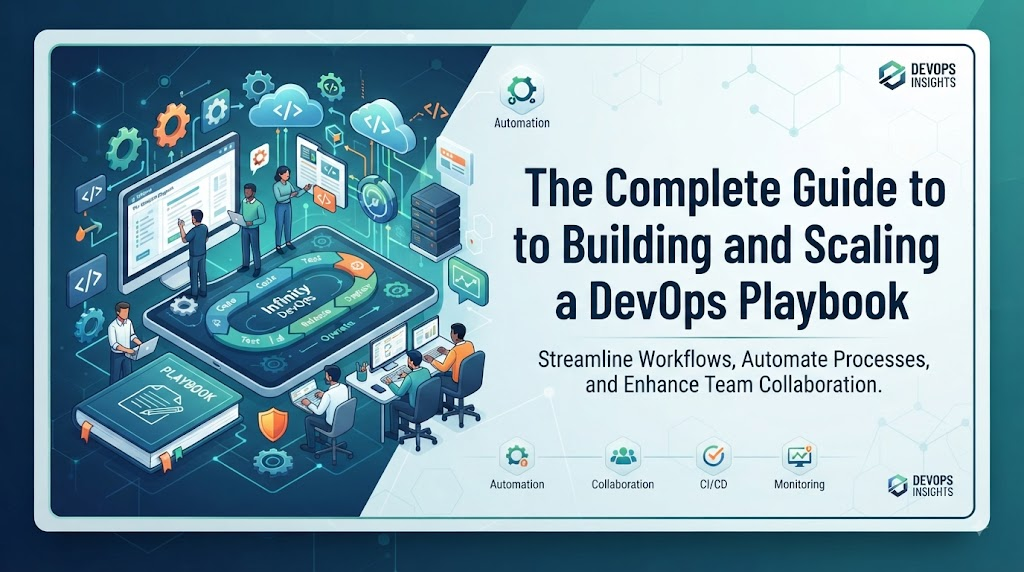
A DevOps playbook serves as a practical collection of standards, procedures, decision guidelines, troubleshooting steps, and operational knowledge. It acts as a single source of truth for engineering teams, helping them perform routine tasks and handle complex incidents with confidence. By documenting established workflows, a well-designed playbook reduces dependency on specific team members while still allowing engineers to use their professional judgment for situations that are not fully covered.
Organizations looking to establish reliable operational practices often train their engineers through specialized courses and certifications provided by platforms like DevOpsSchool. This practical approach ensures that the entire engineering organization aligns on common automation, security, and deployment standards.
What Is a DevOps Playbook?
A DevOps playbook is a comprehensive operational reference document that guides a technical team through the complete lifecycle of software delivery and infrastructure management. It captures how a team designs, builds, tests, deploys, monitors, secures, and maintains production systems.
Unlike a static reference manual, a practical playbook combines several distinct documentation types into a cohesive operational guide. It clarifies team responsibilities and ensures that engineering practices remain consistent across different projects and environments.
Document Type Comparison
| Document Type | Purpose | Example |
| DevOps Playbook | End-to-end operational guide and standards | Complete enterprise delivery and SRE framework |
| Runbook | Step-by-step instructions for a specific task | Restarting a crashed database cluster |
| SOP | High-level standard operating procedure | Compliance approval workflow |
| Architecture Document | System design and component interaction | High-level cloud network topology diagram |
| Troubleshooting Guide | Diagnostic steps for known error states | Resolving persistent pod restart loops |
Why DevOps Teams Need a Playbook
Engineering teams operate in fast-paced environments where downtime directly impacts business revenue and customer trust. Establishing a structured playbook brings predictability and resilience to engineering workflows.
- Consistency: Standardizes how deployments, infrastructure provisioning, and monitoring alerts are handled across all engineering squads.
- Faster Onboarding: Accelerates the time it takes for new engineers, SREs, and system administrators to become productive in production environments.
- Reduced Operational Risk: Minimizes human error during manual interventions and high-risk production changes.
- Better Incident Response: Provides clear diagnostic paths and escalation channels when critical services experience outages.
- Knowledge Sharing: Prevents critical operational knowledge from remaining locked inside the heads of a few senior engineers.
- Repeatable Deployments: Ensures that software releases follow identical validation and deployment steps in every environment.
- Reduced Tribal Knowledge: Eliminates reliance on informal chat threads or unwritten rules for critical production operations.
- Better Collaboration: Aligns development, QA, security, and operations teams around shared engineering goals.
- Continuous Improvement: Provides a baseline that teams regularly update based on post-incident reviews and retrospectives.
Documentation only creates value when teams actually use, test, and maintain it as part of their daily engineering routine.
What Should a DevOps Playbook Contain?
A comprehensive DevOps playbook covers every major phase of the software delivery lifecycle. Organizations should tailor their document to include only the sections relevant to their specific technology stack, architecture, and maturity level.
Playbook Content Overview
| Section | What It Should Contain |
| DevOps Principles | Core engineering philosophy and values |
| Team Responsibilities | RACI matrix and role definitions |
| Git Standards | Branching strategies and commit guidelines |
| CI/CD | Pipeline stages and artifact management |
| Infrastructure | Provisioning and configuration standards |
| Cloud | Account setup, tagging, and network layout |
| Containers | Image building and registry rules |
| Kubernetes | Cluster management and resource policies |
| Security | DevSecOps scans and secret handling |
| Monitoring | Metrics, logs, traces, and alert thresholds |
| Incident Response | Severity levels and communication flow |
| Disaster Recovery | Backup schedules and RPO/RTO targets |
| Change Management | Approval workflows and audit trails |
| Troubleshooting | Diagnostic runbooks for common failures |
| Automation | Guidelines for reducing manual toil |
| Continuous Improvement | Review cycles and feedback loops |
Define the Purpose and Scope
Every playbook must start by clearly defining its target audience, boundaries, and operational ownership. A well-scoped document prevents confusion about what systems the playbook governs and who is responsible for keeping it updated.
- Purpose: State clearly why the playbook exists and what operational challenges it solves.
- Audience: Identify who should read and follow the document, such as software engineers, platform engineers, and SREs.
- Scope: Define the boundaries of the playbook, including covered applications, clusters, and cloud accounts.
- Systems Covered: List specific production applications, databases, and pipelines managed under these rules.
- Environments Covered: Specify whether the rules apply to development, staging, UAT, production, or disaster recovery environments.
- Ownership: Assign a designated team or engineering lead responsible for maintaining the document.
- Review Frequency: Establish a regular schedule, such as quarterly reviews, to keep the content accurate.
Simple Scope Example
Plaintext
Scope: Governs all microservices deployed in the production Kubernetes cluster (us-east-1).
Excludes: Legacy monolithic applications running on legacy virtual machines managed by the IT department.
Owner: Platform Engineering Team.
Define DevOps Principles and Standards
Playbooks work best when anchored in core engineering principles. These principles guide daily technical decisions and prevent teams from taking shortcuts that compromise reliability.
- Automation First: Eliminate manual tasks wherever possible through scripting and CI/CD pipelines.
- Infrastructure as Code: Manage all infrastructure using version-controlled code templates.
- Version Control: Store all application code, configuration, and infrastructure definitions in Git repositories.
- Continuous Integration: Merge code frequently and validate every commit with automated tests.
- Continuous Delivery: Ensure software can be released to production safely at any time through automated pipelines.
- Security by Design: Integrate security checks early in the development lifecycle rather than treating security as an afterthought.
- Observability: Instrument all applications with comprehensive metrics, structured logs, and distributed traces.
- Reliability: Design systems to handle component failures gracefully without total service interruption.
- Documentation: Keep technical guides updated alongside code changes.
- Continuous Improvement: Learn from every deployment, incident, and retrospective to improve future workflows.
Define Team Roles and Responsibilities
Clear ownership prevents confusion during high-pressure situations like production deployments and critical outages. A responsibility matrix defines who leads a task and who supports it.
Responsibility Matrix
| Activity | Developer | DevOps | SRE | Security | Manager |
| Code | Responsible | Supportive | Consulted | Informed | Informed |
| CI/CD | Responsible | Accountable | Consulted | Consulted | Informed |
| Infrastructure | Consulted | Responsible | Accountable | Consulted | Informed |
| Security | Consulted | Supportive | Consulted | Responsible | Informed |
| Monitoring | Supportive | Responsible | Accountable | Consulted | Informed |
| Incident Response | Supportive | Responsible | Responsible | Consulted | Accountable |
| Production Changes | Consulted | Responsible | Accountable | Consulted | Informed |
Build a Git and Branching Standard
Consistent version control practices make code reviews smoother and release management predictable. The playbook should document repository structures, branching rules, and commit conventions.
- Repository Structure: Define standard folder layouts for application code, configuration manifests, and infrastructure code.
- Branching Strategy: Document the adopted branching model, such as Trunk-Based Development or GitFlow.
- Commit Conventions: Enforce descriptive commit messages, preferably following semantic commit standards.
- Pull Requests: Require peer reviews, automated test execution, and passing security scans before merging code.
- Code Review: Establish guidelines for constructive code reviews, focusing on maintainability, security, and performance.
- Tags: Use semantic versioning tags for production releases.
- Release Branches: Define when and how release branches are cut and patched.
- Branch Protection: Enable branch protection rules on main branches to prevent direct pushes and unreviewed merges.
Document the CI/CD Process
A standard continuous integration and continuous delivery pipeline ensures code moves from development to production through rigorous automated checks.
Plaintext
Code
↓
Pull Request
↓
Review
↓
Build
↓
Test
↓
Security Checks
↓
Package
↓
Deploy to Test
↓
Validation
↓
Production Deployment
↓
Monitoring
The playbook should document the exact tools, build commands, test suites, and gating criteria for every stage of this pipeline.
Create Deployment Procedures
Deployments should be repeatable, automated, and safe. Documenting pre-deployment checks, execution steps, and rollback procedures prevents deployment failures from turning into prolonged outages.
- Pre-deployment Checks: Verify system health, test coverage, and downstream dependencies.
- Deployment Steps: Outline exact commands or pipeline triggers required to execute the release.
- Environment Requirements: Document necessary environment variables, secrets, and configuration flags.
- Configuration: Detail how configuration changes are applied alongside application updates.
- Database Changes: Specify how database migrations are executed safely without locking tables or breaking backward compatibility.
- Validation: Run smoke tests and health checks immediately after deployment.
- Rollback: Define the exact trigger conditions and steps to revert a failed deployment.
- Post-deployment Monitoring: Monitor error rates, latency, and resource utilization for a defined observation window.
Deployment Checklist
- Automated tests pass successfully in staging environment.
- Database migration scripts tested against a staging database replica.
- Production feature flags configured correctly.
- On-call engineer notified of scheduled deployment window.
- Smoke tests prepared for immediate post-deployment execution.
Document Infrastructure Standards
Infrastructure as Code ensures environments are reproducible, version-controlled, and consistent across staging and production.
- Infrastructure as Code: Define all cloud resources using tools like Terraform or OpenTofu.
- Naming: Establish clear naming conventions for cloud resources, resource groups, and networks.
- Environments: Isolate development, staging, and production environments using separate accounts, subscriptions, or VPCs.
- Networking: Document VPC layouts, public and private subnets, routing tables, and security groups.
- Compute: Specify standard instance types, sizing guidelines, and auto-scaling configurations.
- Storage: Define storage class selections, encryption standards, and lifecycle policies.
- IAM: Enforce the principle of least privilege across all user roles and service accounts.
- Backups: Configure automated snapshots and retention policies for critical data stores.
- Configuration: Manage server configuration through immutable images or configuration management tools.
Document Cloud Standards
Cloud standards ensure cost efficiency, strong security postures, and architectural consistency across cloud service providers.
- Account Structure: Establish multi-account or multi-subscription management strategies.
- IAM: Implement strong password policies, multi-factor authentication, and federated identity providers.
- Network Design: Enforce private subnets for application workloads and restrict direct internet exposure.
- Resource Tagging: Mandate tags for cost allocation, environment identification, and resource ownership.
- Logging: Centralize audit logs, application logs, and network flow logs into a dedicated security account.
- Monitoring: Enable native cloud monitoring agents across all virtual machines and container clusters.
- Backup: Configure cross-region backups for critical disaster recovery targets.
- Cost Awareness: Set up budget alerts and identify unused or idle resources regularly.
- Security: Enable native cloud security posture management tools to detect misconfigurations.
Document Container and Kubernetes Standards
Containerization and orchestration platforms require strict standardization to ensure security, stability, and predictable resource utilization.
- Containers: Build lightweight containers using minimal base images like Alpine or Distroless.
- Image Naming: Use clear tagging strategies incorporating semantic versioning and commit hashes.
- Registry Usage: Store all approved container images in a secure private container registry.
- Dockerfile Standards: Avoid running containers as root and pin base image versions.
- Image Scanning: Scan all container images for high and critical vulnerabilities before deployment.
- Resource Limits: Define explicit CPU and memory requests and limits for every container.
- Secrets: Inject secrets securely using external secret managers rather than baking them into images.
- Kubernetes: Organize workloads logically using dedicated namespaces for different teams and applications.
- Labels: Apply standardized metadata labels to all Kubernetes objects for easy filtering and management.
- RBAC: Restrict cluster access using Role-Based Access Control and service account limitations.
- Health Checks: Implement liveness, readiness, and startup probes for every deployed application.
Add Security and DevSecOps Standards
Security must be embedded directly into the engineering workflow through automated scanning and regular compliance reviews.
- Secrets Management: Prohibit hardcoded credentials in source code and use secret managers like HashiCorp Vault or cloud key vaults.
- Vulnerability Scanning: Run automated software composition analysis to detect vulnerable third-party libraries.
- Dependency Management: Keep application dependencies updated and patch known security flaws promptly.
- Container Scanning: Block deployments containing unpatched operating system vulnerabilities.
- IaC Scanning: Scan infrastructure code for security misconfigurations before applying changes.
- IAM: Review user permissions and access keys periodically to remove orphaned credentials.
- Security Reviews: Conduct threat modeling and architecture reviews for critical new features.
- Patch Management: Establish routine patch cycles for underlying operating systems and cluster nodes.
- Security Incident Handling: Define communication channels and escalation paths for security breaches.
Build Monitoring and Observability Standards
Effective monitoring gives engineering teams visibility into application health, performance bottlenecks, and emerging failures before they impact users.
- Metrics: Collect quantitative performance data including CPU utilization, memory usage, request rates, and error rates.
- Logs: Generate structured JSON logs containing correlation IDs for request tracing.
- Traces: Implement distributed tracing across microservices to track request lifecycles.
- Dashboards: Maintain operational dashboards for every core service displaying key performance indicators.
- Alerts: Configure actionable alerts based on symptoms that impact users rather than raw resource saturation.
- Service Health: Define Service Level Objectives and Service Level Indicators for core business transactions.
- Infrastructure Health: Monitor underlying nodes, disk space, network latency, and database connection pools.
- Alert Severity: Classify alerts clearly to ensure appropriate response times.
- Escalation: Define paging rotations and escalation paths for unacknowledged alerts.
Alert Classification
| Severity | Example | Response |
| Critical | Complete service outage; payment gateway failure | Immediate page; response within 15 minutes |
| High | Degraded performance; elevated error rates | Page on-call engineer; response within 30 minutes |
| Medium | Single non-core worker node offline | Ticket created; response within 4 hours |
| Low | Non-critical disk space warning at 70% | Ticket created; review during normal business hours |
Create Incident Response Procedures
When incidents occur, a structured response workflow minimizes downtime and reduces stress for the on-call team.
Plaintext
Detect
↓
Acknowledge
↓
Assess
↓
Contain
↓
Recover
↓
Validate
↓
Communicate
↓
Learn
- Detect: Automated alerts or user reports identify an anomaly.
- Acknowledge: The on-call engineer acknowledges the alert in the paging system.
- Assess: The engineer evaluates the blast radius, affected services, and customer impact.
- Contain: Implement immediate mitigations, such as traffic rerouting or feature flag toggles, to stop the bleeding.
- Recover: Apply permanent fixes or roll back broken deployments.
- Validate: Run smoke tests and check dashboards to confirm the service has fully recovered.
- Communicate: Provide timely updates to stakeholders, support teams, and customers.
- Learn: Conduct a blameless post-mortem to identify root causes and preventive action items.
Create Troubleshooting Runbooks
Troubleshooting guides help engineers diagnose and resolve recurring error states quickly without guessing.
Troubleshooting Guide Format
- Problem: Brief summary of the failure state.
- Symptoms: Observable errors, log snippets, or dashboard spikes.
- Possible Causes: Root causes such as database lockups, expired certificates, or memory leaks.
- Diagnostic Commands or Checks: Specific CLI commands or dashboard queries to confirm the cause.
- Resolution: Step-by-step instructions to fix the issue.
- Validation: Verification steps to ensure the system is healthy.
- Escalation: Who to contact if initial troubleshooting steps fail.
- Lessons Learned: Notes for preventing recurrence.
Example: Failed Application Deployment
- Problem: Application pods failing to start after deployment.
- Symptoms: Pod status showing
CrashLoopBackOffin Kubernetes. - Possible Causes: Missing environment variable, database connection failure, or invalid startup command.
- Diagnostic Commands or Checks: Run
kubectl logs <pod-name> --previousand inspect container exit codes. - Resolution: Update missing secret in the secret manager, restart the deployment using
kubectl rollout restart deployment/<name>. - Validation: Confirm all pods reach
Runningstate and health check probes return HTTP 200. - Escalation: Escalate to the platform infrastructure team if cluster-level networking is broken.
- Lessons Learned: Add pre-deployment validation check for required environment variables in CI pipeline.
Document Rollback Procedures
Every deployment procedure must include a well-tested rollback plan. Knowing how to revert a bad release quickly protects production stability.
- When Rollback is Appropriate: Trigger a rollback when error rates spike significantly after a release or core functionality breaks.
- Who Can Authorize It: The on-call engineer, tech lead, or engineering manager can authorize an emergency rollback.
- Application Rollback: Revert to the previous stable container image tag via CI/CD pipeline or deployment tool.
- Configuration Rollback: Revert configuration maps and environment variables to the previous version.
- Infrastructure Rollback: Apply previous Terraform state or destroy newly created problematic cloud resources.
- Database Considerations: Ensure database changes are backward-compatible so rolling back application code does not break data models.
- Validation after Rollback: Verify application logs, error rates, and smoke tests return to pre-deployment baselines.
Rollback procedures must be tested regularly in staging environments rather than assumed to work during a crisis.
Document Disaster Recovery
Disaster recovery planning ensures an organization can restore operations after a catastrophic cloud region failure, severe data corruption, or security breach.
- Backup: Define automated backup frequencies for databases, object storage, and configuration states.
- Recovery: Document step-by-step instructions for restoring data from backups into a clean environment.
- Failover: Detail procedures for switching DNS and traffic routing to a secondary disaster recovery region.
- Restore: Verify data integrity and application consistency post-restoration.
- Recovery Point Objective: Define the maximum acceptable data loss measured in time.
- Recovery Time Objective: Define the maximum acceptable time to restore service operations.
- Disaster Recovery Testing: Schedule regular game days to test failover and restore procedures in practice.
Disaster Recovery Component Table
| Component | Backup | Recovery Method | Owner |
| Application | Container images in registry | Redeploy via CI/CD pipeline | Platform Team |
| Database | Automated daily snapshots + WAL archiving | Point-in-time restore to secondary instance | Database Team |
| Infrastructure | Version-controlled Terraform code | Apply infrastructure templates in DR region | DevOps Team |
| Configuration | Git repository manifests | Re-apply GitOps sync to cluster | Platform Team |
| Secrets | Encrypted vault snapshots | Restore secret store from backup archive | Security Team |
Add Change Management Guidelines
Change management processes should ensure production changes are reviewed and audited without slowing down software delivery speed.
- Standard Changes: Low-risk, repetitive changes that follow pre-approved templates and automated pipelines.
- Normal Changes: Routine code and infrastructure updates that require peer review and staging validation.
- Emergency Changes: Urgent hotfixes for critical production incidents that require post-implementation review.
- Change Review: Document changes clearly in pull requests or change tickets before merging.
- Testing: Require automated test results and staging validation evidence.
- Rollback: Ensure a validated rollback plan exists for every change.
- Audit Evidence: Maintain automated audit logs of who approved and deployed every production change.
Automation Standards
Automation eliminates toil, reduces human error, and ensures consistency across engineering workflows.
- CI/CD: Automate building, testing, packaging, and deployment stages.
- Infrastructure Provisioning: Use infrastructure as code to provision environments programmatically.
- Configuration: Automate configuration management to avoid manual server modifications.
- Testing: Integrate unit tests, integration tests, and security scans into every pull request.
- Security: Automate secret scanning and container vulnerability checks.
- Monitoring: Automatically provision monitoring dashboards and alert rules when new services are deployed.
- Incident Response: Automate alert routing, pager notifications, and preliminary diagnostic data collection.
Automated actions should always include appropriate safeguards, such as dry-run modes and approval gates for destructive operations.
DevOps Playbook Template
Organizations can use this practical template to structure their internal engineering playbook.
- Purpose: Define the objective of the playbook.
- Scope: Specify covered systems, applications, and environments.
- Team Responsibilities: Outline RACI matrix and ownership roles.
- Engineering Standards: State core principles and engineering values.
- Git Standards: Document repository layout and branching rules.
- CI/CD Standards: Detail pipeline stages and build requirements.
- Infrastructure Standards: Define IaC and resource provisioning rules.
- Cloud Standards: Specify multi-account, tagging, and networking policies.
- Container Standards: Detail base images, tagging, and registry rules.
- Kubernetes Standards: Outline namespaces, RBAC, and resource limits.
- Security Standards: Document secret management and scanning tools.
- Monitoring Standards: Define metrics, logs, and alert severity levels.
- Incident Response: Outline detection, containment, and review steps.
- Troubleshooting: Provide structured diagnostic runbooks for common errors.
- Disaster Recovery: Detail backup schedules, RPO, RTO, and failover steps.
- Change Management: Define standard, normal, and emergency change rules.
- Automation: Identify automation opportunities and safeguard rules.
- Review and Improvement: Establish feedback loops and review schedules.
Real-World DevOps Playbook Example
Consider an enterprise e-commerce company operating a containerized application stack on cloud infrastructure with automated CI/CD pipelines and 24/7 on-call support.
- Deployment: The team uses GitOps to sync Kubernetes manifests automatically when pull requests merge into the main branch. Pre-deployment smoke tests validate database connectivity before traffic shifts.
- Monitoring: Prometheus and Grafana collect system metrics, triggering PagerDuty alerts only when error rates exceed defined thresholds for more than five minutes.
- Incident Response: When an alert fires, the on-call engineer follows the incident response workflow: assessing impact, containing the issue, communicating status updates, and logging findings.
- Rollback: If a deployment causes a spike in HTTP 500 errors, the engineer executes an immediate rollback script to revert the container image tag to the previous stable release.
- Security: Container images undergo automated vulnerability scans during the CI build stage, blocking deployments that contain critical security flaws.
- Infrastructure Changes: All cloud resource modifications are written in Terraform, reviewed by a peer, and applied through an automated CI pipeline.
- Onboarding: New engineers use the playbook’s architecture overview, Git standards, and setup guides to deploy their first development environment within their first week.
This practical alignment ensures that every engineer handles operational tasks consistently and efficiently.
DevOps Playbook for Incident Response
Teams should use a standardized incident template during active outages to ensure clear communication and effective root-cause analysis.
- Incident Name: [Descriptive title of the incident]
- Severity: [Critical / High / Medium / Low]
- Affected Service: [Name of impacted microservice or database]
- Start Time: [Timestamp when incident began]
- Detection Method: [Automated Alert / Customer Report / Internal Check]
- Initial Symptoms: [Observed error messages, metric spikes, or user impact]
- Investigation: [Steps taken to diagnose the root cause]
- Mitigation: [Immediate actions taken to stop user impact]
- Recovery: [Permanent fix applied to resolve the root cause]
- Validation: [Checks confirming system health restored]
- Communication: [Timeline of stakeholder and customer updates]
- Root Cause: [Underlying technical reason for the failure]
- Follow-Up Actions: [Preventive engineering tasks created in issue tracker]
Incident documentation must focus on systemic learning and engineering improvements rather than assigning blame.
DevOps Playbook for New Engineer Onboarding
A well-structured playbook helps new engineers ramp up quickly without requiring constant supervision from senior staff.
- Architecture: Review high-level system diagrams and core service interactions.
- Repositories: Gain access to Git repositories and review branch protection rules.
- Environments: Set up local development environments and access staging clusters.
- CI/CD: Understand how code moves from pull request to production deployment.
- Infrastructure: Review Terraform modules and cloud resource layouts.
- Monitoring: Explore Grafana dashboards, log aggregators, and alerting tools.
- Security: Learn secret management practices and vulnerability scanning tools.
- Deployment: Shadow a senior engineer through a routine staging deployment.
- Incident Response: Review past post-mortems and understand on-call escalation paths.
- Escalation: Know who to contact when blocked or facing critical production issues.
New-Engineer Onboarding Checklist
- Access granted to Git repositories, cloud accounts, and internal chat tools.
- Local development environment configured and verified.
- First pull request created, reviewed, and merged successfully.
- Shadowed an on-call engineer during a shift rotation.
- Completed required security and compliance training modules.
How to Keep a DevOps Playbook Updated
Playbooks quickly become obsolete if teams do not establish regular maintenance routines. Stale documentation can become dangerous during high-pressure production incidents.
- Ownership: Assign clear ownership of the playbook to a specific team or engineering lead.
- Review Schedules: Schedule regular quarterly reviews to audit and update outdated procedures.
- Change History: Maintain a version history or changelog within the document repository.
- Feedback: Encourage engineers to submit pull requests when they discover outdated instructions.
- Incident-Driven Updates: Update troubleshooting guides and runbooks immediately after resolving a production incident.
- Automation: Generate documentation automatically from code comments, API specs, or infrastructure definitions where possible.
- Documentation Testing: Test operational runbooks periodically during routine maintenance windows to ensure instructions remain accurate.
- Retrospectives: Incorporate lessons learned from team retrospectives and post-mortems back into the playbook.
Common DevOps Playbook Mistakes
Avoiding common pitfalls ensures that your playbook remains a practical, well-utilized asset rather than an ignored shelf-ware document.
- Making the Document Too Large: Avoid stuffing every piece of company history into a single monolithic document. Break information into logical, searchable sections.
- Copying Generic Procedures: Avoid copy-pasting generic internet templates that do not match your actual technology stack or architecture.
- No Ownership: Assigning no clear owner guarantees the document will quickly become outdated.
- No Review Process: Failing to schedule regular reviews leads to stale documentation and incorrect commands.
- Ignoring Real Incidents: Not updating runbooks after resolving a production incident misses valuable learning opportunities.
- Documenting Ideal Processes Instead of Actual Processes: Write down how work actually gets done safely, not how management wishes it was done.
- Too Many Manual Steps: If a procedure requires twenty manual clicks, automate it rather than documenting it.
- No Examples: Abstract descriptions confuse readers; include concrete code snippets and command examples.
- No Escalation Paths: Failing to define who to call when procedures fail leaves engineers stranded during outages.
- Never Testing Procedures: Runbooks that are never tested in practice often fail during real emergencies.
- Treating Documentation as Complete Forever: A playbook is a living document that must evolve alongside your software and infrastructure.
DevOps Playbook Quality Checklist
Engineering teams can use this detailed checklist to evaluate the completeness and quality of their DevOps playbook.
- Purpose is defined.
- Scope is clear.
- Owners are assigned.
- Git standards are documented.
- CI/CD is documented.
- Deployment procedures exist.
- Rollback is documented.
- Infrastructure standards exist.
- Cloud standards exist.
- Security standards exist.
- Monitoring standards exist.
- Incident response is documented.
- Troubleshooting guides exist.
- Disaster recovery is documented.
- Change management is defined.
- Onboarding guidance exists.
- Automation opportunities are identified.
- Review process exists.
- Procedures are tested.
- Lessons learned are incorporated.
DevOps Playbook Tools and Documentation Approaches
The underlying technology platform matters less than accessibility, version control, and team ownership.
Documentation Approaches
| Approach | Purpose | Suitable Use |
| Markdown Repository | Store playbooks alongside code in Git | Technical teams using Docs-as-Code workflows |
| Wiki | Collaborative enterprise knowledge base | Broad organizational policies and guidelines |
| Internal Documentation Portal | Centralized developer hub (e.g., Backstage) | Enterprise platform engineering teams |
| Issue Tracker | Task-linked operational notes | Project-specific operational checklists |
| Runbook Automation | Executable automation scripts with UI | Automated remediation and recurring operational tasks |
| Version-Controlled Documentation | Track document history and pull requests | Teams requiring strict audit compliance |
Career Value of DevOps Playbook Skills
Mastering playbook creation elevates an engineer from executing isolated tasks to designing repeatable enterprise systems.
Role-Based Value
| Role | Playbook Skills Impact |
| DevOps Engineer | Translates manual delivery steps into automated, documented pipelines. |
| SRE | Defines robust incident response workflows, SLOs, and troubleshooting guides. |
| Platform Engineer | Creates standardized self-service infrastructure templates for development squads. |
| Cloud Engineer | Establishes secure, compliant, and cost-optimized cloud architecture standards. |
| DevSecOps Engineer | Embeds automated security scanning and compliance checks into delivery workflows. |
| Engineering Manager | Reduces operational risk, accelerates onboarding, and scales engineering teams effectively. |
| DevOps Consultant | Audits client maturity and establishes scalable operational frameworks. |
Senior engineers are expected to turn individual tribal knowledge into repeatable team practices that scale across the organization.
DevOps Learning Roadmap
Plaintext
Linux & Networking
↓
Git
↓
DevOps Fundamentals
↓
CI/CD
↓
Cloud
↓
Containers
↓
Infrastructure as Code
↓
Monitoring & Observability
↓
DevSecOps
↓
Incident Management
↓
Automation
↓
Documentation & Playbooks
↓
Continuous Improvement
- Linux & Networking: Understand core operating system principles and network routing.
- Git: Master version control, branching strategies, and collaborative code reviews.
- DevOps Fundamentals: Learn the cultural and technical philosophy of continuous delivery.
- CI/CD: Build automated build, test, and release pipelines.
- Cloud: Provision and manage cloud compute, storage, and networking resources.
- Containers: Package applications into portable, reproducible container images.
- Infrastructure as Code: Define cloud infrastructure programmatically using declarative templates.
- Monitoring & Observability: Implement metrics, structured logs, and distributed traces.
- DevSecOps: Integrate security scans and secret management into delivery workflows.
- Incident Management: Master incident response workflows, paging rotations, and post-mortems.
- Automation: Write scripts and automation workflows to eliminate manual toil.
- Documentation & Playbooks: Synthesize technical knowledge into practical, maintainable team playbooks.
- Continuous Improvement: Refine engineering processes through regular feedback and retrospectives.
Frequently Asked Questions
What is a DevOps playbook?
A DevOps playbook is a comprehensive operational reference document that guides a technical team through software delivery, infrastructure management, security, and incident response.
What should a DevOps playbook contain?
It should contain team principles, Git standards, CI/CD pipeline documentation, infrastructure standards, security guidelines, monitoring rules, incident response workflows, and troubleshooting runbooks.
What is the difference between a playbook and a runbook?
A playbook is a broad, end-to-end operational guide for a team, whereas a runbook is a step-by-step instruction guide for performing a specific operational task.
Why do DevOps teams need playbooks?
Playbooks reduce operational risk, accelerate engineer onboarding, eliminate tribal knowledge, and ensure consistent execution across deployments and incidents.
Who should own a DevOps playbook?
A designated team or engineering lead, such as a platform engineering team or SRE lead, should own the playbook, though all team members should contribute updates.
How often should a DevOps playbook be updated?
Playbooks should be reviewed at least quarterly and updated immediately after major architecture changes or critical production incidents.
Should deployment procedures be included?
Yes. Documenting pre-deployment checks, execution steps, validation, and rollback procedures is essential for safe software releases.
Should incident response be included?
Yes. Clear incident workflows, severity classifications, and communication channels reduce chaos during critical outages.
Should security standards be included?
Yes. Embedding secret management, vulnerability scanning, and compliance checks into the playbook ensures security is a core part of the workflow.
How detailed should a DevOps playbook be?
It should be detailed enough to guide a new engineer safely through routine tasks and incidents without being overly bureaucratic or difficult to maintain.
Can a small DevOps team use a playbook?
Yes. Small teams benefit from playbooks by reducing key-person dependencies and establishing scalable standards before the team grows.
How can teams make sure engineers actually use the playbook?
Keep the documentation concise, store it alongside code in Git, update it regularly based on real incidents, and integrate it into onboarding workflows.
Final Thoughts
A good DevOps playbook turns operational knowledge into repeatable team practices without attempting to document every possible edge case. The best playbooks are practical, version-controlled, owned by the team, tested during real operations, and continuously improved based on incidents, deployments, and engineering feedback. By building a clear and maintainable playbook, engineering teams can deliver software faster, respond to incidents more effectively, and maintain high standards of reliability and security across their entire infrastructure.