




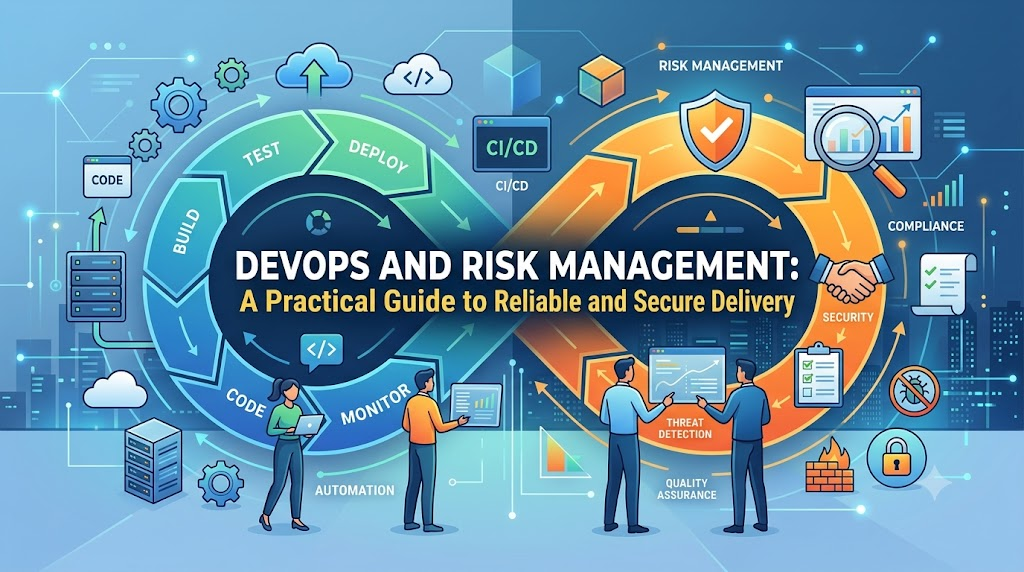
Modern software delivery emphasizes speed, rapid iteration, and frequent releases. Yet high deployment velocity without adequate operational controls can turn minor code defects into widespread outages, data leaks, or compliance failures. Effective software engineering does not treat speed and stability as opposing goals. Instead, it pairs fast iteration with proactive governance.
DevOps and risk management focuses on identifying, evaluating, and mitigating technical and operational threats across the software delivery lifecycle. Rather than relying on rigid, bureaucratic sign-offs that delay releases, engineering teams use automated guardrails, infrastructure as code, observability, and progressive rollouts to control exposure while maintaining delivery momentum.
Understanding Risk Management in DevOps
In a DevOps setting, risk management evaluates what could disrupt service availability, compromise system security, degrade performance, or violate operational policies. It balances potential downsides against delivery objectives.
Traditional IT organizations often manage risk through external change advisory boards (CABs) and lengthy manual review cycles. While intended to prevent defects, these mechanisms can paradoxically increase release risk: changes accumulate into massive, infrequent batches that are difficult to review and hazardous to deploy.
DevOps alters this dynamic by shifting risk controls directly into the delivery pipeline.
+-----------------------------------------------------------------------+
|                       Traditional Risk Management                     |
| Large Batches -> Infrequent Deployments -> Manual CAB -> Opaque Impact|
+-----------------------------------------------------------------------+
                                  VS
+-----------------------------------------------------------------------+
|                         DevOps Risk Management                        |
| Small Batches -> Automated Checks -> Progressive Rollouts -> Fast MTTR|
+-----------------------------------------------------------------------+
Core Tenets of DevOps Risk Governance
- Likelihood vs. Impact Reduction: Controls must address both how often failures occur and how severe they are when they happen. Automated testing reduces the likelihood of shipping a regression; canary rollouts and feature flags reduce the impact by limiting exposure to a small fraction of traffic.
- Informed Release Decisions: Risk management does not aim to eliminate every possible failure—an impossible goal in complex, distributed systems. Instead, it helps teams understand acceptable risk boundaries, document explicit trade-offs, and deploy with confidence.
- Continuous Feedback Loops: Risk assessment is an ongoing operational discipline, not a static checkpoint completed before deployment. Telemetry, incident post-mortems, and audit logs feed back into development to refine automated policies continuously.
Major Technical and Operational Risks in DevOps
Risk in modern environments extends well beyond application security vulnerabilities. Platform, operations, and delivery teams manage threats spanning multiple technical domains.
1. Deployment and Release Risks
Deploying application updates introduces the chance of runtime crashes, configuration drift, broken dependencies, or incompatible database schema changes. A simple syntax error in an environment variable can trigger crash loops across an entire fleet.
While blue-green or rolling deployments mitigate stateless application bugs, irreversible data migrations require careful handling. If a new schema drops a column or mutates records before all services can process the format, a traditional rollback may fail, making backward-compatible database migrations essential.
2. Security and Access Risks
Accelerated delivery cycles can inadvertently expose credentials, introduce vulnerable dependencies, or deploy misconfigured permissions. If build agents run with broad cloud administrator access, a compromised build script could grant unauthorized access across an entire environment.
Managing these risks requires zero-trust access, secret scanning in source repositories, automated static application security testing (SAST), and strict adherence to least privilege for CI/CD runners.
3. Infrastructure and Cloud Risks
Cloud infrastructure brings flexibility alongside risks of misconfiguration, accidental deletions, sudden regional resource shortages, and unexpected provider outages.
Defining infrastructure manually through cloud management consoles creates unrecorded differences between environments. Infrastructure as Code (IaC) mitigates this risk by capturing infrastructure definitions in version control, allowing teams to review changes and apply automated policy-as-code validations before provisioning resources.
4. Reliability and Availability Risks
Distributed microservices are vulnerable to cascading failures, network partitions, thread exhaustion, and unmonitored queue pileups. Without visibility into operational metrics and service dependencies, pinpointing the origin of latency spikes becomes difficult.
Managing availability risk requires defined Service Level Objectives (SLOs), automated alerting based on error budgets, distributed tracing, and realistic capacity planning.
5. Automation and CI/CD Pipeline Risks
Automation executes logic reliably, including flawed instructions. A defect in an automated deployment script can tear down production clusters just as efficiently as it provisions them.
Pipelines themselves represent high-value attack targets. Threats include:
- Malicious dependencies injected during container builds
- Pipeline scripts running without verification
- Deployment steps that bypass automated branch protection rules
Securing automation demands locked pipeline definitions, signed container images, and reproducible build environments.
6. Dependency and Software Supply Chain Risks
Modern applications rely heavily on external open-source packages, libraries, base container images, and third-party APIs. A vulnerability or malicious code update in a deep transitive dependency can introduce immediate risk into an otherwise sound codebase.
Organizations address supply chain risk by generating a Software Bill of Materials (SBOM), running software composition analysis (SCA) scanners, pinning dependency versions, and hosting internal artifact repositories.
7. Human, Process, and Knowledge Concentration Risks
Unclear ownership, tribal knowledge, missing recovery runbooks, and fatigue cause significant operational disruption. When only one engineer understands how a critical service runs, any outage occurring during their absence presents severe business risk.
Teams mitigate organizational risk through shared operational responsibilities, documented runbooks, automated processes, and blameless post-incident reviews focused on systematic improvements.
Identifying and Assessing DevOps Risks
To prioritize mitigation efforts, engineering teams need a consistent framework for assessing technical risk without slowing day-to-day work.
+-----------------------------------------------------------------------------------+
|                           Risk Assessment Lifecycle                               |
|                                                                                   |
| 1. Scope Target  -->  2. Identify Threats  -->  3. Evaluate Likelihood & Impact    |
|                                                              |                    |
| 6. Monitor & Refine <-- 5. Assign Owner & Fix <-- 4. Calculate Inherent vs. Residual|
+-----------------------------------------------------------------------------------+
The Assessment Process
- Scope the System: Define the specific application boundary, infrastructure asset, or pipeline stage under review.
- Identify Potential Failure Scenarios: Detail realistic threats, such as connection pool exhaustion, expired certificates, or corrupted deployment bundles.
- Determine Likelihood: Assess how often this failure could happen based on historical incident data, architectural complexity, and rate of change.
- Estimate Business Impact: Measure the consequence across customer experience, data integrity, security boundaries, and revenue.
- Evaluate Existing Controls: Document existing safeguards, such as synthetic testing, automated alerts, or database read replicas.
- Determine Residual Risk: Assess the remaining exposure after factoring in those existing controls.
- Assign Ownership and Remediation: Establish an owner and define concrete actions (e.g., implementing circuit breakers or adding integration tests).
- Review Continuously: Re-evaluate whenever the architecture, dependencies, or traffic patterns change significantly.
Illustrative Likelihood-Impact Framework
Teams often prioritize threats using a qualitative risk matrix. This model serves as an illustrative framework for engineering discussions rather than a source of mathematical certainty.
| Likelihood Category | Operational Impact | Illustrative Severity | Typical Engineering Action |
| High (Frequent triggers, no safeguards) | Critical (Full outage, data loss) | Severe | Immediate sprint blocker; deploy automated gates and fallback paths. |
| Medium (Occurs during edge cases) | High (Degraded performance, user disruption) | Elevated | Schedule mitigation in current sprint; enhance monitoring and alerting. |
| Low (Rare, complex prerequisite chain) | Moderate (Internal tool failure, minor delay) | Moderate | Track in backlog; add basic health checks and alerts. |
| Low (Isolated corner case) | Low (Cosmetic defect, negligible impact) | Minor | Accept residual risk with documented rationale. |
Multiplying qualitative scores does not produce an exact risk calculation. The purpose of a matrix is to build consensus around which engineering investments will best protect service stability.
Core DevOps Practices That Mitigate Operational Risk
Engineering teams use specific technical practices to manage and reduce risk throughout the delivery lifecycle:
+-------------------------------------------------------------------------+
|                  Defensive Delivery Pipeline Architecture               |
|                                                                         |
|  Code Commit --> Automated Tests (Unit/SAST) --> Artifact Signing       |
|                                                          |              |
|  Canary Release (10%) <-- Staging Validation <-- IaC Policy Evaluation  |
|         |                                                               |
|  Telemetry OK? --> Full Production (100%) [Rollback Ready via Flags/IaC]|
+-------------------------------------------------------------------------+
Continuous Integration and Automated Testing
Continuous Integration (CI) reduces integration debt by running code through automated test suites on every commit. Combining unit tests, contract tests, and integration tests identifies functional defects early, when fixing them is simpler and less expensive.
Infrastructure as Code and Policy as Code
Managing cloud infrastructure through tools like Terraform, OpenTofu, or AWS CloudFormation ensures that environments remain consistent and auditable. Teams can review infrastructure modifications using standard pull requests and enforce configuration rules—such as requiring encryption for storage buckets or blocking public access—using automated policy checks before provisioning.
Observability and Telemetry
Observability goes beyond basic ping checks by correlating metrics, structured logs, and distributed traces. This telemetry provides real-time visibility into application health, helping teams identify rising error rates, memory leaks, and connection pool saturation before users report issues.
Progressive Delivery
Progressive delivery limits blast radius by releasing updates incrementally. Techniques include:
- Canary Deployments: Routing a small portion of user traffic (e.g., 2% to 5%) to the new version while watching error budgets and latency.
- Feature Flags: Decoupling software deployment from feature activation, allowing teams to toggle problematic capabilities off instantly without redeploying code.
- Blue-Green Deployments: Maintaining two identical environments so teams can redirect traffic back to the stable environment if the new release behaves unexpectedly.
Disaster Recovery: RTO and RPO
Resilience engineering requires clear operational recovery metrics:
- Recovery Time Objective (RTO): The maximum acceptable duration of system downtime after an outage.
- Recovery Point Objective (RPO): The maximum acceptable age of data that can be lost when recovery occurs.
A team with an RTO of 15 minutes and an RPO of 1 hour needs automated failover mechanisms and continuous database snapshotting. These recovery configurations require regular restoration drills to ensure backups operate as expected during real outages.
Practical Walkthrough: Managing Deployment Risk
Consider an engineering team preparing a major release for a core transaction service that includes an application refactor and a non-destructive database index addition. The following steps show how the team mitigates risk throughout the release:
[Phase 1: CI Verification]
  - Run Unit, Integration, SAST, and SCA suites.
  - Generate and verify signed container image.
            │
            ▼
[Phase 2: Configuration & Staging]
  - Run IaC drift detection and schema backward-compatibility tests.
  - Deploy to staging and run synthetic load tests.
            │
            ▼
[Phase 3: Progressive Rollout]
  - Route 5% traffic to canary instance.
  - Monitor HTTP 5xx errors, latency, and system resources.
            │
     ┌──────┴──────┐
     │ Telemetry   │
     ▼             ▼
[Anomalies Found]  [Metrics Stable]
  - Auto-rollback    - Route 100% traffic.
  - Toggle flag off  - Document post-deployment notes.
Phase 1: Pre-Deployment Automated Verification
- Run unit, integration, and security scans in the CI pipeline.
- Inspect open-source components with dependency scanners to confirm no known critical vulnerabilities exist.
- Build an immutable container image, compute its digest, and sign it before pushing to the internal registry.
Phase 2: Staging Validation and Configuration Checks
- Compare planned cloud configuration changes against environment baselines to prevent unintended infrastructure modifications.
- Apply database index changes in a staging environment to confirm the migration runs without locking tables or degrading performance.
- Run automated synthetic user journeys against the staging environment to verify end-to-end transaction flows.
Phase 3: Canary Release and Health Monitoring
- Deploy the updated container to a canary instance receiving 5% of production traffic.
- Monitor service health against defined thresholds:
- HTTP 5xx error rate remains below 0.1%
- 95th percentile latency does not exceed 180 ms
- Database connection pools remain below 70% utilization
- Keep feature flags disabled initially, enabling them only after runtime metrics demonstrate service stability.
Phase 4: Automated Recovery and Post-Release Review
- If error rates exceed baseline thresholds during the canary phase, the deployment pipeline halts and rolls traffic back automatically.
- Once the release reaches 100% traffic with stable metrics, the team records deployment telemetry, updates documentation, and reviews operational data to refine future test automation.
Maintaining an Actionable DevOps Risk Register
A risk register helps engineering teams balance technical risk alongside regular feature work. To remain practical, it must focus on concrete engineering decisions rather than static compliance documentation.
Illustrative DevOps Risk Register
| Risk / Failure Scenario | Likelihood | Impact | Existing Controls | Planned Mitigation | Owner | Review Status |
| Pipeline Credential Exposure | Low | Critical | GitHub Secret storage | Introduce dynamic, short-lived OIDC tokens for cloud provider access | Platform Engineering | In Progress |
| Database Migration Lockout | Medium | High | Staging test runs | Add automated backward-compatibility checks and query linters to CI | Database Operations | Planned |
| Container Base Image Vulnerability | High | High | Daily registry scans | Pin container digests; fail builds on unpatched vulnerabilities | DevSecOps Lead | Active |
| Silent Backup Failures | Low | Critical | Automated nightly database snapshots | Implement automated monthly restoration tests with alert verification | Site Reliability Engineering | Review Complete |
Measuring Risk Management Effectiveness
Tracking operational metrics helps teams determine whether risk controls improve system stability or simply add friction. However, individual metrics require context; for example, a decline in recorded incidents may reflect deteriorating monitoring rather than improved stability.
+--------------------------------------------------------------------+
|                Balancing Velocity and Risk Controls                |
|                                                                    |
|    Stability Indicators                  Delivery Velocity         |
|  - Change Failure Rate                 - Deployment Frequency      |
|  - Mean Time to Recovery (MTTR)        - Lead Time for Changes     |
|  - Mean Time to Detect (MTTD)                                      |
+--------------------------------------------------------------------+
Key Risk and Reliability Metrics
- Change Failure Rate (CFR): The percentage of deployments that cause a production degradation, rollback, or emergency fix. A rising CFR often points to gaps in testing or review processes.
- Mean Time to Recovery (MTTR): The average time required to restore service after an outage. A low MTTR indicates effective rollbacks, clear runbooks, and useful telemetry.
- Mean Time to Detect (MTTD): The duration between an issue’s emergence and when the engineering team identifies it. High MTTD values highlight blind spots in observability.
- Vulnerability Remediation Age: The average number of days required to resolve security issues based on severity levels. Tracking this metric shows whether security risks are addressed systematically.
- Backup Restoration Verification: The success rate and duration of regular data restoration tests, confirming that disaster recovery plans operate as expected.
Common Mistakes in DevOps Risk Management
| Antipattern | Operational Consequence | Practical Alternative |
| Focusing solely on application security | Teams miss operational failures like resource exhaustion, network bottlenecks, or configuration drift. | Treat availability, data integrity, infrastructure resilience, and security as interconnected disciplines. |
| Relying on manual Change Advisory Boards | Creates large, delayed release batches that are harder to inspect and riskier to deploy. | Replace manual approvals with automated CI/CD guardrails, policy-as-code, and progressive rollouts. |
| Deploying without tested recovery plans | Outages drag on while engineers improvise fixes directly in production. | Pair major updates with automated rollback triggers, feature flags, or tested roll-forward paths. |
| Treating risk reviews as one-off exercises | Risk registers become outdated documents created only to satisfy audits. | Review technical risks during sprint planning, architectural reviews, and post-incident retrospectives. |
| Blaming individuals for operational outages | Engineers hide mistakes, reducing institutional visibility into systemic risks. | Run blameless post-mortems focused on fixing process gaps, brittle automation, and missing safeguards. |
Building a Risk-Aware Engineering Culture
Sustainable risk management relies on organizational culture as much as technical tooling. Organizations scale risk practices by making resilience a shared responsibility across development, platform, and security teams.
Engineering leadership can support this alignment by:
- Integrating Security and Operations Early: Involve security and infrastructure specialists during initial system design rather than right before release.
- Providing Pre-Configured Golden Paths: Platform teams can supply standardized, secure CI/CD templates, base container images, and IaC modules that incorporate standard controls by default.
- Investing in Professional Skills: As organizations adopt automated delivery models, teams need ongoing training in cloud infrastructure, container orchestration, and continuous compliance. Professional education platforms such as DevOpsSchool provide structured training programs across DevOps, DevSecOps, site reliability engineering, and cloud automation to help teams build these foundational capabilities.
- Encouraging Safe Experimentation: Running controlled chaos engineering experiments and disaster recovery drills helps teams identify systemic weaknesses before they cause customer-facing outages.
Frequently Asked Questions
What does risk management mean in a DevOps context?
It is the practice of identifying, assessing, and reducing technical, operational, and security risks throughout the software delivery lifecycle. It uses automated testing, policy guardrails, observability, and progressive deployments to release software quickly without compromising stability or security.
How does continuous delivery reduce deployment risk?
Continuous delivery breaks large updates into small, frequent releases. Smaller releases contain fewer changes, making them simpler to test, easier to review, and faster to troubleshoot or roll back if an issue emerges.
What is the role of DevSecOps in managing risk?
DevSecOps integrates security controls into continuous delivery workflows. It incorporates automated security scans, secret detection, vulnerability tracking, and compliance policies directly into CI/CD pipelines, allowing teams to catch and fix vulnerabilities early in development.
How do teams maintain speed while managing operational risk?
Teams sustain delivery speed by automating routine risk controls. Replacing manual reviews with automated quality checks, policy-as-code validations, canary releases, and feature flags lets engineers ship updates quickly within defined, automated guardrails.
Why is rollback planning alone insufficient for risk reduction?
Rollbacks work well for stateless application bugs, but they may fail when updates include complex database schema modifications or irreversible data changes. Complete risk management also requires backward-compatible database designs, feature flags, data backups, and validated disaster recovery procedures.
Conclusion
Reliable delivery does not require choosing between deployment speed and operational stability. When risk management is embedded directly into engineering workflows—through automated testing, policy-as-code guardrails, comprehensive observability, and progressive rollouts—teams reduce the blast radius of inevitable failures without stalling momentum.
Ultimately, effective DevOps risk management is an ongoing engineering discipline rather than a compliance checklist. By treating reliability, security, and infrastructure resilience as shared responsibilities, organizations build resilient delivery pipelines capable of adapting to change, recovering rapidly from incidents, and supporting sustainable business growth.