






Introduction
Serverless computing has transformed how engineering teams build and scale modern software. By abstracting away virtual machines and container runtimes, cloud platforms allow developers to focus entirely on writing business logic. However, managing deployments in a distributed, event-driven ecosystem introduces unique architectural challenges. When your application consists of dozens of independent functions, event triggers, managed databases, and fine-grained permissions, manual deployments quickly become fragile and error-prone. This is where implementing a robust automated pipeline becomes critical. For professionals looking to sharpen their cloud automation, infrastructure management, and continuous delivery skills, comprehensive guidance and structured learning paths are available through platforms like DevOpsSchool.
Deploying serverless applications requires more than just moving code files to the cloud. A successful automation strategy must orchestrate function code, infrastructure declarations, event mappings, and security policies together. This guide explores the complete journey of building, testing, securing, and monitoring serverless applications through a modern CI/CD workflow.
A Small Function, a Complex Release
Consider a common scenario: a developer updates an AWS Lambda function to fix a data validation bug. In a traditional monolithic application, updating code might mean rebuilding a container or deploying a single artifact. In a serverless architecture, however, that single function code change rarely stands alone.
The update might rely on a newly modified environment variable, an adjusted API Gateway route mapping, an updated IAM execution role granting access to a new DynamoDB table, or an altered event trigger schedule in EventBridge. If the developer deploys only the function code while forgetting to update the infrastructure configuration or permissions, the application will fail at runtime.
Because serverless components are tightly coupled with cloud infrastructure, a reliable and repeatable CI/CD process is essential. It ensures that application code, infrastructure as code (IaC) templates, dependencies, and configuration parameters are validated, packaged, and deployed atomically.
Understanding the Serverless Application Model
Before designing a deployment pipeline, it helps to review the architectural building blocks of serverless computing. Serverless does not mean operations vanish; rather, the cloud provider absorbs the responsibility of provisioning, patching, and scaling underlying resources.
- Function as a Service (FaaS): Stateless code snippets—such as AWS Lambda, Azure Functions, or Google Cloud Functions—that execute in response to events and scale automatically from zero to thousands of concurrent instances.
- Event-driven execution: Workflows initiated by asynchronous or synchronous events rather than direct user requests.
- API Gateways: Managed HTTP endpoints that route incoming web requests to specific backend functions.
- Managed databases and storage: Serverless persistence layers like Amazon DynamoDB, Azure Cosmos DB, or cloud object storage that scale automatically with application load.
- Queues and event streams: Message brokers like SQS, EventBridge, or Kafka-compatible streams that decouple services and handle buffering.
- Function triggers and dependencies: The declarative bindings connecting event sources to execution environments.
Understanding these interconnected services highlights why serverless deployments require specialized automation tools and workflows.
How CI/CD Changes for Serverless Applications
Traditional CI/CD pipelines are typically designed around monolithic applications or long-running containerized microservices. Serverless applications demand a different approach across several key areas:
- Build and packaging processes: Serverless functions often require precise runtime environments, native dependencies compiled for specific operating system architectures, and minimal deployment packages to reduce cold-start latency.
- Function-level deployment: Instead of deploying a single large binary, pipelines must manage and update individual functions independently or coordinate multi-function deployments cleanly.
- Infrastructure and configuration management: Infrastructure (such as queues, tables, and permissions) is often defined alongside code using Infrastructure as Code frameworks, requiring simultaneous validation of both layers.
- Event source integration: Pipelines must ensure that event subscriptions and routing rules are correctly registered with cloud services during deployment.
- Permissions and identity: Fine-grained IAM roles and security policies must be provisioned and updated securely without introducing excessive privileges.
- Testing strategies: Testing requires mocking cloud events, validating asynchronous messaging, and executing integration checks against real or emulated cloud services.
- Monitoring and release validation: Traditional server health metrics (CPU utilization, memory pressure) are replaced by invocation counts, error rates, duration, throttling, and cold-start frequencies.
Designing a Serverless CI/CD Workflow
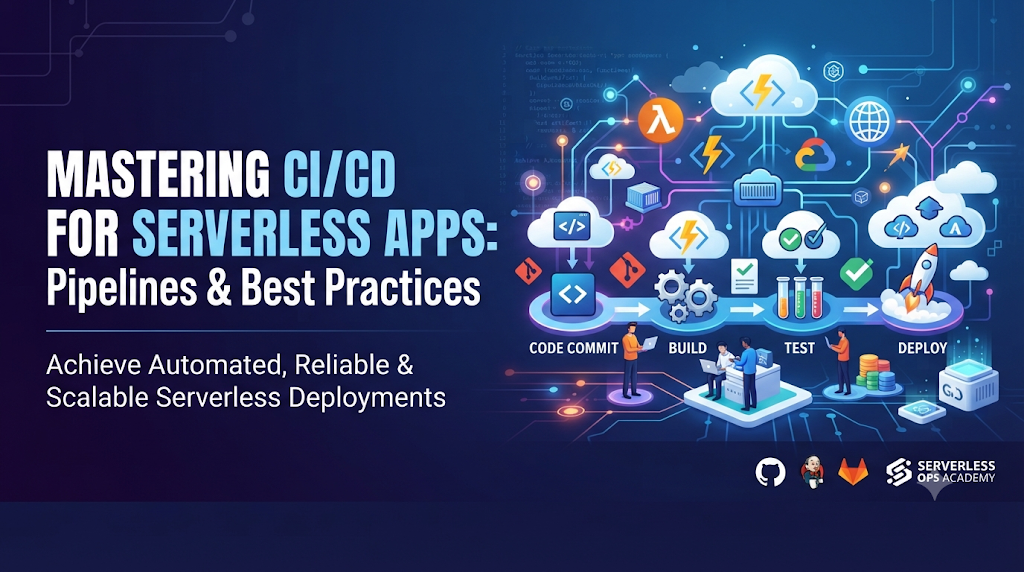
A mature serverless pipeline moves code from a developer’s workstation to production through a series of automated, repeatable stages:
- Developer commits code: Changes are pushed to a version control branch, triggering the automated pipeline.
- Pipeline performs code validation: Static code analysis, linting, and style checks run to catch syntax errors early.
- Dependencies are installed and checked: Third-party libraries are downloaded, scanned for known vulnerabilities, and prepared for packaging.
- Unit and integration tests run: Business logic is tested in isolation using mocked event payloads.
- Security and configuration checks are performed: Infrastructure code and IAM policies are scanned for security misconfigurations.
- Deployment artifacts are packaged: Code and dependencies are bundled into optimized archives or containers.
- Infrastructure changes are validated: Cloud provider validation tools check the Infrastructure as Code templates for syntax and structural correctness.
- Application is deployed to a target environment: Resources are provisioned and updated in a development or staging cloud environment.
- Smoke tests and health checks are executed: Automated tests verify that endpoints respond correctly and functions trigger as expected.
- Monitoring confirms the release behavior: Post-deployment metrics and logs are evaluated for anomalies before promoting to production.
Choosing the Right Deployment and Infrastructure Tools
Several specialized tools help teams manage serverless applications declaratively. Choosing the right tool depends on your cloud provider, team expertise, and architectural complexity.
- AWS Serverless Application Model (SAM): An extension of AWS CloudFormation designed specifically for defining serverless applications, providing shorthand syntax for functions, APIs, and tables.
- Serverless Framework: A popular open-source framework supporting multi-cloud deployments (AWS, Azure, Google Cloud) via plugin-driven configuration files.
- AWS Cloud Development Kit (CDK): Allows developers to define cloud infrastructure using familiar programming languages (TypeScript, Python, C#) that compile down to CloudFormation templates.
- Terraform: An industry-standard Infrastructure as Code tool capable of provisioning complex multi-cloud serverless architectures alongside traditional infrastructure.
- Azure Functions Core Tools & CLI: Native utilities for local development, building, and deploying Azure serverless workloads.
- Google Cloud deployment tooling: Native deployment managers, Cloud Build integrations, and Firebase/Cloud Run deployment utilities.
These tools enforce Infrastructure as Code principles, ensuring that cloud environments remain reproducible, version-controlled, and transparent.
Build a Practical Serverless CI/CD Pipeline
To illustrate how these concepts come together, consider a practical pipeline configuration using GitHub Actions to deploy an AWS Lambda function.
Repository Organization
A clean repository structure separates application code from infrastructure definitions:
Plaintext
my-serverless-app/
├── src/
│   └── handler.py
├── tests/
│   └── test_handler.py
├── template.yaml
└── .github/
    └── workflows/
        └── deploy.yml
Illustrative Workflow Configuration
The following example workflow validates, packages, and deploys a serverless application when code is merged to the main branch:
YAML
name: Serverless CI/CD Pipeline

on:
  push:
    branches:
      - main

jobs:
  build-and-deploy:
    runs-on: ubuntu-latest
    steps:
      - name: Checkout Code
        uses: actions/checkout@v4

      - name: Set up Python
        uses: actions/setup-python@v5
        with:
          python-version: '3.10'

      - name: Install Dependencies
        run: |
          python -m pip install --upgrade pip
          pip install pytest
          if [ -f src/requirements.txt ]; then pip install -r src/requirements.txt; fi

      - name: Run Unit Tests
        run: |
          pytest tests/

      - name: Configure AWS Credentials
        uses: aws-actions/configure-aws-credentials@v4
        with:
          aws-access-key-id: ${{ secrets.AWS_ACCESS_KEY_ID }}
          aws-secret-access-key: ${{ secrets.AWS_SECRET_ACCESS_KEY }}
          aws-region: us-east-1

      - name: Setup AWS SAM CLI
        uses: aws-actions/setup-sam@v2

      - name: Build Serverless Application
        run: |
          sam build --template template.yaml

      - name: Deploy to Production
        run: |
          sam deploy \
            --no-confirm-changeset \
            --no-sai-prompts \
            --stack-name production-serverless-stack \
            --capabilities CAPABILITY_IAM
Testing Serverless Applications Before Release
Testing serverless applications requires a multi-layered strategy because functions do not run inside a traditional web server process.
- Function-level unit testing: Test individual handler functions by passing simulated event payloads (such as API Gateway requests, S3 bucket notifications, or SQS messages) and asserting correct output responses.
- Event payload validation: Ensure functions handle malformed, missing, or unexpected event structures gracefully without crashing.
- Integration testing with connected services: Verify that functions interact correctly with downstream databases, caches, and external APIs using test environments or sandboxed services.
- API contract testing: Ensure that API schemas remain consistent across updates to prevent breaking frontend clients.
- Local execution and emulation: Use local emulators (such as SAM Local or LocalStack) to simulate cloud services during development.
- Failure and retry behavior: Test how functions handle timeouts, throttling limits, dead-letter queues, and asynchronous event retries.
Deployment Strategies for Serverless Releases
Releasing updates directly to production without safeguards can cause widespread outages if a bug slips through. Modern cloud services support sophisticated deployment strategies for serverless workloads.
- Direct deployment: Overwriting the existing function code immediately. This is suitable for development environments but risky for production.
- Versioned deployments: Publishing immutable function versions alongside an
$LATESTpointer, allowing precise rollbacks if an issue arises. - Alias-based traffic management: Creating function aliases (e.g.,
prod) that point to specific version numbers. - Canary releases: Routing a small percentage of production traffic to a newly deployed function version while monitoring error rates and latency.
- Linear traffic shifting: Gradually increasing traffic to the new version over a set duration (e.g., 10% every 5 minutes) until 100% adoption is reached.
- Rollback and roll-forward decisions: Automatically rolling back traffic to the previous stable version if CloudWatch alarms trip during a canary release window.
Security and Configuration: The Details That Can Break a Release
Security in serverless pipelines must be enforced across both the deployment machinery and the runtime environment.
- Least-privilege IAM permissions: Ensure that function execution roles grant access only to the specific resources required (e.g., a single DynamoDB table rather than all databases).
- Secrets management: Never hardcode API keys or database passwords in source code or configuration files. Retrieve secrets dynamically from managed secret stores at runtime.
- Secure pipeline authentication: Use short-lived credentials or OpenID Connect (OIDC) federation between CI/CD platforms and cloud providers instead of long-lived access keys.
- Dependency vulnerability scanning: Integrate automated scanners in the pipeline to check third-party libraries for known CVEs before packaging.
- Environment variable protection: Encrypt sensitive configuration variables using cloud-native key management services.
- Infrastructure policy validation: Use static analysis tools (such as Checkov or cfn-lint) to scan Infrastructure as Code templates for security misconfigurations before deployment.
- Artifact integrity: Ensure deployment packages are signed or transferred over secure channels to prevent tampering.
Managing Multiple Functions and Environments
As serverless applications grow from a single function to enterprise-grade systems containing dozens of microservices, operational complexity multiplies.
- Development, staging, and production environments: Isolate cloud resources completely across environments to prevent experimental changes from impacting live users.
- Shared infrastructure components: Manage shared networking, VPC configurations, and central databases separately from rapidly changing application functions.
- Independent deployment versus coordinated releases: Decide whether functions should be deployed in independent repositories or as part of a cohesive service monorepo.
- Configuration separation: Use environment-specific configuration files or parameter stores to inject appropriate database endpoints, log levels, and feature flags.
- API and event contract compatibility: Ensure that asynchronous message producers and consumers maintain backward-compatible event schemas.
Monitoring What Happens After Deployment
A successful pipeline build and green deployment indicator do not guarantee that an application is operating correctly in production. Comprehensive observability is required immediately after release.
- Invocation count: Track request volumes to verify traffic patterns and detect unexpected spikes or drops.
- Error rate: Monitor unhandled exceptions, timeout errors, and function crashes in real time.
- Function duration and latency: Measure execution time to identify performance regressions or slow downstream database queries.
- Cold starts: Track initialization duration when functions spin up new execution containers.
- Throttling: Monitor concurrency limits to ensure the application does not exceed cloud provider quotas.
- Retry behavior: Analyze dead-letter queues and asynchronous retry counts to spot failing background jobs.
- Cost and resource consumption: Monitor memory allocation versus actual usage to optimize cloud expenditure.
Common Serverless CI/CD Problems and Their Solutions
Engineering teams frequently encounter specific hurdles when automating serverless workflows. Recognizing these issues helps prevent deployment bottlenecks:
- Dependency packaging failures: Native dependencies compiled on local developer operating systems (like macOS or Windows) may fail when executed in Linux-based cloud runtimes. Solution: Use containerized build environments or cloud-native build commands (like
sam build) to compile dependencies for the correct target architecture. - Incorrect event trigger configuration: Event mappings failing to attach properly due to missing IAM permissions. Solution: Ensure deployment roles possess explicit permissions to manage event source mappings.
- Deployment package size limitations: Exceeding direct upload size limits for function code archives. Solution: Package large dependencies or machine learning models as container images or load them from external object storage.
- Infrastructure drift: Manual modifications made directly in the cloud console conflicting with automated IaC templates. Solution: Lock down production console access and enforce all changes through version-controlled pipelines.
- Unexpected cloud costs: Misconfigured event loops or runaway recursive triggers generating massive invocation bills. Solution: Implement strict concurrency limits, budget alerts, and circuit breakers.
A Practical Adoption Roadmap
Transitioning to a fully automated serverless delivery model is best approached in deliberate phases:
- Start with one small serverless application: Pick a non-critical utility function or microservice to pilot your CI/CD tooling.
- Automate source validation and unit tests: Set up basic repository triggers to run linters and unit tests on every pull request.
- Add packaging and deployment automation: Introduce automated artifact bundling and cloud deployment steps in your pipeline.
- Manage infrastructure through code: Transition manual cloud resources into declarative templates using tools like SAM, Serverless Framework, or Terraform.
- Introduce security and approval controls: Add automated vulnerability scans and manual approval gates for production deployments.
- Add integration tests and release strategies: Implement staging environment validation, canary deployments, and automated rollbacks.
- Implement monitoring and post-deployment validation: Connect cloud metrics, error tracking, and automated health checks to release pipelines.
- Expand reusable pipeline practices across projects: Standardize templates and share pipeline patterns across engineering teams.
Frequently Asked Questions
What is CI/CD for serverless applications?
CI/CD for serverless applications is the automated process of building, testing, securing, and deploying function code, event triggers, permissions, and infrastructure configurations to cloud environments without manual intervention.
How is serverless CI/CD different from traditional CI/CD?
Unlike traditional pipelines that deploy monolithic binaries or container images to steady-state servers, serverless pipelines must coordinate discrete function runtimes, fine-grained IAM permissions, event source mappings, and serverless infrastructure resources concurrently.
Can AWS Lambda be deployed through GitHub Actions?
Yes. GitHub Actions provides flexible workflow runners that can authenticate with AWS securely, install dependency packages, build application bundles using tools like the AWS SAM CLI, and deploy updates directly to Lambda functions.
How do you test serverless functions before deployment?
Serverless functions are tested using local unit tests with mocked event payloads, integration tests against emulated or sandbox cloud environments, API contract tests, and automated validation of infrastructure security policies.
Is Infrastructure as Code necessary for serverless CI/CD?
While simple functions can be deployed manually, Infrastructure as Code is virtually essential for production serverless applications to manage event sources, databases, API gateways, and permissions consistently across environments.
How can serverless deployments be rolled back?
Serverless deployments can be rolled back by updating function aliases to point to a previously published immutable function version or by reverting the Infrastructure as Code template and executing a new pipeline deployment.
What security checks should a serverless pipeline include?
A secure pipeline should include static analysis of Infrastructure as Code templates, dependency vulnerability scanning, least-privilege permission validation, secret management scanning, and OIDC-based cloud authentication.
Final Perspective: Automate the Entire Serverless Lifecycle
Building resilient serverless applications demands more than writing clean function code—it requires treating the entire cloud ecosystem as a cohesive, version-controlled system. Effective CI/CD automation bridges the gap between application logic and infrastructure provisioning, ensuring that updates to code, event triggers, permissions, and configurations are delivered safely and reliably. By combining robust testing, Infrastructure as Code, progressive deployment strategies, and continuous observability, engineering teams can unlock the true agility of serverless computing while maintaining operational confidence and cost control.