






Introduction
DevOps has become an important part of modern software development and IT operations. Organizations are adopting cloud computing, automation, microservices, containerization, and continuous delivery to develop and release applications faster. As a result, professionals who understand both software development and IT operations are increasingly valuable to technology teams.
For beginners, however, entering the DevOps field can feel challenging. There are many technologies to explore, including Linux, Git, Python, Jenkins, Docker, Kubernetes, AWS, Terraform, Ansible, and monitoring platforms. The biggest challenge is not finding tools to learn but understanding the correct order in which to learn them.
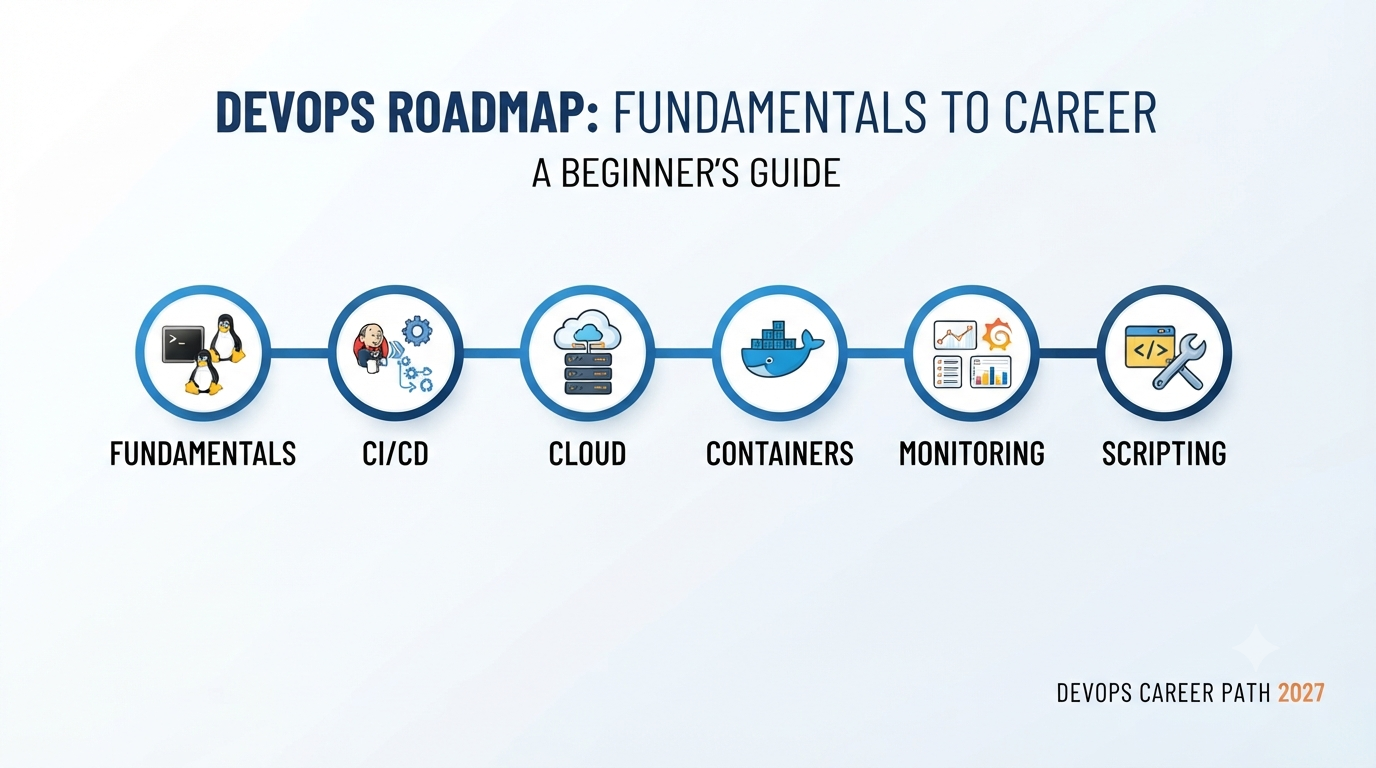
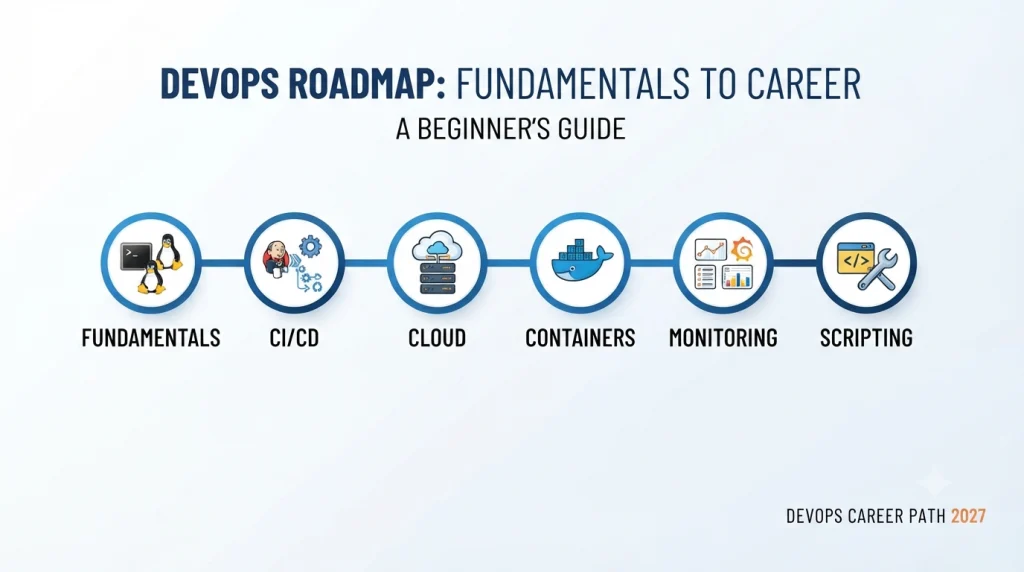
A structured DevOps roadmap for beginners in 2027 provides a practical learning path. It begins with fundamental IT concepts and gradually introduces automation, CI/CD, containers, cloud infrastructure, infrastructure as code, monitoring, security, and advanced engineering practices.
This guide explains how beginners can build DevOps knowledge step by step, which tools are worth exploring, what projects they should complete, and how to prepare for DevOps career opportunities. Whether you are a student, fresher, software developer, system administrator, or IT professional planning a career transition, this roadmap can help you organize your learning journey.
What Is DevOps?
DevOps is a combination of cultural practices, processes, and technologies that brings software development and IT operations closer together. Its primary objective is to improve collaboration, automate repetitive activities, accelerate software delivery, and maintain application reliability.
Traditionally, development and operations teams often worked separately. Developers concentrated on writing application code, while operations teams handled deployment, servers, infrastructure, and production support. This separation could create communication gaps, deployment delays, and difficulties resolving application issues.
DevOps encourages both teams to share responsibility throughout the software delivery lifecycle. Teams collaborate during planning, development, testing, deployment, monitoring, and maintenance.
Important DevOps principles include:
- Collaboration between development and operations teams.
- Continuous integration and continuous delivery.
- Infrastructure automation and configuration management.
- Continuous testing and quality improvement.
- Monitoring, logging, and operational feedback.
- Security throughout the development lifecycle.
- Continuous learning and process improvement.
DevOps is not a single software product or programming language. It is an approach that uses suitable tools and engineering practices to improve the complete application delivery process.
Why Should Beginners Learn DevOps in 2027?
DevOps skills are relevant because organizations need reliable methods to build, deploy, operate, and maintain software applications. As cloud-native architectures and distributed applications become more common, engineering teams require professionals who can automate infrastructure and improve delivery workflows.
Several developments make DevOps a valuable learning direction in 2027.
1. Growing Adoption of Cloud Computing
Organizations increasingly use cloud platforms to host applications, databases, storage, networking, and development environments. DevOps engineers help automate and manage these resources using cloud-native services and infrastructure automation tools.
2. Faster Software Delivery
Businesses want to release new features, security updates, and bug fixes without unnecessary delays. CI/CD pipelines help automate building, testing, and deployment activities.
3. Increased Demand for Automation
Manual infrastructure management and repetitive deployment tasks consume time and can introduce errors. DevOps professionals use scripting, configuration management, and infrastructure as code to create repeatable workflows.
4. Expansion of Containerized Applications
Docker and Kubernetes have become important technologies for packaging and operating modern applications. Understanding containers and orchestration can help beginners prepare for cloud-native engineering responsibilities.
5. Greater Focus on Security
Security is increasingly integrated into development and deployment workflows. DevSecOps practices help teams identify vulnerabilities, protect credentials, scan dependencies, and apply security controls throughout software delivery.
6. Opportunities in Related Career Paths
DevOps knowledge can support career development in several related areas, including:
- DevOps Engineer
- Cloud Engineer
- Site Reliability Engineer (SRE)
- Platform Engineer
- Build and Release Engineer
- Infrastructure Automation Engineer
- DevSecOps Engineer
- Kubernetes Administrator
- Cloud Operations Engineer
The best career direction depends on your interests, experience, and the technical responsibilities you want to pursue.
Complete DevOps Roadmap for Beginners in 2027
A successful DevOps learning journey should follow a logical sequence. Beginners should develop strong technical foundations before moving toward advanced automation and cloud-native technologies.
Step 1: Understand IT Fundamentals and the Software Development Lifecycle
Before learning DevOps tools, understand how software applications are developed, tested, released, and maintained.
The Software Development Life Cycle (SDLC) describes the major stages involved in creating and maintaining software. DevOps practices connect these stages through collaboration, automation, and continuous feedback.
Start by learning:
- Software development fundamentals.
- Software Development Life Cycle (SDLC).
- Agile and Scrum methodologies.
- Application development and testing environments.
- Development, staging, and production environments.
- Basic software architecture.
- Release management.
- Quality assurance and testing.
- Differences between traditional IT operations and DevOps.
Understand how application code moves from a developer’s computer into a production environment. Learn why testing, version control, deployment automation, and monitoring are important.
Practical exercise: Draw a simple software delivery workflow showing planning, coding, source control, testing, building, deployment, and monitoring.
Step 2: Learn Linux and Command-Line Administration
Linux is one of the most important foundations for DevOps engineering. Many servers, containers, cloud workloads, and automation environments use Linux-based operating systems.
A beginner should become comfortable working in a terminal rather than depending entirely on graphical interfaces.
Important Linux topics include:
- Linux distributions such as Ubuntu, Debian, and Red Hat Enterprise Linux.
- File and directory management.
- Users, groups, and permissions.
- File ownership and access control.
- Process and service management.
- Package installation and updates.
- Disk and memory management.
- SSH and remote server administration.
- Environment variables.
- System logs and troubleshooting.
- Cron jobs and scheduled tasks.
- Basic shell commands and text processing.
Common commands worth practicing include ls, cd, pwd, mkdir, cp, mv, rm, cat, grep, find, chmod, chown, ps, top, df, du, and systemctl.
Learn how to connect to a remote Linux server through SSH, inspect system logs, identify resource problems, and restart services.
Recommended tools: Ubuntu, Rocky Linux, Red Hat Enterprise Linux, OpenSSH, and Windows Subsystem for Linux.
Practical project: Set up a Linux virtual machine, create multiple users, configure permissions, install a web server, and troubleshoot a service that fails to start.
Step 3: Understand Computer Networking
DevOps engineers regularly work with applications, servers, cloud networks, load balancers, and distributed systems. Networking knowledge is therefore essential for diagnosing connectivity and deployment problems.
Learn the following concepts:
- IP addresses and subnetting.
- Public and private IP addresses.
- TCP and UDP.
- DNS and domain resolution.
- HTTP and HTTPS.
- SSL/TLS certificates.
- Ports and protocols.
- Firewalls and security groups.
- Routing and gateways.
- Proxies and reverse proxies.
- Load balancing.
- VPN fundamentals.
- Network troubleshooting.
Understand what happens when a user enters a website address into a browser. Learn how DNS resolves a domain, how a connection is established, and how an application server responds to an HTTP request.
Useful networking commands include ping, curl, traceroute, nslookup, dig, ip, ss, and netstat where available.
Practical project: Configure a Linux web server, connect to it from another machine, inspect its network ports, and troubleshoot a deliberately blocked connection.
Step 4: Learn Programming and Scripting
DevOps engineers do not always need the same programming depth as application developers, but they must understand scripts and basic code logic.
Scripting helps automate repetitive activities such as backups, file processing, service checks, log analysis, infrastructure operations, and deployment tasks.
Start with Bash scripting because it is useful in Linux environments.
Learn:
- Variables and data types.
- Conditional statements.
- Loops.
- Functions.
- Command-line arguments.
- Exit codes.
- File handling.
- Process execution.
- Error handling.
- Scheduling scripts.
After learning Bash fundamentals, explore Python. Python is useful for writing automation scripts, interacting with APIs, processing data, and integrating different systems.
Important Python topics include variables, conditions, loops, functions, modules, file operations, exception handling, JSON, and API requests.
Recommended tools: Bash, Python, Visual Studio Code, and Git.
Practical project: Create a Bash script that checks disk usage and running services. Then create a Python script that reads system information and generates a simple status report.
Step 5: Master Git and Version Control
Version control allows teams to track code changes, collaborate on projects, review modifications, and maintain a reliable history of software development.
Git is a foundational DevOps technology because application code, infrastructure configuration, pipeline definitions, and automation scripts are commonly maintained in repositories.
Learn these Git concepts:
- Repository creation.
- Initializing a repository.
- Adding and committing changes.
- Branch creation and management.
- Merging and rebasing.
- Pull requests and code reviews.
- Conflict resolution.
- Tags and releases.
- Reverting changes.
- Repository collaboration.
- Basic branching strategies.
Explore platforms such as GitHub, GitLab, and Bitbucket to understand how teams manage source code.
A beginner should know how to clone a repository, create a feature branch, commit changes, push updates, and submit a pull request.
Practical project: Create a GitHub repository containing your Linux scripts and Python automation projects. Use branches, meaningful commits, and a pull request to demonstrate a collaborative workflow.
Step 6: Understand Build Automation and Software Testing
Before learning advanced CI/CD, understand how applications are compiled, packaged, tested, and prepared for deployment.
Different programming languages use different build systems. For example, Java projects commonly use Maven or Gradle, while JavaScript projects may use npm or similar package managers.
Important concepts include:
- Source code compilation.
- Dependency management.
- Build artifacts.
- Unit testing.
- Integration testing.
- Functional testing.
- Automated test execution.
- Package repositories.
- Build failure analysis.
- Software versioning.
Explore tools such as Maven, Gradle, npm, and relevant testing frameworks.
Practical project: Build a small application, execute its tests, generate a build artifact, and store the result in a repository or artifact management system.
Step 7: Learn Continuous Integration and Continuous Delivery
Continuous Integration and Continuous Delivery or Deployment are central DevOps practices.
Continuous Integration (CI) involves frequently integrating code changes into a shared repository and validating them through automated builds and tests.
Continuous Delivery (CD) prepares tested software for release through an automated process. Continuous Deployment goes further by automatically releasing qualifying changes into production.
Learn:
- CI/CD pipeline architecture.
- Pipeline stages and jobs.
- Automated builds.
- Automated testing.
- Pipeline triggers.
- Branch-based workflows.
- Build artifacts.
- Environment variables.
- Secure credential management.
- Deployment automation.
- Pipeline approvals.
- Rollbacks and failure handling.
Popular CI/CD tools include:
- Jenkins.
- GitHub Actions.
- GitLab CI/CD.
- Azure Pipelines.
Beginners should select one tool and understand it properly instead of attempting to master every platform simultaneously.
Jenkins is widely used for flexible automation pipelines. GitHub Actions provides convenient automation for repositories hosted on GitHub. GitLab CI/CD offers integrated source control and pipeline capabilities.
Practical project: Create a CI/CD pipeline that automatically runs tests when code is pushed, builds an application package, and deploys the application to a test server.
Step 8: Learn Docker and Containerization
Containerization allows applications and their dependencies to be packaged into consistent, portable environments.
Docker is an important technology for understanding how applications are built and executed in containers.
Start with these concepts:
- Containers and virtual machines.
- Docker architecture.
- Docker Engine.
- Docker images.
- Docker containers.
- Dockerfiles.
- Image layers.
- Container networking.
- Persistent volumes.
- Environment variables.
- Image registries.
- Docker Compose.
- Container logs and troubleshooting.
Learn how to build a custom image, run a container, expose application ports, mount volumes, and connect multiple services.
Also understand basic container security, including trusted base images, minimal image size, dependency updates, and avoiding hardcoded secrets.
Practical project: Containerize a simple web application and its database. Use Docker Compose to run the application and database together.
Step 9: Understand Cloud Computing
Cloud computing is a major part of modern DevOps environments. Cloud platforms provide computing, storage, networking, databases, identity management, and managed application services.
Beginners should choose one major cloud provider first.
Popular platforms include:
- Amazon Web Services (AWS).
- Microsoft Azure.
- Google Cloud Platform (GCP).
Focus on transferable cloud concepts rather than memorizing every service.
Important topics include:
- Cloud computing models.
- Virtual machines and compute services.
- Object and block storage.
- Virtual networks.
- Subnets and routing.
- Identity and access management.
- Security groups and firewalls.
- Load balancers.
- Managed databases.
- DNS services.
- Autoscaling.
- Cloud monitoring.
- Cost management.
For example, on AWS, learners can explore EC2, S3, IAM, VPC, Elastic Load Balancing, and CloudWatch. Similar concepts exist in Azure and Google Cloud, although service names and implementation details differ.
Practical project: Deploy a basic web application on a cloud virtual machine, configure network access securely, and enable monitoring.
Step 10: Learn Infrastructure as Code
Infrastructure as Code (IaC) allows engineers to define and manage infrastructure through configuration files rather than creating every resource manually.
IaC improves consistency, repeatability, collaboration, and infrastructure change management.
Important topics include:
- Infrastructure provisioning.
- Declarative and imperative approaches.
- Configuration files.
- Variables and outputs.
- Reusable modules.
- State management.
- Infrastructure planning.
- Change review.
- Environment management.
- Drift detection.
Explore Terraform or OpenTofu for infrastructure provisioning. Learn Ansible for configuration management and automation.
Terraform is commonly used to define cloud infrastructure, while Ansible helps configure systems and automate operational tasks.
Practical project: Create a cloud virtual network and virtual machine using infrastructure configuration files. Document the deployment process and demonstrate how the infrastructure can be recreated.
Step 11: Learn Kubernetes and Container Orchestration
After understanding Docker and container fundamentals, progress to Kubernetes.
Kubernetes is an open-source container orchestration platform that helps deploy, scale, manage, and maintain containerized applications.
It is particularly useful when applications consist of multiple services that need coordinated deployment and operation.
Important Kubernetes concepts include:
- Kubernetes architecture.
- Control plane and worker nodes.
- Pods.
- Deployments.
- ReplicaSets.
- Services.
- Namespaces.
- ConfigMaps.
- Secrets.
- Persistent Volumes.
- Ingress and networking.
- Resource requests and limits.
- Health probes.
- Horizontal Pod Autoscaling.
- Helm charts.
- Kubernetes troubleshooting.
Learn how to use kubectl to inspect resources, deploy applications, view logs, and investigate failures.
Start with a local learning environment such as Minikube or kind before moving to managed Kubernetes services.
Practical project: Deploy a containerized application to a local Kubernetes cluster. Configure a Deployment and Service, expose the application, and test scaling and recovery after a container failure.
Step 12: Learn Configuration Management and Automation
Configuration management helps maintain consistent system settings across multiple servers and environments.
Ansible is a useful starting point because it supports automation through readable playbooks.
Explore:
- Inventory management.
- Ansible modules.
- Playbooks.
- Variables.
- Templates.
- Roles.
- Handlers.
- Configuration automation.
- Application deployment.
- Server provisioning.
Understand how configuration management differs from infrastructure provisioning. Terraform or OpenTofu can create infrastructure resources, while Ansible can configure operating systems and applications on those resources.
Practical project: Use Ansible to install and configure a web server across multiple Linux virtual machines.
Step 13: Learn Monitoring, Logging, and Observability
Deploying an application is not the end of the DevOps process. Engineering teams must monitor application performance, detect failures, investigate incidents, and maintain service reliability.
Monitoring helps identify whether systems are healthy. Logging provides event information, while observability combines metrics, logs, and traces to help engineers understand complex system behavior.
Important concepts include:
- Infrastructure monitoring.
- Application performance monitoring.
- Metrics and dashboards.
- Centralized logging.
- Distributed tracing.
- Alert management.
- Incident response.
- Service-Level Indicators (SLIs).
- Service-Level Objectives (SLOs).
- Error budgets.
- Root cause analysis.
Popular tools include Prometheus, Grafana, OpenTelemetry, Loki, and the Elastic Stack.
Practical project: Configure Prometheus to collect application or system metrics and create Grafana dashboards. Add an alert that triggers when a selected metric crosses a defined threshold.
Step 14: Understand DevSecOps and Security Fundamentals
Security should be integrated throughout the software development and deployment lifecycle rather than treated as a final activity.
DevSecOps introduces security checks and controls into development workflows, CI/CD pipelines, infrastructure, and production operations.
Important topics include:
- Secure coding fundamentals.
- Identity and access management.
- Least-privilege permissions.
- Secrets management.
- Dependency vulnerability scanning.
- Static Application Security Testing (SAST).
- Dynamic Application Security Testing (DAST).
- Container image scanning.
- Infrastructure security.
- Cloud security.
- Network security.
- Audit logging.
- Security policies and compliance fundamentals.
Explore tools such as Trivy, SonarQube, OWASP ZAP, and suitable cloud-native security services.
Practical project: Add dependency scanning and container image scanning to an existing CI/CD pipeline. Store sensitive credentials securely and ensure they are not exposed in source code or pipeline logs.
Step 15: Explore GitOps and Advanced DevOps Practices
Once you understand CI/CD, Kubernetes, and infrastructure automation, explore GitOps.
GitOps uses version-controlled declarative configuration as the source of truth for managing application and infrastructure states. Automated agents compare the desired configuration with the actual environment and reconcile differences.
Useful tools include Argo CD and Flux.
Other advanced topics include:
- Helm and Kustomize.
- Progressive delivery.
- Blue-green deployments.
- Canary releases.
- Automated rollback.
- Policy as Code.
- Service mesh fundamentals.
- Platform engineering.
- Internal developer platforms.
- Site Reliability Engineering.
- FinOps and cloud cost optimization.
These technologies are not all required for an entry-level DevOps role. Learn them progressively as your practical experience grows.
DevOps Tools Beginners Should Learn in 2027
The DevOps ecosystem contains many tools, but beginners should focus on a manageable selection that covers the main engineering responsibilities.
| Skill Area | Tools to Explore | Learning Objective |
|---|---|---|
| Operating System | Linux, Ubuntu | Server administration |
| Networking | SSH, curl, DNS utilities | Network troubleshooting |
| Scripting | Bash, Python | Automation |
| Version Control | Git, GitHub, GitLab | Source management |
| Build Automation | Maven, Gradle | Application builds |
| CI/CD | Jenkins, GitHub Actions | Pipeline automation |
| Containers | Docker, Docker Compose | Application packaging |
| Cloud | AWS, Azure, GCP | Cloud infrastructure |
| Infrastructure as Code | Terraform, OpenTofu | Infrastructure provisioning |
| Configuration Management | Ansible | System configuration |
| Orchestration | Kubernetes, Helm | Container management |
| Monitoring | Prometheus, Grafana | Metrics and alerting |
| Observability | OpenTelemetry | Telemetry collection |
| Security | Trivy, SonarQube, OWASP ZAP | Security testing |
| GitOps | Argo CD, Flux | Declarative delivery |
The objective is not to learn every tool listed. Select one technology in each major category, build practical experience, and expand your knowledge when a project or job requirement demands it.
Practical DevOps Projects for Beginners
Hands-on projects are essential because they demonstrate whether you can apply technical concepts to real engineering problems.
Project 1: Linux Server Administration
Create a Linux virtual machine and configure users, permissions, services, storage, SSH access, and scheduled tasks.
Skills demonstrated: Linux administration, command-line operations, and troubleshooting.
Project 2: Automated Backup Script
Write a Bash or Python script that backs up selected directories, creates timestamped archives, and records execution results.
Skills demonstrated: Scripting, file management, scheduling, and error handling.
Project 3: Git-Based Collaboration Workflow
Create an application repository, maintain feature branches, submit pull requests, and document changes.
Skills demonstrated: Git, GitHub, branching, and collaboration.
Project 4: Automated CI/CD Pipeline
Build a pipeline that checks out application code, installs dependencies, executes tests, and creates a build artifact.
Skills demonstrated: CI/CD, build automation, and automated testing.
Project 5: Dockerized Web Application
Create a Dockerfile for a web application and use Docker Compose to run it with a database.
Skills demonstrated: Containerization, networking, volumes, and application packaging.
Project 6: Cloud Application Deployment
Deploy an application to AWS, Azure, or Google Cloud. Configure networking, access permissions, and basic monitoring.
Skills demonstrated: Cloud infrastructure and application deployment.
Project 7: Infrastructure Automation with Terraform
Create reusable infrastructure configuration files that provision a virtual machine and required networking resources.
Skills demonstrated: Infrastructure as Code, cloud provisioning, and configuration management.
Project 8: Kubernetes Application Deployment
Deploy a containerized application to a Kubernetes cluster and configure services, resource limits, and health checks.
Skills demonstrated: Kubernetes, container orchestration, and troubleshooting.
Project 9: Monitoring and Alerting Setup
Create monitoring dashboards and configure alerts for CPU usage, memory consumption, application availability, or request errors.
Skills demonstrated: Prometheus, Grafana, monitoring, and incident detection.
Project 10: Complete End-to-End DevOps Pipeline
Combine Git, CI/CD, Docker, Kubernetes, cloud infrastructure, Terraform, security scanning, and monitoring into one project.
The project should demonstrate how a code change moves through automated testing, container creation, deployment, and production monitoring.
Skills demonstrated: End-to-end DevOps implementation and practical engineering problem-solving.
A 10-Month DevOps Learning Plan for Beginners in 2027
A planned schedule can help beginners avoid jumping between unrelated technologies. The following example assumes approximately 8–12 hours of study and practice each week. Your progress may vary depending on your previous IT experience and available learning time.
| Month | Learning Focus | Expected Practical Outcome |
|---|---|---|
| Month 1 | DevOps fundamentals and Linux | Manage a Linux virtual machine |
| Month 2 | Networking and Git | Configure a web server and maintain a Git repository |
| Month 3 | Bash and Python scripting | Automate routine system tasks |
| Month 4 | Build tools and CI/CD | Create an automated build and test pipeline |
| Month 5 | Docker and Docker Compose | Containerize a web application |
| Month 6 | Cloud fundamentals | Deploy an application to a cloud platform |
| Month 7 | Terraform and Ansible | Provision and configure infrastructure |
| Month 8 | Kubernetes and Helm | Deploy and manage containerized applications |
| Month 9 | Monitoring and DevSecOps | Configure dashboards, alerts, and security checks |
| Month 10 | End-to-end project and interview preparation | Publish a practical DevOps portfolio |
At the end of each month, review your learning and complete a practical task. Do not move forward simply because you have watched a course or completed a tutorial. Make sure you can perform the main tasks independently.
Important Skills Required to Become a DevOps Engineer
DevOps engineering combines technical knowledge with communication, problem-solving, and operational awareness.
Technical Skills
A beginner should gradually develop:
- Linux system administration.
- Networking fundamentals.
- Bash and Python scripting.
- Git and version control.
- CI/CD pipeline development.
- Docker and Kubernetes.
- Cloud computing.
- Infrastructure as Code.
- Configuration management.
- Monitoring and logging.
- Security fundamentals.
- Application deployment and troubleshooting.
Problem-Solving Skills
DevOps engineers regularly investigate failed deployments, unavailable services, performance problems, infrastructure errors, and network connectivity issues.
Develop the habit of examining logs, checking system resources, understanding error messages, and testing possible solutions systematically.
Communication and Collaboration
DevOps involves collaboration with developers, testers, security specialists, architects, and operations teams. Clear communication helps teams coordinate releases, resolve incidents, and improve delivery processes.
Continuous Learning
Cloud platforms, automation tools, and engineering practices continue to evolve. A successful DevOps professional should be willing to learn new technologies while maintaining strong foundational knowledge.
DevOps Certifications to Consider in 2027
Certifications can help learners organize their studies and demonstrate knowledge of specific technologies. However, certifications should complement practical experience rather than replace it.
Some options to explore include:
Cloud Certifications
- AWS Certified Cloud Practitioner.
- AWS Certified Solutions Architect – Associate.
- Microsoft Azure Administrator Associate.
- Google Cloud Associate Cloud Engineer.
Kubernetes Certifications
- Certified Kubernetes Administrator (CKA).
- Certified Kubernetes Application Developer (CKAD).
- Certified Kubernetes Security Specialist (CKS).
Infrastructure and Automation Certifications
- HashiCorp Terraform Associate.
- Relevant Linux administration certifications.
- Cloud-provider automation and DevOps credentials.
Always check the official certification provider for current exam names, prerequisites, costs, and syllabus changes before registering.
For beginners, a foundational cloud certification may be a reasonable starting point. More advanced credentials are best pursued after gaining practical experience.
Common Mistakes Beginners Should Avoid
Learning DevOps can become confusing when beginners try to cover too many technologies at once. Avoiding common mistakes can make the learning process more effective.
1. Starting with Advanced Tools Too Early
Learning Kubernetes without understanding Linux, networking, and containers can create unnecessary difficulties. Build the foundation first.
2. Learning Too Many Tools Simultaneously
Trying to learn Jenkins, GitHub Actions, GitLab CI/CD, AWS, Azure, and multiple configuration tools at the same time can divide your attention. Start with one tool in each category.
3. Ignoring Networking Fundamentals
Many deployment and cloud infrastructure issues are related to DNS, ports, routing, firewall rules, and connectivity. Networking should be part of your early learning plan.
4. Depending Only on Video Tutorials
Watching tutorials is useful, but it does not prove practical ability. Recreate the examples, change configurations, troubleshoot errors, and build independent projects.
5. Neglecting Security
Never store passwords, access keys, or tokens directly in source code. Learn secure credential handling and least-privilege access from the beginning.
6. Ignoring Monitoring
A deployment is not successful simply because an application starts. Learn how to verify application health, inspect logs, monitor performance, and respond to failures.
7. Not Documenting Projects
A project without documentation is difficult for others to evaluate. Maintain clear README files, architecture diagrams, setup instructions, and explanations of the problems solved.
Career Opportunities After Learning DevOps
DevOps knowledge can help beginners explore several technical career paths. The exact responsibilities depend on the company, team structure, and experience level.
DevOps Engineer
A DevOps engineer works on automation, CI/CD pipelines, infrastructure management, application deployment, and collaboration between development and operations teams.
Cloud Engineer
A cloud engineer focuses on cloud infrastructure, networking, access management, compute resources, storage, and cloud operations.
Site Reliability Engineer
An SRE focuses on system reliability, availability, performance, automation, incident management, and service-level objectives.
Platform Engineer
A platform engineer develops internal platforms and reusable infrastructure capabilities that make it easier for application developers to build and deploy software.
DevSecOps Engineer
A DevSecOps engineer integrates security controls into application development, infrastructure, CI/CD pipelines, and operational workflows.
Build and Release Engineer
A build and release engineer manages software build systems, release automation, artifact management, and deployment processes.
Beginners should build broad DevOps fundamentals before choosing a specialization.
How to Prepare for Your First DevOps Job
Getting a first DevOps opportunity requires more than knowing tool names. Employers want candidates who understand engineering workflows and can demonstrate practical ability.
Follow these recommendations:
- Build a strong foundation in Linux, networking, Git, and scripting.
- Create at least three to five well-documented practical projects.
- Publish project code and configuration files on GitHub.
- Learn one CI/CD platform and one cloud provider.
- Practice Docker, Kubernetes fundamentals, and infrastructure automation.
- Understand basic application security and monitoring.
- Prepare to explain the architecture and decisions behind your projects.
- Practice troubleshooting scenarios involving Linux, pipelines, containers, and cloud infrastructure.
- Create a resume that highlights practical outcomes rather than only listing tools.
- Continue learning through technical communities, documentation, and structured training.
During interviews, be prepared to explain how you would investigate a failed pipeline, troubleshoot a container that repeatedly restarts, secure a deployment pipeline, or recover an unavailable application.
Future Trends in DevOps Beyond 2027
DevOps continues to evolve as organizations adopt cloud-native architectures, automation, and new software delivery approaches.
Platform Engineering
Platform engineering focuses on building internal developer platforms that provide reusable tools, infrastructure, templates, and workflows. It can reduce the operational burden on application development teams.
AI-Assisted DevOps
AI-based tools can assist with log analysis, code suggestions, troubleshooting, documentation, and workflow automation. Engineers still need to review generated configurations and understand the risks of automated changes.
GitOps Adoption
GitOps continues to support declarative infrastructure and application management, especially in Kubernetes environments. It encourages version-controlled configuration and automated reconciliation.
DevSecOps Integration
Security checks are increasingly incorporated into build pipelines, container workflows, infrastructure configuration, and software supply chain management.
Cloud Cost Optimization
As cloud environments grow, businesses need better visibility into resource consumption and spending. DevOps teams may work more closely with FinOps practices to improve infrastructure efficiency.
Observability and Reliability Engineering
Modern distributed applications require stronger visibility into metrics, logs, traces, and service health. SRE practices help teams balance delivery speed with system reliability.
These developments are worth exploring after learning the core DevOps concepts. Foundational skills remain essential even as tools and industry practices change.
How DevOpsSchool.jp Can Support Your Learning Journey
Learning DevOps requires a combination of technical fundamentals, structured guidance, and hands-on practice. A learning resource can help beginners understand complex topics in a more organized way and identify the next skills to develop.
DevOpsSchool.jp presents expertise in DevOps, Site Reliability Engineering (SRE), DevSecOps, and MLOps, alongside training, consulting, and enterprise support offerings. Learners can explore the platform to understand its areas of specialization and identify relevant learning or professional development opportunities.
When selecting a training program, consider whether it provides:
- A structured learning path from fundamentals to advanced topics.
- Practical demonstrations and hands-on exercises.
- Exposure to commonly used DevOps tools.
- Real-world project experience.
- Guidance from experienced technical instructors.
- Opportunities to practice troubleshooting.
- Relevant career and interview preparation.
A good learning approach should combine guided study with independent projects. Use documentation, practical labs, and real deployment exercises to develop the ability to solve problems without relying entirely on step-by-step instructions.
Explore the official website: https://devopsschool.jp/
Frequently Asked Questions (FAQs)
1. What is the best DevOps roadmap for beginners in 2027?
A practical roadmap begins with IT fundamentals, Linux, networking, Bash or Python scripting, and Git. After building these foundations, learn build automation, CI/CD, Docker, cloud computing, Terraform, Ansible, Kubernetes, monitoring, and security. Complete practical projects at every stage to understand how the tools work together. This progressive approach is more effective than trying to learn many advanced technologies simultaneously.
2. Can a complete beginner learn DevOps in 2027?
Yes. A complete beginner can learn DevOps by following a structured learning path and practicing consistently. Previous experience in programming, system administration, or networking can be helpful, but it is not essential to begin. Start with Linux and networking fundamentals, develop basic scripting skills, and gradually move toward automation, cloud infrastructure, and container technologies.
3. How long does it take to learn DevOps?
The learning period depends on your previous experience, study schedule, and practical training. Someone starting from zero may need approximately 8 to 12 months of consistent part-time learning to build a broad foundation and complete meaningful projects. Learners with software development, Linux, or cloud experience may progress faster. Job readiness also depends on troubleshooting ability, project quality, and interview preparation.
4. Which programming language is best for DevOps beginners?
Bash and Python are useful starting points. Bash is particularly helpful for automating Linux administration and command-line tasks, while Python supports more complex automation, API integrations, and data processing. Beginners do not need to become advanced software developers immediately, but they should understand variables, loops, functions, conditions, file handling, and error management.
5. Is Linux necessary for DevOps?
Yes, Linux is a highly valuable skill for DevOps professionals. Many cloud servers, containers, and production environments use Linux-based systems. DevOps engineers should understand file permissions, users, processes, services, networking commands, SSH, logs, package management, and system troubleshooting. Practical Linux experience makes it easier to understand Docker, Kubernetes, and cloud infrastructure.
6. Which DevOps tools should I learn first?
Start with Linux, Git, Bash, and Python. Then choose one CI/CD platform, such as Jenkins or GitHub Actions, and learn Docker for containerization. After that, select one cloud provider and explore Terraform, Ansible, Kubernetes, Prometheus, and Grafana. Learning one tool properly in each category is usually more effective than collecting superficial knowledge of many tools.
7. Is Kubernetes required to become a DevOps engineer?
Kubernetes is an important technology in many modern cloud-native environments, but it should not be the first topic for beginners. Learn Linux, networking, Docker, and CI/CD before moving to Kubernetes. Entry-level responsibilities differ between organizations, and some DevOps roles may emphasize cloud infrastructure, scripting, pipelines, or configuration management more heavily than Kubernetes.
8. Which cloud platform should a beginner learn for DevOps?
AWS, Microsoft Azure, and Google Cloud are all useful platforms. A beginner should select one based on learning resources, career interests, and the environments they want to work with. Focus on transferable concepts such as virtual machines, storage, networking, identity and access management, load balancing, and monitoring. Once you understand one cloud platform, learning another becomes easier.
9. Are DevOps certifications enough to get a job?
Certifications can demonstrate knowledge and provide a structured way to study, but they are not a substitute for practical experience. Employers may evaluate your ability to create CI/CD pipelines, manage Linux servers, deploy containerized applications, automate infrastructure, and troubleshoot technical problems. Combine certifications with well-documented projects, GitHub repositories, and practical interview preparation.
10. What projects should beginners build for a DevOps portfolio?
Beginners should build projects that demonstrate the complete software delivery process. Good examples include Linux automation scripts, Git collaboration workflows, CI/CD pipelines, Dockerized applications, cloud deployments, Terraform infrastructure, Kubernetes deployments, and Prometheus-Grafana monitoring systems. An end-to-end project combining several of these technologies can demonstrate a stronger understanding of real DevOps workflows.
11. Can freshers apply for DevOps jobs?
Yes, freshers can apply for junior DevOps, cloud support, infrastructure support, build and release, and related entry-level opportunities. However, job requirements vary between employers. Freshers should develop strong fundamentals, complete practical projects, understand basic cloud and automation workflows, and be prepared to explain their work during technical interviews.
12. What is the difference between DevOps and DevSecOps?
DevOps focuses on collaboration, automation, continuous delivery, and reliable software operations. DevSecOps extends these practices by integrating security throughout the software development and delivery lifecycle. It includes activities such as dependency scanning, secure configuration, secrets management, container scanning, vulnerability testing, and security monitoring. DevSecOps helps teams deliver software efficiently while addressing security risks earlier in the process.
Conclusion
A complete DevOps roadmap for beginners in 2027 should focus on building skills in the correct sequence. Start with IT fundamentals, Linux, networking, scripting, and Git. Then progress toward build automation, CI/CD, Docker, cloud computing, Infrastructure as Code, configuration management, and Kubernetes. Once these foundations are established, develop your knowledge of monitoring, observability, DevSecOps, GitOps, and advanced engineering practices.
The most effective way to learn DevOps is through practical implementation. Build small projects, automate repetitive tasks, deploy applications, investigate failures, and document your work. Rather than trying to master every tool available, focus on understanding the concepts behind the technologies and learning how they work together.
With consistent practice, a structured learning plan, and a portfolio of meaningful projects, beginners can develop the technical foundation needed to pursue DevOps and related engineering opportunities in 2027 and beyond. DevOpsSchool.jp can be explored as one of the resources for learners interested in DevOps, SRE, DevSecOps, and MLOps training and professional development.