




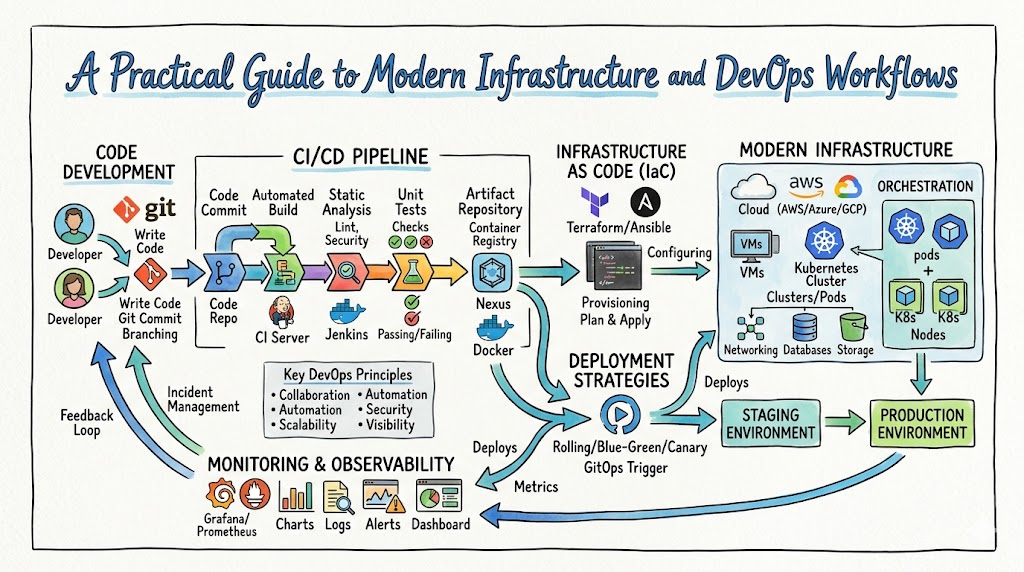
Introduction
When beginners first enter the world of software development, they often misunderstand what DevOps actually looks like inside a real business. Many students and IT professionals assume that DevOps is simply a single software tool, a specific cloud certification, or a standalone job title held by an isolated engineer.
This misconception often leads people to believe that a single individual can handle the entire automation footprint of an enterprise. In reality, modern software delivery relies on deep organizational change and highly integrated groups of professionals working toward a common goal.
The myth that DevOps is just a single person or a set of automation tools often breaks down during real-world deployments. You cannot solve systemic communication gaps between software developers and system administrators simply by purchasing a new software license or hiring one engineer.
True software delivery efficiency comes from building structural collaboration across entire engineering departments. This requires shared responsibilities, unified goals, and open communication channels between everyone involved in the application lifecycle.
Because every company faces unique challenges, real DevOps teams vary significantly across different organizations. A fast-moving tech startup with five developers will structure its operations differently than a global banking enterprise with thousands of legacy applications.
To gain a practical, industry-grade understanding of these configurations, professionals often look to structured training systems like DevOpsSchool, which highlight real-world engineering setups. Understanding how these groups operate in practice is essential for anyone looking to build a sustainable career in modern IT.
What Is a DevOps Team?
A DevOps team is a cross-functional group of professionals who share responsibility for the entire lifecycle of a software application. This includes everything from the initial code design and development to testing, deployment, security, and ongoing production maintenance.
Unlike traditional IT setups where developers write code and hand it off to a separate operations team, this approach focuses on absolute shared ownership. Team members work together to remove historical barriers and speed up delivery.
This operational model relies heavily on a culture of continuous collaboration and open feedback. Instead of working in isolated silos, team members use shared metrics, automated pipelines, and transparent communication channels to ensure software is stable and secure.
The core objective is to deliver frequent, high-quality updates to users without causing system downtime or service interruptions.
[Local Development] ---> [Automated Testing] ---> [CI/CD Pipeline] ---> [Production Monitoring]
       ^                                                                           |
       |_______________________ Continuous Feedback Loop ___________________________|
Consider a beginner-friendly example: an e-commerce company building a mobile shopping application. In a traditional IT setup, the software developers might write a new checkout feature and send it to an isolated operations team for deployment. If the deployment fails, the two groups often blame each other, leading to delays.
In a true DevOps environment, developers, operations specialists, and quality assurance engineers collaborate from day one. They build automated testing and deployment steps together, ensuring that potential issues are caught long before the software reaches live customers.
Why There Is No Single DevOps Team Structure
There is no single, one-size-fits-all DevOps team structure because every organization has different business goals, operational scales, and historical engineering architectures. A structure that works perfectly for a small, cloud-native software company can easily cause major issues inside a large financial institution.
Companies must design their teams around their specific technical requirements, regulatory challenges, and existing internal cultures.
Startup vs. Enterprise Scale
Startups typically operate with minimal staff, flat management hierarchies, and a clear focus on rapid product iteration. In these environments, engineers usually wear multiple hats, writing application features while simultaneously managing cloud environments and build pipelines.
Enterprises, on the other hand, manage hundreds of complex legacy applications, strict compliance frameworks, and large engineering departments. These organizations require more structured, specialized configurations to maintain stability across massive corporate infrastructures.
Team Maturity
An organization’s operational maturity also plays a major role in how it structures its teams. Companies just beginning their digital modernization journey often start with a dedicated, centralized team focused entirely on building basic automation pipelines.
As the engineering organization matures over time, these centralized responsibilities often shift. Individual product teams begin taking direct ownership of their own deployments, reducing the need for an isolated operations group.
Technology Stack Influence
The specific technologies an organization uses will also shape its operational structures. A company running simple applications on a single cloud provider requires less operational overhead than an enterprise managing a complex multi-cloud environment.
Similarly, teams working with modern microservices and container orchestration tools like Kubernetes require different day-to-day workflows than those maintaining traditional, on-premise physical servers.
Common Roles Inside a DevOps Team
To understand how these groups function in daily operations, it helps to examine the specific responsibilities of each team member. While titles often vary across different companies, the core responsibilities remain highly consistent.
| Role | Responsibility |
| Software Developers | Write application features, create unit tests, and fix bugs in the code. |
| DevOps Engineers | Build CI/CD pipelines, manage infrastructure as code, and automate workflows. |
| SRE Engineers | Focus on system reliability, manage production uptime, and handle on-call incidents. |
| QA/Test Engineers | Build automated testing suites and validate application functionality. |
| Security Engineers | Integrate security scanning tools and ensure regulatory compliance. |
| Cloud Engineers | Provision cloud infrastructure, optimize resources, and manage network security. |
| Platform Engineers | Build internal developer platforms and maintain shared internal tooling. |
Software Developers
Software developers focus primarily on writing the actual business logic and application features that provide value to customers. In a collaborative DevOps environment, their responsibilities extend beyond simply writing code.
They write automated unit tests, collaborate on deployment configurations, and help troubleshoot production issues when their specific applications experience downtime.
DevOps Engineers
DevOps engineers act as critical bridges between application development and live production environments. They specialize in building and maintaining automated continuous integration and continuous delivery pipelines.
These specialists spend their days writing infrastructure as code templates, configuring build tools, and ensuring that code moves smoothly from local laptops to live cloud servers.
Site Reliability Engineers (SRE)
Site Reliability Engineers treat operational infrastructure as a software engineering problem. They focus heavily on production system availability, application latency, performance optimization, and emergency capacity planning.
SREs establish clear service level objectives, configure advanced monitoring dashboards, and run post-incident reviews to ensure production systems remain highly resilient.
QA/Test Engineers
Quality Assurance and test engineers focus on moving testing steps directly into the automated delivery pipeline. Instead of manually clicking through applications at the very end of a development cycle, they write automated testing scripts that run with every single code commit.
This approach ensures that functional bugs and performance regressions are flagged immediately, long before code reaches production.
Security Engineers
Security engineers working within a DevSecOps framework ensure that security checks are an active part of the daily development workflow. They integrate automated vulnerability scanners directly into build pipelines to check for insecure dependencies and exposed configuration secrets.
By automating these checks early in the lifecycle, they prevent security issues from delaying production release timelines.
Cloud Engineers
Cloud engineers focus on the core infrastructure design, resource provisioning, and network architecture of cloud provider environments. They ensure that storage systems, compute instances, and virtual networks are properly configured for scale, security, and cost efficiency.
These professionals collaborate closely with pipeline developers to ensure target deployment environments are consistently stable.
Platform Engineers
Platform engineers build and maintain internal developer platforms that simplify infrastructure management for application teams. They package complex underlying cloud resources into clear, reusable, and automated self-service portals.
This allows software developers to provision databases, testing environments, and hosting resources on demand without needing deep expertise in low-level infrastructure.
How DevOps Teams Work Together
Real-world DevOps teams succeed by replacing old communication barriers with a model of deep, shared responsibility. In traditional organizations, developers were judged solely on how many features they shipped, while operations teams were judged on system stability.
This conflict naturally created tension, as new code updates inherently introduced risks to system stability. Modern DevOps teams align these incentives so that everyone shares responsibility for both feature delivery and production uptime.
Traditional Model:  [Dev Team] --(Ships Code)--> [Silo / Wall] --(Deploys)--> [Ops Team]
Modern DevOps:      [Dev + Ops + QA + Security] ---> Shared Ownership / Shared Pipelines
This alignment fundamentally changes how different engineering specialists interact on a daily basis. Developers work directly with operations engineers during the initial architecture phase of a feature, rather than waiting until deployment day.
They discuss expected database loads, network configurations, and monitoring requirements well before writing any production code. This upfront collaboration significantly reduces surprises when the software goes live.
Continuous feedback loops form the operational backbone of this collaborative approach. Automated monitoring tools constantly track application performance, user behavior, and system errors in live production environments.
This real-time operational data is fed directly back to development and testing teams. When a live performance issue occurs, the entire cross-functional group reviews the data together to build permanent fixes, rather than pointing fingers or shifting blame.
Typical DevOps Workflow in Practice
To see how these principles operate in a live company, it helps to walk through a standard software delivery workflow. The table below outlines how different roles collaborate across each distinct phase of a modern software lifecycle.
| Stage | Team Involvement |
| Planning | Developers, Product Managers, and Operations map out infrastructure and feature needs. |
| Development | Developers write feature code while Operations builds supporting infrastructure templates. |
| Testing | QA Engineers run automated test suites while Security scans code for vulnerabilities. |
| CI/CD | DevOps Engineers manage automated build tools to package code and run validation checks. |
| Deployment | Automated pipelines push the verified software build out to live cloud hosting environments. |
| Monitoring | SREs and Developers track system metrics, resource consumption, and application errors. |
| Incident Response | Operations, SREs, and Developers collaborate via on-call schedules to resolve live bugs. |
Planning Phase
During the planning phase, product managers, software developers, security analysts, and operations engineers sit down together to review upcoming project requirements. They evaluate the infrastructure impact of new features, estimate cloud hosting costs, and identify potential security risks.
By addressing these architectural concerns during planning, the team avoids costly rebuilds later in the project.
Development Phase
As developers write application logic on their local computers, operations specialists concurrently write infrastructure as code templates using tools like Terraform or OpenTofu. This parallel workflow ensures that the destination environments match development environments exactly.
Developers regularly check their code into a shared repository, where peer reviews help catch logic bugs early.
Testing Phase
Once code is checked into the repository, automated testing suites instantly run functional tests, integration checks, and performance benchmarks. QA engineers monitor these results to ensure the new code does not break existing application features.
Concurrently, automated security tools scan code dependencies to ensure no known software vulnerabilities are introduced.
CI/CD Phase
The continuous integration and continuous delivery phase compiles code, packages applications into deployable containers, and runs final validation suites. DevOps engineers design and optimize these pipeline workflows to run quickly and reliably.
If any test fails during this automated process, the pipeline stops immediately and alerts the engineering team to fix the issue.
Deployment Phase
Once a software build successfully passes all automated gates, the CI/CD pipeline deploys the update to production environments using strategies like blue-green or canary releases. This minimizes user impact by routing traffic to the new version gradually.
Because this process is entirely automated, teams can safely deploy software updates multiple times a day.
Monitoring Phase
After a deployment completes, real-time monitoring platforms track system health, memory usage, API response times, and error rates. Site Reliability Engineers use these live metrics to confirm that the new deployment is running smoothly under real user traffic.
This continuous observational data helps teams discover and address minor performance slips before they impact customers.
Incident Response Phase
If a production system experiences a critical failure or performance drop, automated alerting systems instantly notify the on-call engineers. Developers and operations specialists join a shared communication channel to review system logs and resolve the issue together.
Once production is stable, the team holds a blameless post-mortem meeting to find the root cause and update their automation to prevent the issue from happening again.
DevOps Team Model #1: Embedded DevOps Team
The embedded DevOps model integrates operations and automation specialists directly into specific product development teams. Instead of sitting in a separate department, these engineers work side-by-side with frontend developers, backend developers, and product designers.
They participate in all daily team meetings, planning sessions, and retrospective reviews.
+---------------------------------------+
|          Product Team Alpha           |
| [Devs]  [QA]  [Embedded DevOps Eng]   |
+---------------------------------------+
This model works exceptionally well because it aligns the automation specialist directly with the product team’s specific goals. The embedded engineer gains a deep understanding of the application’s unique code architecture, database requirements, and user patterns.
This localized knowledge allows them to build highly customized pipelines and infrastructure configurations tailored exactly to that application’s needs.
However, this approach can sometimes create consistency challenges across a larger company. If an organization has ten different product teams, each with an embedded DevOps engineer, those engineers may build ten different ways to deploy code.
Without regular cross-team alignment, this lack of standardized tooling can lead to fragmented infrastructure setups that are difficult for an enterprise to manage long-term.
An example of this model in practice is a mobile banking app development team. The embedded operations engineer focuses entirely on the unique iOS and Android build environments, specific financial security tools, and data encryption pipelines required for that specific application.
They can move quickly because they do not have to wait for help from an outside, centralized infrastructure team.
DevOps Team Model #2: Centralized DevOps Team
The centralized DevOps model sets up a dedicated team of automation and infrastructure specialists who serve the entire engineering organization. This group acts as a central hub of expertise, building shared build pipelines, managing core cloud infrastructure, and selecting standardized engineering tools.
Individual development teams submit requests to this central group whenever they need new infrastructure resources or pipeline modifications.
                  +--------------------------+
                  | Centralized DevOps Team  |
                  +--------------------------+
                    /          |           \
                   v           v            v
        [Product Team A]  [Product Team B]  [Product Team C]
This model is effective for maintaining strict architectural consistency, cost controls, and security standards across an entire company. Because a single team manages the core infrastructure, they can ensure every department follows identical security protocols and deployment workflows.
This centralized approach also prevents individual product teams from wasting time reinventing infrastructure setups from scratch.
The main drawback of a centralized model is that the team can easily become an operational bottleneck. If dozens of development teams must wait for the centralized group to manually approve pipeline updates or provision new cloud servers, software delivery slows down.
If the central team falls behind on requests, frustrated developers may try to bypass official processes to ship their features on time.
Consider a large enterprise scenario: an insurance company with forty separate software development teams. The centralized DevOps group maintains a standard deployment pipeline template that every team must use.
While this setup keeps security audits simple and predictable, individual development groups may face long wait times when requesting custom pipeline changes for a new product.
DevOps Team Model #3: Platform Engineering Model
The platform engineering model is a modern approach where a dedicated platform team builds and maintains an Internal Developer Platform (IDP). This team treats the internal platform as a product, and their users are the company’s application developers.
The goal is to build automated, self-service tools that allow developers to manage their own infrastructure needs without needing deep operations expertise.
+-------------------------------------------------------------+
|                     Product Developers                      |
+-------------------------------------------------------------+
                              |
                     (Self-Service APIs / IDP)
                              v
+-------------------------------------------------------------+
|             Platform Engineering Team (Tooling)             |
+-------------------------------------------------------------+
                              |
                      (Cloud Infrastructure)
                              v
                [AWS / Azure / GCP Cloud Space]
This model drastically reduces the cognitive load on software developers. Instead of forcing developers to master complex cloud networking, container orchestration, and security compliance policies, the platform team bakes these standards directly into simple self-service portals.
Developers can easily click a button or run a simple command to provision a secure database or launch a pre-configured testing environment.
This approach balances the speed of decentralized teams with the governance of centralized models. Application developers gain the autonomy to move fast and deploy code independently, while the platform team maintains overarching control by writing the underlying infrastructure automation templates.
This setup keeps corporate environments secure and cost-efficient without slowing down delivery timelines.
For instance, a modern software-as-a-service (SaaS) company might use a platform engineering group to manage their Kubernetes infrastructure. The platform team builds a clean internal web dashboard for the staff.
When a backend developer needs to deploy a new microservice, they simply input the service name into the dashboard, and the platform automatically configures the underlying hosting space, security policies, and monitoring connections.
DevOps Team Model #4: DevSecOps Integration
The DevSecOps model shifts security checks from a final review phase directly into every step of the daily development and deployment process. In older IT configurations, security teams only reviewed applications right before production release.
This late review often caused friction, as fixing newly discovered security issues at the end of a project required massive code rewrites and delayed launch dates.
[Plan] -> [Code] -> [Automated Security Scan] -> [Test] -> [Deploy] -> [Monitor]
In a mature DevSecOps model, automated security validation tools are embedded directly into the continuous integration pipelines. Every time an engineer pushes new code, automated workflows scan the application for outdated dependencies, exposed API keys, and common coding flaws.
Security engineers focus on configuring these automated guardrails, analyzing threat metrics, and training development groups, rather than manually auditing every line of code.
This structural integration helps organizations maintain high delivery speeds while keeping their software secure against evolving digital threats. By catching vulnerabilities early in the development cycle, teams can patch bugs quickly and cheaply.
This proactive approach turns security into a shared daily responsibility for the entire engineering department, rather than an isolated compliance check.
For example, a healthcare technology team handling sensitive patient data uses a DevSecOps approach to maintain regulatory compliance. Their automated pipeline includes mandatory compliance scanners that check data encryption configurations with every single build.
If a developer accidentally leaves a database port exposed to the public internet in an infrastructure script, the automated pipeline flags the error immediately and cancels the deployment before the code can ever reach production.
Real-World Example: Startup DevOps Team
Inside a typical early-stage startup with a total engineering staff of ten people, there is rarely enough budget or work to support dedicated, isolated operations roles. The DevOps team structure in this environment is highly fluid and collaborative.
The company typically employs a few versatile developers, a senior engineer with strong cloud experience, and a product manager.
Startup Team Model (Highly Overlapping):
+-----------------------------------------+
| [Full Stack Dev]      [Cloud-Savvy Dev] |
|                                         |
| [Product Manager]     [QA / Tester]     |
+-----------------------------------------+
The daily workflow here relies on shared responsibility and minimalist infrastructure setups. The team intentionally uses managed platform-as-a-service providers and automated serverless technologies to minimize manual system maintenance.
The cloud-savvy developer might spend a morning setting up a simple GitHub Actions workflow to automate code deployments, then spend the rest of the day writing frontend application code alongside the other developers.
Communication in a startup happens instantly via direct channels or quick stand-up meetings. When a production bug pops up, the entire team jumps in together to review logs, deploy a fix, and verify the patch.
While this unstructured flexibility allows the startup to iterate rapidly and adapt to market needs, the lack of dedicated operational specialists can create technical debt if the application’s infrastructure scales up quickly.
Real-World Example: Enterprise DevOps Team
Inside a large enterprise, such as a multinational retail brand or an insurance company, the DevOps landscape is much more structured and specialized. The organization must coordinate hundreds of developers spread across dozens of global product teams while maintaining strict data compliance and system stability.
To manage this scale, the company implements a mature platform engineering or matrixed DevOps model.
Enterprise Matrix Infrastructure:
   [Platform Team] ---- Provides Shared IDP & Core Tooling ----+
                                                              |
   [Product Team 1] --> Has Embedded SRE / DevOps Support <----+
   [Product Team 2] --> Has Embedded SRE / DevOps Support <----+
The enterprise sets up a dedicated platform engineering team tasked with building and maintaining a highly secure internal development platform. Concurrently, specialized Site Reliability Engineers and security analysts are embedded directly into individual, high-priority business units.
Every single change to code or infrastructure must pass through automated testing matrices, compliance verification steps, and change-management tracking platforms before reaching live servers.
The daily operations in this enterprise environment follow highly predictable, documented processes. While individual application developers can ship features independently using the self-service developer platform, the underlying system guardrails prevent them from making configuration errors that could impact compliance.
This structured configuration allows large corporations to maintain high security standards and operational resilience across massive software footprints, though introducing major infrastructure updates can take longer than it would in a small startup.
Common Challenges DevOps Teams Face
Transitioning to a collaborative operational model comes with distinct organizational and technical challenges. Companies frequently encounter significant roadblocks that can slow down their modernization efforts if not managed carefully.
Communication Gaps
The largest obstacles to successful DevOps adoptions are cultural, not technical. Even with high-end automation tools in place, deep-seated historical mistrust between separate development and operations groups can stall progress.
If management fails to align individual performance incentives, engineers may slip back into isolated communication habits, leading to dropped handoffs and finger-pointing during production outages.
Tool Overload
Modern engineering departments often struggle with tool sprawl and excessive system complexity. Without clear, centralized engineering standards, different product teams may adopt entirely different software components for building pipelines, tracking bugs, and monitoring applications.
This unmanaged tool sprawl increases software licensing costs, complicates security audits, and makes it incredibly difficult for engineers to collaborate across different internal projects.
Ownership Confusion
When an organization transitions to a shared ownership model without defining clear boundaries, team members can become confused about their daily responsibilities. If developers assume the automation engineers are solely responsible for production health, and automation engineers assume developers are monitoring code behavior, critical alerts can easily slip through the cracks.
Organizations must clearly document who owns specific operational tasks at every step of the application lifecycle.
Security Coordination
Integrating security checks into fast-moving delivery pipelines can cause major operational friction if implemented poorly. If security teams simply dump large, complicated, manual vulnerability audit reports onto fast-moving development groups right before a product launch, it disrupts delivery timelines.
Teams must dedicate time to fine-tuning automated scanning tools to minimize disruptive false-positive alerts, ensuring security remains an enabler rather than a roadblock.
Common Misconceptions About DevOps Teams
To build a high-performing engineering organization, teams must identify and move past common operational myths. Below is a practical checklist highlighting common misconceptions and the real-world operational facts behind them.
- Misconception: DevOps is a single job title or a one-person team.
- Reality: DevOps is an organizational culture and shared operational model. Hiring a single engineer and changing their job title on paper does not fix broken communication loops between development and operations departments.
- Misconception: Adopting DevOps means completely eliminating the Operations team.
- Reality: Operations work does not vanish; its focus shifts. Operations specialists move away from tedious manual server provisioning to build advanced automation, system platforms, and long-term infrastructure resilience.
- Misconception: Implementing DevOps means developers handle all operations work alone.
- Reality: Forcing application developers to master every single nuance of cloud networking, security compliance, and container orchestration creates excessive cognitive fatigue. High-performing organizations use structured platform teams to provide clear infrastructure guardrails.
- Misconception: Buying modern automation tools instantly solves all collaboration issues.
- Reality: Tools simply automate your existing processes. If an organization has fractured communication habits and poorly designed manual workflows, adding automated tools will only accelerate those broken workflows. Cultural alignment must come first.
Best Practices for Successful DevOps Teams
Building a reliable, high-performing software engineering organization requires a deliberate focus on proven cultural guidelines and operational habits. Teams can use the practical checklist below to audit and improve their daily delivery workflows.
- Establish true shared ownership for system outcomes.
- Ensure developers, testers, and operations specialists share identical project goals and uptime metrics.
- Include application developers directly in on-call support schedules so they understand how their code performs in live production environments.
- Prioritize small, frequent software deployments.
- Break large application updates down into small, isolated code changes that can be safely deployed multiple times a day.
- Smaller updates drastically minimize deployment risk and make tracking down the root cause of production errors simple.
- Automate workflows wherever practical and repeatable.
- Automate repetitive, error-prone manual tasks including software compilation, basic code testing, security dependency scanning, and environment resource provisioning.
- Save engineering time for high-value tasks like architecture design, code optimization, and building long-term system resilience.
- Maintain open, continuous feedback loops across departments.
- Share real-time production performance data, system error rates, and user metrics openly across all engineering groups.
- Hold blameless post-mortem reviews after production incidents to focus on improving automated guardrails, rather than assigning blame.
Role of DevOpsSchool in Understanding DevOps Teams
Navigating modern team configurations, complex deployment tools, and shifting cultural practices can feel overwhelming for beginners and experienced IT professionals alike. Developing a clear understanding of these workplace dynamics requires educational frameworks that look beyond basic software syntax to focus on real-world engineering workflows.
Educational ecosystems like DevOpsSchool play a valuable role here by providing structured, hands-on learning paths that mirror authentic corporate environments.
These programs help students and engineering professionals build a practical, collaborative mindset by simulating real-world team interactions. Instead of learning tools like Git, Jenkins, Docker, and Kubernetes in complete isolation, learners interact with these technologies inside integrated, continuous integration and continuous delivery pipelines.
This training methodology helps individuals understand exactly how code moves from a developer’s local laptop through automated testing gates and security checks out to live cloud destinations.
By focusing heavily on practical engineering scenarios, multi-role communication dynamics, and modern infrastructure as code strategies, these structured programs demystify real-world corporate frameworks. This comprehensive educational grounding ensures that freshers, developers, and system administrators can join modern software organizations with the technical skills and collaborative awareness required to contribute to a team from day one.
Career Importance of Understanding DevOps Teams
For anyone working in modern technology, understanding how operations teams are structured is a massive career advantage. As companies globally phase out old, siloed IT models, professionals who understand cross-functional collaboration are in high demand.
This systemic shift has opened up diverse, highly rewarding career tracks across the software industry.
                  +-----------------------------------+
                  | Modern Infrastructure Career Paths|
                  +-----------------------------------+
                     /        |             |        \
                    v         v             v         v
             [DevOps Eng]  [SRE Eng]  [Platform Eng]  [DevSecOps]
DevOps Engineer
DevOps engineers focus heavily on building automated software delivery systems and managing continuous integration pipelines. They possess a deep understanding of application development workflows, source control management, and cloud platform infrastructure.
Their ability to bridge different engineering departments makes them incredibly valuable assets for fast-moving software companies.
Site Reliability Engineer (SRE)
Site Reliability Engineers focus on maximizing production system availability, optimizing application performance, and engineering long-term operational resilience. They are highly skilled software developers who apply engineering principles directly to infrastructure scaling and incident response.
This career track is ideal for professionals who love solving complex, large-scale system problems.
Platform Engineer
Platform engineers specialize in building and maintaining internal self-service developer platforms that simplify infrastructure management for application developers. They understand API design, cloud-native architectures, and user-experience principles for internal staff.
As enterprises adopt internal platforms to reduce developer fatigue, this specialization continues to see rapid growth.
DevSecOps Engineer
DevSecOps engineers focus entirely on embedding automated security checks, vulnerability scanning systems, and compliance guardrails directly into modern build pipelines. They possess deep expertise in network security, access control management, and regulatory compliance standards.
Organizations handling sensitive user data value these specialists for keeping delivery pipelines secure at scale.
Beyond specific job titles, mastering these collaborative operational frameworks helps professionals build highly adaptable, future-proof career skillsets.
- Cross-Functional Collaboration: Learning to communicate effectively across software development, quality assurance, security, and operations groups helps engineers grow into impactful technical leaders.
- Workflow Automation: Developing the ability to spot manual bottlenecks and write reusable, automated scripts saves organizations immense time and money.
- Cloud Infrastructure Competency: Gaining a strong command of cloud provisioning tools, network design, and cost-optimization practices opens up doors across every industry using modern cloud technology.
- Systemic Problem Solving: Learning to analyze software delivery pipelines holistically allows professionals to diagnose and fix structural development bottlenecks efficiently.
Industries Using DevOps Teams
Modern collaborative engineering structures are no longer exclusive to hyper-scale Silicon Valley technology firms. Organizations across nearly every major industry vertical depend on fast, stable software deployment pipelines to remain competitive.
SaaS Platforms
Software-as-a-Service companies operate in highly competitive markets that demand constant innovation and maximum system uptime. These cloud-native firms rely heavily on automated platforms and embedded engineering models to ship feature updates multiple times a day without disrupting global users.
Continuous monitoring helps them identify and optimize performance bottlenecks instantly.
Banking and Finance
Financial institutions manage highly complex legacy systems, massive transaction volumes, and strict regulatory security audits. These organizations adopt structured DevSecOps and centralized platform engineering configurations to automate compliance checking and protect user data.
This automation allows banks to introduce modern digital features quickly while minimizing the risk of costly downtime.
Healthcare
Healthcare technology providers handle highly confidential patient health records and strict regulatory compliance requirements like HIPAA. By implementing integrated DevSecOps models, they build automated data encryption checks and rigorous audit trails directly into their delivery pipelines.
This setup allows them to deploy medical applications safely and reliably without compromising data security.
E-Commerce
Digital retail platforms experience massive, unpredictable swings in user traffic during seasonal shopping holidays and promotional events. These businesses leverage mature cloud engineering and site reliability practices to build self-scaling infrastructure environments.
Automated canary deployments ensure they can roll out user-experience updates safely, even during high-traffic shopping rushes.
Telecom
Telecommunication giants manage massive global networks and highly distributed edge-computing installations. They use centralized platform teams and advanced infrastructure automation to deploy system patches and service updates across thousands of distant hardware nodes safely.
This automated consistency ensures core communication networks remain highly reliable.
Enterprise IT
Traditional corporate IT groups managing large internal application portfolios use platform engineering models to modernize their legacy operations. By providing application developers with clean, automated self-service infrastructure portals, they eliminate weeks of manual ticket approvals.
This operational shift helps large, traditional businesses move with the speed and agility of modern technology startups.
Future of DevOps Team Structures
As cloud ecosystems and software delivery methodologies continue to evolve, the way organizations organize their engineering teams is shifting. One clear trend is the widespread rise of platform engineering as a distinct corporate practice.
Instead of forcing every application developer to master complex infrastructure tools, companies are increasingly relying on dedicated platform teams to build clean, automated self-service development systems.
Future Trend: AI Engine -> (Assists) -> [Platform Engineering Platform] -> (Empowers) -> [Developers]
Artificial intelligence and automated machine learning operations (AIOps) are also starting to reshape daily operational workflows. Modern monitoring systems leverage intelligent algorithms to analyze millions of infrastructure log entries in real-time, allowing teams to spot and isolate performance anomalies before they trigger critical system outages.
This intelligent automation helps on-call engineers cut through alert noise and resolve production bugs much faster.
The integration of security practices is becoming an absolute baseline requirement across all modern engineering environments. Security automation is no longer treated as an extra step added onto an existing deployment pipeline; it is baked directly into the core platform tools.
As cloud-native architectures grow more intricate, the teams that build them will rely on highly integrated, automated self-service frameworks that prioritize developer autonomy and systemic security.
FAQs (15 Questions)
What does a DevOps team do?
A DevOps team builds and maintains automated software delivery systems, manages cloud-hosting environments, and establishes continuous deployment pipelines. They align development, quality assurance, and operations workflows to help companies ship secure software updates quickly and reliably.
Is DevOps a separate team?
It varies by company. In some organizations, it exists as a centralized infrastructure team that builds shared pipelines. In other companies, DevOps is a collaborative cultural approach where automation specialists are embedded directly within application development groups.
Do developers work with DevOps engineers?
Yes, in a healthy engineering organization, developers and automation engineers collaborate daily. They work together during the early planning phases to discuss infrastructure needs, evaluate application performance metrics, and troubleshoot production deployment issues.
What is the difference between DevOps and SRE teams?
DevOps focuses primarily on breaking down organizational silos, automating delivery pipelines, and accelerating software release speeds. Site Reliability Engineering (SRE) is a specific implementation of DevOps that focuses heavily on production system availability, application latency, and building highly resilient infrastructure.
Why do companies structure DevOps differently?
Companies design their engineering teams around their specific organizational scale, application architectures, and regulatory requirements. A small startup prioritizes fluid flexibility and flat structures, while a massive financial enterprise requires specialized compliance and platform engineering groups to manage risk.
Is DevOps only for large companies?
No, small startups benefit immensely from adopting automated delivery workflows. While a startup may not have the budget for a dedicated infrastructure team, using basic automation and managed cloud services helps small teams deploy features quickly without manual errors.
What skills matter in DevOps teams?
Successful team members need a balanced mix of technical competencies and collaboration skills. Key technical skills include version control management, writing infrastructure as code, configuring CI/CD pipelines, and mastering cloud platforms. Strong communication skills and empathy are equally vital for resolving production issues.
Do DevOps teams handle security?
Yes, modern teams use a DevSecOps framework where security checks are integrated directly into the daily deployment workflow. Automated security scanning tools run alongside code compilation steps to catch software dependencies and configuration flaws early.
What is platform engineering?
Platform engineering is the practice of designing and building self-service internal platforms that automate infrastructure management for application developers. The platform team treats this internal interface as a product, minimizing developer friction and keeping cloud environments secure.
How does QA fit into a DevOps team?
Quality assurance shifts from a manual review phase at the very end of a project to an automated step embedded directly in the deployment pipeline. QA specialists write automated test scripts that run instantly with every code commit, providing developers with immediate feedback.
What happens when a production deployment fails?
The automated pipeline can instantly roll back the application update to the last known stable version to minimize user impact. The cross-functional team then joins a shared communication channel to review system logs, identify the root cause, and build a permanent code fix.
Can a manual developer transition into a DevOps role?
Yes, application developers can transition into infrastructure and automation roles by expanding their skillsets. Developers can start by learning cloud architecture fundamentals, mastering infrastructure as code tools like Terraform, and practicing building automated build pipelines.
What tools do these teams use in practice?
Teams leverage a wide variety of automation tools based on their technology stacks. Common tools include Git for version control, Jenkins or GitHub Actions for pipeline orchestration, Docker for containerization, Kubernetes for container orchestration, and Terraform for managing infrastructure as code.
How do teams measure their delivery success?
Organizations track their performance using industry-standard metrics including deployment frequency, lead time for changes, mean time to restore service (MTTR), and change failure rate. Monitoring these metrics helps teams discover and optimize operational bottlenecks over time.
Why should a fresher learn about DevOps team structures?
Understanding how engineering groups collaborate helps freshers adapt to real-world corporate environments quickly. Knowing how developers, testers, security teams, and infrastructure specialists interact ensures freshers can contribute effectively to modern software projects from day one.
Final Thoughts
At its core, DevOps is about building an authentic culture of collaboration and shared responsibility across an engineering organization, not just accumulating job titles or mastering individual software tools. The exact way a company chooses to structure its infrastructure teams depends entirely on its specific scale, business goals, and technology choices.
Whether an organization utilizes embedded operations engineers, a centralized infrastructure hub, or a modern platform engineering model, the fundamental goal remains identical: breaking down historical corporate silos to deliver stable software value safely.
For anyone pursuing a career in modern information technology, moving past industry hype to understand how these teams operate in daily practice is incredibly valuable. True operational efficiency is achieved through shared project metrics, automated testing loops, and a team-wide commitment to continuous system improvement.
As cloud-native environments grow more sophisticated over time, professionals who combine strong technical skills with a collaborative, empathetic mindset will continue to drive the future of software engineering.