




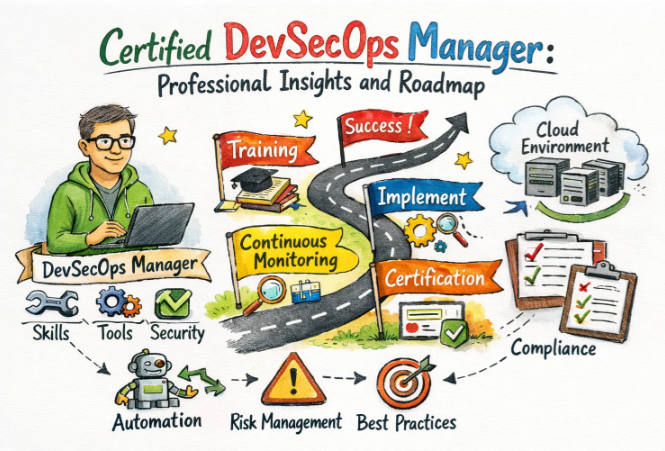
Securing a software pipeline is no longer just a technical task; it is a business-critical leadership function. This guide provides a strategic roadmap for those ready to move from technical execution to high-level management.
To be a top-tier leader, you must understand the full-stack health of your organization. Beyond security, mastering total system visibility is crucial. I highly recommend looking into the Master in Observability Engineering Certifications Program as a companion to your management journey. It’s the difference between guessing where a problem is and knowing exactly how to fix it before the business is impacted.
Global Certification Master Matrix
Use this table to map out your next three years of professional growth. These tracks represent the pillars of a modern, resilient engineering organization.
| Track | Level | Who it’s for | Prerequisites | Skills covered | Recommended order |
| DevOps | Associate | Aspiring Talent | Basic Linux/Cloud | CI/CD, Scripting, Docker | 1 |
| DevOps | Expert | Senior Engineers | 2+ Years Exp | IaC, Orchestration, Scaling | 2 |
| DevSecOps | Master | Team Leads & Managers | 3-5 Years Exp | Governance, Risk, Strategy | 3 |
| SRE | Specialist | Reliability Pros | Coding & Systems | SLOs, Incident Response | 2 |
| AIOps/MLOps | Specialist | ML & Data Leads | Python, Cloud | Model Pipelines, Auto-tuning | 3 |
| DataOps | Specialist | Data Architects | SQL, Big Data | Data Pipeline Integrity | 3 |
| FinOps | Specialist | Cloud Managers | Financial Basics | Unit Economics, Optimization | 2 |
| Observability | Master | Architects / Leads | Deep Telemetry | Distributed Tracing, Metrics | 4 |
Deep Dive: Certified DevSecOps Manager
The Certified DevSecOps Manager (CDOM) is not just a technical badge. It is a credential for those who want to own the security culture of an entire organization.
What it is
The CDOM is a master-level program that focuses on the governance, risk management, and strategic leadership of secure software delivery. It isn’t about running individual scans; it is about building an automated environment where security is a shared responsibility. It covers the strategic side of “Shift-Left,” ensuring that security doesn’t slow down innovation. Just as the Master in Observability Engineering provides visibility into performance, the CDOM provides visibility into organizational risk and compliance.
Who should take it
This path is designed for those ready to move from “doing” to “leading.”
- Engineering Managers standardizing security across multiple squads.
- Lead DevOps Engineers transitioning into administrative roles.
- Security Directors who need to integrate with agile development cycles.
- Compliance Architects looking to automate regulatory auditing (SOC2, HIPAA).
Skills you’ll gain
This certification transforms your approach from a technical contributor to a business-aligned leader.
You will master the art of balancing speed with safety. You will learn how to persuade developers to care about security by making it easy for them.
- Strategic Leadership: Managing cultural shifts and team dynamics in a DevSecOps environment.
- Governance as Code: Setting automated “guardrails” that prevent non-compliant code from ever reaching production.
- Risk Management: Identifying and prioritizing threats based on business impact rather than just technical severity.
- Security Orchestration: Choosing and managing the right mix of SAST, DAST, and SCA tools without breaking the developer experience.
- Compliance Visibility: Turning complex regulations into automated, real-time dashboards for executive stakeholders.
Real-world projects you should be able to do after it
Upon completion, you will have the capability to deliver high-stakes results for any global organization.
You will be able to design systems that protect the company’s bottom line.
- Building a Secure Delivery Roadmap: Designing a multi-quarter plan that weaves security into every phase of the product lifecycle.
- Implementing Continuous Compliance: Creating a system where your team is always “audit-ready,” eliminating the stress of manual quarterly reviews.
- Managing Vulnerability Response: Establishing a cross-functional process to identify, prioritize, and patch security issues in record time.
- Security Cost Optimization: Auditing your security tool stack to ensure the business gets the best ROI on its protection investments.
Preparation Plan
- 7–14 Days (The Expert Sprint): For seasoned leaders. Focus purely on the exam format and the specific governance frameworks (like ISO/NIST) mentioned in the curriculum. Spend 3 hours a day on mock assessments.
- 30 Days (The Career Pivot): The standard track. Spend the first two weeks on technical tool integration. Spend the last two weeks focusing on the “Manager” modules: risk assessment, team leadership, and compliance.
- 60 Days (The Foundation Builder): Recommended if you are moving from a non-security background. Spend the first month mastering the technical basics of DevSecOps. Spend the second month mastering management theory and the practical capstone projects.
Common Mistakes
Avoiding these pitfalls is essential for success in a management role.
Focusing on the “No” rather than the “How” is a common trap for new security managers.
- The Tool-First Trap: Many candidates think buying expensive security tools equals security. As a manager, you must focus on the process and the people using them.
- Ignoring Developer Friction: If your security checks slow down a release, developers will bypass them. You must focus on automation that is invisible to the developer.
- Working in a Silo: Security is a feature, not a department. If you don’t align your security goals with the product’s release goals, your strategy will fail.
- Neglecting Observability: You cannot secure what you cannot see. Failing to implement deep telemetry will leave you blind when an incident occurs. This is why the Master in Observability Engineering is so vital for modern leads.
Best Next Certification After This
Once you have mastered secure management, round out your profile with these three options:
- Same Track: Advanced Security Leadership for C-suite preparation.
- Cross-Track: FinOps Practitioner (to manage the high costs of cloud security infrastructure).
- Leadership Path: Master in Observability Engineering (to gain a 360-degree view of your technical estate).
Choose Your Path
Identify your five-year goal and follow the roadmap that gets you there.
- DevOps Path: Concentrates on the velocity and efficiency of software delivery.
- DevSecOps Path: Focuses on the integration of automated security into every phase of the lifecycle.
- SRE Path: Prioritizes the stability, scalability, and performance of large systems.
- AIOps/MLOps Path: Explores the use of artificial intelligence to manage and predict system behavior.
- DataOps Path: Streamlines the secure and reliable delivery of data for business intelligence.
- FinOps Path: Manages the financial efficiency of cloud resources to ensure maximum value.
Role → Recommended Certifications
| Your Current Role | Target Career Step | Recommended Path |
| DevOps Engineer | Senior / Lead | DevOps (E) $\rightarrow$ SRE (A) $\rightarrow$ CKA |
| SRE | Systems Architect | SRE (M) $\rightarrow$ Observability (M) |
| Platform Engineer | Engineering Manager | CDO Manager $\rightarrow$ FinOps (A) |
| Security Engineer | Security Lead | CDO Manager $\rightarrow$ SRE (A) |
| Data Engineer | Data Architect | DataOps $\rightarrow$ MLOps |
| Engineering Manager | Executive Leader | CDO Manager $\rightarrow$ Observability (M) |
Industry Leaders in Professional Training
Clear the Certified DevSecOps Manager exam by training with organizations that understand the global market.
- DevOpsSchool: A global powerhouse in professional training. They are known for high-intensity, hands-on labs that prepare you for real-world production crises, not just the exam.
- Cotocus: They specialize in corporate and department-wide training. They are the best choice for organizations looking to shift their entire engineering team to a DevSecOps mindset.
- Scmgalaxy: A technical community leader providing deep-dive documentation and workshops on the complex mechanics of orchestration and automation.
- BestDevOps: They offer a highly personalized approach, providing mentorship that helps you not just get certified, but also plan your next salary jump.
- Devsecopsschool: The official home for the CDOM certification. Their curriculum is updated constantly to reflect the latest global security threats and exam standards.
- Sreschool: The go-to source for reliability engineering. If you want to master SLOs, error budgets, and incident response, this is the place.
- Aiopsschool: Leading the charge into the future of operations. They provide the training needed to manage AI-driven infrastructures at scale.
- Dataopsschool: The authority on operationalizing data pipelines and maintaining data governance across massive datasets.
- Finopsschool: The essential hub for learning how to bridge the gap between technical engineering and corporate finance in the cloud.
General Career FAQs
- How do I decide between technical and management tracks? If you love solving code problems, stick with technical (SRE/Architect). If you love solving people and process problems, move to management (CDOM).
- What is the average time to get certified? Most professionals can complete a master-level certification like the CDOM in 30 to 60 days of focused study.
- Is there a difference in demand between India and the global market? The technology is the same, but the Indian market is seeing a massive surge in demand for managers who can handle global compliance standards like SOC2.
- Do I need a strong coding background for CDOM? You need to be “code-literate.” You don’t need to be the best developer, but you must be able to read scripts and understand pipeline logic.
- What is the ROI of these certifications? They act as a “career multiplier.” They move you from a replaceable worker to a strategic advisor who commands a higher salary.
- Can I transition from QA into DevSecOps? Yes. Experience with automated testing is a very natural bridge into the world of secure engineering.
- Why is Observability mentioned so much in management? Because a manager’s biggest fear is being blind. The Master in Observability Engineering gives you the “eyes” to see your system’s health.
- Are these exams proctored? Yes, to maintain the integrity of the credential, master-level exams are typically proctored online.
- What is the best way to prove the value of a cert to my boss? Show them the “Real-world projects” list. Explain how you can automate their audit process and reduce security risks.
- How often should I renew my certifications? Usually every 3 years. This ensures you stay current with the fast-moving tech landscape.
- Do I need an MBA to be an Engineering Manager? No. In the technical world, specialized master certifications like the CDOM are often valued more than a generic business degree.
- What is the first step I should take? Start with a vendor-neutral DevOps certificate to get the foundation, then specialize in the CDOM path.
Certified DevSecOps Manager (CDOM) FAQs
- How does the CDOM differ from a CISSP? The CISSP is very broad and often legacy-focused. The CDOM is specifically built for high-speed, automated, cloud-native environments.
- Is there a practical exam component? Yes, the program typically includes hands-on labs and project work where you must build and secure a real pipeline.
- Does it cover multi-cloud security? Yes, the principles are vendor-neutral and apply whether you are on AWS, Azure, or Google Cloud.
- How demanding is the course? It is a master-level program. It requires a serious commitment to learning both management theory and security technology.
- Is formal training mandatory? While you can self-study, the scenarios and case studies in formal training (like at devsecopsschool.com) are crucial for passing the manager-level exam.
- Can I take this if I’m a Project Manager? Yes, provided you have a basic understanding of how software is delivered and deployed.
- How does this certification help with remote teams? It provides a standardized framework for security that works across any location, making it easier to manage distributed engineers.
- What is the pass rate? Due to its rigorous nature, the pass rate for the CDOM is often under 50% on the first attempt, which is why proper training is vital.
Conclusion
Making the leap to become a Certified DevSecOps Manager is a defining moment in a professional’s career. It signifies that you are ready to take responsibility for the safety and reliability of your organization’s digital future. By merging speed with security and business logic, you become a rare and valuable leader in the global engineering market. This guide has provided you with the technical requirements, the preparation strategies, and the visionary paths available to you. Whether you choose to double down on the technicalities of SRE or the economics of FinOps, remember that the foundation of all modern leadership is visibility. Engaging with programs like the Master in Observability Engineering Certifications Program will ensure that you are never managing in the dark. Now is the time to invest in your growth, choose your specialization, and lead your organization with clarity and confidence.