




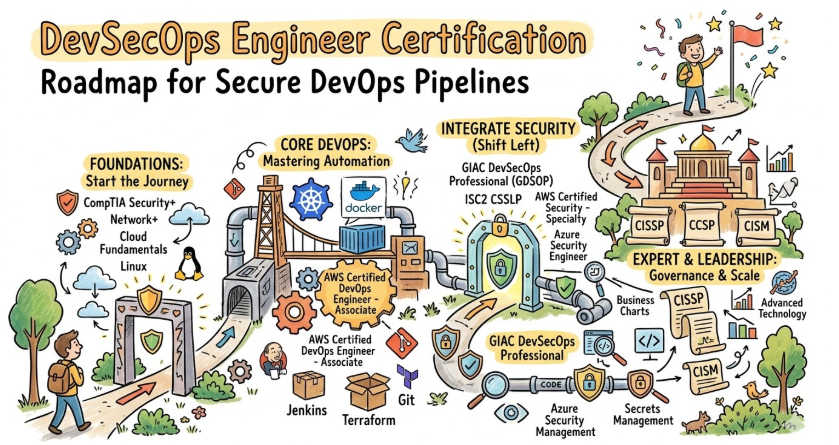
The Certified DevSecOps Engineer is a professional role focused on the seamless integration of security protocols within the software development and operational lifecycle. This role is no longer a luxury but a requirement for modern engineering teams. By ensuring that security is not a final checkpoint but a continuous process, software is delivered with higher quality and lower risk. Security is integrated into the automated pipeline, allowing for rapid releases that remain protected against evolving threats.
This guide is structured to help software engineers and managers understand the strategic importance of this certification. It provides a clear path for those who aim to transition from traditional roles into the specialized world of security-focused engineering.
Master in Observability Engineering Certifications Program
In high-scale systems, the ability to protect a system is limited by the ability to see what is happening within it. The Master in Observability Engineering Certifications Program is designed to address this challenge. It provides the technical foundation required to monitor, trace, and analyze complex systems in real-time.
Observability is considered the “eyes” of the engineer. Without deep insights into logs, metrics, and traces, security threats can remain hidden for long periods. This program teaches professionals how to build systems that are inherently transparent. For those pursuing the DevSecOps path, understanding observability is essential. It ensures that when a security incident occurs, it is detected, understood, and remediated without delay.
Deep Dive: Certified DevSecOps Engineer
The following sections outline the specific components of the certification and the requirements for those seeking to earn it.
What it is
The Certified DevSecOps Engineer certification is a validation of the technical ability to automate security within a CI/CD pipeline. It represents a shift from manual security reviews to automated, code-based safety checks. The program is built around the “shift-left” principle, where security is addressed at the earliest possible stage of development.
Who should take it
This track is designed for Software Engineers, DevOps Professionals, and Security Analysts. It is equally valuable for Engineering Managers who are responsible for overseeing secure digital transformations. The curriculum is relevant for professionals working in India and across the global technology sector.
Skills you’ll gain
The acquisition of specific technical skills is the primary goal of this program. A broad range of capabilities is developed through hands-on learning.
The ability to automate security testing is a core outcome. This includes the implementation of Static Application Security Testing (SAST) and Dynamic Application Security Testing (DAST) within automated workflows. Infrastructure as Code (IaC) security is also emphasized, ensuring that cloud environments are built with safety in mind from the first line of code. Furthermore, knowledge regarding container security and Kubernetes hardening is acquired, which is critical for modern, microservices-based applications.
- Automated Pipeline Security: The integration of safety checks into Jenkins, GitLab, or GitHub Actions.
- Vulnerability Assessment: The identification and prioritization of risks within the code and dependencies.
- Compliance Automation: The translation of regulatory requirements into automated tests.
- Cloud Security Configuration: The management of secure access and networking in environments like AWS and Azure.
- Secrets Management: The implementation of secure storage for API keys and passwords.
Real-world projects you should be able to do after it
Upon the successful completion of the certification, several practical objectives can be achieved. These projects demonstrate the ability to apply theoretical knowledge to production environments.
The creation of a fully automated secure pipeline is a standard project. This involves setting up a system that blocks any code that contains high-severity vulnerabilities from being deployed. Another key project is the implementation of a centralized secrets management system, such as HashiCorp Vault, to protect sensitive data across the organization. Additionally, the hardening of a Kubernetes cluster using network policies and pod security standards is a common requirement for graduates.
- Secure CI/CD Implementation: Building a pipeline that includes automated linting, scanning, and testing.
- Infrastructure Auditing: Writing scripts to check cloud environments for misconfigurations automatically.
- Compliance Dashboarding: Creating a visual interface that tracks the security status of all projects in real-time.
- Automated Remediation: Developing scripts that can automatically fix common security issues when they are detected.
Preparation plan
The time required for preparation depends on the existing background of the professional. A structured approach is recommended.
- 7–14 days: This path is suitable for experts who are already working with DevOps tools. The focus is placed on reviewing the specific exam domains and practicing with automated scanning tools.
- 30 days: This is the standard timeline for most engineers. It is suggested that two hours per day are dedicated to study, covering one major technical domain each week.
- 60 days: This is the ideal path for those new to the field. It provides sufficient time to build a lab environment and gain comfort with the underlying Linux and cloud technologies.
Common mistakes
Several common pitfalls are often encountered during the preparation and implementation phases of DevSecOps.
A common error is the over-reliance on tools without understanding the underlying security logic. It is also observed that many fail to account for the impact of security checks on development speed. If security becomes a bottleneck, it is often bypassed by the teams it is meant to protect. Finally, skipping practical lab work is a significant mistake, as the ability to troubleshoot real-world pipeline issues is a key requirement for the exam.
- Tool Obsession: Focusing on the software rather than the security principles.
- Siloed Thinking: Treating security as a separate task rather than a shared responsibility.
- Manual Overload: Attempting to solve every security problem manually instead of using automation.
Best Next Certification
After the completion of the DevSecOps track, the most logical progression is the Master in Observability Engineering. This ensures that the secure systems being built are also fully transparent and reliable during production operations.
Professional Certification Comparison
The following table provides a comparison of various technical tracks to help in the selection of a career path.
| Track | Level | Who it’s for | Prerequisites | Skills Covered | Recommended Order |
| DevSecOps | Intermediate | Software & Security Engineers | CI/CD Basics | Pipeline Security, Automation | 1st for Security |
| SRE | Intermediate | Reliability Engineers | Linux Basics | SLIs, SLOs, Reliability | After DevOps |
| AIOps | Advanced | Data & Ops Engineers | Python/ML | AI-driven Automation | After SRE |
| DataOps | Intermediate | Data Engineers | Data Pipeline knowledge | Data Quality, Governance | After Cloud Basics |
| FinOps | Intermediate | Managers & Engineers | Cloud Basics | Cloud Cost Optimization | After Cloud Basics |
| Cloud Arch | Expert | Senior Architects | Multi-Cloud basics | Design, Governance | After 5 years exp |
Choose Your Path: 6 Learning Journeys
Selecting a learning path is a strategic decision based on long-term career goals.
- DevOps Path: This journey is centered on the speed and efficiency of software delivery through continuous integration and deployment.
- DevSecOps Path: The focus is placed on the automation of security within the delivery lifecycle to ensure safety at scale.
- SRE Path: This path is designed for those who wish to specialize in the reliability, scalability, and performance of complex systems.
- AIOps/MLOps Path: This journey explores the intersection of artificial intelligence and operations to build self-healing systems.
- DataOps Path: The focus is on managing the flow and quality of data to support business intelligence and analytics.
- FinOps Path: This journey is dedicated to managing the financial aspects of the cloud, ensuring that infrastructure costs are optimized.
Role → Recommended Certifications Mapping
To ensure the best career outcomes, certifications should be aligned with specific professional roles.
- DevOps Engineer: Certified DevOps Professional, Kubernetes Administrator.
- SRE: SRE Certified Professional, Master in Observability Engineering.
- Platform Engineer: Infrastructure as Code Specialist, Certified DevSecOps Engineer.
- Cloud Engineer: AWS or Azure Solutions Architect.
- Security Engineer: Certified DevSecOps Engineer, Cloud Security Specialist.
- Data Engineer: DataOps Professional, Big Data Specialist.
- FinOps Practitioner: Certified FinOps Associate.
- Engineering Manager: DevOps Leader, Cloud Business Professional.
Next Certifications to Take
After the status of Certified DevSecOps Engineer is achieved, three primary directions for growth are available:
- Same Track (Deepening Expertise): Advanced security certifications for specific platforms, such as AWS Security Specialty.
- Cross-Track (Broadening Skills): The SRE Certified Professional track, which provides a holistic view of system uptime and performance.
- Leadership (Career Growth): The DevOps Leader certification, designed for those moving into strategic management and team leadership.
Leading Training Institutions for DevSecOps
The selection of a training partner is a critical step in the certification journey. Several institutions provide high-quality support.
DevOpsSchool is a prominent provider of instructor-led training for various DevOps disciplines. The programs are designed to be highly technical and are led by experts with deep industry knowledge. A strong emphasis is placed on practical labs, ensuring that participants can apply their skills in real-world scenarios immediately after the sessions.
Cotocus offers specialized training and consulting for engineering teams looking to modernize their workflows. The curriculum is tailored to the needs of the corporate sector, focusing on the integration of security and operations at a high level. It is an ideal choice for organizations seeking to upskill their entire technical workforce.
Scmgalaxy provides an extensive community platform and training resources for software configuration and security. The institution is known for its vast library of technical content and its commitment to keeping materials updated with the latest industry trends. It is a valuable resource for engineers who prefer a mix of self-paced and community-driven learning.
BestDevOps is recognized for its intensive bootcamps that focus on rapid skill acquisition. The training is structured to provide a high-impact learning experience in a short period. This makes it a preferred option for busy professionals who need to gain specialized knowledge without a long-term time commitment.
DevSecOpsSchool is a dedicated institution that focuses exclusively on the intersection of security and DevOps. The courses are built around the latest security frameworks and automation tools. It provides a deep dive into the technical requirements for securing modern, cloud-native applications.
Sreschool provides specialized education in the principles of Site Reliability Engineering. The training is designed to help engineers build systems that are not only secure but also highly reliable and scalable. It serves as an excellent bridge for those moving from security into broader systems engineering roles.
Aiopsschool is at the forefront of training for AI-driven operations. The curriculum explores how machine learning can be used to improve system monitoring and incident response. This institution is recommended for those who wish to stay ahead of the curve in terms of technical innovation.
Dataopsschool offers training focused on the management of data pipelines and the automation of data delivery. The programs are designed to teach engineers how to apply DevOps principles to the world of data, ensuring both speed and quality in analytics.
Finopsschool provides a unique curriculum that combines cloud engineering with financial management. The focus is on helping organizations understand and control their cloud spending. It is a vital resource for those looking to manage the business side of cloud infrastructure.
General FAQs
1. How difficult is the Certified DevSecOps Engineer exam?
The exam is considered moderately difficult. It requires a balanced understanding of both security theory and practical automation.
2. How much time is needed for preparation?
For most working professionals, 30 to 60 days of consistent study is sufficient to cover all exam domains.
3. What are the prerequisites?
There are no formal prerequisites, but a basic understanding of Linux, Git, and cloud fundamentals is highly recommended.
4. In what sequence should these certifications be taken?
It is usually best to start with a foundation in DevOps, followed by Kubernetes, and then specialize in DevSecOps or SRE.
5. What is the value of this certification globally?
The value is high, as companies worldwide are prioritizing security within their delivery pipelines to prevent data breaches.
6. What are the career outcomes?
Graduates often move into roles such as Security Architect, DevSecOps Lead, or Senior Cloud Engineer, which typically offer higher compensation.
7. Is the training available online?
Yes, all mentioned institutions offer online, proctored formats for both training and the certification exam.
8. Is there a lab environment provided?
Yes, most training programs include access to a cloud-based lab where security scenarios can be practiced safely.
9. How is the exam structured?
The exam consists of a mix of theoretical questions and scenario-based tasks that test practical application.
10. Is the certification recognized in India?
Yes, it is highly recognized by major tech firms and startups across the Indian technology sector.
11. Does the course cover specific cloud providers?
The core principles are cloud-agnostic, but practical examples often involve AWS, Azure, or Google Cloud.
12. How long is the certification valid?
The certification is typically valid for two or three years, after which a renewal or advanced certification is suggested.
Specific FAQs on Certified DevSecOps Engineer
1. What is the primary goal of this certification?
The main objective is to teach engineers how to automate security within the software development lifecycle, ensuring continuous protection.
2. Does the course include hands-on projects?
Yes, the program is designed around practical, real-world projects that simulate the tasks of a DevSecOps professional in a live environment.
3. How much coding is required?
A basic comfort level with scripting and reading code is required to implement security tests and infrastructure automation.
4. What tools are focused on during the training?
The training focuses on tools for SAST, DAST, container scanning, secrets management, and infrastructure as code.
5. Why is the “shift-left” philosophy important?
Shifting left allows for the identification of security flaws when they are easiest and cheapest to fix, which is early in the development process.
6. Can a manager benefit from this technical certification?
Yes, it provides managers with the knowledge needed to lead their teams through secure transformations and make informed technical decisions.
7. How is the certification delivered?
The certification is earned through a combination of training sessions and the successful completion of a proctored exam.
8. What is the first step to get started?
The first step is to visit the official provider’s website and review the certification syllabus to align with your career goals.
Conclusion
The pursuit of the Certified DevSecOps Engineer status is a significant step for any professional dedicated to modern software engineering. In an environment where threats are constantly evolving, the ability to automate safety is a critical capability. This journey requires the adoption of new technical skills, a commitment to a collaborative culture, and a deep understanding of the automated pipeline. By following a structured learning path and utilizing the resources provided by expert training partners, the transition to this specialized role can be achieved successfully. The result is a career that is not only central to the safety of digital organizations but also positioned for long-term growth and leadership in the global technology market.