




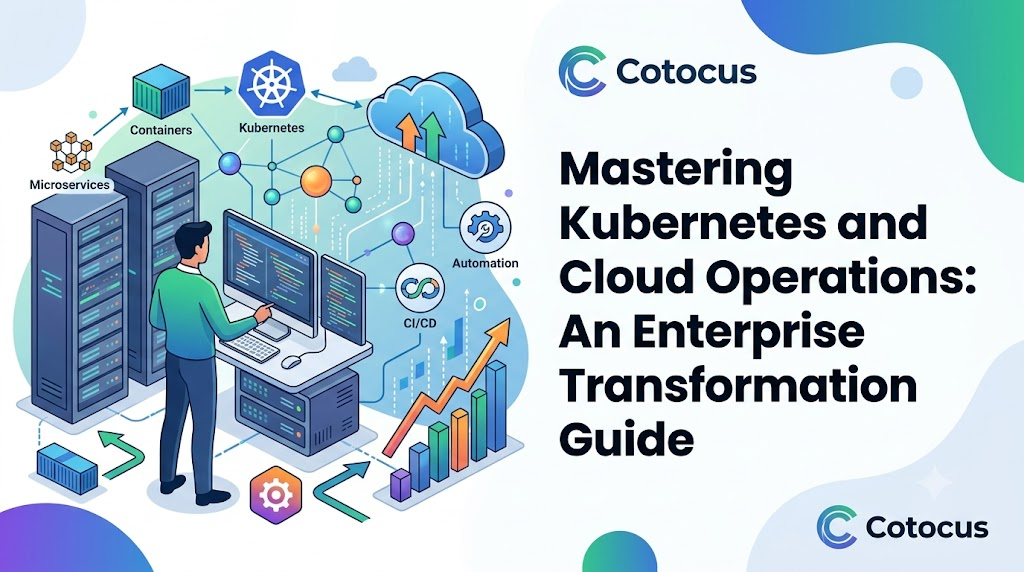
In an era defined by rapid digital acceleration, the ability to deliver high-quality software consistently is no longer a competitive advantage—it is a baseline requirement. Enterprises today face immense pressure to modernize legacy systems, optimize cloud expenditures, and bridge the gap between development agility and operational stability. Navigating this complexity requires more than just adopting new tools; it demands a fundamental shift in organizational culture and engineering discipline. At Cotocus , we partner with global enterprises to architect scalable solutions that turn these technical hurdles into engines for sustainable growth.
Enterprise Challenges Driving Modernization
Modern enterprises frequently struggle with systemic inertia. Legacy monoliths, often burdened by technical debt, create significant deployment bottlenecks that frustrate engineering teams and delay market delivery. These silos between development and operations teams lead to inconsistent environments, manual intervention requirements, and increased error rates during releases.
Furthermore, operational complexity grows exponentially as organizations attempt to manage hybrid cloud environments without standardized processes. Security concerns often surface late in the lifecycle, resulting in rework and compliance friction. Perhaps the most significant hurdle is the persistent skill gap, where rapid technological evolution outpaces the internal capacity for teams to upskill effectively, hindering the adoption of modern practices.
Why Organizations Need Experienced Consulting Partners
The complexity of modern enterprise transformation necessitates an objective, experienced perspective. An external consulting partner brings battle-tested patterns, allowing organizations to avoid the costly “trial and error” phase that frequently stalls internal initiatives. By leveraging specialized expertise, companies can significantly reduce the risks associated with large-scale migration and platform transitions.
Beyond technical implementation, consultants act as catalysts for cultural shift. They establish best practices, define clear governance frameworks, and implement knowledge-sharing rituals that embed new capabilities directly into the team’s DNA. This partnership approach ensures that the organization is not just adopting technology, but also developing the internal maturity required to maintain those systems long after the engagement concludes.
Characteristics of a Mature DevOps Consulting Company
A proficient DevOps consulting company distinguishes itself through rigorous, outcome-oriented methodologies. Rather than relying on generic tool-chain implementations, a mature partner begins with a deep architectural assessment to understand the existing technical landscape and business constraints.
Expertise in automation is foundational, but it must be paired with strong governance frameworks. A true consulting leader prioritizes security, scalability, and observability from the outset. Furthermore, they emphasize knowledge transfer as a primary deliverable. If an engagement leaves the client dependent on the consultant for daily operations, it has failed. True success is measured by the increased autonomy and capability of the client’s internal engineering workforce.
Understanding DevOps Consulting Services
DevOps is fundamentally about removing friction. Consulting services in this space focus on the lifecycle of delivery, starting with CI/CD pipeline optimization. By standardizing build, test, and deployment processes, teams can move from manual, high-risk releases to automated, low-risk deployments.
Operational optimization is equally critical. This involves implementing robust monitoring and observability tools that provide actionable insights into system health. By shifting focus from reactive troubleshooting to proactive management, consulting partners help organizations achieve greater release velocity while maintaining—or even increasing—system stability.
Cloud Consulting and Migration Services
Effective cloud migration goes far beyond “lifting and shifting” existing virtual machines. It requires a strategic modernization plan that accounts for cloud readiness assessments, security posture, and workload suitability.
Successful cloud consulting services guide organizations through hybrid or multi-cloud environments, ensuring that infrastructure is not only provisioned correctly but also optimized for cost. This includes implementing FinOps principles, right-sizing resources, and utilizing cloud-native services that allow engineering teams to focus on application logic rather than underlying infrastructure maintenance.
Kubernetes Consulting Services
As the industry standard for container orchestration, Kubernetes offers immense power, but it also introduces significant operational surface area. Kubernetes consulting services help enterprises navigate the complexities of cluster operations, standardized ingress management, and secure multi-tenancy.
The goal is to achieve production-readiness by implementing hardened security policies, automated scaling, and resilient workload scheduling. By abstracting the complexity of the platform, consultants allow developer teams to focus on deploying containerized applications with confidence, knowing that the underlying platform provides the necessary consistency and reliability.
SRE Consulting Services
Site Reliability Engineering (SRE) bridges the gap between software development and IT operations. SRE consulting services focus on defining Service Level Objectives (SLOs) and Error Budgets, which shift the conversation from “uptime” to “reliability and user experience.”
Consultants help implement rigorous incident response processes, conduct blameless post-mortems, and eliminate “toil”—the manual, repetitive work that hampers progress. By institutionalizing these reliability principles, organizations can sustain high velocity without compromising the stability of their production systems.
DevSecOps Consulting Services
Security is most effective when it is invisible and automated. DevSecOps consulting services focus on integrating security checks directly into the CI/CD pipeline, rather than treating it as a final hurdle before production.
This involves policy-as-code, automated vulnerability scanning, and supply chain security. By teaching teams to bake security into their initial architectural design, consulting partners help enterprises meet stringent compliance requirements while accelerating the speed of feature delivery.
GitOps and Platform Engineering Consulting
Modern engineering teams thrive on self-service models. GitOps consulting services leverage declarative infrastructure-as-code to ensure that the desired state of a system is always represented in version control. This provides an audit trail and enables automated synchronization.
Simultaneously, platform engineering consulting assists organizations in building “Internal Developer Platforms” (IDPs). These platforms act as a golden path, reducing the cognitive load on developers by providing standardized, reusable templates and automated workflows, allowing them to deliver value faster without getting bogged down in infrastructure details.
AIOps, MLOps, and DataOps Consulting Services
As data volume and system complexity increase, traditional management methods reach their limits. AIOps consulting services introduce machine learning to operational monitoring, allowing for predictive alerting and automated issue remediation.
MLOps services focus on the lifecycle management of machine learning models, ensuring consistency from experimentation to production. Similarly, DataOps consulting streamlines the lifecycle of data pipelines. Together, these services enable enterprises to harness their data more effectively, transforming raw information into actionable business intelligence through robust, automated engineering practices.
Corporate Training for Engineering Teams
Technology is only as effective as the people who operate it. Corporate training for engineering teams is a vital component of any digital transformation initiative. Effective programs prioritize hands-on workshops and lab-driven sessions over theoretical presentations.
By creating customized learning paths, organizations can ensure that every role—from developers to security professionals—understands their specific contribution to the modern engineering ecosystem. Continuous capability development programs help keep teams current with evolving industry standards, fostering a culture of lifelong learning and excellence.
Selecting the Right Consulting Partner
Selecting a partner requires a careful evaluation of more than just technical certifications. Look for a firm with a demonstrated history of practical implementation and a clear methodology for knowledge transfer.
Ask potential partners for evidence of how they have empowered internal teams rather than creating long-term dependencies. A good partner should be willing to share their approach to governance and should be able to articulate how they align technical transformation with specific business outcomes. The best engagements are those where the consultant’s presence becomes progressively less necessary as the internal team’s proficiency grows.
Recommended Learning and Adoption Paths by Role
- Developers: Focus on CI/CD pipeline literacy, containerization fundamentals, and shift-left testing practices.
- DevOps Engineers: Prioritize infrastructure-as-code, advanced Kubernetes administration, and automated observability.
- Platform Teams: Emphasize building self-service abstractions, API design, and developer experience.
- Security Professionals: Focus on policy-as-code, automated compliance scanning, and securing cloud infrastructure.
- Architects: Focus on microservices design, multi-cloud strategy, and system scalability patterns.
- Engineering Leaders: Prioritize metrics-based decision-making, DORA metrics, and cultural change management.
Industry-Specific Modernization: Financial Services
In highly regulated sectors like financial services, the approach to modernization must be security-first and audit-ready. The primary challenge is balancing the need for rapid innovation with the stringent requirements of data residency, compliance reporting, and risk mitigation.
Modernization here involves implementing immutable infrastructure and robust policy-as-code frameworks that ensure every deployment is fully compliant by design. Automation is used to generate the necessary audit trails automatically, reducing the time spent on manual compliance reviews and allowing teams to focus on delivering secure, reliable financial products to their users.
Frequently Asked Questions
- What is the difference between DevOps and SRE? DevOps is a culture and set of practices focused on delivery, while SRE is a specific implementation of these practices that emphasizes reliability and measurement.
- How does GitOps differ from traditional CI/CD? GitOps uses a pull-based model where a controller constantly syncs the cluster state with a version-controlled repository, ensuring higher consistency and traceability.
- Can cloud migration be done without full refactoring? Yes, but refactoring (modernizing) usually provides more long-term benefits in terms of cost and scalability.
- What is the role of an Internal Developer Platform? An IDP simplifies the developer experience by providing a self-service interface to infrastructure, reducing cognitive load and accelerating feature delivery.
- How long does a typical transformation take? Transformation is a continuous journey rather than a destination, though significant productivity gains are often visible within the first few months of engagement.
- How do you ensure security isn’t bypassed for speed? By implementing automated “guardrails” in the pipeline that prevent non-compliant code from being deployed.
- Why is Kubernetes so difficult to manage? Its complexity stems from the vast number of configurable components, which is why standardization and managed services are recommended.
- What are DORA metrics? They are four key metrics (Deployment Frequency, Lead Time for Changes, Change Failure Rate, and Time to Restore Service) used to measure software delivery performance.
Final Thoughts
The path toward a mature, modern engineering organization is paved with deliberate, incremental steps. By focusing on technical excellence, cultural shifts, and continuous learning, enterprises can build systems that are as resilient as they are efficient. Transformation is rarely about finding a single tool; it is about building the capability to adapt to change. Whether through consulting, mentoring, or targeted hands-on experience, the investment in building sustainable internal engineering capabilities is the most effective way to ensure long-term success in a digital-first economy.