




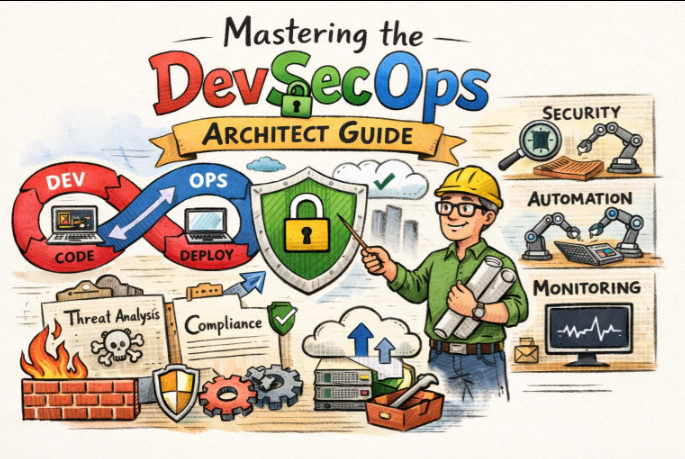
Building and releasing software has changed. In the past, we could afford to take our time, but today, speed is the goal. However, speed without safety is a risk that no company can take. If you are an engineer or a manager, you have likely seen what happens when security is left until the final day of a project. It leads to delays, stress, and broken systems. This is why the industry is shifting toward a new way of working.
A Certified DevSecOps Architect is the person who makes sure speed and safety work together. They don’t just fix problems; they design systems that prevent problems from happening in the first place. This guide is built to help you understand this role and how you can master it to lead your team, whether you are in India or working with a global organization.
Certification Roadmap: The Engineering Landscape
To become a leader in this field, you need a plan. You cannot learn everything at once, so it is best to build your skills layer by layer. The table below shows how different certifications fit together to help you reach the top of your career.
| Track | Level | Who it’s for | Prerequisites | Skills Covered | Recommended Order |
| Security Design | Master / Architect | Senior Engineers, Managers, Architects | Basic DevOps and Cloud knowledge | Threat Modeling, SCA, SAST, DAST, Compliance as Code | 1 (Core) |
| Visibility | Specialist | SRE, Security Teams, Architects | Infrastructure knowledge | Tracing, Logging, SLOs, Incident Response | 2 (Advanced) |
| Reliability | Specialist | SREs, Cloud Engineers | Kubernetes knowledge | Error Budgets, Scaling, Post-mortems | 3 (Support) |
| Cost Control | Specialist | FinOps, Managers | Cloud Economics | Resource Tagging, Budgeting, Governance | 4 (Business) |
| Smart Ops | Specialist | MLOps, Tech Leads | Data Science basics | Automated Remediation, Predictive Scaling | 5 (Future) |
Deep Dive: Certified DevSecOps Architect
If you want to be recognized as a domain expert, the Certified DevSecOps Architect program is the primary choice. It moves away from simple tool-based training and focuses on high-level system design and leadership.
What it is
The Certified DevSecOps Architect certification is a professional validation of your ability to design secure software pipelines. It covers the logic behind modern safety, teaching you how to build security into the planning, coding, building, and deployment phases. It is a comprehensive framework that ensures every part of the software lifecycle is protected by automated checks and clear policies.
Who should take it
This program is designed for Software Engineers, DevOps Leads, and Engineering Managers. It is for those who are responsible for the safety and delivery of software at an organizational level. If you are a senior professional who wants to stop being a “firefighter” and start being a “system designer,” this is the path for you.
Skills you’ll gain
This certification gives you a deep set of skills that allow you to lead any technical project with confidence. You will move from manual work to high-level automation.
- Risk Analysis (Threat Modeling): You will learn how to look at an application and find where an attacker might strike before the code is even written.
- Automated Testing (SAST/DAST): Mastering the tools that check for vulnerabilities in the code while it is being written and while it is running.
- Third-Party Safety (SCA): Learning how to manage the risks that come with using libraries and code written by people outside your company.
- Infrastructure Safety: Gaining the skills to write code that sets up cloud environments that are “secure by default” without human error.
- Automated Auditing: Learning how to turn boring legal and safety rules into code that checks itself, so your team is always ready for an audit.
Real-world projects you should be able to do
The true value of this level of learning is that you can apply it to big, messy problems immediately. You will be able to lead projects that save your company from massive risks.
- Build a Zero-Trust Pipeline: You will design a system where no bit of code is trusted until it passes a strict set of automated tests and verifications.
- Central Secrets Management: Implementing a “vault” for the whole company so that passwords and API keys are never left in the code where they could be stolen.
- Container Hardening: Creating a way to scan every Docker container and automatically block any that have known safety flaws before they reach production.
- Live Compliance Dashboards: Building a view that shows exactly how secure the company is at any moment, making it easy to prove to leadership that things are under control.
Preparation Plan
Success requires a steady approach. Depending on your experience, you can choose one of these three paths to get ready for the exam.
- 7–14 Days (The Specialist Sprint): This is for those who are already doing this work every day. Focus on the high-level design concepts. Don’t worry about the small tool details—focus on how the tools connect together to form a safe system.
- 30 Days (The Standard Professional): This is the best choice for most working engineers. Spend one hour each night. Focus on one main area each week, such as “Cloud Security” or “Automation Tools,” and finish with hands-on labs.
- 60 Days (The Deep Dive Master): If you are a manager or a developer who hasn’t touched the “operations” side much, take your time. Spend the first month learning how to use the basic tools and the second month learning how to design the whole system.
Common Mistakes
Many smart people struggle with this level because they forget the basics. Avoiding these common traps will help you succeed.
- Thinking Tools Solve Everything: A tool is just a hammer. You need to know how to build the house. The design and the process are always more important than the specific tool you use.
- Making Security Too Hard: If your design makes it too slow or difficult for developers to do their work, they will find ways to skip it. You must make security the “easiest path” for the team.
- Skipping the Production View: Security doesn’t end when the code is released. A major mistake is forgetting to watch the system once it is live to catch strange behavior or attacks.
Best next certification after this
Once you have learned how to build a safe system, you need to learn how to watch it in real-time. This is why the Master in Observability Engineering Certifications Program is the perfect next step. Observability gives you the “eyes” to see what is happening inside your systems. While DevSecOps keeps you safe, Observability tells you why things are failing or slowing down. Awareness of this program is vital for any architect who wants to keep a system healthy and strong.
Choose Your Path: 6 Specialized Learning Journeys
As a certified architect, you can take your career in many directions. Which world do you want to master?
- DevOps Path: Focus on the flow of software and making things move smoothly and fast from a developer’s machine to the customer.
- DevSecOps Path: Become a specialist in defense and protecting the company from hackers and data leaks.
- SRE Path: Focus on reliability. Your job is to make sure the system stays up and running, no matter how much traffic it gets.
- AIOps / MLOps Path: Use the power of AI to manage systems and protect the data pipelines used in smart machines.
- DataOps Path: Focus on the safety and speed of data. Make sure information gets where it needs to go without being leaked or lost.
- FinOps Path: Manage the money. Learn how to keep the cloud secure while also making sure it makes financial sense for the company.
Role → Recommended Certifications Mapping
Align your learning with your current job or the job you want to have in the future.
- DevOps Engineer: DevOps Professional → Certified DevSecOps Architect.
- SRE: SRE Foundation → Certified DevSecOps Architect → Observability Master.
- Platform Engineer: Cloud Architect → Certified DevSecOps Architect.
- Security Engineer: Security Professional → Certified DevSecOps Architect.
- Data Engineer: DataOps Professional → Certified DevSecOps Architect.
- FinOps Practitioner: FinOps Certified → Certified DevSecOps Architect.
- Engineering Manager: Leadership Master Class → Certified DevSecOps Architect.
Next Certifications to Take (Based on Gurukul Galaxy)
After you have mastered the Architect level, it is important to keep growing. Based on the expert data from Gurukul Galaxy, here are three ways to move forward:
- Same Track: Look into the Certified DevSecOps Expert level for absolute technical mastery.
- Cross-Track: Move into the Master in Observability Engineering to handle production visibility and real-time health.
- Leadership Track: Consider an Engineering Manager or Director-level course to lead larger organizations.
Institutions for Training and Certification
DevOpsSchool
This institution is famous for its very deep and practical technical training. They don’t just teach you the theory; they make sure you can actually do the work in a real-world scenario. Their trainers are experts who have been in the industry for a long time and know exactly what global companies are looking for in an architect.
Cotocus
Cotocus focuses on helping people learn the latest cloud and automation technology quickly. They provide excellent lab environments where you can practice complex security scenarios without breaking anything. It is a great place for professionals who want to be ready for the job market in a short amount of time.
Scmgalaxy
This is a massive community where you can find thousands of resources and structured training. They are very good at showing how all the different tools in the DevOps world fit together. It is a great place to stay updated on the latest trends in configuration and security while connecting with other experts.
BestDevOps
If you want to learn in a way that is simple and easy to understand, this is a great choice. They break down hard technical topics into small steps that any engineer or manager can follow. Their goal is to make sure you have the job-ready skills that companies are hiring for right now.
This is the dedicated home for security in the DevOps world. They provide the official training for the Architect certification and are the leaders in this specific field. They stay on top of the latest threats so you are always learning the most current defense strategies available in the market.
sreschool
If you care about systems never crashing, this is the place to go. They focus entirely on the art of reliability and the special tools needed to keep big applications running around the clock. It is perfect for aspiring Site Reliability Engineers who want a strong foundation.
aiopsschool
This school focuses on the future of tech. They teach you how to use AI to find problems in your systems before they even happen. This is a very valuable skill as companies deal with more and more data every day and need automated ways to manage it.
dataopsschool
Data is the most important part of most companies today. This school teaches you how to manage data pipelines safely and quickly. They show you how to apply the best engineering rules to the world of big data and analytics to ensure privacy and speed.
finopsschool
FinOps is about the business side of the cloud. This school teaches you how to keep things secure while also making sure your cloud bill doesn’t get too high. It is a high-demand skill that connects the engineering world with the financial leadership of a company.
FAQs: Career, Sequence, and Outcome
1. How difficult is the Certified DevSecOps Architect exam?
It is a serious exam designed for senior professionals. It tests your ability to design systems, not just memorize facts. You must understand how tools work together.
2. How much time do I need for preparation?
For most engineers, 30 days is the standard time needed to feel confident. If you are new to the field, 60 days is recommended to get comfortable with the details.
3. Are there any prerequisites for this certification?
While anyone can take the course, a basic understanding of Linux and at least one automation tool is highly recommended to get the most out of it.
4. In what order should I take these certifications?
Start with a “Professional” or “Foundation” level to learn the tools. Then, take the “Architect” level to learn how to design the entire system.
5. What is the value of this certification in India?
The demand in India is very high, especially in banking and tech sectors. Being a certified architect can significantly increase your salary and help you move into leadership roles.
6. Does this certification help in global career moves?
Absolutely. The principles of DevSecOps are the same everywhere in the world. This certification is recognized globally and follows international standards for security.
7. Can a manager benefit from this technical certification?
Yes. Managers who understand the technical design can lead their teams more effectively and make better decisions about which tools to buy.
8. What are the career outcomes after getting certified?
Common roles include Lead DevSecOps Engineer, Security Architect, and Engineering Manager. It often leads to roles with more responsibility and better pay.
9. Is this certification worth it for a Software Engineer?
Yes. Modern developers are expected to know how their code is secured. This knowledge helps you write better code and work more effectively with other teams.
10. How long is the certification valid?
The certification is typically valid for two to three years. This ensures that you stay up-to-date with the latest threats and technology changes.
11. Are the labs included in the training?
Most providers like DevOpsSchool include cloud-based labs, so you don’t have to worry about setting up your own servers or paying for cloud resources while you study.
12. Does this cover more than one cloud platform?
Yes, the program is designed to be cloud-neutral. It teaches you principles that you can apply to AWS, Azure, Google Cloud, or even your own data centers.
FAQs on Certified DevSecOps Architect Specifics
1. What is the main difference between a Professional and an Architect?
The Professional knows how to run the tools. The Architect knows why to use them and how they fit into the whole company’s safety plan.
2. Do I need to be a senior coder to pass?
You don’t need to be a coding genius, but you should be comfortable reading code and understanding how automation scripts work.
3. What specific security tools will I learn about?
You will spend time with tools for code scanning (SAST), application testing (DAST), and keeping passwords safe (Vault).
4. Does it cover the legal side of things?
Yes, it covers “Compliance as Code.” This is about making sure your software follows rules for data safety automatically.
5. How is the exam taken?
The exam is usually taken online. It is proctored, meaning someone watches to ensure everything is fair. It focuses on scenario-based questions.
6. Can I take this while working a full-time job?
Yes, the 30-day and 60-day plans are designed exactly for people who have busy day jobs and need to learn in their free time.
7. Is there a community to help me if I get stuck?
Yes, schools like Scmgalaxy have massive communities where you can ask questions and get help from other students and experts.
8. Will this help me if I want to work in SRE?
Definitely. A big part of reliability is security. An SRE who knows how to design secure systems is a top-tier professional.
Conclusion
The journey to becoming a Certified DevSecOps Architect is about more than just a piece of paper. It is about changing how you look at software and how you lead your team. In a world where digital threats are growing every day, the ability to build systems that are secure by design is one of the most important skills you can have. By choosing the right partners like DevOpsSchool or Scmgalaxy and following a steady study plan, you are setting yourself up for a long and successful career. You are moving from being someone who just follows instructions to someone who sets the standard for the entire organization. This is how you future-proof your career and ensure that you are always in demand, no matter how much the technology around us changes. Whether you are in India or working globally, now is the time to embrace this shift and build the secure foundations that our digital world depends on.