




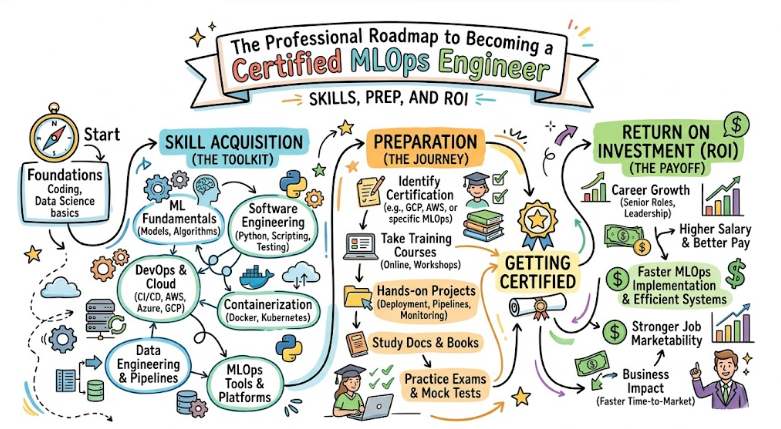
Introduction
The Certified MLOps Engineer program is a professional-grade credential designed for those who want to bridge the gap between data science and production engineering. Managed and hosted by AIOps School, this certification focuses on the operational rigor required to manage machine learning models in a cloud-native environment. It is not just about writing algorithms; it is about building the infrastructure that allows those algorithms to thrive at scale.
This guide is written for engineers and managers who are navigating the complex intersection of DevOps and Artificial Intelligence. As a senior mentor, I have seen many professionals struggle to move models from a laptop to a production cluster. This certification serves as a roadmap to solve that specific problem, providing a structured approach to model deployment, monitoring, and governance.
Whether you are a DevOps professional looking to specialize or a Data Scientist aiming to improve your engineering skills, this guide will help you understand the value of this path. We will break down the prerequisites, the learning curve, and the long-term career impact of mastering MLOps. By the end of this article, you will have a clear decision-making framework for your professional development.
What is the Certified MLOps Engineer?
The Certified MLOps Engineer represents a paradigm shift in how we approach machine learning in the enterprise. In the past, data science was often a siloed activity, resulting in “model debt” where great ideas failed to reach production. This certification exists to standardize the engineering practices required to automate the machine learning lifecycle.
It emphasizes real-world, production-focused learning over academic theory. Instead of just focusing on hyperparameter tuning, candidates learn about model registries, feature stores, and automated retraining pipelines. It aligns perfectly with modern engineering workflows, treating machine learning models with the same level of discipline as microservices.
By focusing on enterprise practices, the certification ensures that engineers can handle large-scale data ingestion and complex deployment strategies. It addresses the “Day 2” operations of machine learning, such as drift detection and performance degradation. This makes it an essential credential for organizations moving beyond experimental AI toward integrated, intelligent applications.
Who Should Pursue Certified MLOps Engineer?
This certification is highly beneficial for DevOps engineers, SREs, and Platform engineers who are increasingly being tasked with managing ML workloads. If you are already comfortable with Kubernetes, CI/CD, and Cloud infrastructure, this program provides the “ML-specific” layer needed to manage data-heavy applications. It helps you speak the language of data scientists while maintaining operational stability.
Data Engineers and Data Scientists also benefit significantly from this track. Many data professionals are excellent at building models but lack the software engineering discipline to deploy them reliably. Pursuing this certification allows them to take ownership of their models throughout the entire lifecycle, reducing the friction between development and operations teams.
From a managerial perspective, engineering leaders and technical architects should consider this to understand the resource and tooling requirements of an AI-driven organization. Globally, and specifically in the growing tech hubs of India, there is a massive shortage of professionals who can combine ML knowledge with SRE principles. This certification acts as a bridge for anyone looking to enter this high-growth niche.
Why Certified MLOps Engineer is Valuable and Beyond
The demand for MLOps is driven by the reality that most AI projects fail due to poor operationalization. As enterprises move from “AI interest” to “AI implementation,” the need for professionals who can maintain these systems is skyrocketing. This certification ensures you have the longevity to remain relevant even as specific tools and libraries change over time.
By mastering the principles of MLOps, you are learning a methodology that is tool-agnostic. While you might use Jenkins today and GitHub Actions tomorrow, the underlying need for automated testing, model versioning, and continuous monitoring remains constant. This focus on fundamental engineering principles provides a high return on investment for your time.
Furthermore, enterprise adoption of MLOps is no longer optional for companies using AI at scale. Organizations are looking for validated proof that an engineer understands the complexities of data security, model governance, and cost management. Having this certification signals that you are ready to handle the high stakes of production-grade AI infrastructure.
Certified MLOps Engineer Certification Overview
The program is delivered via the official Certified MLOps Engineer link and is hosted on the AIOps School platform. The certification is structured as a multi-level journey, moving from fundamental concepts to complex architectural implementation. It uses a practical, hands-on assessment approach that requires candidates to demonstrate their skills in simulated production environments.
The ownership and structure of the program are designed to mirror the actual tasks an engineer performs on the job. Rather than multiple-choice questions alone, the focus is on building pipelines and troubleshooting deployment issues. This ensures that the certification holds weight during technical interviews and internal promotions.
There are three primary levels: Foundation, Professional, and Advanced. Each level builds upon the previous one, ensuring a gradual but deep mastery of the subject matter. The structure is transparent, allowing both individual learners and corporate training departments to map progress against specific technical milestones.
Certified MLOps Engineer Certification Tracks & Levels
The certification is divided into levels to accommodate professionals at different stages of their careers. The Foundation level is aimed at those new to the intersection of ML and Ops, focusing on the core terminology and the overall lifecycle. It establishes the baseline knowledge required to communicate effectively within a cross-functional team.
The Professional level is where the bulk of the technical execution happens. At this stage, candidates dive deep into containerization, orchestration with tools like Kubeflow or MLflow, and the automation of data pipelines. This level is designed for active practitioners who are responsible for building and maintaining ML infrastructure day-to-day.
The Advanced level focuses on architecture, governance, and optimization. This track is for senior engineers and architects who need to design multi-cloud ML strategies, manage large-scale GPU clusters, and ensure compliance with data privacy laws. It aligns with senior career roles where strategic decision-making and long-term system health are the primary responsibilities.
Complete Certified MLOps Engineer Certification Table
| Track | Level | Who it’s for | Prerequisites | Skills Covered | Recommended Order |
| MLOps Foundation | Entry | Aspiring ML Engineers, Managers | Basic Linux & Python knowledge | ML Lifecycle, Tooling Overview, CI/CD Basics | 1st |
| MLOps Professional | Intermediate | DevOps Engineers, Data Engineers | Foundation Cert, Kubernetes basics | Model Versioning, Pipeline Automation, Monitoring | 2nd |
| MLOps Advanced | Expert | Architects, Principal Engineers | Professional Cert, Cloud experience | Distributed Training, LLMOps, Cost Optimization | 3rd |
| AIOps Specialist | Specialist | SREs, Systems Engineers | Professional MLOps | AI for IT Operations, Log Anomaly Detection | Optional |
| DataOps Specialist | Specialist | Data Architects, DBAs | Foundation MLOps | Data Governance, Pipeline Orchestration | Optional |
Detailed Guide for Each Certified MLOps Engineer Certification
Certified MLOps Engineer – Foundation
What it is
This certification validates a candidate’s understanding of the basic principles that govern the machine learning operations lifecycle. It confirms that the individual understands the core differences between traditional software engineering and ML engineering.
Who should take it
This is suitable for junior engineers, project managers, and traditional DevOps professionals who are new to the data science domain. It is an ideal starting point for anyone looking to build a career in AI-driven infrastructure.
Skills you’ll gain
- Understanding the MLOps Maturity Model.
- Basic model tracking and experimentation terminology.
- Knowledge of the tools involved in the ML lifecycle.
- Understanding the role of data versioning in production.
Real-world projects you should be able to do
- Set up a basic model registry to track training metadata.
- Create a simple documentation framework for model governance.
- Diagram a complete CI/CD pipeline specifically for a machine learning model.
Preparation plan
- 7-14 days: Focus on terminology and the “Why” behind MLOps; review the official study guide.
- 30 days: Deep dive into the differences between ML and standard DevOps; complete basic labs on model versioning.
- 60 days: Engage with community case studies and practice the conceptual exam questions.
Common mistakes
- Treating ML models exactly like static code artifacts.
- Ignoring the importance of data quality in the early stages.
- Overcomplicating the initial toolchain before understanding the workflow.
Best next certification after this
- Same-track option: Certified MLOps Engineer – Professional.
- Cross-track option: DataOps Foundation.
- Leadership option: Certified Engineering Manager in AI.
Certified MLOps Engineer – Professional
What it is
This level validates the ability to implement and manage automated ML pipelines in a production environment. It proves that the engineer can use industry-standard tools to deploy models that are scalable, reliable, and observable.
Who should take it
It is designed for working DevOps engineers, SREs, and Data Engineers who have at least one year of experience with cloud platforms. It is for those who want to be the “hands-on” technical lead for ML infrastructure.
Skills you’ll gain
- Building CI/CD pipelines for ML models using containers.
- Implementing automated testing for both code and data.
- Configuring monitoring and alerting for model drift.
- Managing feature stores for high-throughput data serving.
Real-world projects you should be able to do
- Deploy a model to a Kubernetes cluster with automated scaling.
- Configure a monitoring dashboard that tracks model accuracy over time.
- Automate a retraining loop that triggers when performance drops below a threshold.
Preparation plan
- 7-14 days: Review containerization and Kubernetes fundamentals; study the MLOps tool stack.
- 30 days: Build hands-on pipelines using MLflow or Kubeflow; focus on automated deployment.
- 60 days: Implement complex monitoring and logging solutions; take several practice lab exams.
Common mistakes
- Neglecting security and access control for sensitive training data.
- Failure to automate the rollback process for failed model deployments.
- Inadequate monitoring of hardware resources like GPU utilization.
Best next certification after this
- Same-track option: Certified MLOps Engineer – Advanced.
- Cross-track option: SRE Professional.
- Leadership option: Technical Program Manager – AI/ML.
Certified MLOps Engineer – Advanced
What it is
The Advanced certification validates the expertise required to architect enterprise-grade ML platforms. It covers high-level strategy, including multi-tenancy, cost management, and the emerging field of LLMOps.
Who should take it
This is for senior architects, principal engineers, and technical leaders who are responsible for the entire ML strategy of an organization. It requires significant prior experience in both software engineering and data systems.
Skills you’ll gain
- Designing distributed training architectures for large datasets.
- Managing the lifecycle of Large Language Models (LLMOps).
- Implementing cost governance for expensive cloud GPU resources.
- Designing multi-cloud and hybrid-cloud ML deployment strategies.
Real-world projects you should be able to do
- Architect a global model serving layer with low latency.
- Develop a cost-optimization framework for high-performance computing clusters.
- Establish a comprehensive governance and compliance audit trail for models.
Preparation plan
- 7-14 days: Focus on architectural patterns and high-level design principles.
- 30 days: Deep dive into specific cloud provider ML services (AWS SageMaker, Google Vertex AI).
- 60 days: Work on complex case studies involving scale, security, and multi-region deployment.
Common mistakes
- Focusing too much on a single cloud vendor’s proprietary tools.
- Underestimating the operational costs of large-scale model inference.
- Ignoring the legal and ethical implications of automated decision-making.
Best next certification after this
- Same-track option: Specialist tracks in AIOps.
- Cross-track option: FinOps Professional.
- Leadership option: CTO / VP of Engineering Track.
Choose Your Learning Path
DevOps Path
Engineers following this path should focus on how ML models can be integrated into existing CI/CD workflows. The goal is to treat the model as an artifact that requires testing, versioning, and deployment just like any other binary. This path emphasizes the use of Docker, Kubernetes, and automated testing frameworks to ensure that the bridge between development and operations remains seamless and repeatable.
DevSecOps Path
The security path focuses on the unique vulnerabilities of machine learning, such as adversarial attacks and data poisoning. Engineers here learn how to secure the data supply chain and ensure that models are not leaking sensitive information. It involves integrating security scanning into the ML pipeline and managing rigorous access controls for training environments and production inference endpoints.
SRE Path
The Site Reliability Engineering path centers on the stability and performance of ML services. This involves defining Service Level Objectives (SLOs) specifically for model latency and accuracy. SREs in this space focus on building robust monitoring systems that can detect “silent failures” where a model is technically running but providing incorrect or biased predictions.
AIOps Path
This path is distinct from MLOps as it focuses on using AI to improve traditional IT operations. Engineers learn how to apply machine learning models to log data, metrics, and traces to predict outages before they happen. It is about automating the management of the infrastructure itself using intelligent algorithms, rather than deploying models for business applications.
MLOps Path
This is the core path dedicated to the lifecycle of machine learning models designed for business logic. It covers everything from data ingestion and feature engineering to model serving and retraining. Professionals on this path are the architects of the “model factory,” ensuring that the pipeline is efficient, scalable, and capable of handling diverse machine learning frameworks.
DataOps Path
DataOps focuses on the speed and quality of the data pipelines that feed the machine learning models. Without high-quality data, MLOps cannot succeed. This path covers data orchestration, data quality testing, and the management of data lakes. It ensures that the data used for training and inference is reliable, timely, and correctly versioned to match the models.
FinOps Path
The FinOps path is critical for managing the massive costs associated with AI and ML infrastructure. Training large models and running high-concurrency inference can quickly drain a budget. Engineers on this path learn how to track spending, optimize GPU usage, and implement architectural changes that reduce the cost-per-prediction without sacrificing model performance.
Role → Recommended Certified MLOps Engineer Certifications
| Role | Recommended Certifications |
| DevOps Engineer | MLOps Foundation, MLOps Professional |
| SRE | MLOps Professional, AIOps Specialist |
| Platform Engineer | MLOps Professional, MLOps Advanced |
| Cloud Engineer | MLOps Foundation, MLOps Professional |
| Security Engineer | MLOps Foundation, DevSecOps Specialist |
| Data Engineer | MLOps Foundation, DataOps Specialist |
| FinOps Practitioner | MLOps Foundation, FinOps Specialist |
| Engineering Manager | MLOps Foundation, MLOps Advanced |
Next Certifications to Take After Certified MLOps Engineer
Same Track Progression
Deepening your specialization within the MLOps track involves moving toward highly specific technical domains. After achieving advanced status, you might look into specialized certifications for LLMOps (Large Language Model Operations) or Edge AI deployment. These focus on the specific challenges of deploying massive transformer models or running inference on low-power devices at the network edge.
Cross-Track Expansion
Broadening your skills is essential for a well-rounded technical career. If you have mastered MLOps, moving into SRE or FinOps provides a more holistic view of the engineering landscape. Understanding how model performance impacts site reliability or how model architecture impacts the company’s bottom line makes you a much more valuable asset to the business and a better technical leader.
Leadership & Management Track
For those looking to move away from individual contributor roles, the next step is often a transition into engineering management or technical product management. These tracks focus on building and leading teams of MLOps engineers. You will learn about resource allocation, strategic planning, and how to align AI initiatives with the broader goals of the organization, moving from “how” to build to “what” and “why” to build.
Training & Certification Support Providers for Certified MLOps Engineer
DevOpsSchool
DevOpsSchool is a prominent name in the technical training space, offering a wide array of courses that cover the entire spectrum of modern engineering. They provide extensive resources for MLOps aspirants, focusing on the practical application of tools like Docker, Kubernetes, and various CI/CD engines. Their approach is community-driven, often providing learners with access to a vast library of recorded sessions and real-world project scenarios. This makes them a solid choice for those who prefer a mix of self-paced learning and community support while preparing for their certification.
Cotocus
Cotocus takes a consulting-led approach to training, which is particularly beneficial for the Certified MLOps Engineer path. They focus on the enterprise reality of implementing these technologies, often drawing on their experience in helping companies migrate to cloud-native architectures. Their training modules are designed to be hands-on, ensuring that students aren’t just learning the theory but are actually building the pipelines they will manage in a professional setting. This practical focus is essential for passing the Professional and Advanced levels of the certification.
Scmgalaxy
Scmgalaxy is a highly technical platform that has been a staple for software configuration management and DevOps professionals for years. They offer deep-dive articles, tutorials, and training programs that are specifically geared toward the technical nuances of automation. For an MLOps candidate, Scmgalaxy provides the granular detail needed to understand the “plumbing” of the ML lifecycle. Their content is often updated to reflect the latest shifts in the industry, making it a valuable resource for staying current with evolving best practices.
BestDevOps
BestDevOps focuses on career transformation and the high-level principles that make an engineer successful in modern roles. Their training for MLOps is structured to help professionals transition from traditional roles into the AI space with a clear roadmap. They emphasize the mindset shift required to move from manual operations to fully automated, intelligent systems. This provider is excellent for those who want a guided experience that covers both the technical skills and the career strategies needed to succeed in the MLOps field.
devsecopsschool.com
As the name suggests, devsecopsschool.com is the primary resource for integrating security into the engineering lifecycle. For MLOps engineers, this provider offers crucial insights into how to secure data pipelines and protect models from external threats. Their curriculum covers everything from identity and access management (IAM) to automated security scanning for containers. In an era where data privacy is paramount, the skills learned here are an essential supplement to the core MLOps certification curriculum.
sreschool.com
sreschool.com focuses on the reliability and stability of large-scale systems. Their training programs are essential for MLOps professionals who want to master the “Operations” side of the equation. They teach the principles of error budgets, incident management, and high availability, all through the lens of machine learning workloads. By studying with this provider, a candidate ensures they can build ML systems that are not just clever, but are also dependable and capable of meeting strict enterprise uptime requirements.
aiopsschool.com
As the primary host for the Certified MLOps Engineer program, aiopsschool.com provides the most direct and aligned training available. Their curriculum is specifically designed to match the certification’s requirements, ensuring that there are no gaps in the learner’s knowledge. They offer a comprehensive suite of labs, practice exams, and expert-led sessions that focus on the intersection of AI and operations. This is the definitive starting point for anyone serious about obtaining this specific certification and mastering the field of MLOps.
dataopsschool.com
dataopsschool.com addresses the critical foundation of any ML project: the data. Their training programs focus on the engineering required to move, transform, and store data at scale. For an MLOps engineer, understanding DataOps is vital for ensuring that the training pipeline is never starved for high-quality information. They cover orchestration tools, data versioning, and the management of complex data architectures, providing the “upstream” knowledge required to make any machine learning model successful in the long run.
finopsschool.com
finopsschool.com is dedicated to the financial management of cloud resources. Given the high cost of training and running machine learning models, this provider offers indispensable training for senior and advanced MLOps engineers. They teach how to implement cost-visibility tools, optimize resource allocation, and foster a culture of financial accountability within engineering teams. Mastering these skills ensures that an MLOps professional can prove the return on investment (ROI) of their AI initiatives to the executive leadership.
Frequently Asked Questions (General)
- How difficult is the Certified MLOps Engineer exam?
The difficulty depends on your level of experience with Kubernetes and CI/CD. The Foundation exam is accessible, while the Professional and Advanced levels require significant hands-on practice and a deep understanding of architectural patterns. - How long does it take to prepare for the certification?
Most professionals with a background in DevOps or Data Engineering spend 30 to 60 days preparing. This allows enough time to go through the theoretical material and complete the necessary lab exercises. - What are the prerequisites for the Foundation level?
There are no formal prerequisites, but having a basic understanding of Linux commands and Python programming is highly recommended to get the most out of the course material. - Is there a high return on investment (ROI) for this certification?
Yes, the scarcity of MLOps talent means that certified professionals often command higher salaries and have access to more senior roles in top-tier technology companies and enterprises. - Should I take the MLOps certification or a general DevOps one first?
If you are new to operations, a general DevOps certification is a good start. However, if you are already in the field, moving straight to MLOps allows you to specialize in a higher-growth niche immediately. - Does the certification expire?
Like most technical credentials, it is usually valid for two to three years. This ensures that professionals stay updated with the rapid changes in the machine learning and cloud-native landscape. - Is the exam proctored online?
Yes, the certification exams are typically proctored online, allowing you to take them from anywhere in the world as long as you have a stable internet connection and a webcam. - Are there any hands-on labs involved?
The Professional and Advanced levels are heavily focused on hands-on labs. You will be expected to build and troubleshoot actual ML pipelines as part of the assessment process. - Can this certification help me switch from Data Science to Engineering?
Absolutely. It is one of the most effective ways for a Data Scientist to prove they have the engineering discipline required to work in a production-focused DevOps or MLOps team. - How does this certification compare to cloud-vendor specific certs?
Cloud-specific certs focus on one vendor’s tools. This certification focuses on the overarching methodology and open-source toolsets, making you more versatile across different cloud environments. - Are the training materials included in the certification fee?
This depends on the package you choose on the official site, but most paths offer a bundled option that includes both the training curriculum and the exam voucher. - Is this certification recognized globally?
Yes, the program is designed to meet international standards and is recognized by major technology firms and global system integrators across the US, Europe, and Asia.
FAQs on Certified MLOps Engineer
- What specific ML frameworks are covered in the training?
The program is designed to be framework-agnostic, but it frequently uses popular tools like TensorFlow, PyTorch, and Scikit-learn to demonstrate pipeline concepts and model serving techniques. - Do I need to be an expert in math or statistics?
No, this is an engineering certification. While you should understand the basics of how models work, the focus is on the infrastructure, automation, and reliability of the delivery system. - How does the program handle the concept of Model Drift?
Model Drift is a core component of the Professional level. You will learn how to set up statistical monitoring to detect when a model’s performance decays in production. - Is LLMOps included in the curriculum?
Yes, the Advanced level specifically addresses the unique operational challenges of Large Language Models, including prompt management, fine-tuning pipelines, and high-concurrency inference for generative AI. - What role does Kubernetes play in the certification?
Kubernetes is the primary orchestration platform used in the labs. You will learn how to use it for scaling model inference and managing distributed training jobs effectively. - Does the certification cover data privacy and ethics?
The Advanced level includes modules on model governance and compliance, ensuring that engineers understand how to implement “Responsible AI” through technical controls and audit trails. - How are the labs structured?
Labs are hosted in cloud environments where you are given a set of requirements to build a pipeline. You are graded on the functionality, security, and efficiency of your solution. - Is there support for local toolsets like Minikube?
The training provides guidance on setting up local environments for practice, but the final assessments are typically conducted in standard cloud-based environments to ensure parity.
Final Thoughts: Is Certified MLOps Engineer Worth It?
As a mentor who has watched the tech landscape evolve for two decades, I can tell you that the most successful engineers are those who position themselves at the intersection of two critical domains. Today, that intersection is Machine Learning and Operations. The “Certified MLOps Engineer” is more than just a piece of paper; it is a structured mental model for solving one of the hardest problems in modern enterprise technology.
If you are looking for a “get rich quick” scheme, this isn’t it. This path requires a genuine commitment to learning both the nuances of data and the rigors of systems engineering. However, if you are willing to put in the work, the career security and the complexity of the problems you will get to solve are incredibly rewarding. It is a practical investment in a future where AI is not just a feature, but the core of every application.
My advice is to start with the Foundation, even if you think you are an expert. Building a solid base in the specific terminology and lifecycle of MLOps will save you from making costly architectural mistakes later. This certification provides the roadmap; your curiosity and discipline will provide the engine. If you want to be at the forefront of the next decade of engineering, this is exactly where you need to be.