




In today’s tech landscape, moving to the cloud is a given, but operating securely within it is the real challenge. For engineers and leaders alike, the ability to design and maintain secure cloud environments is now a critical skill that separates generalists from true specialists. The AWS Certified Security – Specialty (SCS-C02) is the definitive credential that validates this expertise.
This guide is written for working professionals—whether you are a software engineer in Hyderabad building new features or an infrastructure manager in London overseeing global operations. It is a practical roadmap to understanding,
Why This Certification Matters Now
The demand for cloud security experts is at an all-time high. Companies are moving more data to the cloud than ever before, and they need people who can keep that data safe. This certification proves to the world that you have the skills to design, implement, and manage a secure AWS environment.
As an expert who has mentored many engineers, I can tell you that this certification stands out. It shows that you aren’t just a generalist—you are a specialist who understands the deep technical details of cloud defense.
The Master Certification Roadmap
To help you understand where this fits in your career, I have put together this table. It compares the Security Specialty with other key tracks you might be considering.
| Track | Level | Who it’s for | Prerequisites | Skills Covered | Recommended Order |
| Security Specialty | Specialty | Security Engineers, DevOps, SRE | 2+ years AWS experience | IAM, KMS, Logging, Incident Response | After Associate level |
| Solutions Architect | Professional | Lead Architects, Managers | Deep AWS Design knowledge | Complex Architecture, Migration | After Security Specialty |
| DevOps Engineer | Professional | DevOps, Platform Engineers | Automation & CI/CD skills | SDLC Automation, HA, Monitoring | After Security Specialty |
| Advanced Networking | Specialty | Network Engineers | Deep Networking knowledge | Hybrid IT, Direct Connect, BGP | After Security Specialty |
Deep Dive: AWS Certified Security Specialty (SCS-C02)
Let’s get into the specifics of this certification. It is a challenging journey, but the rewards are worth it.
What it is
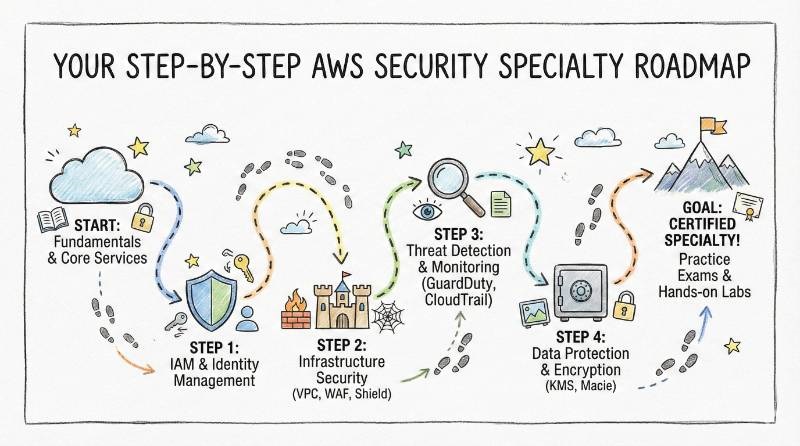
The AWS Certified Security Specialty (SCS-C02) is an advanced-level certification. It focuses on the technical aspects of securing the AWS platform. It covers five main areas: Threat Detection, Logging and Monitoring, Infrastructure Security, Identity and Access Management, and Data Protection. Unlike general certifications, this one goes very deep into the “how-to” of security.
Who should take it
This is for working engineers and managers who are already comfortable with AWS. It is ideal for:
- Security Engineers who want to prove their cloud expertise.
- DevOps Engineers who need to build security into their pipelines.
- SREs who want to ensure system reliability through security.
- Software Engineers who want to write more secure code.
- Managers who need to understand the security posture of their teams.
Skills you’ll gain
This training transforms how you look at the cloud. You will move from basic configurations to advanced security architecture.
You will learn how to manage identities at a massive scale and how to use encryption to protect data even if it falls into the wrong hands. You will also learn how to build automated systems that can detect a threat and stop it before a human even knows it’s happening.
- Identity Management: Mastering IAM roles, policies, and federation.
- Encryption: Deep dive into KMS (Key Management Service) and CloudHSM.
- Infrastructure Defense: Using WAF, Shield, and Security Groups to build a fortress.
- Incident Response: Automating your reaction to security alerts.
- Compliance: Using AWS Config and Security Hub to stay audit-ready.
Real-world projects you should be able to do after it
After completing this training, you won’t just have a certificate; you will have new capabilities. You will be able to handle complex security scenarios that are common in top-tier tech companies.
Imagine being able to set up a system that automatically locks down an account if it sees suspicious behavior. Or designing a data lake that is encrypted in a way that even the administrators can’t see the sensitive parts without permission.
- Automated Remediation: Building Lambda functions that fix security gaps automatically.
- Centralized Logging: Creating a “Single Source of Truth” for all security logs across multiple AWS accounts.
- Secure CI/CD: Integrating security scans directly into the deployment process.
- Cross-Account Security: Managing complex permissions across a global organization.
Preparation plan
How long you need to study depends on your experience. Here is a realistic breakdown.
- 7–14 days: This is for the “Cloud Veteran.” If you use AWS security tools every single day and already have other certifications, you can spend this time focusing on the specific exam domains and taking practice tests.
- 30 days: This is the most common path. Spend the first two weeks on video courses and documentation. Spend the next two weeks on hands-on labs. This is where you build things in the AWS console to see how they work.
- 60 days: This is for those who are newer to security. It gives you time to really understand the “Why” behind the tools. You can take your time with the labs and read the official whitepapers thoroughly.
Common mistakes
Many people fail this exam because they treat it like a memory test. It isn’t. It’s a logic test.
The most common mistake is ignoring the “JSON” part of security. You need to be able to read and write IAM policies and KMS policies. Another mistake is focusing only on one tool. In the real world, security is about how multiple tools work together.
- Ignoring the CLI: You must know how to perform security tasks using the command line.
- Rushing the Questions: The questions are often long and tricky. One small word can change the whole answer.
- Skipping the Labs: You cannot pass this exam just by watching videos. You must build things yourself.
Best next certification after this
Once you have this specialty, you are in a great position.
- Same Track: Go for the Solutions Architect Professional. It will help you see how security fits into the bigger picture of cloud design.
- Cross-Track: Try the Advanced Networking Specialty. Security and Networking are two sides of the same coin.
- Leadership: Consider the DevOps Engineer Professional. It will help you lead teams in automating everything you just learned.
Choose Your Path: 6 Learning Tracks
Security isn’t a standalone role anymore. It is integrated into every part of modern tech. Here is how you can use this certification in different paths.
1. DevOps Path
In this path, you focus on speed. Your goal is to make sure security doesn’t slow down the development team. You will use the SCS-C02 skills to create “Guardrails” that keep the environment safe while allowing developers to push code quickly.
2. DevSecOps Path
This is for those who want to be specialists in security automation. You will focus on “Shifting Left”—putting security at the very beginning of the software lifecycle. You will build automated testing and scanning into every part of the pipeline.
3. SRE (Site Reliability Engineering) Path
Reliability and security go hand-in-hand. An insecure system is an unreliable one. In this track, you use security training to protect the system’s uptime. You’ll focus on DDoS protection and incident response to keep the lights on.
4. AIOps/MLOps Path
As AI becomes more common, securing the data used to train models is vital. This path uses SCS-C02 knowledge to protect data lakes and ensure that AI models aren’t tampered with. It’s about protecting the “brain” of the company.
5. DataOps Path
Data is the most valuable asset a company has. In this track, you focus on data privacy and governance. You’ll use your skills in encryption and access management to ensure that data is handled according to strict regulations like GDPR or HIPAA.
6. FinOps Path
Believe it or not, security affects the bottom line. Rogue resources and data breaches can cost millions. In this path, you use security expertise to prevent “Billing Surprises” caused by compromised accounts or inefficient security configurations.
Role → Recommended Certifications Mapping
Not sure where to start? Look at your current or desired role below.
| Role | Recommended Path |
| DevOps Engineer | SysOps Associate → SCS-C02 → DevOps Professional |
| SRE | Solutions Architect Associate → SCS-C02 → SysOps Associate |
| Platform Engineer | Solutions Architect Associate → SCS-C02 → Solutions Architect Pro |
| Cloud Engineer | Cloud Practitioner → Developer Associate → SCS-C02 |
| Security Engineer | SCS-C02 → Advanced Networking → CISSP (External) |
| Data Engineer | Data Analytics Specialty → SCS-C02 |
| FinOps Practitioner | Cloud Practitioner → SCS-C02 (Foundation) |
| Engineering Manager | Solutions Architect Associate → SCS-C02 |
Where to Get the Best Training?
Choosing the right institution is the first step toward success. You need a place that offers practical, hands-on experience, not just theory.
- DevOpsSchool: This is a top choice for those who want a deep, mentor-led experience. They focus on real-world scenarios that you will actually face in a job. Their curriculum is updated constantly to match the latest AWS changes.
- Cotocus: They provide excellent training with a focus on consulting and enterprise-level security. Great for those working in large organizations.
- Scmgalaxy: A fantastic community-driven platform. They offer a wealth of resources and training for those looking to master configuration and security.
- BestDevOps: Known for their focused and high-quality training modules that help engineers bridge the gap between development and operations.
- DevSecOpsSchool: As the name suggests, they are specialists. If you want to live and breathe security automation, this is the place to be.
- SRESchool: They focus on the intersection of stability and safety. Excellent for engineers who are responsible for large-scale production environments.
- AIOpsSchool: The go-to institution for learning how to secure the future of AI and machine learning infrastructure.
- DataOpsSchool: They specialize in the security of data pipelines and big data environments, ensuring your data stays private and protected.
- FinOpsSchool: Unique in their approach, they help you understand the financial impact of security and how to manage cloud costs through better safety practices.
FAQs on AWS Certified Security Specialty (SCS-C02) Training
General Career FAQs
1. How hard is the SCS-C02 exam?
It is considered one of the more difficult AWS exams. It requires a deep understanding of how different services interact. It is not something you can pass by just reading a book.
2. Do I need to be a security expert to start?
No, but you should have a solid foundation in AWS. If you know your way around a VPC and IAM, you are ready to start training.
3. How long is the certificate valid?
Like most AWS certifications, it is valid for three years. After that, you will need to recertify to show you are up to date with the latest tools.
4. Is there a big salary jump after getting this?
In many cases, yes. Security is a specialized field, and specialists generally command higher salaries than generalists.
5. Can I take the exam online?
Yes, AWS offers proctored online exams that you can take from the comfort of your home or office.
6. What is the format of the exam?
It consists of 65 questions. They are either multiple-choice or multiple-response. You have 170 minutes to finish.
7. Does this certification cover non-AWS tools?
The exam is focused on AWS-native tools, but the principles of security you learn are universal and will help you in any environment.
8. Are there any prerequisites?
Technically, no. AWS removed official prerequisites for all exams. However, I strongly recommend having an Associate-level certification first.
9. What is a passing score?
You need a score of 750 out of 1000 to pass.
10. How much does the exam cost?
The standard price for an AWS Specialty exam is $300 USD.
11. Is this certification good for managers?
Yes. It helps managers understand the risks their teams are facing and the tools available to mitigate them.
12. Why did the exam change from SCS-C01 to SCS-C02?
AWS updates its exams to include new services and reflect the latest security best practices in the industry.
Specific Training FAQs
1. Which service is the most important for the exam?
IAM (Identity and Access Management) is the most critical. You must understand it inside and out.
2. How much networking do I need to know?
You need to be very comfortable with VPCs, Security Groups, NACLs, and things like VPC Endpoints and PrivateLink.
3. Do I need to know about encryption?
Yes, specifically KMS. You need to understand how keys are created, managed, and used across different services.
4. What is the focus of the logging section?
You will be tested on CloudTrail, CloudWatch Logs, and VPC Flow Logs. You need to know which tool to use for which situation.
5. How deep should I go into Incident Response?
You should know how to use tools like GuardDuty and Security Hub to detect issues and Lambda to fix them automatically.
6. Is compliance covered in the training?
Yes. You will learn about AWS Config and how it can be used to ensure your infrastructure meets specific compliance standards.
7. Are there labs in the training?
Yes, good training should always include labs. You need to practice building secure architectures in a real AWS environment.
8. What is the best way to study?
A mix of high-quality video courses, reading the official AWS documentation, and lots of hands-on practice in the console.
Conclusion
Cloud security is a high-stakes world, but it is also one of the most rewarding areas to work in. The AWS Certified Security Specialty (SCS-C02) is your ticket to joining the ranks of elite cloud professionals. By going through this training, you aren’t just earning a credential; you are building a mindset that prioritizes safety, reliability, and excellence. Whether you are an engineer looking to level up or a manager aiming to build a more resilient organization, this path offers the knowledge you need to succeed. The cloud is only going to get bigger and more complex, and the people who know how to secure it will always be in demand. Take the leap, invest in your training, and become the security expert that the modern industry needs.