




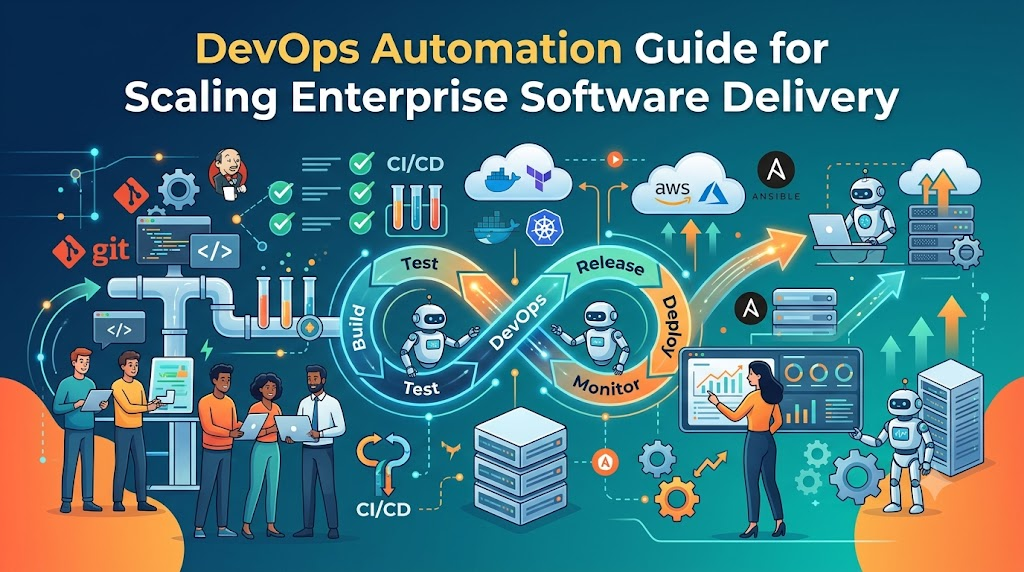
Introduction
In the era of rapid software delivery, relying on manual IT operations—where engineers copy files over SSH, execute database scripts by hand, and configure servers individually—creates constant bottlenecks, environment drift, and costly outages during critical deployments. To eliminate these human errors and accelerate release cycles, modern organizations are investing heavily in automation to turn complex, repetitive infrastructure tasks into predictable, code-driven pipelines. This systematic shift toward software-driven workflows defines the foundation of modern engineering, and mastering these automated practices through structured training platforms like DevOpsSchool is essential for teams looking to build resilient delivery engines, improve software quality, and focus on innovation instead of firefighting infrastructure failures.
What Is Automation in DevOps?
Automation in DevOps refers to the practice of using technology tools, programmatic scripts, and repeatable processes to perform tasks across the software development lifecycle with minimal human intervention. Instead of relying on manual commands to build, test, secure, deploy, and monitor software applications, engineers codify these tasks into software systems.
The core purpose of automating these workflows is to create a predictable, repeatable, and transparent delivery engine. In a manual ecosystem, knowledge is often trapped inside the minds of specific individuals. If the primary systems engineer is unavailable, deployments halt. Codifying the deployment logic ensures that the process becomes organizational property, visible to everyone and executable at any time.
This foundation directly enables continuous delivery. Continuous delivery means that the software build is always in a deployable state. Achieving this state requires that every code change undergoes a standard battery of automated tests, security checks, and configuration validations.
Real-World Example
Consider a cloud-native e-commerce application. When a developer changes the checkout logic, an automated process immediately compiles the code, builds a container image, checks the image for known security vulnerabilities, provisions an isolated testing environment, deploys the code, runs simulated checkout transactions, and tears the environment down. The entire process takes minutes, requiring no manual effort from an operator until the final approval step for production release.
Why Automation Matters in DevOps
[Developer Commit] ➔ [Automated Build & Test] ➔ [Automated Security Scan] ➔ [Automated Deployment]
                                                                                     │
[Continuous Innovation] 💡 💳 [Lower Operational Cost] ⚡ [Rapid Delivery] 🪓 [Reduced Outages] ◄┘
Faster Software Delivery
Automation removes human wait times from the delivery lifecycle. In traditional setups, code sits idle waiting for a QA environment to open up or an operations engineer to approve a ticket. Automated pipelines execute the next phase of the lifecycle the instant the preceding phase finishes successfully, shortening the time it takes for a feature to move from a developer’s laptop to an end-user.
Reduced Human Errors
Humans excel at creative problem solving but struggle with repetitive consistency. Typing the wrong password, omitting a configuration variable, or applying a patch to the wrong server directory are common manual errors. Automated tools follow explicit instructions identically every single time, eliminating variance.
Improved Consistency
A common engineering complaint is: “It worked on my local machine, but it fails in production.” This happens because environments drift over time due to ad-hoc manual changes. Automating environment provisioning guarantees that development, staging, and production environments match perfectly in configuration, software packages, and security baselines.
Better Collaboration
When deployment workflows are written as code and stored in shared repositories, developers and operations teams gain a single source of truth. Developers see how their code runs on infrastructure, while operations engineers understand how application dependencies change over time, breaking down cultural siloes.
Increased Scalability
Managing five physical servers manually is manageable. Managing five thousand cloud instances across multiple geographic zones manually is impossible. Automation allows a small engineering team to provision, configure, and manage massive infrastructure codebases efficiently through centralized scripts and scheduling tools.
Lower Operational Costs
While designing automated workflows requires upfront engineering investment, it significantly reduces long-term operational costs. Teams spend fewer hours resolving post-release bugs, tracking environment anomalies, or manually executing deployments during off-hours, freeing engineers to focus on product features.
Evolution of Automation in DevOps
The transition from physical data centers to modern cloud-native platforms happened over several distinct operational eras:
Manual Deployments
The earliest era relied on physical hardware racks. Systems administrators physically mounted servers, ran network cables, and manually installed operating systems from discs. Software releases required printing physical instruction checklists, copying files over FTP, and editing configuration files live on production servers.
Script-Based Automation
As operating systems matured, administrators wrote custom Bash, Perl, or PowerShell scripts to batch process repetitive commands. While this accelerated tasks, these scripts were fragile, lacked unified error handling, and often failed if the underlying server environment changed slightly.
CI/CD Pipelines
The introduction of dedicated continuous integration engines shifted the industry toward automated pipeline concepts. Code integration moved from a quarterly or monthly event to a daily habit, as central servers automatically compiled code and ran basic unit tests upon every code repository commit.
Infrastructure as Code (IaC)
With the rise of public cloud providers, infrastructure became software. Instead of clicking through web consoles to create virtual networks and machines, engineers began writing declarative configuration files that defined their ideal infrastructure state, allowing networks and servers to be versioned alongside application code.
Cloud-Native Automation
The containerization movement abstracted the application away from the underlying operating system. Orchestrators took over the automated scheduling, healing, scaling, and networking of microservices across large server clusters, replacing static infrastructure management with dynamic, API-driven pools of compute resource.
AI-Assisted Automation
Modern enterprise environments leverage data-driven intelligence to optimize operations. Automated systems analyze log patterns, predict performance anomalies, automatically scale resources before traffic spikes arrive, and assist engineers by generating boilerplate pipeline code.
Types of Automation in DevOps
To build a reliable delivery engine, automation must span across multiple operational domains:
| Automation Type | Purpose | Example |
| Build Automation | Compiles source code, fetches packages, and creates deployable binaries or container images. | Compiling a Java application into a JAR file and packaging it into a Docker image using a build script. |
| Test Automation | Runs automated tests to ensure code changes do not break existing functionality or introduce bugs. | Executing unit test suites, integration tests, and end-to-end browser simulations via an testing tool. |
| Deployment Automation | Moves verified software packages automatically into staging, testing, or production infrastructure. | Using a deployment script to push a new application version to a cluster with zero downtime. |
| Infrastructure Automation | Provisions and modifies cloud infrastructure resources programmatically. | Spin up cloud networks, storage buckets, and server groups using declarative code definitions. |
| Configuration Management | Configures internal operating system settings and application environments uniformly. | Installing specific packages, applying OS security patches, and managing application configuration flags. |
| Monitoring Automation | Collects telemetry data and alerts teams to performance anomalies or system issues. | Dynamically discovering new cloud containers and creating monitoring dashboards and alert channels. |
| Security Automation | Scans code repositories, dependencies, and images for vulnerabilities and compliance leaks. | Scanning an application code repository for hardcoded API keys or outdated open-source libraries. |
| Incident Response Automation | Detects systemic failures and executes automated remediation tasks to restore service health. | Restarting a crashed service or clearing temporary log spaces automatically when a disk health alarm fires. |
Automation Across the DevOps Lifecycle
    [PLAN] ➔ [DEVELOP] ➔ [BUILD] ➔ [TEST]
      ▲                              │
      │                              ▼
   [FEEDBACK] 🗘 [MONITOR] 🗘 [DEPLOY] 🗘 [RELEASE]
1. Planning
Automation begins before a line of code is written. Project management tools use automation to link developer code commits directly to project task boards. When an engineer creates a branch, the corresponding project issue moves from “To Do” to “In Progress” automatically, providing stakeholders with real-time status updates without status meetings.
2. Development
Modern development workflows rely heavily on local code linters and pre-commit hooks. When an engineer saves a file, automated tools check the syntax, verify adherence to team style guides, and block the engineer from committing the file if it contains structural flaws or exposed credentials.
3. Build
Once code shifts to a central repository branch, a build server detects the event. The server isolates the new code, downloads the required software library versions, resolves dependency trees, and compiles the source code into a uniform executable format, producing a version-tagged artifact ready for validation.
4. Testing
The compiled artifact passes directly into an automated testing phase. The system executes thousands of granular unit tests within seconds. If those pass, the artifact is deployed to a temporary staging environment where automated integration scripts simulate user behaviors to ensure the system works as a cohesive whole.
5. Release
The release phase manages the business logic of software distribution. Automation tools handle version tagging, generate human-readable release notes based on commit history logs, and store the validated artifact inside secure repository registries, making it ready for production installation.
6. Deployment
Deployment automation updates production instances while maintaining service availability. The system schedules the distribution of the new application package across the infrastructure, manages traffic routing changes, verifies health check responses from new instances, and handles immediate rollbacks if the checks fail.
7. Monitoring
The moment new code goes live, automated monitoring engines hook into the running processes. They collect application metrics, system logs, and network trace data, dynamically updating operations dashboards and adjusting operational thresholds based on live application performance baselines.
8. Feedback
Automated analytics systems monitor system performance and track user interaction data. If a specific component encounters unusual error rates, the system opens a bug ticket automatically, attaches the relevant log traces, assigns it to the responsible development team, and restarts the lifecycle.
CI/CD Automation
Continuous Integration (CI) and Continuous Delivery/Deployment (CD) represent the operational engine of DevOps automation.
- Continuous Integration: Focuses on the developer workflow. Multiple developers frequently merge their code updates into a single main branch. Every merge triggers an automated build and test sequence to catch integration errors early.
- Continuous Delivery: Ensures that code passing through the CI pipeline is automatically built, tested, and packaged into a deployable state. Moving the artifact into production requires manual sign-off.
- Continuous Deployment: Eliminates the manual release approval. Every single code change that passes all validation gates deploys directly to the production environment automatically.
Continuous Integration (CI)  ➔  Continuous Delivery (CD)       ➔  Continuous Deployment (CD)
[Code] ➔ [Build] ➔ [Test]      [Staging Deployment] ➔ (Manual OK)  [Automated Production Deployment]
Core Enterprise CI/CD Tools
- Jenkins: An extensible, open-source automation framework with a large plugin ecosystem, suitable for building highly customized pipeline workflows.
- GitHub Actions: A modern, cloud-native automation tool embedded inside GitHub repositories, enabling developers to build pipelines using simple YAML configuration files.
- GitLab CI/CD: A unified, single-application platform providing native container management, security scanning, and pipeline dashboards out of the box.
- Azure DevOps: A comprehensive enterprise suite combining project tracking, code repositories, artifact storage, and pipeline management tools.
Enterprise Pipeline Workflow Example
A typical enterprise pipeline uses a declarative script style. When an engineer pushes code to production branches, the pipeline initializes an execution agent, sets environmental parameters, runs comprehensive linting checks, executes parallelized testing blocks, generates coverage artifacts, builds an image container, and updates target server groups.
Infrastructure as Code (IaC)
Infrastructure as Code (IaC) treats server infrastructure, networking topologies, load balancers, and storage arrays as software code. Instead of manually configuring resources via cloud provider dashboards, teams define their desired state inside human-readable configuration files.
Why IaC Changes Enterprise IT
Traditionally, if an application required ten new servers, the request went through an operations ticketing system, taking days or weeks. With IaC, an engineer describes the architecture in a text file. The IaC engine evaluates the file, communicates with cloud provider APIs, and deploys the entire network stack within minutes.
Because these configuration files are stored in version control systems, teams track every single infrastructure modification over time. If an environment becomes corrupted, engineers do not spend hours troubleshooting configurations; they destroy the environment and rerun the IaC script to build a clean instance from scratch.
Leading IaC Tools
- Terraform: An open-source, cloud-agnostic tool created by HashiCorp. It uses a declarative language called HCL to manage infrastructure across multiple cloud environments simultaneously.
- Ansible: A flexible, agentless system that excels at both infrastructure provisioning and server configuration management using readable YAML structures.
- AWS CloudFormation: A native AWS service that automates the provisioning of resources exclusively within the Amazon Web Services ecosystem using JSON or YAML files.
Configuration Management Automation
While Infrastructure as Code focuses on provisioning networks and virtual machines, Configuration Management focuses on what happens inside those servers once they are online.
[Infrastructure as Code]          ➔   [Configuration Management]
Provisions Virtual Machine/VPC        Installs Packages, Patches, Configures Apps
Configuration management automation ensures that operating systems are patched, required application frameworks are installed, system variables are set correctly, and security parameters conform to internal baselines across the enterprise fleet.
This approach eliminates configuration drift, which happens when individual servers receive unique manual patches over time, making them behave differently than the rest of the fleet. Configuration management tools enforce a declared system state globally, continually scanning servers to overwrite unauthorized manual changes.
Key Tools in the Domain
- Ansible: Uses an agentless model, connecting to target servers over standard SSH or WinRM connections to execute system tasks without requiring pre-installed software on the targets.
- Puppet: Operates on an agent-based model, where a daemon running on each target server regularly polls a central master server for configuration state updates.
- Chef: A code-heavy automation framework that allows advanced platforms to write configurations using pure Ruby code structures.
Container and Kubernetes Automation
The shift toward microservice architectures requires advanced abstraction tools. Containers package application code along with its exact runtime dependencies, libraries, and configuration files into a single object that executes reliably on any host machine.
Managing hundreds of individual containers across cloud clusters manually is too complex for human teams, which is why organizations use orchestrators like Kubernetes.
[Developer Code] ➔ [Docker Automation (Package)] ➔ [Kubernetes Automation (Orchestrate)]
                                                          │
   ┌───────────────────────┼───────────────────────┐      ▼
[Auto-Scaling]     [Self-Healing]    [Rolling Updates]  [Service Mesh]
Automation Workflows Managed by Kubernetes
- Auto-scaling: The platform tracks memory and CPU strain. If traffic spikes, it automatically provisions new application container copies within seconds to distribute the load.
- Self-healing: If an individual application instance crashes or fails its internal health check, the orchestrator terminates the broken container and launches a replacement copy on a healthy host automatically.
- Rolling Updates: When deploying new code versions, the platform swaps out older container versions with new ones sequentially, ensuring the application stays online and responsive throughout the release process.
Automated Testing
Manual software testing creates significant project delays. If testing teams spend weeks manually clicking through registration forms, verifying checkout buttons, and running stress calculations before every major release, software velocity stalls.
Automated testing moves these validation routines into the continuous delivery pipeline, executing them immediately after the software builds.
[Code Change] ➔ [Unit Tests] ➔ [Integration Tests] ➔ [Performance Tests] ➔ [Deploy Gate]
                  (Seconds)       (Minutes)             (Hours)
Critical Testing Categories in DevOps
- Unit Testing: Validates isolated sections of code, such as an individual function or class method, ensuring mathematical calculations and basic logic work perfectly.
- Integration Testing: Verifies that separate software services interact correctly, ensuring database connections, API calls, and message queues pass data seamlessly.
- Functional Testing: Simulates user workflows on the application interface to confirm the software delivers the expected business value.
- Performance Testing: Subjects the application to high-volume simulated traffic loads to analyze system responsiveness, resource saturation levels, and stability breakpoints under stress.
- Regression Testing: Runs existing functional tests against new builds to confirm that recent code changes have not introduced errors into older, established parts of the application.
Monitoring and Observability Automation
Deploying software successfully is only half the battle; maintaining its long-term operational health in production environments is equally critical. Monitoring and observability automation collects, visualizes, and evaluates massive streams of system health data in real time.
Modern telemetry frameworks track four core performance indicators: request rates, error percentages, transaction latency, and infrastructure resource utilization. Instead of requiring engineers to log into individual instances manually to run diagnostic tools, automated monitoring frameworks dynamically discover newly deployed systems and stream performance metrics into centralized management dashboards.
[Cloud Resources] ➔ [Prometheus (Metric Collection)] ➔ [Grafana (Visual Alerting)]
                           ▲
                           └─ [Automated Pager Notification if SLA Broken]
Key Technologies for Observability
- Prometheus: An open-source, time-series monitoring engine that collects system data via a pull model, using custom metric endpoints.
- Grafana: A visualization framework that connects to diverse data sources to render clean, interactive operations dashboards.
- ELK Stack (Elasticsearch, Logstash, Kibana): A log aggregation toolset designed to ingest text logs from thousands of distributed application instances, index them centrally, and provide search interfaces.
- Jaeger: An open-source, end-to-end distributed tracing engine used to track transaction pathways across complex microservice networks.
Security Automation in DevOps (DevSecOps)
Historically, security reviews happened at the very end of the software delivery lifecycle. Security teams audited code bases just prior to production release, often uncovering vulnerabilities that required developers to rewrite significant portions of application logic, delaying shipments by weeks.
Security automation, often referred to as DevSecOps, shifts these security evaluations directly into the daily delivery pipeline. Every time code is committed, automated security checks run instantly alongside build and test routines.
[Git Commit] ➔ [SAST Scan] ➔ [Dependency Check] ➔ [Container Image Scan] ➔ [Secure Pipeline Build]
Core Security Gates in Automated Pipelines
- Static Application Security Testing (SAST): Code scanners review raw source text files during the initial pipeline run to catch insecure coding practices, SQL injection vulnerabilities, and cross-site scripting risks before compilation.
- Secret Management Automation: Automated compliance checkers inspect code repositories to block engineers from accidentally hardcoding database passwords, security tokens, or encryption keys into public repositories.
- Dependency Scanning: Automated tools scan third-party open-source libraries used by the application, matching them against global vulnerability databases to warn engineers about vulnerable dependencies.
- Compliance Automation: Programmatic auditors regularly verify production server configurations against established security compliance frameworks, ensuring infrastructure remains properly hardened.
Real-World DevOps Automation Workflow
To understand how these separate components work together, let us review the step-by-step lifecycle of an application update moving through an enterprise automation pipeline:
[1. Commit] ➔ [2. Build] ➔ [3. Test] ➔ [4. Secure] ➔ [5. IaC Deploy] ➔ [6. Code Push] ➔ [7. Monitor]
- Step 1: Code Commit: A developer finishes a new features patch and pushes the code changes to the central version control repository.
- Step 2: Automated Build Trigger: The code repository uses webhook alerts to notify the CI framework. The build server creates a temporary execution container, pulls down the latest code updates, and compiles the application binaries.
- Step 3: Test Suite Execution: The pipeline runs the complete internal unit test suite. If any isolated test routine fails, the pipeline halts immediately, emails the developer, and rejects the deployment.
- Step 4: Security Analysis: The pipeline runs automated vulnerability scans on the source code and its external library dependencies, checking for configuration flaws or security issues.
- Step 5: Infrastructure Provisioning: The pipeline runs Infrastructure as Code scripts, verifying that target cloud environments are active, securely configured, and up to date.
- Step 6: Production Application Rollout: The delivery tool deploys the updated container images across the live cluster, using a rolling deployment strategy to ensure zero application downtime for users.
- Step 7: Observability Monitoring: The centralized monitoring dashboard registers the new version tag, updates system metrics, and tracks transaction error rates to verify application health.
- Step 8: Automated Remediation: If application error metrics spike unexpectedly, the monitoring alert system flags the anomaly and instructs the deployment pipeline to roll back the release automatically, restoring the previous stable build.
Benefits of Automation in DevOps
Implementing a comprehensive automation framework delivers significant returns across the technology organization:
┌───────────────────────────────────────┬───────────────────────────────────────┐
│           Velocity Benefits           │          Reliability Benefits         │
├───────────────────────────────────────┼───────────────────────────────────────┤
│ • Features reach markets faster.      │ • Standardized system configurations. │
│ • Reduced manual task overhead.      │ • Less post-release engineering bugs. │
│ • Higher daily code merge volumes.    │ • Rapid Mean-Time-To-Recovery (MTTR). │
└───────────────────────────────────────┴───────────────────────────────────────┘
Higher Engineering Productivity
Automation handles routine, manual tasks like provisioning development boxes and running regression suites, freeing engineers to focus on designing core application architecture and writing features code.
Faster Feature Releases
By building a delivery pipeline that removes human handoffs, organizations move features from concept to production in hours rather than months, helping them stay ahead of market competitors.
Improved Operational Reliability
Automated pipelines ensure that every single release undergoes identical, strict testing and validation gates, significantly reducing software bugs, system outages, and post-release errors.
Reduced Application Downtime
When production issues occur, automated configuration rollbacks and self-healing cluster mechanics restore application health within minutes, protecting business revenue and user trust.
Greater Operational Efficiency
Replacing labor-intensive manual system administration workflows with automated, code-driven delivery logic enables lean technology teams to manage massive global cloud footprints easily.
Common Challenges and Solutions
Transitioning to automated DevOps practices comes with several practical challenges that engineering teams must navigate:
Legacy Enterprise Architecture
Older monolithic software systems are often closely tied to specific underlying hardware platforms, making it difficult to package them into modern cloud pipelines or containers.
Solution: Avoid trying to automate the entire monolithic system at once. Instead, gradually break off small, independent services from the monolith, containerizing these individual components one at a time.
Tool Integration Complexity
The DevOps ecosystem includes hundreds of specialized software tools. Connecting diverse systems across testing, provisioning, and security can lead to overly complex pipeline designs.
Solution: Standardize on open, well-supported platform tools that provide native API structures and clear integration documentation, avoiding overly customized setups.
Technical Skill Gaps
Traditional systems administrators may lack deep programming experience, while application developers often struggle to understand cloud networking patterns and infrastructure security rules.
Solution: Establish structured internal upskilling tracks and mentoring initiatives. Teams often leverage professional bootcamps or structured institutional courses, such as those designed by DevOpsSchool, to build shared engineering skills.
Automation Script Sprawl
As development footprints grow, teams can accumulate hundreds of custom pipeline scripts and unorganized IaC configuration files, creating long-term maintenance issues.
Solution: Treat pipeline code exactly like core application code. Store configurations in central version control systems, perform peer code reviews on infrastructure changes, and reuse modular configuration templates across projects.
Best Practices for DevOps Automation
To build a reliable automation engine, prioritize these foundational design practices:
- Automate Repetitive Tasks First: Do not try to automate every process on day one. Focus on automating the most frequent manual bottlenecks, like code compilation, daily test runs, or environment setup.
- Keep Pipeline Structures Simple: Design your deployment pipelines with modular, decoupled stages. If a single stage encounters an error, it should fail clearly and provide explicit log output to speed up debugging.
- Enforce Complete Version Control: Store application code, infrastructure scripts, pipeline configurations, database migrations, and security policies in a shared version control system to maintain a single source of truth.
- Monitor Automated Workflows: Treat your automation tools like production systems. Set up dedicated telemetry tracking for build nodes, test run durations, and pipeline error rates to detect operational issues early.
- Test Automation Code Regularly: Treat infrastructure definitions and test scripts as software code. Run regular syntax linters and validations against your automation scripts to ensure they work reliably.
- Commit to Continuous Improvement: Periodically review pipeline performance data. Identify slow test suites, optimize build image sizes, and update outdated software dependencies to keep the platform fast and modern.
Manual Processes vs. DevOps Automation
Understanding the structural differences between traditional operations and automated workflows helps highlight the value of modernization:
| Feature Dimension | Traditional Manual Process | Modern DevOps Automation |
| Execution Speed | Takes days or weeks to process infrastructure requests and software rollouts. | Runs builds, tests, and cloud deployments in minutes. |
| Operational Accuracy | Prone to human errors, missing variables, and configuration typos. | Executes instructions identically every single time, avoiding human error. |
| System Scalability | Requires adding headcount to manage growing server footprints. | Allows small teams to scale huge cloud systems using code. |
| Platform Reliability | Environments drift over time due to untracked manual patches. | Guarantees identical environment configurations across the fleet. |
| Resource Expenses | High long-term costs due to manual testing and constant troubleshooting. | Higher upfront engineering design cost, followed by low operational expenses. |
| Team Productivity | Engineers spend their time on manual operations tickets and firefighting outages. | Engineers focus on writing features code and driving product innovation. |
Popular DevOps Automation Tools
Building a reliable DevOps platform requires assembling a balanced toolset that covers every phase of the delivery lifecycle.
[CI/CD: Jenkins/GitHub Actions] ➔ [IaC: Terraform] ➔ [Config: Ansible] ➔ [Run: K8s/Docker] ➔ [Observe: Grafana]
Jenkins
An open-source continuous integration server that allows teams to build tailored deployment pipelines through an extensive, community-driven plugin ecosystem.
GitHub Actions
An integrated automation tool within the GitHub platform that allows developers to run continuous integration workflows triggered by native code repository events.
GitLab CI/CD
A comprehensive platform that manages the entire software lifecycle within a single tool, featuring strong container registries and built-in pipeline security analytics.
Terraform
A cloud-agnostic Infrastructure as Code tool that uses a clear, declarative language to provision and manage resources across diverse cloud platforms.
Ansible
An agentless configuration management engine that simplifies system updates and package deployments across server fleets using simple YAML files.
Docker
A containerization technology that packages applications and their underlying environments into isolated containers, ensuring consistent execution across platforms.
Kubernetes
A container orchestrator that automates the scheduling, scaling, network routing, and health management of containerized workloads across large server clusters.
Prometheus
A time-series monitoring engine built for cloud-native applications, using a data-pull model to collect detailed performance metrics.
Grafana
A powerful visualization engine that turns system metrics from various data sources into clean, real-time performance dashboards.
Tool Comparison Matrix
| Tool | Core Purpose | Difficulty Level | Primary Use Case |
| Jenkins | Continuous Integration / Delivery | Medium to High | Custom enterprise deployment pipelines. |
| GitHub Actions | Native Code Repository Automation | Easy to Medium | Modern, Git-centric continuous integration workflows. |
| Terraform | Infrastructure Provisioning | Medium | Multi-cloud resource setup and management. |
| Ansible | System Configuration Management | Easy to Medium | Standardizing OS setups and deploying app configurations. |
| Docker | Application Containerization | Easy | Packaging applications with all dependencies. |
| Kubernetes | Container Cluster Orchestration | High | Managing large microservice networks at scale. |
| Prometheus | Performance Metric Aggregation | Medium | Monitoring cloud-native microservice health data. |
Industries Benefiting from DevOps Automation
Every modern business sector relies on software automation to drive operational scale, security compliance, and product delivery velocity:
Banking and Financial Services
Financial institutions operate under strict regulatory rules, high transaction volumes, and constant security threats. Automation allows these platforms to run automated compliance checks, check code for security issues during the build phase, and update banking services safely without causing service downtime.
Healthcare Platforms
Medical platforms handle sensitive patient data across distributed networks. Adopting DevOps automation helps healthcare systems maintain strict data handling compliance, dynamically scale resources during traffic spikes, and deploy system updates safely.
E-Commerce Systems
Online retailers face highly variable traffic patterns, experiencing major spikes during holiday sales. Container orchestration and automated cloud monitoring allow these e-commerce platforms to automatically scale up server capacity to handle traffic surges and scale down during quiet periods to minimize infrastructure costs.
SaaS Enterprises
Software-as-a-Service providers rely on delivering constant value to global users. Using fully automated continuous deployment pipelines allows SaaS companies to roll out new features, bug fixes, and performance updates to millions of active users daily without service interruptions.
Telecommunications
Modern telecom organizations manage complex networks across global regions. Using automated infrastructure platforms allows telecom providers to deploy software-defined networks, update network functions dynamically, and detect system issues before they impact user connectivity.
Career Opportunities
The global transition toward automated operations has created strong demand for skilled engineering professionals who bridge the gap between software development and systems engineering.
                    ┌──► Site Reliability Engineer (SRE)
                    ├──► Platform Engineer
[DevOps Specialist] ┼──► Cloud Infrastructure Engineer
                    ├──► DevSecOps Automation Specialist
                    └──► Build & Release Architect
Key Engineering Roles
- DevOps Engineer: A specialist focused on designing continuous integration pipelines, managing environment configurations, and supporting application delivery.
- Cloud Engineer: An infrastructure specialist focused on provisioning public cloud environments, managing network security, and optimizing infrastructure architectures.
- Automation Engineer: A professional dedicated to identifying manual operational tasks and transforming them into reusable scripts and code workflows.
- Platform Engineer: A system architect who designs and maintains internal developer platforms, helping application teams build software efficiently.
- Site Reliability Engineer (SRE): An operations specialist who applies software engineering principles to infrastructure challenges, focusing on system reliability, uptime, and performance.
- DevSecOps Engineer: A security specialist focused on integrating vulnerability scans, compliance checks, and access controls directly into delivery pipelines.
Required Skillsets and Career Growth
Building a successful career in this domain requires developing a balanced combination of technical skills:
- Solid command of core Linux systems administration and command-line operations.
- Proficiency in at least one scripting or programming language, such as Python, Go, or Bash.
- Hands-on experience with modern CI/CD engines, container tools, and Infrastructure as Code frameworks.
- A clear understanding of cloud networking basics, system security patterns, and distributed log monitoring.
As enterprises continue to adopt cloud-native platforms, the career path for automation specialists remains strong. Experienced engineers frequently advance into platform architecture roles, engineering management positions, and enterprise cloud consulting career tracks.
Certifications and Learning Paths
Entering the DevOps space requires a structured learning path that builds foundational conceptual knowledge alongside practical, hands-on tool experience. Relying on professional guidance, like the comprehensive learning tracks provided by DevOpsSchool, helps engineers map out their upskilling path efficiently through real-world projects and lab work.
[Linux & Scripting Basics] ➔ [CI/CD Pipelines] ➔ [Cloud & IaC] ➔ [Kubernetes Orchestration]
Strategic Certification Path
| Certification Name | Target Audience | Skill Level | Core Technical Focus |
| AWS Certified DevOps Engineer | Public Cloud Administrators | Advanced | Provisioning, operating, and managing AWS infrastructure environments. |
| Certified Kubernetes Administrator (CKA) | Systems Administrators & Engineers | Medium to High | Installing, configuring, and managing enterprise Kubernetes clusters. |
| HashiCorp Certified: Terraform Associate | Infrastructure Engineers | Easy to Medium | Declarative multi-cloud infrastructure management via HCL. |
| Red Hat Certified Specialist in Ansible | Configuration Managers | Medium | Writing reusable playbooks and managing server fleets agentlessly. |
Common Beginner Mistakes
Avoid these frequent pitfalls when starting your automation learning journey:
- Automating Inefficient Processes First: Designing automated pipelines around broken, unoptimized manual workflows only accelerates architectural issues. Fix the underlying process mechanics before writing the automation code.
- Neglecting Testing and Security: Focus on more than just the speed of your deployments. A pipeline that pushes untested code straight to production only helps you break things faster. Build comprehensive test gates into every stage.
- Skipping Linux and Networking Fundamentals: Do not rush into advanced tools like Kubernetes without a clear understanding of core operating system principles, file permissions, SSH keys, and basic network routing rules.
- Learning Tools Without the Core Concepts: Focus on understanding the underlying engineering methodologies rather than just memorizing tool syntax. Tool interfaces change regularly, but foundational DevOps principles remain consistent.
- Operating Without System Monitoring: Deploying pipelines without tracking telemetry data leaves you blind to production performance issues. Always build automated alerts alongside your deployment routines.
Future of Automation in DevOps
The discipline of automated operations continues to evolve, shaped by several emerging industry movements:
[AI-Driven Operations (AIOps)] ➔ [Autonomous Pipeline Remediation]
[Platform Engineering Platforms] ➔ [Internal Developer Self-Service]
[GitOps Delivery Models]         ➔ [Declarative Git-to-Cluster Sync]
AI-Powered Operations (AIOps)
Artificial intelligence is moving beyond basic code generation and into day-to-day systems operations. Future platforms will leverage machine learning models to analyze massive streams of system telemetry, spot complex performance issues before they cause failures, and automatically adjust system resources without human intervention.
Platform Engineering and Developer Portals
Organizations are shifting away from allowing every individual developer to design unique, custom infrastructure setups. Instead, specialized platform engineering teams build standardized, secure internal developer portals. These self-service platforms enable developers to safely spin up databases and standard deployment pipelines with a few clicks, ensuring company-wide compliance.
GitOps Delivery Models
The GitOps approach extends Infrastructure as Code principles to application delivery management. In a GitOps framework, the desired state of a Kubernetes cluster is stored directly inside a version-controlled Git repository. Specialized software agents inside the cluster continually compare the live state with the Git repository, automatically correcting any configuration changes to match the approved repository state.
FAQs
What is automation in DevOps?
It is the practice of using programmatic scripts, specialized software tools, and repeatable processes to handle tasks across the development lifecycle—such as compiling code, running tests, provisioning cloud resources, and tracking system metrics—without relying on manual human steps.
Why is automation important?
Automation eliminates manual errors, speeds up software feature delivery, ensures consistent environments, helps teams scale huge cloud infrastructures efficiently, and frees engineers to focus on product design rather than troubleshooting outages.
Which DevOps processes should be automated first?
Teams should focus on automating their most frequent, repetitive engineering bottlenecks first. This typically includes setting up continuous integration builds, running basic code test suites, and automating application artifact compilation.
What are the best DevOps automation tools?
Popular platform tools include Jenkins and GitHub Actions for managing deployment pipelines, Terraform for provisioning cloud infrastructure, Ansible for handling server configurations, Docker for containerizing workloads, and Kubernetes for running container clusters at scale.
Is automation replacing DevOps engineers?
No. Automation changes the day-to-day focus of the role, moving engineers away from repetitive manual tasks. Organizations still need skilled professionals to design, secure, optimize, and manage these automated delivery platforms as business needs evolve.
How does IaC support automation?
Infrastructure as Code allows teams to define networks and cloud servers using text configuration files. This means infrastructure can be versioned, reviewed, and deployed automatically by software tools, replacing manual cloud console configurations.
Is Kubernetes required for automation?
No. Kubernetes is an excellent tool for managing complex container architectures at scale, but teams can build highly effective automated CI/CD pipelines for standard applications using virtual machines, serverless architectures, or basic cloud platforms.
Can beginners learn DevOps automation?
Yes. Begin by building a solid foundation in Linux administration, mastering basic command-line utilities, learning a scripting language like Python or Bash, and then gradually experimenting with fundamental CI/CD tools and cloud platforms.
What is the difference between Continuous Delivery and Continuous Deployment?
Continuous Delivery ensures that code passing through the pipeline is automatically tested and ready for production, but requires a manual human sign-off to release. Continuous Deployment eliminates that human check, automatically pushing every validated code update straight to production.
How does security automation fit into DevOps?
Often called DevSecOps, security automation integrates automated compliance checkers, vulnerability scanners, and dependency verifiers directly into the daily CI/CD pipeline, catching security issues while code is being written rather than right before release.
What is configuration drift?
Configuration drift occurs when individual servers in a fleet develop unique configurations over time due to ad-hoc manual updates and hotfixes. This makes them behave differently than standard environments, often causing unexpected software failures.
What does “self-healing” mean in automation?
Self-healing refers to the ability of modern orchestrators to monitor running application containers, automatically terminate instances that crash or fail internal health checks, and launch new, healthy replacements without human intervention.
How does automated monitoring help teams?
Automated monitoring platforms constantly collect system logs and metrics, update performance dashboards in real time, and immediately alert engineering teams via communication channels if performance drops below defined thresholds.
What is a webhook in DevOps pipelines?
A webhook is an automated communication link that allows one software system to send real-time data to another when a specific event occurs. For example, a code repository uses a webhook to tell a CI server to start a new build the moment a developer pushes a code update.
Why is version control critical for automation?
Storing application code, infrastructure definitions, and pipeline scripts in a single version control system ensures that every system modification is tracked, auditable, and easily reversible if an update causes errors.
Final Thoughts
As you build out your automated delivery workflows, remember an important piece of advice: successful automation starts with a deep understanding of the manual processes you are trying to replace. Do not fall into the trap of using advanced, complex software tools just because they are popular in the tech industry. If you automate a chaotic, unoptimized manual workflow without fixing its structural flaws, you will only succeed in creating automated chaos at a larger scale.
True DevOps modernization is not about trying to automate every single task on day one. It is about committing to a process of continuous, incremental improvement. Focus on identifying your team’s biggest operational bottlenecks, build simple and readable automated pipelines to address them, and treat your infrastructure definitions with the same care and review standards as your core product code. By taking a methodical, step-by-step approach to building your platform tools, you will create a reliable, scalable delivery engine that enables your engineering teams to spend less time managing system outages and more time driving product innovation.