





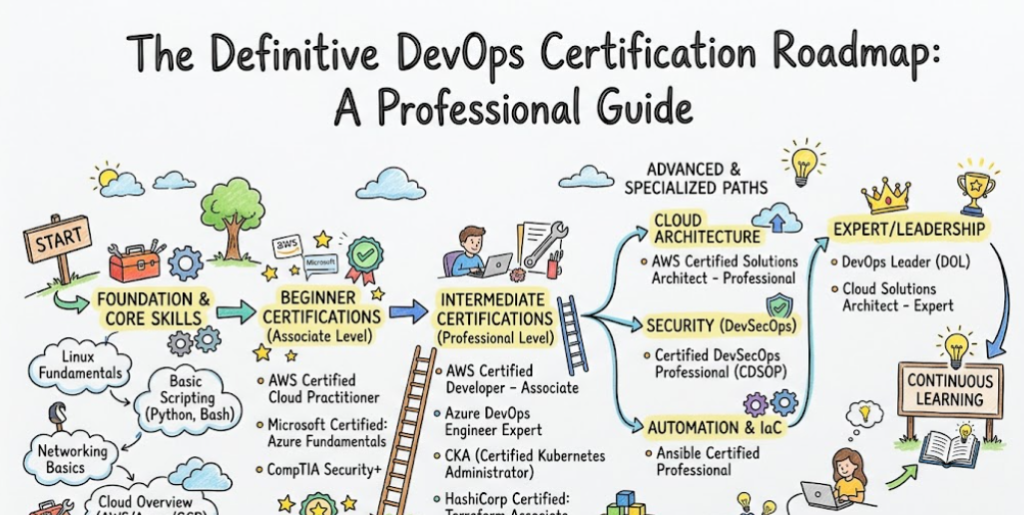
Navigating the world of DevOps certifications can feel overwhelming. With dozens of credentials available, it is easy to find yourself stuck in a loop of endless courses without knowing which path actually moves your career forward. Many learners unfortunately fall into the trap of collecting random certificates that do not align with their actual day-to-day work or long-term career aspirations.
The real secret to success in this competitive domain does not lie in how many badges you can accumulate on your resume. Instead, it relies on building a well-planned roadmap that directly matches your current skills and long-term professional milestones. Choosing the right path ensures you spend your time and energy learning the specific tools and platforms that companies are actively looking for.
This detailed, comprehensive master guide is built to clear up the confusion. Whether you are a complete beginner trying to break into the industry, a systems administrator planning your next transition, or an experienced engineer looking to specialize in security or platform engineering, this article will walk you through the options. Every single certification outlined in this guide is derived from the official Best DevOps Certification framework, ensuring you get verified, real-world pathways to advance your technical journey.
Why DevOps Certifications Matter
In a rapidly evolving corporate landscape, certifications provide far more than just a piece of paper or a digital badge. They serve as a structured forcing function that shapes your learning habits and validates your expertise in the market.
- Structured Learning Paths: Trying to learn DevOps without a plan can feel chaotic. A proper certification curriculum forces you to learn tools and concepts in a logical, step-by-step sequence rather than learning random commands.
- Skill Validation & Credibility: A certification serves as solid, third-party proof that you possess a specific baseline of technical knowledge. It helps build immediate trust with hiring managers and team leaders.
- Better Interview Preparation: Preparing for a structured exam teaches you the deeper mechanics and engineering theory behind why systems work. This depth makes it much easier to confidently answer complex, architectural questions during technical interviews.
- Boosted Career Confidence: Working through challenging labs and passing a rigorous exam provides a massive boost to your professional confidence. It empowers you to voice your ideas clearly during infrastructure planning and team meetings.
- Keeping Up with Cloud Growth: As public cloud infrastructure and Kubernetes adoption continue to grow worldwide, organizations need certified professionals who know how to manage scalable, containerized environments without causing costly downtime.
- Hands-On Learning Habit: The best certifications require extensive lab work. By preparing for them, you naturally build up hundreds of hours of actual terminal practice, which translates directly to solving real production incidents.
Who Should Read This Guide
This roadmap guide is purposefully tailored for a wide range of professionals across the IT spectrum:
- Freshers & Grads: Beginners wanting a clear, zero-fluff entry point into automation and continuous integration.
- Developers: Software engineers who want to break down walls between code production and infrastructure deployment.
- Linux Administrators: Systems administrators aiming to upgrade their traditional terminal skills into automated, modern infrastructure practices.
- Cloud Engineers: Professionals managing basic cloud virtual machines who want to learn how to orchestrate full automation workflows.
- Kubernetes & Container Engineers: Specialists focused on deeply mastering scalable container architectures and microservice networking.
- SRE Engineers: System reliability professionals looking to automate operations, set up monitoring metrics, and minimize application downtime.
- DevSecOps Professionals: Security-minded learners focused on shifting security practices left by integrating compliance directly into development pipelines.
- Platform Engineers: Senior professionals looking to build unified internal developer platforms that simplify internal company workflows.
DevOps Certification Categories
To make your educational journey easier to navigate, available certifications are split into six distinct, easy-to-understand categories:
Foundation Certifications
These credentials focus entirely on core concepts, high-level theory, and basic culture. They are perfect for beginners, project managers, and freshers who need to learn the core terminology and fundamental phases of the software development lifecycle before diving deep into complex command lines.
Tool-Based Certifications
These are highly specific exams centered on single, industry-standard technologies. They validate that you possess a deep, practical understanding of a specific utility—such as container runtimes, infrastructure automation engines, or configuration management platforms.
Cloud DevOps Certifications
These tracks combine classic automated engineering practices with the massive ecosystem of a specific public cloud vendor. They ensure you know how to build, deploy, optimize, and secure applications using the native features and managed services of a specific cloud provider.
DevSecOps Certifications
These specialized programs emphasize that security is a shared responsibility throughout the entire development lifecycle. The curriculum focuses on automating vulnerability scans, managing secrets safely, and protecting code pipelines without slowing down standard delivery speeds.
SRE and Platform Engineering Certifications
Built for advanced professionals, these pathways focus on building highly scalable, reliable, and observable infrastructure systems. They cover core production metrics, error budgets, automated responses to incidents, and service mesh networks.
Advanced and Specialized Certifications
These courses focus heavily on emerging industry trends, including artificial intelligence operations, automated machine learning pipelines, complex data engineering systems, and Git-driven continuous delivery workflows.
Best DevOps Certifications at a Glance
The following comprehensive comparison table highlights exactly 20 industry-relevant certifications available directly through the Best DevOps Certification curriculum to help you find your ideal match.
| Certification Name | Best For | Level | Main Skills | Career Scope |
| 1. DevOps Certified Professional (DCP) | Complete Beginners & Freshers | Beginner | Core DevOps Lifecycle, 20+ Toolsets | Junior DevOps Associate, Systems Analyst |
| 2. DevSecOps Certified Professional (DSOCP) | Security Engineers & Developers | Intermediate | Pipeline Security Automation, Vulnerability Scans | DevSecOps Engineer, Security Consultant |
| 3. Site Reliability Engineering (SRE) Certified Professional | Operations Specialists & Admins | Advanced | System Reliability, SLAs/SLOs/SLIs, Automation | SRE Engineer, Infrastructure Lead |
| 4. Master in DevOps Engineering (MDE) | Aspiring Core DevOps Engineers | Intermediate | Continuous Integration, Automated Deployments | DevOps Engineer, Cloud Specialist |
| 5. Master in Azure DevOps | Microsoft Ecosystem Specialists | Advanced | AZ-900, AZ-104, AZ-400 Architecture | Azure DevOps Engineer Expert, Cloud Architect |
| 6. AWS Certified DevOps Professional | Amazon Web Services Engineers | Advanced | Robust Cloud Architecture, Cost Optimization | AWS DevOps Lead, Cloud Infrastructure Engineer |
| 7. Master in Python Programming | Scripting Beginners & Automation Learners | Beginner | Scripting Structures, Logic Flow, Variables | Automation Scripting Associate, Python Engineer |
| 8. Hashicorp Certified Terraform Associate | Infrastructure Automation Learners | Intermediate | Infrastructure as Code (IaC), State Management | Cloud Automation Engineer, IaC Specialist |
| 9. Certified Kubernetes Administrator (CKA) | Container Orchestration Engineers | Advanced | Cluster Architecture, Troubleshooting, Storage | Kubernetes Administrator, Platform Engineer |
| 10. Docker Certified Associate (DCA) | Container Management Specialists | Intermediate | Container Runtimes, Images, Multi-stage Builds | Container Engineer, Systems Administrator |
| 11. Envoy ISTIO Certification Training | Microservices & Networking Engineers | Advanced | Service Mesh, Traffic Routing, L7 Proxy | Microservices Architect, Network Engineer |
| 12. MLOps Certification Training Course | Machine Learning Operations Engineers | Advanced | ML Lifecycle Automation, Model Deployment | MLOps Engineer, Data Science Operations Lead |
| 13. Google Cloud Professional Cloud DevOps Engineer | GCP Platform Specialists | Advanced | Google Cloud Services, Metrics, Site Delivery | GCP DevOps Engineer, Cloud Solutions Architect |
| 14. Master in Machine Learning | Data Engineers & Analysts | Advanced | Algorithmic Data Processing, Predictions | Machine Learning Specialist, Data Analyst |
| 15. Master in Artificial Intelligence | AI System Designers | Advanced | Intelligent System Frameworks, Automation | AI Systems Engineer, Innovation Architect |
| 16. Master in AppDynamics | Performance Monitoring Engineers | Intermediate | Application Performance Management (APM), Metrics | Performance Monitoring Analyst, Monitoring Lead |
| 17. Master in Data Science | Analytical Data Specialists | Intermediate | Data Extractions, Statistical Analytics | Data Scientist, Business Intelligence Analyst |
| 18. Master in Deep Learning | Advanced Neural Network Researchers | Advanced | Neural Network Architectures, Complex Modeling | Deep Learning Research Engineer, AI Scientist |
| 19. Prometheus with Grafana | Observability & Alerting Specialists | Intermediate | Time-Series Metrics, Dashboard Visualizations | Monitoring Engineer, Observability Specialist |
| 20. GitOps Certified Professional (GOCP) | Continuous Delivery Innovators | Advanced | Declarative Git Workflows, Pull-Based Deployments | GitOps Automation Engineer, Release Manager |
Certification Deep Dive
Here is an in-depth breakdown of the primary engineering certifications featured in the roadmap, clarifying what they cover, who they serve, and how they apply in production scenarios.
1. DevOps Certified Professional (DCP)
- What It Is: An essential training course designed from scratch to deliver a strong foundation in modern engineering culture. It covers the core phases of development and operations while introducing an expansive set of 20 modern tools.
- Who Should Take It: Freshers, non-technical transitions, and traditional IT support staff looking for an accessible, clear entry path.
- Best Career Fit: Junior DevOps Associate, Systems Support Analyst.
- Difficulty Level: Beginner.
- Career Scope: High entry-level potential across IT services firms globally.
- Skills You Will Learn: High-level automation loops, foundational deployment methodologies, team collaboration mindsets.
- Tools and Technologies Covered: Linux basics, Git essentials, Jenkins principles, core container ideas.
- Exam Details: Multiple-choice format tracking fundamental conceptual knowledge.
- Study Roadmap: Focus first on learning standard operational terms, spend time inside basic labs, and review simple command syntax.
- Real-World Use Case: A newly onboarded team member uses their foundational knowledge to understand how an organization’s code travels from a developer’s laptop down to a testing environment.
- Pros: Highly comprehensive intro; covers an incredible variety of toolsets.
- Cons: Focuses mainly on broad overviews rather than ultra-deep specialized architecture.
- Best Recommendation: Perfect first step for individuals with zero prior automation experience.
2. DevSecOps Certified Professional (DSOCP)
- What It Is: A specialized engineering track focusing entirely on shifting security left by integrating reliable safeguard controls directly into automated deployment pipelines.
- Who Should Take It: Security analysts, compliance professionals, and system developers wanting to automate protection frameworks.
- Best Career Fit: DevSecOps Engineer, Security Automation Consultant.
- Difficulty Level: Intermediate.
- Career Scope: Exponential demand in banking, healthcare, and enterprise software sectors.
- Skills You Will Learn: Automated pipeline vulnerability scanning, secure secrets management, compliance tracking.
- Tools and Technologies Covered: Ansible, Docker, Git, GitHub, Kubernetes, Terraform.
- Exam Details: Scenario-based evaluation focusing on pipeline security practices.
- Study Roadmap: Master container security baselines first, then focus your study on embedding automated scanning steps into classic CI/CD pipelines.
- Real-World Use Case: Automatically running a static code analysis scan the exact moment a developer opens a pull request, blocking insecure code before it ever gets built.
- Pros: Highly practical; emphasizes shared team responsibility for security.
- Cons: Requires a solid grasp of basic development pipelines before starting.
- Best Recommendation: Highly recommended for cloud professionals looking to stand out in a crowded market.
3. Site Reliability Engineering (SRE) Certified Professional
- What It Is: A deep software engineering approach focused on designing, building, and running exceptionally scalable, automated, and stable infrastructure environments.
- Who Should Take It: Systems administrators, operations leads, and platform engineers looking to treat production issues as software challenges.
- Best Career Fit: SRE Engineer, Infrastructure Reliability Specialist.
- Difficulty Level: Advanced.
- Career Scope: Critical core role across major SaaS businesses and high-scale consumer applications.
- Skills You Will Learn: SLA/SLO/SLI metric formulation, automated incident recovery, capacity planning, latency optimization.
- Tools and Technologies Covered: 20+ specialized operational automation tools, performance trackers, alerting frameworks.
- Exam Details: Deep scenario assessments testing system architecture and reliability strategies.
- Study Roadmap: Spend time studying production metrics, error budget calculations, and learning how to build self-healing infrastructure.
- Real-World Use Case: Building an automated script that detects a sudden spike in application latency and safely shifts traffic over to a secondary healthy system region.
- Pros: Strong focus on building highly scalable architectures; great technical support benefits during training.
- Cons: Concepts can be quite abstract for individuals who have never managed large-scale production environments.
- Best Recommendation: Ideal choice for systems administrators ready to move into modern, high-scale engineering roles.
4. Master in DevOps Engineering (MDE)
- What It Is: A practical, step-by-step program designed to take learners from core fundamentals directly into intermediate execution across modern build and delivery chains.
- Who Should Take It: Aspiring core automation engineers who need a deep dive into code delivery, build management, and continuous orchestration.
- Best Career Fit: DevOps Engineer, System Cloud Specialist.
- Difficulty Level: Intermediate.
- Career Scope: Highly stable, universal career demand across nearly all corporate enterprise markets.
- Skills You Will Learn: Multi-stage continuous integration setup, automated builds, release delivery setups.
- Tools and Technologies Covered: Git, Jenkins, Docker, foundational configuration systems, deployment tools.
- Exam Details: Combined conceptual evaluations and practical environment challenges.
- Study Roadmap: Dedicate your study time to mastering Jenkins pipeline scripts and learning how to package applications cleanly inside containers.
- Real-World Use Case: Creating a unified build pipeline that takes raw code updates, compiles them, runs tests, and packages them up for deployment within minutes.
- Pros: Exceptionally well-structured step-by-step learning path; live instructor assistance available.
- Cons: Requires consistent time dedication to master all the different continuous delivery phases.
- Best Recommendation: The definitive primary track for professionals who want to work as core DevOps engineers.
5. Master in Azure DevOps
- What It Is: A specialized cloud certification track that brings together three distinct milestones (AZ-900, AZ-104, and AZ-400) to help you earn the status of an Azure DevOps Engineer Expert.
- Who Should Take It: Systems administrators and engineers working within dedicated enterprise environments built on the Microsoft technology stack.
- Best Career Fit: Azure Cloud Infrastructure Architect, Azure DevOps Engineer Expert.
- Difficulty Level: Advanced.
- Career Scope: Massive enterprise-level adoption, especially within large global organizations.
- Skills You Will Learn: Enterprise cloud design, complex virtual network configuration, native Azure pipeline management.
- Tools and Technologies Covered: Azure Boards, Azure Pipelines, Azure Repos, Azure Artifacts, Resource Templates.
- Exam Details: Curated alignment with official Microsoft certification structures across multiple exam levels.
- Study Roadmap: Start by mastering basic Azure administration, then dive into native cloud build pipelines and multi-stage release definitions.
- Real-World Use Case: Automating the secure deployment of a corporate database and application backend across multiple global cloud zones using Azure Pipelines.
- Pros: Deeply specialized; awards a highly respected enterprise certification tier upon completion.
- Cons: Locked completely into the Microsoft ecosystem, making it less applicable for purely open-source cloud setups.
- Best Recommendation: An absolute must-have if your target organization runs its workloads on Microsoft Azure.
6. AWS Certified DevOps Professional
- What It Is: An advanced cloud certification focused on architecting, deploying, securing, and operating highly robust, automated application environments natively inside Amazon Web Services.
- Who Should Take It: Cloud engineers and systems developers who want to master high-scale architecture and smart cost optimization on AWS.
- Best Career Fit: AWS DevOps Lead, Cloud Infrastructure Engineer.
- Difficulty Level: Advanced.
- Career Scope: Exceptionally dominant global footprint with top-tier compensation options in modern tech hubs.
- Skills You Will Learn: Scalable cloud architecture layout, automated cost-saving controls, advanced cloud network security.
- Tools and Technologies Covered: AWS CloudFormation, CodePipeline, EC2, ECS, CloudWatch, IAM, S3, RDS.
- Exam Details: Demanding situational questions tracking deep cloud architecture rules.
- Study Roadmap: Spend significant time learning about cloud network topologies, complex IAM access policies, and automated horizontal scaling rules.
- Real-World Use Case: Setting up an automated system that monitors real-world user traffic and scales server capacity up or down to keep performance fast while reducing costs.
- Pros: Massive real-world market relevance; covers deep architectural design principles.
- Cons: The learning curve can be steep for engineers without real-world cloud experience.
- Best Recommendation: The gold standard credential for any engineer dedicated to mastering the Amazon Web Services cloud ecosystem.
7. Hashicorp Certified Terraform Associate
- What It Is: A highly technical tool-specific certification focused on managing cloud infrastructure safely and predictably through declarative code scripts.
- Who Should Take It: Cloud engineers, systems administrators, and automation leads who want to stop manually clicking through cloud consoles.
- Best Career Fit: Cloud Automation Engineer, Infrastructure as Code (IaC) Specialist.
- Difficulty Level: Intermediate.
- Career Scope: Universal adoption across multi-cloud environments, making it a highly versatile resume asset.
- Skills You Will Learn: Declarative syntax rules, multi-environment state file tracking, reusable infrastructure module creation.
- Tools and Technologies Covered: Terraform Open Source, Cloud Provider Plugins, HCL Syntax.
- Exam Details: Mix of multiple-choice and fill-in-the-blank questions on configuration mechanics.
- Study Roadmap: Write actual code scripts to build out test cloud setups, learn how state files work, and practice broken script troubleshooting.
- Real-World Use Case: Spinning up identical development, staging, and production environments across multiple clouds in minutes using a single command line.
- Pros: Platform-agnostic value; highly prized by modern technical hiring teams.
- Cons: Focuses entirely on provisioning infrastructure rather than application code deployment.
- Best Recommendation: Highly essential for any engineer looking to specialize in modern cloud automation.
8. Certified Kubernetes Administrator (CKA)
- What It Is: A rigorous, performance-based certification focused on verifying your ability to build, configure, manage, and troubleshoot high-scale production container clusters.
- Who Should Take It: Container specialists, platform engineers, and advanced operations staff who manage microservices at scale.
- Best Career Fit: Kubernetes Administrator, Platform Systems Engineer.
- Difficulty Level: Advanced.
- Career Scope: Premium career opportunities across high-growth tech firms and modern microservice companies.
- Skills You Will Learn: Cluster architecture setup, complex workload scheduling, persistent storage configuration, deep network troubleshooting.
- Tools and Technologies Covered: Kubernetes Core Componentry, Kubeadm, Container Network Interfaces (CNI), Etcd.
- Exam Details: Hands-on practical performance assessment inside a live terminal environment.
- Study Roadmap: Practice managing cluster nodes inside a test terminal, study networking paths, and practice fixing deliberately broken clusters under time constraints.
- Real-World Use Case: Safely upgrading a live production container cluster to a newer version without dropping active user connections.
- Pros: Deeply respected; purely practical exam format that proves actual engineering capability.
- Cons: Demands significant hands-on muscle memory and deep terminal practice to pass.
- Best Recommendation: An absolute necessity for anyone looking to build a career around enterprise container orchestration.
9. GitOps Certified Professional (GOCP)
- What It Is: An advanced operations methodology certification centered on using Git version control repositories as the absolute single source of truth for all infrastructure and application states.
- Who Should Take It: Advanced release engineers, cloud architects, and container administrators wanting to move away from classic push-based delivery models.
- Best Career Fit: GitOps Automation Specialist, Continuous Delivery Architect.
- Difficulty Level: Advanced.
- Career Scope: Growing footprint within cutting-edge cloud-native enterprises and microservice environments.
- Skills You Will Learn: Declarative environment reconciliation, automated drift detection, pull-based delivery architecture.
- Tools and Technologies Covered: Git, ArgoCD, Flux, Kubernetes resource configurations.
- Exam Details: Scenario assessments on state reconciliation loop mechanics and rollback strategies.
- Study Roadmap: Build a Kubernetes cluster that automatically updates its live apps the second a code change is merged into a main Git branch.
- Real-World Use Case: Instantly rolling back an unstable production deployment to a working state by simply reverting a single commit in your Git repository.
- Pros: Represents the cutting edge of continuous deployment; prevents manual system changes.
- Cons: Highly dependent on advanced Kubernetes skills being fully locked in first.
- Best Recommendation: The ideal specialized certification for cloud professionals aiming to master modern delivery systems.
Certification Comparison Table
This analytical overview compares the primary tracks across experience requirements and focus areas to help you narrow down your search.
| Certification | Best For | Difficulty | Main Focus | Recommended Experience Level |
| DevOps Certified Professional (DCP) | Entry-level awareness | Beginner | Core foundational phases and wide tool overviews | Less than 1 year in IT |
| DevSecOps Certified Professional (DSOCP) | Automated pipeline security | Intermediate | Shifting security left into active delivery chains | 1 to 2 years in tech |
| Site Reliability Engineering (SRE) | High-scale system uptime | Advanced | Infrastructure stability, metrics, and incident recovery | 2+ years in infrastructure |
| Master in DevOps Engineering (MDE) | Core automation roles | Intermediate | Continuous integration setups and structured build lines | 1+ years in IT operations |
| Master in Azure DevOps | Microsoft enterprise platforms | Advanced | Native cloud architecture across AZ-104 and AZ-400 | 2+ years cloud work |
| AWS Certified DevOps Professional | Amazon Cloud ecosystems | Advanced | Complex cloud architectures and cost frameworks | 2+ years AWS focus |
| Hashicorp Certified Terraform Associate | Multi-cloud IaC automation | Intermediate | Declarative infrastructure blueprint provisioning | 1+ years cloud exposure |
| Certified Kubernetes Administrator (CKA) | Cluster management at scale | Advanced | Container layout setup, networking, and terminal fixes | 2+ years container work |
| GitOps Certified Professional (GOCP) | Modern pull-based delivery | Advanced | Continuous reconciliation loops via Git version control | 2+ years advanced DevOps |
DevOps Certification Roadmap
To get the most value out of your studies, avoid jumping randomly between toolsets. Follow this structured roadmap to build your skills step by step.
Beginner Roadmap: Building the Core Foundation
- Linux Administration Fundamentals: Learn how to comfortably navigate the command line, manage file permissions, configure basic networking, and read system logs.
- Git Version Control: Master code tracking, branches, merging updates, and working with remote repositories like GitHub.
- Docker Containers: Learn how to package applications, write simple Dockerfiles, and manage isolated container environments.
- DevOps Cultural Basics: Understand the core concepts of continuous integration and breaking down walls between teams.
Intermediate Roadmap: Automated Execution
- CI/CD Pipeline Design: Set up your first automation server using Jenkins to handle code tests and builds automatically.
- Infrastructure as Code (IaC): Use Terraform to write clear scripts that spin up cloud resources automatically instead of manually clicking consoles.
- Cloud Infrastructure Basics: Get comfortable handling virtual networks, storage options, and computing resources inside cloud environments.
Advanced Roadmap: Enterprise Orchestration & Stability
- Production Container Orchestration: Deeply master Kubernetes using the CKA blueprint to handle live application deployments across multi-node clusters.
- Advanced Cloud Platforms: Focus on clearing professional-level cloud exams like the AWS or Azure DevOps paths to learn deep architecture rules.
- Automated Security (DevSecOps): Integrate automated vulnerability scanners directly into your build lines to catch security bugs early.
- Production System Reliability (SRE): Master system uptime, service metrics (SLAs/SLOs), and performance tracking under heavy traffic.
Specialized Roadmap: Modern Technology Frontiers
- GitOps Workflows: Move to advanced pull-based delivery styles using tools like ArgoCD.
- Platform Engineering: Build unified, self-service portals that make it easy for your internal developers to deploy code safely.
- Observability & Monitoring: Create advanced performance dashboards using Prometheus and Grafana to track production system metrics.
- MLOps / DataOps Tracks: Apply classic automation and build pipelines directly to machine learning models and large data processing systems.
Recommended Certification Path by Role
This quick-reference matrix maps roles to their ideal certification sequences.
| Target Professional Role | Recommended Primary Certification | Secondary Tool Specialist Track |
| DevOps Beginner / Fresher | DevOps Certified Professional (DCP) | Master in Python Programming |
| Cloud Infrastructure Engineer | AWS or Azure DevOps Professional Track | Hashicorp Certified Terraform Associate |
| Kubernetes / Container Specialist | Certified Kubernetes Administrator (CKA) | Docker Certified Associate (DCA) |
| Site Reliability Engineer (SRE) | SRE Certified Professional | Prometheus with Grafana Master Track |
| DevSecOps Engineer | DevSecOps Certified Professional (DSOCP) | Certified Kubernetes Administrator (CKA) |
| Platform / Release Engineer | GitOps Certified Professional (GOCP) | Envoy ISTIO Certification Training |
Real-World Career Scenarios
Here is how different professionals can plan out their learning journeys in the real world:
Scenario A: The Fresher Starting with Zero Experience
- The Goal: Landing an entry-level technical position without a long background in tech.
- The Path: Start simple. Focus on clearing the DevOps Certified Professional (DCP) track to build a solid foundational understanding of the field. Combine this with the Master in Python Programming course to master basic scripting logic.
- Next Steps: Build simple portfolios showcasing basic Git updates and a couple of Docker containers running simple web pages to prove your skills to hiring teams.
Scenario B: The Cloud Engineer Seeking Deeper Automation Skills
- The Goal: Moving away from basic cloud support tasks and into real automated infrastructure engineering.
- The Path: Dive into the Hashicorp Certified Terraform Associate track to master Infrastructure as Code. Follow this up by working toward the AWS Certified DevOps Professional or Master in Azure DevOps based on the platform your company uses.
- Next Steps: Replace your team’s manual cloud infrastructure configurations with clean, reusable automation scripts.
Scenario C: The Operations Administrator Transitioning into an SRE Role
- The Goal: Upgrading traditional data center or server support skills to manage high-scale, automated platforms.
- The Path: Jump straight into the Site Reliability Engineering (SRE) Certified Professional framework to shift your mindset toward automated system management. Pair this with the Prometheus with Grafana course to master production performance tracking.
- Next Steps: Focus on tracking real-world application uptime and building automated alerts to catch and fix minor errors before they impact users.
Scenario D: The Developer Moving into Platform Engineering
- The Goal: Creating smooth internal tools and reliable delivery setups that make life easier for internal development teams.
- The Path: Master container architectures by earning your Certified Kubernetes Administrator (CKA) designation. Once that is locked in, clear the GitOps Certified Professional (GOCP) track to learn pull-based delivery models.
- Next Steps: Build a centralized internal delivery pipeline that allows your team to launch secure testing environments automatically with a simple code update.
Common Mistakes to Avoid
When working through your career development path, make sure to steer clear of these common pitfalls:
- Skipping the Linux Command Line: Trying to learn complex cloud setups without knowing basic Linux terminal commands is like trying to build a house without a foundation. Spend time getting comfortable with the terminal first.
- Ignoring Network Basics: You don’t need to be a network wizard, but you must understand IP routing, basic DNS rules, port numbers, and firewall settings. Without these, fixing cloud connection issues will be incredibly frustrating.
- Jumping into Kubernetes Too Early: Kubernetes is a highly advanced tool designed for complex, high-scale container networks. If you don’t understand basic Docker containers or standard network rules yet, jumping straight into Kubernetes will feel overwhelming.
- Chasing Certificates Without Building Skills: Passing multiple-choice exams by simply memorizing answers won’t help you pass a practical technical interview. Always prioritize hands-on terminal practice over simply collecting badges.
- Neglecting Practical Lab Work: If you can’t build a working system from a blank terminal page without relying on a step-by-step tutorial, you aren’t ready for a live production environment. Build things from scratch.
- Forgetting About Team Culture: DevOps isn’t just a collection of software tools—it’s a culture of open communication and collaboration between development and operations teams. Don’t let your focus on tools eclipse the importance of teamwork.
Hands-On Projects to Build
To turn your certification knowledge into real-world engineering skills, make sure to build these practical portfolio projects:
- Automated CI/CD Pipeline: Set up a clean Jenkins workflow that automatically pulls code updates from a GitHub repository, runs basic code checks, compiles the application, and alerts you if the build fails.
- Containerized Web Applications: Take a basic application web page, write a clean Dockerfile to package it safely, optimize the final image size using multi-stage builds, and run it locally.
- Automated Cloud Setup: Write a clean Terraform script that automatically builds out a secure cloud network, spins up a virtual machine, and configures basic firewall rules with a single command line.
- Kubernetes Application Cluster: Build a local multi-node container cluster, deploy your web applications across it, configure persistent storage drives, and set up an internal load balancer to distribute user traffic cleanly.
- Production Performance Dashboard: Set up Prometheus to collect live performance metrics from your servers and build an clear Grafana dashboard to track memory usage, CPU spikes, and network traffic.
- GitOps Automated Delivery: Configure ArgoCD on a test container cluster so that any changes made to your deployment code in GitHub are instantly and automatically applied to your live apps.
- Secure Development Pipeline: Integrate an automated security scanner into your build lines to check container images for known vulnerabilities, automatically halting the deployment if any critical security risks are found.
How to Choose the Right DevOps Certification
If you are still trying to figure out which certification path makes the most sense for you right now, ask yourself these practical questions:
- What is my current day-to-day skill level? If you are brand new to the command line, start with foundation courses. If you have been managing servers for years, skip the basics and jump straight into advanced infrastructure toolsets.
- What cloud platforms does my company use? Look around your current workplace. If your team runs entirely on AWS, prioritize AWS training tracks. If your company relies heavily on Microsoft enterprise tools, focus on the Azure path.
- What are my immediate career goals? If your primary goal is landing a core automation engineering role, look at comprehensive engineering certifications. If you want to specialize in high-growth areas, focus on security or platform reliability tracks.
- Am I getting enough hands-on terminal practice? Make sure any program you choose offers extensive practical labs. The time you spend working inside a live terminal terminal is what truly prepares you for production challenges.
FAQs
1. Which certification is best for an absolute beginner in DevOps?
The DevOps Certified Professional (DCP) track is highly recommended for beginners. It provides a clear, high-level overview of the entire development lifecycle and introduces you to 20 industry-standard tools without requiring advanced engineering background.
2. Can I get a DevOps job by just clearing certifications?
Certifications are incredibly valuable for getting your resume noticed and passing initial HR screenings, but you must pair them with hands-on practice. You need to prove to hiring teams that you can confidently solve real-world system issues inside a live terminal.
3. Is learning Linux absolutely necessary before starting DevOps training?
Yes. Nearly all enterprise container networks, cloud automation engines, and production server platforms run on Linux. Spending time learning basic command-line navigation and file management first will save you massive amounts of frustration later.
4. What is the main difference between the MDE and DCP certifications?
The DCP course serves as an entry-level foundation track focused on broad overviews and cultural concepts. The Master in DevOps Engineering (MDE) program goes much deeper, focusing on intermediate continuous integration setups, build automation scripts, and deployment pipelines.
5. Why should I choose a DevSecOps certification over a standard DevOps track?
Standard tracks focus primarily on build speeds and smooth deployment loops. A DevSecOps certification like DSOCP teaches you how to automatically embed security safeguards directly into those deployment loops, which is a highly prized specialization in modern enterprise markets.
6. Is the Certified Kubernetes Administrator (CKA) exam hard for beginners?
The CKA is a purely performance-based exam where you must solve real system issues inside a live terminal under a strict time limit. It can be very challenging if you don’t have solid, hands-on muscle memory with containers, so it is best approached after mastering basic Docker concepts.
7. How does Site Reliability Engineering (SRE) differ from classic DevOps?
DevOps focuses primarily on breaking down organizational silos to build and deploy code quickly and smoothly. SRE applies core software engineering principles to operations, focusing heavily on system reliability, performance metrics, and keeping high-scale platforms stable under heavy user traffic.
8. Should I learn Terraform or focus entirely on cloud-native automation tools?
Terraform is highly recommended because it is completely platform-agnostic. Learning Terraform allows you to automate infrastructure predictably across AWS, Azure, and Google Cloud using the same declarative scripting logic.
9. What exactly is a GitOps certification?
A GitOps track like GOCP focuses on using Git version control repositories as the absolute source of truth for your infrastructure. Instead of manually pushing updates to your servers, automated systems continuously watch your Git repository and pull down changes automatically to keep everything synchronized.
10. Do I need to be an expert software developer to work in DevOps?
You do not need to be a senior software developer, but you do need to understand basic programming logic and feel comfortable writing automation scripts. Taking a structured course like Master in Python Programming is an excellent way to build this foundational scripting skill.
Final Recommendation
At the end of the day, certifications are highly effective tools for shaping your educational habits, validating your expertise, and opening doors to new career opportunities. However, the true value comes from the actual engineering skills you build along the way, not just the digital badges on your resume.
As you plan out your career development roadmap, remember to focus on long-term skill growth over simply collecting credentials. Pair every hour of video training with multiple hours of active terminal practice. Build out your own portfolio projects from scratch, practice troubleshooting broken systems, and focus on deeply understanding the core principles behind the tools you use.
Take a look at your current technical background, pick a certification track from the official Best DevOps Certification framework that matches your immediate professional goals, and start building your skills step by step. Real success in this field belongs to the engineers who love to learn, practice constantly, and focus on building reliable, automated systems that drive real business value.