





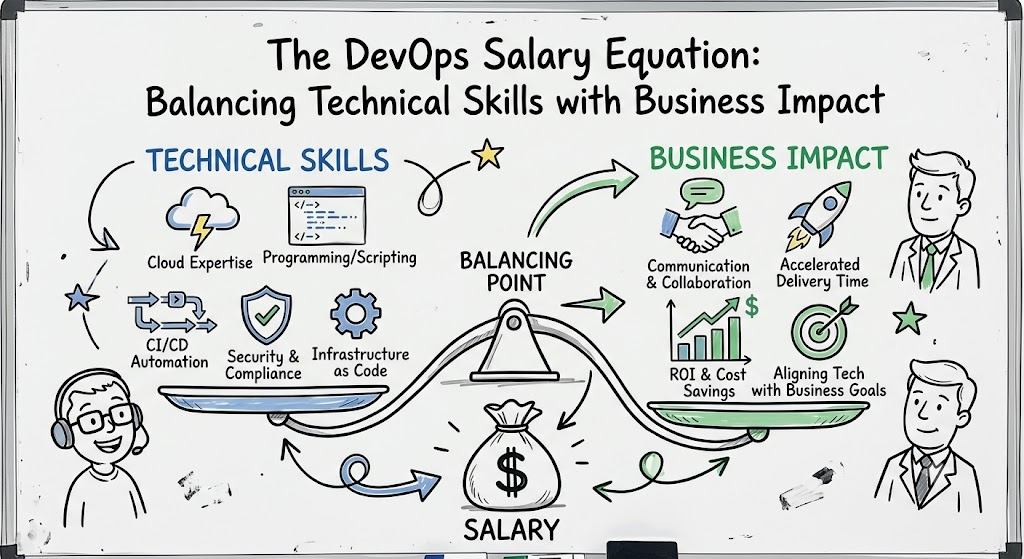
The landscape of DevOps salary expectations has evolved significantly. Today, DevOps is not just a role; it is a critical business function that bridges the gap between software development and stable infrastructure operations. As organizations accelerate their transition to cloud-native architectures, the demand for professionals who can automate delivery, ensure reliability, and manage complex systems continues to climb globally.
Understanding the factors that influence compensation is essential for any professional looking to advance their career. Whether you are an aspiring engineer or a seasoned specialist, knowing how to align your technical skills with market demand is the most effective way to grow your income. This guide provides a clear look at how role definitions, business risk, and specialized skill sets dictate salary growth in the modern IT market.
Why DevOps Salaries Are High
The high compensation associated with DevOps roles is driven by the direct impact these engineers have on business outcomes. Key factors include:
- Cloud Adoption: As companies migrate to multi-cloud environments, the complexity of infrastructure management has increased, requiring experts to design and maintain these systems.
- Automation Demand: Businesses are moving away from manual operational tasks. Professionals who can build pipelines and automated workflows reduce operational toil and increase team velocity.
- Kubernetes and Containerization: The widespread adoption of container orchestration requires specialized knowledge that remains in high demand.
- Security Integration (DevSecOps): With the rising threat landscape, integrating security into the development lifecycle is now a critical skill, commanding premium compensation.
- Reliability Engineering: SRE practices ensure uptime and performance. When an engineer’s work is tied to revenue uptime, their compensation potential rises accordingly.
- Scarcity of Skills: There is a persistent gap between the supply of professionals with deep operational and architectural knowledge and the industry’s need for such talent.
Who Should Read This Guide
This guide is designed for:
- Freshers entering the IT and DevOps space.
- Developers looking to transition into infrastructure and automation.
- Linux and System Administrators aiming to upgrade their skill sets.
- Cloud Engineers seeking to specialize.
- SRE and Platform Engineers focusing on reliability and internal products.
- DevSecOps professionals interested in pipeline security.
DevOps Salary Overview
In the current market, DevOps salary structures are fragmenting into different pay markets based on organization type. High-scale product organizations often offer equity-heavy compensation, while regulated enterprises prioritize bonus structures, and service-based companies focus on market-rate cards.
Titles such as “Platform Engineer” and “SRE” are increasingly being mapped to software engineering career ladders in mature organizations, leading to higher compensation bands. Conversely, generic titles are often treated as baseline roles.
DevOps Salary by Experience Level
Salary growth typically follows a trajectory based on the scope of responsibility and the ability to influence technical direction.
| Experience Level | Typical Roles | Skills Expected | Salary Growth Potential | Career Scope |
| Junior | DevOps Engineer | Task execution, on-call basics, scripting | Baseline | Individual Contributor |
| Mid-Level | DevOps/SRE | Independent CI/CD, pipeline changes | Moderate | Individual Contributor |
| Senior | Senior Engineer | Architecture design, incident lead | High | Technical Leadership |
| Staff/Principal | Staff SRE/Architect | Cross-team strategy, reliability standards | Very High | Org-wide direction |
Highest Paying DevOps Roles
Certain roles carry specific market premiums based on the scarcity of the skill and its impact on business risk.
| Role | Main Skills | Difficulty Level | Salary Potential |
| DevSecOps Engineer | Security policy-as-code, pipeline security | High | Premium |
| Platform Engineer | Internal developer platform, paved roads | Moderate-High | Premium |
| SRE Engineer | SLOs, incident response, toil reduction | High | High |
| Cloud Architect | Cloud landing zones, IAM, multi-cloud | High | High |
| DevOps Engineer | CI/CD, infra automation, deployment | Moderate | Baseline |
| Infra/Systems Engineer | Compute, storage, network ops | Moderate | Moderate |
DevOps Salary by Skills
Salary growth is directly correlated with the ability to solve complex, business-critical problems. Skills like Linux, Docker, Kubernetes, and Terraform are foundational. However, the highest salary potential comes from combining these with advanced disciplines:
- Reliability Engineering: Expertise in SLOs, error budgets, and design reviews.
- Security Platform: Scaling security controls and developer enablement.
- FinOps: Managing unit costs and capacity economics.
- Observability: Building telemetry architecture and logging solutions.
Focusing on skills that reduce business risk—such as security platform engineering or cost engineering—typically yields higher compensation than focusing solely on basic pipeline implementation.
DevOps Salary by Certification
Certifications serve as a signal of competence but are most effective when coupled with real-world application. While specific certifications vary by industry, the most valuable ones are those that validate hands-on expertise in cloud architecture, security, and container orchestration. The salary impact of a certification is highest when it helps you bridge the gap between being an “operator” and a “platform owner.”
DevOps Salary by Country or Region
DevOps salary data varies significantly by geography. In markets like the USA and Switzerland, compensation is generally higher due to the cost of living and tech-sector density. In other regions, compensation is often adjusted based on local economic conditions and market competition. Remote-first organizations continue to redefine these bands, though many companies still apply geographic multipliers to their salary offers.
DevOps Salary by Company Type
- Startups: Often offer significant learning exposure and equity, though base salaries can be lower in the very early stages.
- Product Companies: Tend to treat DevOps/SRE roles similarly to software engineering roles, resulting in higher compensation bands.
- Enterprise/MNCs: Focus on stability and bonus structures.
- Service-Based Companies: Compensation is often determined by client rate cards, which can limit the ceiling compared to product-focused organizations.
Factors That Affect DevOps Salary
Your salary is not just about the tools you know; it is about how you influence the business. Key factors include:
- Scope of Authority: Moving from a “pipeline implementer” to a “platform owner.”
- Reliability Ownership: The ability to tie your work to uptime and SLOs.
- Security Competency: Integrating security policies directly into the code.
- Cost Management: Demonstrating an understanding of cloud economics (FinOps).
- Communication: The ability to lead incidents and influence architectural decisions.
Best Skills for High DevOps Salary
To maximize your potential, follow this progression:
- Beginner Path: Focus on Linux, Git, Networking, and Shell scripting.
- Intermediate Path: Master Docker, Jenkins/CI/CD tools, and Terraform.
- Advanced Path: Specialize in Kubernetes, Cloud Architecture, GitOps, Observability, DevSecOps, and Platform Engineering.
Real-World Career Scenarios
- Moving from Development to DevOps: You bring a unique advantage—the ability to write code. Focus on automating infrastructure and building internal tools to increase your value.
- System Administrator Transitioning to Cloud: Your knowledge of compute, storage, and networking is the foundation. Shift your focus to automation (Terraform) and cloud identity management.
- SRE Growth: If you want to maximize your salary as an SRE, move from “responding to alerts” to “designing systems that don’t need alerts.” Focus on error budgets and incident command.
Common Mistakes That Reduce Salary Growth
- Focusing on Tools over Outcomes: Learning a tool without understanding the business problem it solves.
- Ignoring Infrastructure Basics: Skipping over Linux or networking fundamentals.
- Weak Communication: Failing to articulate the value of your work to non-technical stakeholders.
- Neglecting Security: Treating security as an afterthought rather than a core engineering requirement.
- Staying in “Ops-Only” Roles: Failing to evolve toward platform or product-focused engineering.
Hands-On Projects to Increase Salary Opportunities
Build projects that demonstrate your ability to handle business risk:
- Secure CI/CD Pipelines: Implement a pipeline that includes automated security scanning.
- Kubernetes Deployment: Manage a complex application with autoscaling and monitoring.
- Infrastructure as Code: Build and manage a multi-environment infrastructure using Terraform.
- Cost Optimization: Create a reporting system that tracks and alerts on cloud spend.
- Reliability Framework: Set up SLOs and dashboards for a sample application.
Career Roadmap for Better Salary Growth
- Foundational Phase: Establish deep knowledge of Linux and Git.
- Automation Phase: Build expertise in CI/CD and Docker.
- Advanced Phase: Transition into Kubernetes, Cloud Architecture, and DevSecOps practices to move toward Platform Engineering.
FAQs
Is DevOps a high-paying career?
Yes, due to the high business value of operational reliability, security, and automation, DevOps remains one of the top-paying paths in IT.
Which DevOps skill gives the highest salary?
Skills that combine security (DevSecOps), reliability (SRE), and cost engineering (FinOps) generally command the highest premiums.
Is Kubernetes good for salary growth?
Yes, but treat it as a tool. The salary increase comes from the ability to architect and secure Kubernetes platforms, not just manage them.
Does certification increase salary?
Certifications help with hiring signaling, but real-world project experience and the ability to demonstrate technical decision-making drive higher long-term growth.
Is DevOps better than software development?
It is not about “better.” It is about a different focus. DevOps/SRE roles are increasingly valued at similar levels to software engineering in mature tech organizations.
How long does it take to become a DevOps engineer?
It depends on your current background, but focusing on hands-on project work is faster than theoretical learning.
Final Recommendation
To secure your future and maximize your DevOps salary, shift your mindset from “doing tasks” to “solving business problems.” Companies pay for reliability, security, and cost efficiency. Build a portfolio of projects that prove you can handle these challenges, and never stop learning. The path to a high salary in this field is paved with real-world experience, not just titles or certificates.