





Introduction
In my two decades of working in the trenches of software engineering—from writing legacy code to orchestrating complex cloud-native architectures—I have noticed a persistent and frustrating pattern. DevOps, despite being a fundamental pillar of modern software delivery, remains one of the most misunderstood concepts in the IT industry.
Walk into almost any startup or enterprise office, and you will hear teams claiming they are “doing DevOps” because they use Jenkins or have a Kubernetes cluster. But often, the underlying culture of collaboration, shared responsibility, and continuous improvement is missing. These misunderstandings are not just academic; they cause failed projects, developer burnout, and unstable production environments.
Social media, aggressive marketing, and the “tool-first” narrative have clouded the reality of what this practice entails. For beginners, students, and even experienced professionals, it is easy to get lost in this noise. My goal in this article is to strip away the hype and help you gain a practical, engineering-focused understanding of what DevOps actually is. If you are looking to build a career on a solid foundation, I highly recommend exploring the resources and hands-on guidance available at DevOpsSchool. Understanding the reality behind these concepts is the first step toward becoming a competent engineer.
What Is DevOps Really?
At its core, DevOps is not a tool, a platform, or a specific department. It is a cultural philosophy and a set of engineering practices designed to break down the silos between software development (Dev) and IT operations (Ops).
When we talk about DevOps, we are talking about:
- Culture: A mindset where teams share accountability for the software they build and run.
- Automation: Using technology to reduce manual toil, not to remove human judgment.
- Collaboration: Developers and operations engineers working on the same goals, from the design phase to production maintenance.
- Continuous Improvement: The feedback loop where failure is treated as a learning opportunity rather than a blame-game scenario.
Think of it as a bridge. Development teams want to ship features fast. Operations teams want to keep systems stable. Without DevOps, these goals often conflict. DevOps aligns them, ensuring that the velocity of development does not sacrifice the reliability of operations.
Why DevOps Misconceptions Exist
The confusion surrounding DevOps largely stems from three factors:
- The “Tool” Trap: Software vendors often market their products as “DevOps Solutions.” If a tool has a pipeline feature, it gets tagged as “DevOps,” leading people to believe that installing the tool equals achieving DevOps success.
- Rapid Industry Evolution: The pace of change in cloud computing, containerization, and microservices is dizzying. In the rush to keep up, many teams adopt new technologies without understanding the underlying process, creating a “cargo cult” approach where they copy practices without knowing why they work.
- Terminology Overload: Terms like SRE, Platform Engineering, CI/CD, and IaC are often used interchangeably, causing significant confusion for those entering the field.
Overview Table: Common DevOps Misconceptions
| Misconception | The Reality |
| DevOps is just a tool | It is a cultural shift supported by tools. |
| DevOps means no ops team | It changes the operations team’s role to be more strategic and supportive. |
| DevOps is only CI/CD | CI/CD is just one delivery mechanism in a broader ecosystem. |
| DevOps is only for big companies | Startups need the agility and efficiency of DevOps to survive. |
| Automation solves everything | Automation of bad processes just speeds up failure. |
| DevOps removes developer responsibility | It increases responsibility through shared ownership. |
| DevOps focuses on speed only | It balances speed with stability and security. |
| DevOps is a job title | It is a mindset and role applied across teams. |
| Monitoring happens after deployment | Monitoring and observability are baked into the design phase. |
| DevOps guarantees zero downtime | It improves recovery times (MTTR) and resilience, not perfection. |
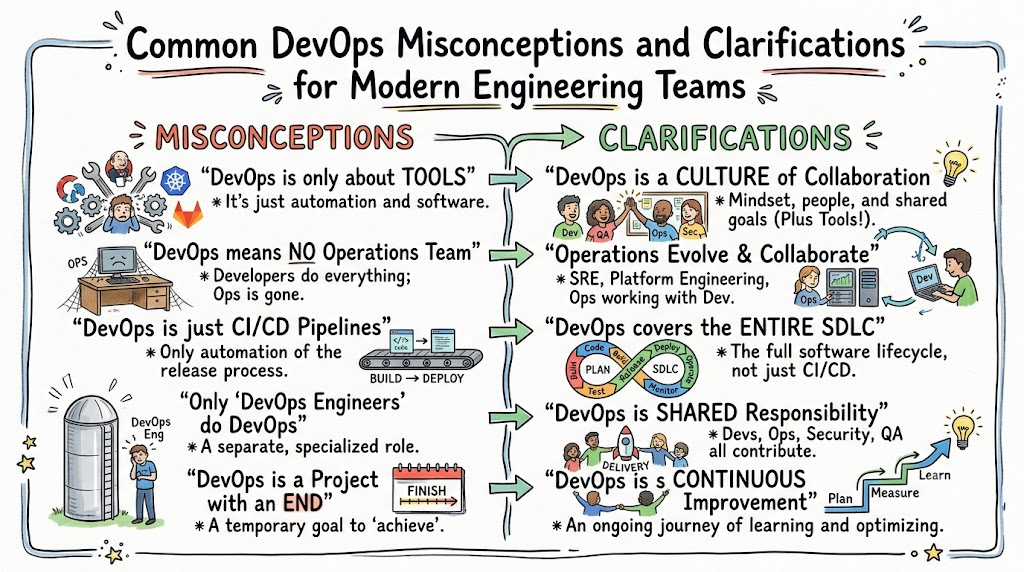
Misconception #1: DevOps Is Just a Tool
The Clarification: Many teams believe that if they implement Jenkins, GitLab CI, or Terraform, they have “done DevOps.” This is akin to buying a stethoscope and calling yourself a doctor.
The Reality: Tools are merely enablers. You can have the most advanced Kubernetes setup, but if your developers and operators are still throwing code over the wall and refusing to communicate, you are not doing DevOps. Tools like Jenkins or Docker allow you to implement automation, but the culture—the communication, the shared goals, and the feedback loops—is what actually drives DevOps.
Misconception #2: DevOps Eliminates Operations Teams
The Clarification: A common myth is that because developers are now pushing code to production, the Operations team becomes obsolete.
The Reality: In reality, the Operations team becomes more important. They evolve into Platform Engineers or SREs (Site Reliability Engineers). They stop being “ticket-takers” who manually provision servers and start being architects who build the internal platforms that empower developers to deploy code safely. You still need experts who understand networking, security, and infrastructure reliability.
Misconception #3: DevOps Is Only CI/CD
The Clarification: CI/CD (Continuous Integration and Continuous Deployment) is the heartbeat of modern delivery, but it is not the whole body.
The Reality: If you focus solely on how fast your code moves through a pipeline, you miss the other vital aspects: security (DevSecOps), observability, cost management, compliance, and disaster recovery. DevOps is a full lifecycle approach that spans from the moment a requirement is conceived to the moment it is retired.
Misconception #4: DevOps Is Only for Large Enterprises
The Clarification: Some believe that DevOps requires an army of engineers and a massive budget, making it impractical for startups.
The Reality: Startups are the primary beneficiaries of DevOps. In a competitive market, the ability to release features quickly and fix bugs instantly is a survival mechanism. By automating infrastructure and testing early, small teams can punch above their weight class and scale efficiently without needing to hire a massive operations department.
Misconception #5: Automation Solves Every Problem
The Clarification: “We will just automate it” is a dangerous phrase.
The Reality: Automation is an amplifier. If you automate a chaotic, broken, or poorly defined process, you will only create chaos faster. Before you automate anything, you must understand, document, and optimize the process. Automation should be the final step after you have a reliable, repeatable manual process.
Misconception #6: Developers No Longer Need Responsibility
The Clarification: Some developers think, “My job is to code; the DevOps team handles the rest.”
The Reality: DevOps promotes the “You build it, you run it” philosophy. Developers are now deeply involved in how their code behaves in production. They must understand containerization, resource limits, and basic debugging to ensure their applications are stable. This shared ownership creates better software from the ground up.
Misconception #7: DevOps Only Focuses on Speed
The Clarification: A common complaint is that DevOps is just about pushing code as fast as possible, which leads to bugs.
The Reality: DevOps focuses on the balance between speed and stability. The goal is to move fast without breaking things, or, when things inevitably break, to recover as quickly as possible. Quality, security, and compliance are non-negotiable parts of the DevOps equation.
Misconception #8: DevOps Is Just a Job Title
The Clarification: Many job boards list “DevOps Engineer” as a specific role. While this is common, it is also misleading.
The Reality: DevOps is a practice that everyone in the engineering organization should adopt. A “DevOps Engineer” is often someone who specializes in the tooling, culture, and automation of these practices, but they are not the only ones responsible for DevOps. The goal of a DevOps team is to put themselves out of a job by teaching developers and operators to work together effectively.
Misconception #9: Monitoring Matters Only After Deployment
The Clarification: Many teams think monitoring is a “final step” in the release process.
The Reality: Modern DevOps relies on observability from the start. You need to know how your code behaves in development, testing, and staging environments. If you wait until production to monitor, you are dealing with the aftermath rather than preventing the problem. Observability is a continuous feedback loop.
Misconception #10: DevOps Guarantees Zero Downtime
The Clarification: Marketing materials often imply that DevOps makes systems invincible.
The Reality: Failure is inevitable. No matter how good your processes are, networks will fail, disks will fill up, and APIs will time out. DevOps does not eliminate failure; it builds systems that are resilient and teams that can recover from failure in minutes rather than days. It is about MTTR (Mean Time To Recovery), not perfect uptime.
Real-World Example: Team Struggling Due to Misconceptions
Imagine “Team Alpha.” They were frustrated by slow releases. They hired a consultant who told them, “You need Jenkins.” So, they set up a massive Jenkins server.
They automated their builds, but they kept their siloed structure. Developers still refused to look at production logs, and the Operations team was still prohibited from touching the source code. The result? The automated pipeline kept failing because of environmental configuration issues, and developers and operators spent hours pointing fingers at each other. They had the tools of DevOps but none of the culture. Their failure stemmed from the belief that the tool was the solution to their communication problem.
Real-World Example: Team Understanding DevOps Correctly
Compare this to “Team Beta.” They faced the same release issues. However, they started by sitting developers and operators in the same room. They defined shared KPIs: uptime and release frequency.
They used Jenkins, but only after they cleaned up their deployment documentation. They instituted “on-call” rotations where developers participated in incident response. When a bug hit production, it wasn’t a “Dev vs. Ops” fight; it was a collaborative debugging session. Within six months, they achieved faster releases, fewer outages, and significantly higher team morale. They succeeded because they viewed DevOps as a way to work, not just a way to deploy.
Common Beginner Misunderstandings
When starting your journey, avoid these common traps:
- The “Tooling” Trap: You do not need to learn every DevOps tool (Jenkins, CircleCI, GitLab, Azure DevOps, AWS, GCP, Docker, Kubernetes, Ansible, Puppet, Chef, etc.) before you get a job. Focus on the concepts and master one or two tools deeply.
- The “Coding” Trap: You do not need to be a software architect, but you must know how to read and write scripts (Python, Bash).
- The “Impossible” Trap: Thinking you need 10 years of experience to enter the field. With the right hands-on practice, beginners can enter the field by focusing on fundamentals like Linux and networking.
- The “Certification” Trap: Certifications are great for structure, but they are useless without hands-on lab experience. Always build things.
Best Practices for Understanding DevOps Correctly
If you want to master DevOps, follow this checklist:
- Start with the Fundamentals: You cannot automate infrastructure if you do not understand how an Operating System (Linux) works or how networking protocols function.
- Learn the “Why,” Not Just the “How”: Don’t just learn how to write a Dockerfile. Understand why containers exist and what problem they solve.
- Embrace Failure: Build things in a lab environment. Break them on purpose. Learn how to fix them. That is where real learning happens.
- Practice Communication: If you are a developer, talk to an operations engineer. Ask them what keeps them up at night. If you are an operator, learn the basics of a programming language.
- Focus on Feedback Loops: Any process you build should have a way to report back if it fails or succeeds.
Role of DevOpsSchool in Building DevOps Understanding
At DevOpsSchool, the philosophy is rooted in this practical reality. It is not about simply memorizing tool commands. It is about understanding the engineering mindset required to build reliable systems. By focusing on hands-on CI/CD projects, monitoring strategies, and real-world infrastructure scenarios, learners gain the ability to adapt to any stack or organization. This type of exposure is critical because it forces you to think like an architect rather than a script-kiddie.
Career Importance of Understanding DevOps Correctly
Understanding DevOps is the gateway to some of the most stable and high-paying roles in the tech industry. Whether you are aiming to be a DevOps Engineer, SRE, Platform Engineer, or Cloud Architect, the core principles remain the same.
- DevOps Engineer: Focuses on the integration of Dev and Ops.
- SRE (Site Reliability Engineer): Applies software engineering to infrastructure problems.
- Platform Engineer: Builds the internal tools that allow others to move fast.
- Automation Engineer: Specializes in removing toil from workflows.
Industries such as Banking, Healthcare, E-Commerce, and SaaS platforms are heavily reliant on these roles. These industries cannot afford downtime, and they need professionals who understand the nuances of stability and security as much as they understand speed.
Future of DevOps Understanding
The future of DevOps is moving toward Platform Engineering and AI-assisted operations. As systems become more complex (using more microservices, serverless, and multi-cloud architectures), we cannot rely on manual intervention for everything.
We are entering an era of “Self-Healing Infrastructure” and “GitOps,” where the definition of the environment is treated exactly like source code. However, the core requirement remains: you must understand the fundamentals. AI can write a script, but it cannot (yet) understand the cultural nuances of why your team isn’t collaborating. The human element of DevOps will remain its most valuable component.
FAQs
1. What are common DevOps misconceptions?
The most common ones are that DevOps is just a tool, that it eliminates the Operations team, and that it is only for big enterprises.
2. Is DevOps only CI/CD?
No, CI/CD is a delivery mechanism. DevOps includes culture, monitoring, security, collaboration, and continuous feedback.
3. Does DevOps remove operations teams?
No. It evolves the Operations team into SREs or Platform Engineers who focus on higher-level reliability and infrastructure design.
4. Is DevOps only for enterprises?
Absolutely not. Startups and small businesses benefit significantly from DevOps agility and efficiency to scale safely.
5. Can beginners learn DevOps?
Yes, provided they focus on fundamentals like Linux, networking, and basic scripting before jumping into complex tools.
6. Is automation enough for a DevOps strategy?
No. Automating a broken or undefined process only leads to faster, more consistent failure.
7. Why is monitoring important in DevOps?
Monitoring provides the feedback loop necessary to understand system health and user experience, which is essential for continuous improvement.
8. Does DevOps guarantee zero downtime?
No. DevOps increases resilience and decreases recovery time (MTTR), but systems will always face some level of risk.
9. Do I need to be a coding expert to do DevOps?
You don’t need to be a software developer, but you need to be comfortable with scripting languages like Python or Bash to automate tasks.
10. Is DevOps a job title?
It is a practice and a culture. While “DevOps Engineer” is a common job title, the mindset applies to all engineering roles.
11. How do I start learning DevOps?
Start by learning Linux, basic networking, and how to build a simple application pipeline manually before using advanced tools.
12. Why do DevOps implementations fail?
They often fail because teams focus on buying tools without changing their internal culture of silos and lack of communication.
13. What is the difference between SRE and DevOps?
DevOps is the culture/philosophy; SRE is a specific way of implementing that philosophy, often with a heavier focus on reliability engineering and software-based operations.
14. Do I need to know cloud computing for DevOps?
Yes. Modern DevOps is heavily reliant on cloud-native environments, so understanding the basics of AWS, Azure, or GCP is essential.
15. Is DevOps relevant for non-software companies?
Yes. Any organization that relies on digital infrastructure, from retail to healthcare, can use DevOps to improve their IT processes.
Final Thoughts
DevOps is not a silver bullet. It is not a quick fix for a dysfunctional team, and it is certainly not a software package you can install to magically improve your velocity. It is a commitment to a way of working that prioritizes the health of the system and the productivity of the people building it.
If you are just starting, do not be overwhelmed by the sheer number of tools. Focus on the basics. Understand how systems communicate. Understand how to automate a task safely. Understand why a feedback loop is necessary. These are the skills that will serve you for the next 20 years, regardless of which tools fall in and out of fashion. DevOps is about people working together to solve problems better, and that is a skill that will never go out of style.