





Introduction
In the technology industry, we often get caught up in the allure of the latest automation tool, the fastest deployment pipeline, or the most robust cloud infrastructure. However, after two decades in engineering leadership, I have observed a consistent truth: the most sophisticated automation cannot fix a fractured team. DevOps is often misconstrued as a collection of technical practices, but at its heart, it is a cultural movement centered on human interaction.
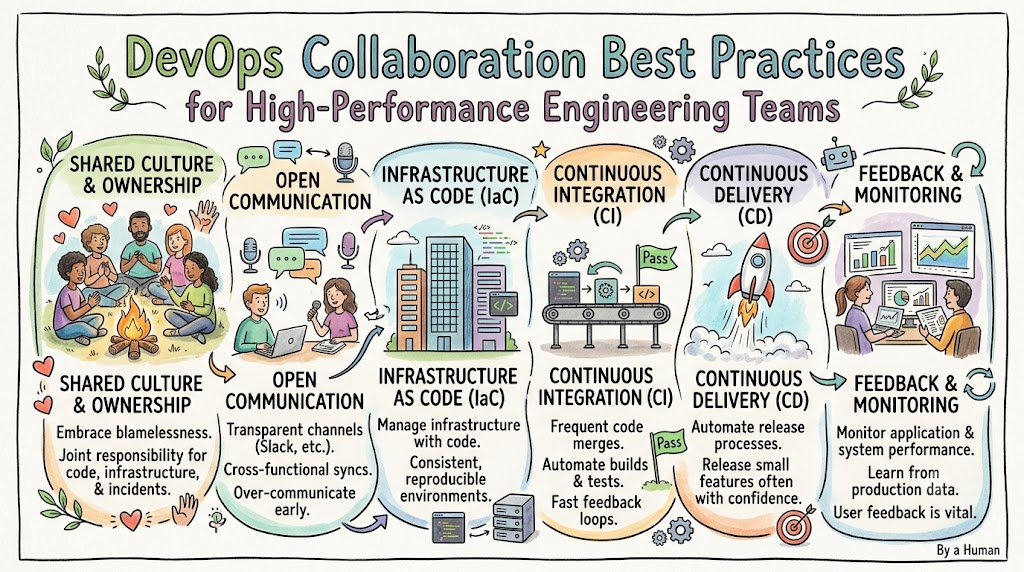
Software delivery is a team sport. When developers, operations engineers, security teams, and quality assurance specialists function as isolated units, the resulting friction acts as a tax on your organization’s productivity. This is where DevOps Collaboration Best Practices become essential. By fostering an environment of shared responsibility and open communication, organizations can bridge the gap between “writing code” and “running code.”
At DevOpsSchool, we emphasize that the success of a deployment is measured not just by its technical stability, but by how effectively the team managed the lifecycle of that change together. In this guide, we will explore the foundational principles of teamwork that drive engineering excellence, ensuring you move beyond simple tool adoption to building a truly collaborative culture.
What DevOps Collaboration Means
At its core, DevOps collaboration is the practice of breaking down the traditional barriers between disparate teams to achieve a common outcome. It means moving away from the “throw it over the wall” mentality, where a developer finishes code and pushes it to an operations team to manage, often without context or shared documentation.
True collaboration in this context relies on three pillars:
- Shared Ownership: Every team member is responsible for the health of the application, from the first line of code to the final delivery in production.
- Cross-Functional Teamwork: Bringing together different skill sets—coding, infrastructure, security, and testing—to solve problems holistically.
- Transparency: Creating an environment where information, logs, metrics, and incident data are accessible to everyone, not just those with specific administrative rights.
When you view collaboration this way, it is no longer about attending more meetings; it is about aligning incentives so that the entire organization wins when the software is stable and delivers value to the user.
Why Collaboration Matters in DevOps
Collaboration is the force multiplier of engineering efficiency. When teams collaborate effectively, the software development lifecycle (SDLC) becomes a smooth pipeline rather than a series of disjointed handoffs.
- Faster Delivery: When developers understand the infrastructure constraints early, they write code that is “production-ready,” reducing the cycle time for bug fixes and feature releases.
- Fewer Production Issues: Operational feedback loops provide developers with immediate data on how their code behaves under real-world stress, allowing for proactive refactoring.
- Better Incident Response: In a collaborative environment, the “blame game” is replaced by “post-mortem learning.” When an outage occurs, the focus shifts to resolving the issue and preventing recurrence rather than identifying who made the mistake.
Common Problems Caused by Poor Collaboration
When silos exist, they create systematic inefficiencies that manifest as business risks.
| Problem | Business Impact |
| Communication Gaps | Inconsistent requirements leading to rework and feature misalignment. |
| Delayed Deployments | Handoff friction and long wait times for environment configuration. |
| Blame Culture | Lower employee morale and fear of innovation; slow incident resolution. |
| Slow Incident Response | Extended downtime because teams lack context on system changes. |
| Security Gaps | Security teams left out of the loop until the final stage of the pipeline. |
| Knowledge Silos | Single points of failure where only one person understands a critical system. |
Core DevOps Collaboration Best Practices
Successful DevOps teams do not happen by accident; they are engineered through intentional practices.
| Practice | Why It Matters |
| Shared Ownership | Aligns incentives; everyone is responsible for production success. |
| Better Communication | Reduces ambiguity and prevents repetitive rework. |
| Cross-Functional Teams | Allows for diverse problem solving and holistic system views. |
| Documentation Culture | Prevents knowledge loss and onboards new members faster. |
| Automation Transparency | Ensures everyone trusts the CI/CD pipeline and its outcomes. |
| Fast Feedback Loops | Enables continuous improvement and faster learning. |
| Shared Goals & KPIs | Keeps all team members focused on the same business metrics. |
Best Practice #1: Shared Ownership
Shared ownership is the philosophy that “if it touches production, it is everyone’s responsibility.”
Workplace Example: Imagine a developer who finishes a feature and considers their job done. When a performance issue arises in production, they might say, “That’s an infrastructure problem.” In a shared ownership model, that developer is involved in the incident triage. By seeing the impact of their code in real-time, they gain invaluable experience that changes how they architect future features.
Best Practice #2: Better Communication
Communication in DevOps is not about endless status meetings; it is about high-signal, low-noise interaction.
Workplace Example: Instead of sending an email to notify the Ops team of a deployment, successful teams use shared communication channels (like Slack or Teams) integrated with their CI/CD tools. When a pipeline fails, an alert is pushed to a shared channel where both Dev and Ops can see the error logs immediately, allowing for real-time collaborative troubleshooting.
Best Practice #3: Cross-Functional Teams
A cross-functional team includes members with diverse skills who work on the same product throughout its lifecycle.
Workplace Example: A squad consisting of one Frontend Developer, one Backend Developer, one DevOps/SRE Engineer, and a QA Automation Specialist. This group shares a single backlog. By working in the same sprint, the QA engineer writes tests while the developer codes, and the DevOps engineer sets up the environment, ensuring the feature is integrated smoothly from day one.
Best Practice #4: Strong Documentation Culture
Documentation is the “memory” of a DevOps team. Without it, you are doomed to repeat past mistakes.
Workplace Example: Maintain a “Runbook” for common services. When an incident occurs, a team member shouldn’t have to search through chat logs or ping a senior engineer. They should be able to open a central repository, find the service documentation, and see the standard operating procedure for resolving common issues.
Best Practice #5: Automation Transparency
Automation should be visible and understood, not a “black box.”
Workplace Example: If a Jenkins or GitLab pipeline fails, the error message should be human-readable and clearly point to the cause—whether it is a syntax error in the code or a misconfiguration in the infrastructure. High-performing teams make sure their automation scripts are reviewed by peers, ensuring that everyone understands how the infrastructure is being provisioned.
Best Practice #6: Fast Feedback Loops
The time between writing code and receiving feedback (from tests, from performance monitors, from users) determines how fast a team can learn.
Workplace Example: Implementing automated unit tests that run on every commit. If a developer pushes code that breaks a previous feature, the system alerts them in minutes. They fix it before it ever reaches the staging environment, preventing a much larger headache later.
Best Practice #7: Shared Goals and KPIs
If Developers are measured by “number of features” and Ops are measured by “number of incidents,” you will have conflict.
Workplace Example: Align both teams on a unified KPI, such as “System Uptime” or “Deployment Success Rate.” When both teams share the goal of stability, the developer is incentivized to write cleaner, more robust code, and the ops engineer is incentivized to provide better tools to make that code stable.
Real-World Example: Team Struggling With Collaboration
The Scenario: A web development company has a “Dev” department and an “Ops” department located on different floors.
- The Workflow: Developers write code in isolation. They “throw” it over the wall to Ops.
- The Struggle: The deployment fails because the production server lacks a dependency that the developer forgot to document. The Ops team spends four hours debugging, while the Developers complain that “it worked on my machine.”
- The Result: Two days of wasted time, finger-pointing, and high stress. The deployment is rolled back.
Real-World Example: High-Performing DevOps Team
The Scenario: A tech startup uses integrated squads.
- The Workflow: The team uses Infrastructure as Code (IaC). The developer writes the code and the Terraform configuration simultaneously. A peer (an Ops engineer) reviews both via Pull Request before merging.
- The Success: The pipeline runs, identifying the missing dependency automatically during the test phase. The developer fixes it in 5 minutes. The deployment goes live without issues.
- The Result: A reliable release, increased team trust, and zero downtime.
Common Collaboration Mistakes
Avoid these pitfalls to maintain a healthy engineering culture:
- Blame Culture: Prioritizing who made the mistake over how to fix it.
- Tool Obsession: Believing that buying a tool will magically create collaboration.
- Poor Documentation: Assuming “everyone knows” how the system works.
- Lack of Feedback: Hiding failure rather than treating it as a learning opportunity.
- Top-Down Dictates: Forcing collaboration methods without getting team buy-in.
- Ignoring Soft Skills: Over-valuing coding ability while ignoring communication skills.
Common Misunderstandings About DevOps Collaboration
- “Collaboration means endless meetings”: True collaboration is about shared workflows, not more meetings.
- “Only Dev and Ops matter”: Modern DevOps requires Security, QA, and Business stakeholders to be involved.
- “Tools solve communication problems”: Communication is a human behavior; tools are just the medium.
- “Documentation slows teams down”: It actually accelerates teams by reducing the time spent answering redundant questions.
Challenges in Building DevOps Collaboration
Building a collaborative culture is difficult because it requires changing habits.
- Team Resistance: Engineers who are used to working in silos may fear losing their autonomy.
- Legacy Silos: Departments often have different budgets, management, and priorities.
- Poor Communication Habits: If a team has a history of conflict, it takes time to rebuild trust.
- Misaligned Incentives: If the management rewards speed over quality, teams will cut corners regardless of collaboration efforts.
To overcome these, start small. Introduce collaborative practices in one project, demonstrate the success, and scale from there.
Best Practices for Improving Collaboration
If you are looking to revitalize your team’s collaboration, take these steps:
- Host Blameless Post-Mortems: Focus on process failure, not human error.
- Create Shared Dashboards: Ensure everyone sees the same metrics (latency, error rates, deployment status).
- Cross-Training: Have developers shadow operations for a day, and vice versa.
- Open Communication Channels: Use transparent chat rooms where discussions are public, not private.
- Build Trust: Trust is built by delivering on promises and supporting each other during failures.
Role of DevOpsSchool in Learning Collaboration Culture
At DevOpsSchool, we believe that learning the tools is only half the battle. Our curriculum is designed to integrate the human element of engineering. We focus on real-world scenarios where students must work through typical industry friction, such as coordinating deployments, managing incidents, and communicating across teams. By exposing learners to these practical engineering collaboration situations, we help them transition from individual contributors to collaborative team players who understand that the strongest code is written by a unified team.
Career Importance of Collaboration Skills
In the current job market, technical skills get you the interview, but collaboration skills get you the promotion.
- DevOps Engineer: You are the bridge; you must speak the languages of both Dev and Ops.
- SRE Engineer: You focus on reliability; you must influence developers to write better code.
- Cloud Engineer: You build the foundation; you must collaborate with finance and security teams.
- Engineering Manager: You build the culture; your primary job is to enable collaboration.
Industries such as Banking, Healthcare, E-Commerce, and Telecom are increasingly prioritizing candidates who demonstrate strong teamwork, communication, and problem-solving abilities alongside technical proficiency.
Future of DevOps Collaboration
The future of collaboration lies in AI-assisted workflows and platform engineering. We will see more “platform teams” providing self-service capabilities that allow developers to manage their own infrastructure, reducing the bottleneck between teams. Furthermore, AI tools will likely play a role in summarizing incident data and suggesting fixes, allowing humans to focus on higher-level collaborative problem-solving.
FAQs
- What is DevOps collaboration? It is the practice of aligning teams, processes, and goals to ensure seamless software delivery.
- Why does collaboration matter in DevOps? It reduces friction, improves software reliability, and speeds up the release cycle.
- How do Dev and Ops work together? They work together through shared CI/CD pipelines, integrated communication, and mutual ownership of production stability.
- Can automation improve collaboration? Yes, by making processes visible, repeatable, and accessible, reducing the need for manual, error-prone coordination.
- What causes poor teamwork in DevOps? Siloed organizational structures, misaligned incentives, and a culture of blame.
- Why is documentation important? It creates a “single source of truth” that prevents knowledge loss and reduces dependency on specific individuals.
- What are cross-functional teams? Teams that include all the roles necessary to deliver a feature from concept to production.
- How do teams reduce blame culture? By implementing blameless post-mortems that focus on process improvement rather than identifying a culprit.
- Is collaboration only for large companies? No, even small teams need it to scale efficiently and maintain high quality.
- How do I start improving collaboration? Start by sharing dashboards and having developers participate in on-call rotations.
- Do I need soft skills for DevOps? Yes, communication and empathy are as important as technical coding skills.
- How does DevOpsSchool help with this? By providing real-world training that emphasizes culture, communication, and practical teamwork scenarios.
- What is a blameless post-mortem? A review meeting after an incident that focuses on what went wrong in the system, not who pressed the wrong button.
- How do shared goals help? They ensure that every team member is moving in the same direction, reducing conflicts of interest.
- Can remote teams collaborate effectively? Yes, by over-communicating, utilizing transparent project management tools, and establishing clear cultural norms.
Final Thoughts
DevOps collaboration is not a luxury; it is a necessity for any organization looking to thrive in a digital-first economy. Tools are merely the instruments; the collaboration is the music. When you invest in your team’s ability to communicate, share ownership, and learn together, you create an environment where reliability and speed are not trade-offs but dual outcomes. Trust is the currency of high-performing teams. Prioritize building it, and the technical outcomes will follow.