





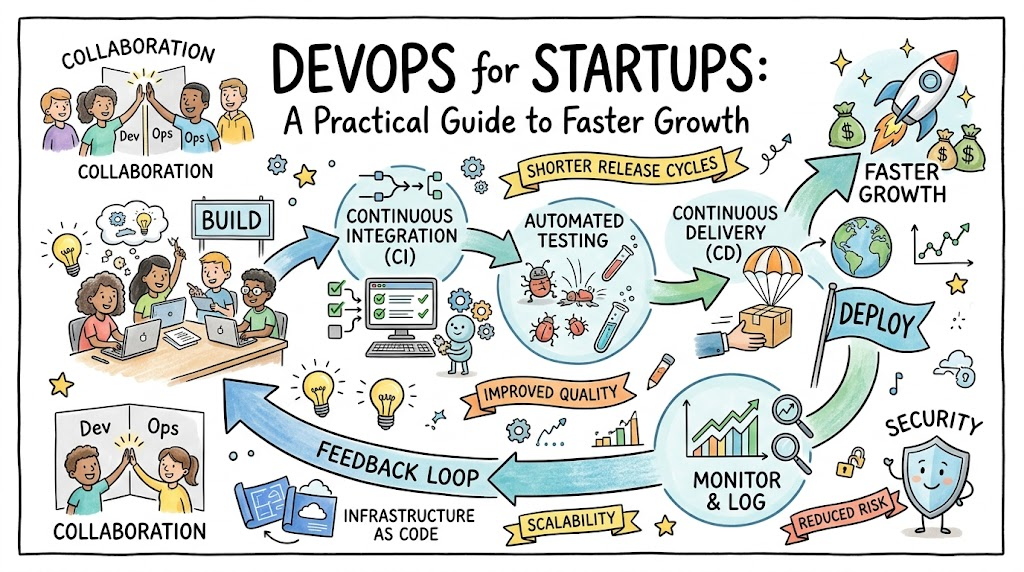
Introduction
In the early days of a startup, everything feels like a race. You are chasing product-market fit, trying to please your first customers, and iterating on your code daily. It is common for founders and early engineers to feel like they are constantly putting out fires. You write code in the morning, manually push it to a server by the afternoon, and pray that nothing breaks while users are active.
This “hero culture,” where individuals save the day through sheer force of will, is not sustainable. It is the primary reason why many promising startups hit a wall when they start to grow. They find that their infrastructure cannot keep up with their product roadmap.
This is where DevOps becomes essential. Contrary to the common myth, DevOps is not an enterprise-level luxury that requires a team of ten engineers and a massive budget. It is a philosophy of speed, reliability, and collaboration that is perfectly suited for small, agile teams.
At DevOpsSchool, we have spent years working with engineering teams to bridge the gap between “working code” and “production-ready systems.” Throughout this guide, we will break down how you can implement these principles without overcomplicating your workflow.
Why Startups Need DevOps Early
When you are a team of two or three, you might think, “We are too small for DevOps.” That is a dangerous assumption. DevOps is about culture and habit. If you wait until you have fifty engineers and a massive technical debt to introduce automation and monitoring, you will face an uphill battle.
Startups need DevOps early because it allows you to:
- Move Faster with Confidence: When you automate testing and deployment, you stop fearing releases. You can push updates daily, not monthly.
- Recover Quickly: Things will break. That is part of the game. DevOps teaches you to build systems that allow you to detect failures immediately and fix them in minutes, not hours.
- Scale Without Chaos: As your user base grows, your manual processes will snap. DevOps practices allow your infrastructure to grow along with your product.
- Focus on the Product: Every hour your team spends manually configuring servers or fixing deployment bugs is an hour they are not spending on features that make your startup money.
Common Problems Startups Face Without DevOps
Early-stage companies often suffer from what I call “The Manual Grind.” Here is a look at the common operational hurdles and the impact they have on your business.
| Problem | Business Impact |
| Manual Deployments | High risk of human error, inconsistent environments, and fear of releasing new features. |
| Downtime | Immediate loss of revenue, damaged brand reputation, and churn of early adopters. |
| Scaling Issues | Inability to handle traffic spikes, leading to site crashes during critical marketing moments. |
| Team Confusion | “It works on my machine” syndrome, leading to wasted time debugging environment differences. |
| Slow Recovery | Long outages because the team doesn’t have visibility into what went wrong. |
| Poor Visibility | No idea how your application is performing until a customer complains on social media. |
What DevOps Means for a Startup
In a startup context, DevOps is not about buying expensive tools or hiring a full-time “DevOps Engineer” before you have product-market fit. It is about practical automation.
It means:
- Treating your infrastructure like code.
- Building a culture where developers own the reliability of the code they write.
- Automating the boring, repetitive parts of the software lifecycle.
- Keeping the feedback loop between writing code and seeing it run in production as short as possible.
It is about creating a “set it and forget it” mindset for the operational parts of your business, so you can keep your eyes on the product.
Step-by-Step Guide to Getting Started With DevOps
Implementing DevOps is an iterative process. Do not try to do everything at once. Use this roadmap to build your foundation.
| Stage | Goal |
| 1. Culture | Foster collaboration and shared ownership. |
| 2. Version Control | Establish disciplined Git workflows. |
| 3. CI/CD | Automate code integration and deployment. |
| 4. Containers | Standardize environments for consistency. |
| 5. Cloud | Use scalable, managed infrastructure. |
| 6. Monitoring | Gain observability into your system. |
| 7. Improvement | Learn from incidents to iterate. |
Step #1: Build a Collaborative Culture
DevOps starts with people, not software. In many startups, there is a wall between “the people who build the app” and “the people who run the servers.” Break that wall. Even if you are a team of two, adopt a “you build it, you run it” mentality. When a developer understands the consequences of a bad code push on production, they naturally write more resilient code.
Step #2: Use Git Properly
Your codebase is your most valuable asset. If you are not using Git with a disciplined workflow, you are already behind. Stop working on master or main directly. Implement a simple branching strategy. Every new feature or bug fix should happen in its own branch, be reviewed by at least one other team member, and then merged. This ensures code quality and provides a clear history of what changed and why.
Step #3: Start CI/CD Basics
Continuous Integration (CI) and Continuous Deployment (CD) are the heart of DevOps. Start small. Even a simple pipeline that runs your tests automatically when you push code is a huge win. When you are ready, configure your pipeline to deploy that code to a staging environment. This removes the “it works on my machine” excuse.
Step #4: Containerize Applications
Docker changed the game for startups. By containerizing your application, you package the code and all its dependencies together. This means the code runs exactly the same on a developer’s laptop, the staging server, and the production cloud environment. It eliminates the configuration drift that plagues many early teams.
Step #5: Adopt Cloud Infrastructure
Stop managing physical servers or complex on-premise hardware. Use cloud providers. They allow you to scale your resources up and down based on traffic. Start with simple managed services. Don’t try to build a complex global network on day one; focus on managed databases and managed compute instances that take care of patching and security updates for you.
Step #6: Add Monitoring
You cannot fix what you cannot see. Start by installing basic monitoring tools that track CPU usage, memory, and error rates. Set up alerts that notify you when something goes wrong. If your site goes down at 3 AM, you want to know before your customers do. Observability is the practice of tracking these metrics to understand the health of your system in real-time.
Step #7: Continuous Improvement
DevOps is a cycle, not a destination. Once you have a pipeline and monitoring in place, hold regular retrospectives. When an incident occurs, don’t ask “Who did this?” Ask “What in our process allowed this to happen?” Use those answers to update your automation and improve your systems.
Real-World Example: Startup Without DevOps
Imagine “Startup A.” They have no DevOps practices. When they need to update the website:
- A developer manually zips the code on their laptop.
- They SSH into the production server and copy the files.
- They restart the server.
- If it crashes, they frantically try to roll back by copying the old files back.
- The team is stressed, the deployment takes an hour, and the site is down for 10 minutes every time they release a feature.
- The founder is worried about growth because the system is too fragile to handle more traffic.
Real-World Example: Startup Adopting DevOps
Now consider “Startup B,” which has adopted basic DevOps:
- A developer pushes code to a feature branch.
- The CI pipeline automatically runs tests.
- The pipeline builds a container and deploys it to a staging environment for review.
- Once approved, the code is merged and automatically deployed to production.
- The entire process is automated, takes minutes, and requires zero manual server intervention.
- If a bug slips through, they roll back with one click. The team feels confident, and the product grows faster.
Budget-Friendly DevOps Practices for Startups
You do not need an enterprise budget to do DevOps.
- Choose Open Source: Tools like Jenkins, GitLab CI, Prometheus, and Docker are free and powerful.
- Cloud Free Tiers: Most cloud providers offer generous free tiers for small startups. Use these to build your proof-of-concept environments.
- Focus on Automation First: Spend your time automating the things that hurt the most. If deployments take forever, automate deployments. Don’t spend time setting up complex security dashboards before you have a deployment process.
- Managed Services: While they might cost a bit more, using managed databases (like AWS RDS or Google Cloud SQL) saves you the immense cost of hiring someone to manage your database backups and security.
Common Mistakes Startups Make
- Overengineering: Trying to implement a full Kubernetes cluster with complex microservices when a simple monolith would suffice.
- Too Many Tools: Buying every DevOps tool on the market. Stick to a simple, standard stack.
- Ignoring Monitoring: Building a great delivery pipeline but having no idea when the site crashes.
- Weak Documentation: Assuming “everyone knows how the server works.” Write down your processes.
- Manual Hotfixes: Directly editing code on the production server. This is the fastest way to lose control of your system.
Best Practices for Startup DevOps Success
- Keep It Simple: Complexity is the enemy of a startup. Choose the simplest tool that gets the job done.
- Automate Gradually: You don’t need 100% automation on day one. Automate the most painful manual task first, then move to the next.
- Monitor Everything: Metrics are your truth. Trust data, not opinions.
- Prioritize Security: Even a small startup can be a target. Use secure practices like managing secrets properly (never hardcode passwords).
- Build a Culture of Learning: Encourage the team to share knowledge. When one person learns a better way to do something, document it.
Role of DevOpsSchool in Startup DevOps Learning
At DevOpsSchool, we believe that DevOps is best learned through doing. We focus on providing the practical, hands-on experience that startup engineers need to succeed. Our approach isn’t about memorizing theory; it’s about understanding how CI/CD pipelines, containerization, and cloud infrastructure work together to create reliable systems. We help bridge the gap between academic knowledge and the real-world pressures of a fast-growing startup.
Career Importance of Startup DevOps Experience
Experience in a startup is arguably the best way to learn DevOps. In a large enterprise, you might be siloed into just one tool. In a startup, you get to see the whole lifecycle. You learn how to build, deploy, monitor, and scale. This makes you incredibly valuable. Whether you want to become a Platform Engineer, an SRE (Site Reliability Engineering) lead, or a CTO, having a background in startup DevOps gives you the “hacker mindset” to solve problems with limited resources.
Industries Where Startup DevOps Matters
- SaaS Platforms: Speed of feature delivery is your competitive advantage.
- FinTech: You cannot afford downtime; reliability and security are non-negotiable.
- HealthTech: Compliance and audit trails are critical; automation ensures you stay compliant.
- E-Commerce: Your site uptime directly correlates to your revenue.
- Telecom Startups: Handling high concurrency requires robust infrastructure.
- Enterprise SaaS: Reliability builds trust with your business clients.
Future of Startup DevOps
The future of DevOps is moving toward Platform Engineering. We are seeing a shift where DevOps teams create “internal platforms” that make it easy for developers to deploy code without needing to know the underlying infrastructure. Additionally, AI-assisted operations are helping teams detect anomalies faster than ever. Security is also being shifted “left,” meaning security checks happen during the development phase, not just before release.
FAQs
- Why do startups need DevOps?It prevents operational chaos and allows your team to move fast without breaking the system.
- Can small teams implement DevOps?Yes, it is often easier for small teams because there is less bureaucracy and resistance to change.
- Is Kubernetes required for startups?No. Kubernetes is powerful but complex. Start with Docker or simple cloud virtual machines first.
- What tools should startups begin with?Git, a CI/CD platform (like GitHub Actions or GitLab), Docker, and a cloud provider.
- Is cloud necessary?Yes, cloud provides the flexibility and scalability that is essential for modern startup growth.
- How expensive is DevOps?It can be very cheap using open-source tools. The cost is primarily in time spent setting it up.
- Can startups automate deployments?Yes, and they should. It is one of the highest-impact automations you can build.
- Why is monitoring important?Because you cannot improve or fix what you cannot measure.
- Should I hire a DevOps engineer early?Focus on a “DevOps culture” first. Your developers should be able to handle basic operational tasks.
- What is the first step in DevOps?Adopting a version control system (Git) and a collaborative mindset.
- How do I deal with technical debt?Schedule regular time in your sprints to pay it down, just like feature development.
- Is security part of DevOps?Yes, it is often called DevSecOps. Security should be integrated into your pipeline, not an afterthought.
- Do I need to be an expert in Linux?You need to understand the basics, but modern cloud tools abstract away much of the complexity.
- How long does it take to implement?It is an ongoing process. You can see benefits in weeks, but it matures over months.
- What if we fail a deployment?Use it as a learning opportunity. That is exactly why you have automated rollbacks and monitoring.
Final Thoughts
Starting your DevOps journey isn’t about being perfect. It is about being better today than you were yesterday. Start small. Pick one manual process that annoys your team and automate it. Once that’s done, move to the next. Focus on reliability, keep your infrastructure simple, and foster a team culture where everyone takes responsibility for the product.
You don’t need complex enterprise systems to succeed; you need a consistent, reliable workflow. Use these practices to build a foundation that can handle the success you are working towards.