




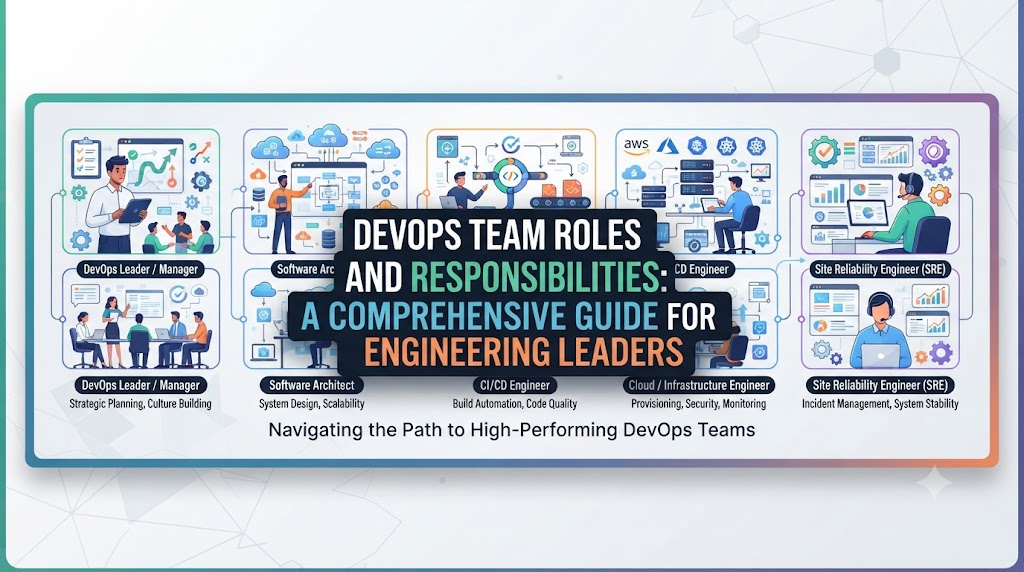
Introduction
In the modern landscape of software engineering, the term DevOps is frequently misunderstood as a single job title or a specific toolset. In reality, it is a cultural and collaborative approach designed to break down the traditional silos between development and operations. Achieving true agility requires more than just installing new software; it requires a clear understanding of how different functions contribute to the collective goal of delivering high-quality, reliable, and secure applications. When roles are clearly defined yet flexible enough to encourage cross-functional collaboration, organizations can significantly accelerate their release cycles and improve the overall reliability of their systems. For those looking to master these organizational dynamics, professional guidance through resources like DevOpsSchool can be an invaluable step in aligning team structure with business objectives. Whether you are building a team from scratch or refining an existing one, viewing DevOps as a unified team effort rather than a collection of isolated responsibilities is the key to sustainable success.
What Is a DevOps Team?
A DevOps team is a cross-functional group of individuals who share responsibility for the entire software development lifecycle (SDLC). Unlike traditional models where developers write code and hand it over a “wall” to operations, a DevOps team works as a cohesive unit.
- Shared Ownership: Every member is responsible for both the feature development and the stability of the application in production.
- Collaboration: Constant communication between developers, testers, and operations professionals is prioritized over documentation silos.
- Automation: The team focuses on automating repetitive tasks—like testing, deployment, and infrastructure provisioning—to minimize human error.
- Customer-Focused Delivery: The primary goal is to deliver value to the end-user faster, more reliably, and more frequently.
Why Clearly Defined Roles Matter
While collaboration is the heart of DevOps, lack of role clarity can lead to “too many cooks in the kitchen” or, conversely, critical tasks falling through the cracks. Defining roles ensures that everyone knows their primary area of focus while still being encouraged to participate in the broader team mission.
- Faster Delivery: When a developer knows who handles the CI/CD pipeline infrastructure, they spend less time troubleshooting environment issues and more time coding.
- Better Accountability: Clear ownership of monitoring, security, or database performance prevents finger-pointing during incidents.
- Improved Collaboration: Knowing the strengths of team members allows for effective delegation and mentorship.
- Reduced Bottlenecks: Defining responsibilities helps identify where automation is needed most to prevent a single role from becoming a service desk for the rest of the team.
Typical DevOps Team Structure
A modern, high-performing DevOps team is rarely a flat hierarchy. It usually follows a structure that balances specialized technical expertise with unified leadership.
- Engineering Manager: Orchestrates resources, manages professional growth, and ensures business goals are met.
- DevOps Lead: Sets the architectural direction and mentors the technical team.
- DevOps Engineers: Focus on the bridge between dev and ops, specifically in CI/CD and automation.
- Platform Engineers: Build internal developer platforms to make self-service infrastructure a reality.
- Cloud Engineers: Manage the architectural integrity and cost optimization of cloud resources.
- SRE Engineers: Ensure system reliability, uptime, and incident response efficiency.
- Security Engineers: Integrate security practices (DevSecOps) into every layer of the pipeline.
- Software Developers: Owners of application logic and automated testing.
- QA Engineers: Specialists in quality strategy and automated test suites.
- Product Managers: The voice of the customer, ensuring the team builds the right features.
DevOps Team Roles and Responsibilities
| Role | Primary Responsibilities | Key Skills |
| DevOps Engineer | CI/CD pipeline, Automation, Infrastructure as Code | Jenkins, GitLab CI, Python, Bash |
| Platform Engineer | Internal developer platform, Self-service tools | Kubernetes, Go, Terraform |
| Cloud Engineer | Architecture, Cost management, Cloud migration | AWS, Azure, GCP, FinOps |
| SRE Engineer | Error budgets, Monitoring, Incident response | Prometheus, Grafana, ELK, PagerDuty |
| Security Engineer | Compliance, Vulnerability scanning, IAM | Vault, SonarQube, OpenSCAP |
Detailed Role Breakdowns
- DevOps Engineer: The engine of the team. They focus on creating robust CI/CD pipelines and automating infrastructure provisioning to ensure code moves from commit to production seamlessly.
- Platform Engineer: These engineers treat the internal infrastructure as a product. They build platforms that allow developers to deploy applications without needing deep knowledge of the underlying cloud hardware.
- Cloud Engineer: Responsible for the design of the cloud environment. They focus on scalability, high availability, and optimizing cloud spend.
- Site Reliability Engineer (SRE): SREs focus on the “Reliability” part of the equation. They create automated responses for system failures and define the metrics that determine whether a service is “healthy.”
- Security Engineer: They champion DevSecOps, ensuring that security is “shifted left”—integrated into the code and pipeline stages rather than checked at the very end.
- Software Developer: In a DevOps culture, developers take ownership of their code all the way into production. They write unit tests and participate in the observability of their services.
- QA Engineer: They move away from manual testing toward developing sophisticated automated test suites that run continuously.
- Product Manager: They bridge the gap between business requirements and technical feasibility, ensuring the roadmap aligns with customer needs.
- Engineering Manager: A servant leader who removes blockers, manages headcount, and fosters a culture of psychological safety and continuous learning.
Collaboration Between Roles
True DevOps collaboration is built on rituals and shared mental models.
- Agile Ceremonies: Daily standups, sprint planning, and retrospectives should include both ops and dev roles to ensure alignment.
- Shared Incident Response: When production goes down, both the developer who wrote the feature and the SRE who manages the infrastructure collaborate on the fix.
- Continuous Feedback Loops: Post-mortem meetings after incidents are treated as learning opportunities, not blame-finding exercises.
Technical Skills by Role
| Role | Essential Technical Skills |
| All Roles | Linux, Git, Basic Networking, Security Principles |
| DevOps/Platform | Docker, Kubernetes, Terraform, Ansible, CI/CD tools |
| SRE | Observability, Distributed systems, Scripting |
| Cloud | VPC, Load Balancing, Auto-scaling, Cloud Cost Management |
Soft Skills for Every DevOps Team Member
Technical skill gets you in the door, but soft skills make you effective.
- Communication: The ability to explain complex technical failures to non-technical stakeholders.
- Problem-Solving: Approaching a system outage with a calm, analytical mindset.
- Adaptability: The tech stack changes rapidly; the ability to unlearn and relearn is crucial.
- Accountability: Owning your mistakes and documenting them so the team doesn’t repeat them.
Measuring Team Performance
| Metric | Why It Matters | Business Value |
| Deployment Frequency | Measures speed of delivery. | Faster time to market. |
| Lead Time for Changes | Measures efficiency of the pipeline. | Improved responsiveness. |
| Change Failure Rate | Measures quality and stability. | Reduced downtime costs. |
| MTTR (Mean Time to Recover) | Measures resilience. | Increased customer trust. |
Common Challenges
| Challenge | Impact | Recommended Solution |
| Role Confusion | Overlap or gaps in work. | Clearly defined RACI matrix. |
| Team Silos | Slow communication. | Cross-functional team squads. |
| Tool Complexity | “Tool fatigue.” | Standardizing on a common tech stack. |
Best Practices for Managing DevOps Teams
- Define Responsibilities Clearly: Use documentation to outline who owns which part of the pipeline.
- Encourage Collaboration: Host knowledge-sharing sessions across departments.
- Automate Everything: If a task is repeated more than twice, automate it.
- Invest in Continuous Training: Technology evolves; provide your team with time and resources to learn new tools.
- Review Performance Continuously: Use retrospectives to adjust the team’s processes.
Real-World Example: Cross-Functional DevOps Team
Consider a mid-sized e-commerce company that struggled with “release Fridays.” Developers were afraid to push code, and the Ops team was overwhelmed with manual deployment tasks.
Restructuring: They created a “Squad” model. Each squad included a developer, a QA engineer, and a DevOps engineer.
Results: By having a DevOps engineer embedded directly within the development squad, the team identified infrastructure bottlenecks during the design phase rather than the deployment phase.
Outcomes: Deployment frequency increased by 40%, and the Change Failure Rate dropped by 25% within six months. The lesson: proximity breeds efficiency.
Common Beginner Mistakes
- Assuming DevOps is one role: It is a methodology, not a person.
- Ignoring communication: Focusing only on tools like Kubernetes while neglecting team dialogue.
- Weak documentation: Relying on tribal knowledge that leaves when an employee resigns.
- Tool-first mindset: Trying to force a tool into a process that hasn’t been fixed yet.
Future of DevOps Team Roles
The industry is moving toward Platform Engineering, where the role of the DevOps engineer is becoming more focused on building internal platforms. AI-assisted DevOps is also emerging, where AI tools help analyze logs and predict infrastructure failures before they happen, allowing the team to focus on higher-level architectural challenges.
Certifications & Learning Paths
| Certification | Best For | Skill Level | Focus Area |
| Certified DevOps Engineer | Beginners | Entry | CI/CD, Scripting |
| Kubernetes Administrator | Intermediate | Advanced | Container Orchestration |
| Cloud Architect | Experienced | Expert | System Design |
| DevSecOps Professional | Intermediate | Advanced | Security Automation |
Professional training, such as that provided by the DevOpsSchool learning ecosystem, can help bridge the gap between theoretical knowledge and real-world application.
Practical Team Collaboration Checklist
- Define ownership of critical services using a RACI matrix.
- Establish a daily communication rhythm.
- Standardize workflows through centralized documentation.
- Share documentation in a central repository (e.g., Confluence/Notion).
- Conduct blameless post-mortems for every incident.
- Dedicate time for team upskilling and certification.
FAQs
- What roles exist in a DevOps team?Common roles include DevOps Engineers, SREs, Platform Engineers, Security Engineers, and Developers working in a unified squad.
- Is DevOps a single job title?No, DevOps is a culture. While “DevOps Engineer” is a common job title, the responsibility is shared across the entire team.
- How do SRE and DevOps engineers differ?DevOps focuses on the delivery pipeline and automation, while SRE focuses specifically on the stability, reliability, and monitoring of systems in production.
- Should QA be part of the DevOps team?Yes. Integrating QA engineers into the DevOps flow ensures that quality is tested early and often, rather than as an afterthought.
- How does DevSecOps fit into the team?Security is not a separate phase. Security engineers should provide the tools and guardrails that allow developers to build secure code by default.
- Which role is best for beginners?A Cloud Associate or Junior DevOps Engineer role is often the best entry point, focusing on learning Linux, Git, and cloud fundamentals.
- How should startups organize DevOps teams?Startups should prioritize cross-functional “full-stack” engineers who can handle both development and basic infrastructure needs before scaling into specialized roles.
- Which soft skills matter most?Communication, empathy, and the willingness to learn are arguably more critical than any specific tool proficiency.
- Does DevOps replace Agile?No, DevOps complements Agile by focusing on operational stability while Agile focuses on development speed.
- What is the biggest mistake in building a DevOps team?Creating a “DevOps Team” that operates in a silo, separate from the rest of the development group.
- How do you measure DevOps success?Focus on DORA metrics: Deployment Frequency, Lead Time, Change Failure Rate, and Mean Time to Recover.
- Is infrastructure automation mandatory?Yes, it is essential for scaling and reducing the risk of human error in production environments.
- What is an Internal Developer Platform?A set of tools and services built by Platform Engineers to provide self-service infrastructure to developers.
- How often should we review team roles?At least once every six months to ensure the team structure still supports the current business goals.
- Where can I find training for these roles?Reputable providers like DevOpsSchool offer comprehensive learning paths tailored to these specific roles.
Final Thoughts
Building a high-performing DevOps team is an ongoing process of refinement. The most successful organizations understand that technology is only half the battle. By prioritizing shared ownership, clear communication, and constant professional development, you create an environment where engineers can thrive. Avoid the temptation to chase the latest tools without first establishing the cultural foundations of collaboration. Focus on the business outcomes—stability, speed, and quality—and the roles will naturally align to support those objectives.