





Introduction
In the modern digital economy, the ability to release software features quickly and reliably is no longer a luxury—it is a competitive necessity. Organizations that struggle with manual, high-risk, and infrequent releases often find themselves falling behind, unable to respond to market shifts or customer feedback. This is where the evolution of software delivery practices becomes critical. Traditional release processes—often characterized by “big bang” deployments, manual handoffs, and prolonged testing phases—frequently result in bottlenecks and system instability. To address these challenges, the industry has shifted toward automation and integrated workflows. Continuous Delivery has emerged as a foundational DevOps practice that enables teams to release software with confidence, speed, and consistency.
For professionals seeking to master these disciplines, resources from DevOpsSchool provide the necessary frameworks and hands-on guidance to navigate this transition effectively. By implementing these modern delivery strategies, engineering teams can bridge the gap between development and production, ensuring that software is always in a releasable state.
Continuous Delivery Explained
At its core, Continuous Delivery (CD) is a software engineering approach in which teams produce software in short cycles, ensuring that the code can be reliably released at any time. It moves away from the concept of a “release event” as a stressful, manual activity and transforms it into a routine, low-risk process.
Release readiness is the defining characteristic of this methodology. Every change that passes through the automated pipeline is validated for quality, security, and performance. Because the process is automated and consistent, the risk associated with human error is significantly reduced. This approach creates a culture of reliability, where the primary goal is not just speed, but the ability to deliver value to customers on demand.
How Continuous Delivery Works
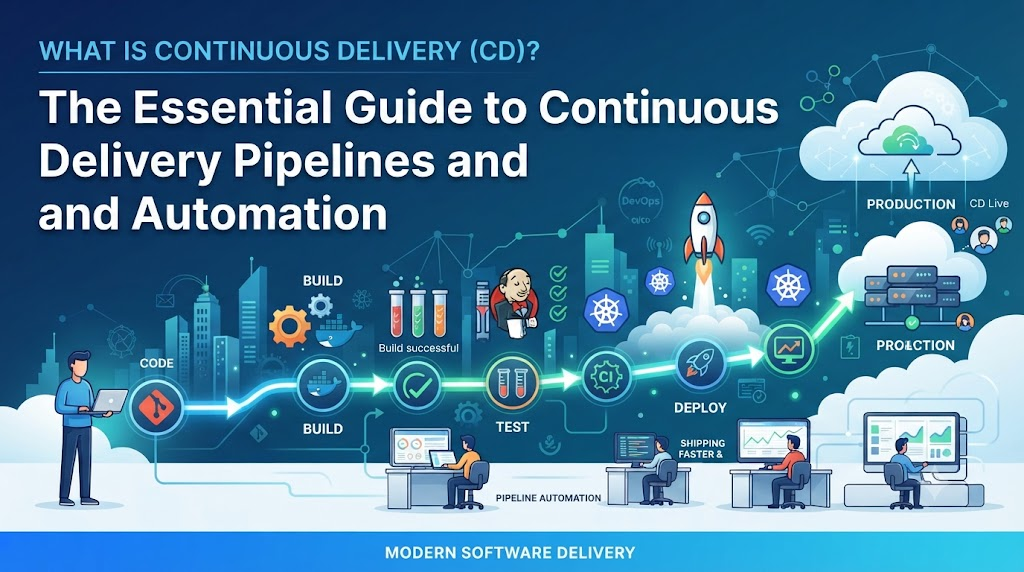
The Continuous Delivery workflow is a structured, automated sequence that ensures code quality from commit to production readiness.
- Code Commit: Developers push code to a shared version control system, triggering the pipeline.
- Continuous Integration: The system automatically builds the application and runs unit tests to ensure no regressions were introduced.
- Automated Testing: Integration, functional, and performance tests are executed to validate behavior.
- Build Validation: The build is packaged into a deployable artifact (e.g., Docker image or binary).
- Security Checks: Automated static and dynamic analysis tools scan for vulnerabilities.
- Artifact Management: The verified artifact is stored in a secure repository for deployment.
- Staging Deployment: The artifact is deployed to a staging environment that mirrors production.
- Approval Gates: Stakeholders perform a final check or approval before the release moves forward.
- Production Readiness: The code is ready for release, awaiting the final trigger to reach the end-user.
Continuous Delivery vs Continuous Deployment
While the terms are often used interchangeably, there is a distinct difference in the final stage of the pipeline.
| Area | Continuous Delivery | Continuous Deployment |
| Human Approval | Required for production release | None (fully automated) |
| Automation Level | High (through testing) | Absolute (end-to-end) |
| Release Control | Business-driven timing | Instant deployment upon success |
| Risk Management | Validated, then held for release | Validated, then live immediately |
| Deployment Frequency | On-demand or scheduled | Constant, per feature completion |
Relationship Between CI and CD
Continuous Integration (CI) and Continuous Delivery (CD) are two halves of the same coin. CI focuses on the developer experience—merging code frequently and ensuring the build remains stable. It provides the essential testing foundation. CD takes these stable, tested builds and automates the path to production. Without a robust CI process, a CD pipeline would constantly fail due to broken builds, rendering the automation useless.
Core Components of a Continuous Delivery Pipeline
| Component | Purpose | Business Benefit |
| Source Control | Versioning and tracking code changes | Team collaboration and auditability |
| Build Automation | Compiling and packaging software | Consistency across environments |
| Automated Testing | Validating features and quality | Reduced bugs in production |
| Artifact Repositories | Versioning deployable packages | Stability and rollback readiness |
| Deployment Automation | Moving code to target environments | Predictable release cycles |
| Monitoring | Real-time health tracking | Fast incident resolution |
Benefits of Continuous Delivery
- Faster Releases: Reduces the time from feature development to production deployment.
- Reduced Risk: Smaller, incremental changes are easier to test and troubleshoot.
- Improved Quality: Automated testing catches issues earlier in the cycle.
- Better Customer Experience: Features reach users faster, allowing for rapid feedback loops.
- Increased Agility: Teams can pivot strategies based on real-time market needs.
- Enhanced Collaboration: Silos between developers, testers, and operations are broken down.
Common Continuous Delivery Challenges
| Challenge | Impact | Recommended Solution |
| Legacy Systems | Hard to automate or containerize | Implement abstraction layers (strangler pattern) |
| Manual Processes | Slow, prone to human error | Prioritize small, iterative automation |
| Testing Gaps | Low confidence in builds | Invest in comprehensive test suites |
| Security Concerns | Compliance and vulnerability risk | Integrate DevSecOps early in the pipeline |
| Org Resistance | Slow cultural adoption | Focus on training and clear ROI metrics |
Security in Continuous Delivery
Security must be embedded directly into the delivery pipeline, a practice known as DevSecOps. This includes running automated vulnerability scans on source code, checking dependencies for known security flaws, and ensuring that deployment configurations comply with organizational policy. By validating security at every stage, teams reduce the likelihood of deploying vulnerable code, making security a continuous priority rather than a final checklist item.
Measuring Continuous Delivery Success
| Metric | Why It Matters | Business Value |
| Deployment Frequency | How often you release value | Competitive agility |
| Lead Time for Changes | Time from code commit to production | Speed of innovation |
| Change Failure Rate | Percentage of failed releases | Stability and reliability |
| MTTR | Speed of restoring service | Minimized downtime costs |
| Release Success Rate | Quality of automated deployments | Process efficiency |
| Automation Coverage | Breadth of testing/delivery | Reduced manual overhead |
Best Practices for Implementing Continuous Delivery
- Automate Everything: From testing to infrastructure provisioning, eliminate manual steps.
- Standardize Environments: Ensure development, staging, and production environments are as identical as possible.
- Build Once, Deploy Anywhere: Do not rebuild the binary for different environments; use the same artifact.
- Integrate Security: Shift security testing to the earliest possible stage in the pipeline.
- Monitor Continuously: Use logging and observability to detect issues immediately after deployment.
- Improve Incrementally: Start with a pilot project before scaling across the entire organization.
Real-World Example
The Challenge: A large e-commerce firm suffered from bi-monthly releases that often resulted in outages. The team had high turnover and a fear of “deployment day.”
The Roadmap: They adopted a phased approach. First, they automated unit tests. Next, they implemented an automated deployment to a staging environment. Finally, they introduced automated approval gates.
The Outcome: The team reduced their release time from weeks to hours. Change failure rates dropped by 60%, and team morale improved because deployments became boring, routine tasks rather than high-stakes events.
Common Misconceptions
- CD means deploying constantly: It means being ready to deploy constantly, not necessarily deploying hourly.
- Automation removes human oversight: It removes human labor, but humans still define the governance and guardrails.
- CD is only for large organizations: Small teams benefit significantly from the increased efficiency.
- More tools automatically improve delivery: Tools must be supported by process and culture to be effective.
- CD eliminates all deployment risks: It makes risks manageable, but doesn’t remove the need for robust recovery planning.
Continuous Delivery Maturity Model
- Level 1 – Manual Releases: Deployments are manual, infrequent, and high-risk.
- Level 2 – Basic Automation: Builds are automated, but testing and deployment are still largely manual.
- Level 3 – Automated Testing: Continuous integration is established; test suites are automated.
- Level 4 – Continuous Delivery: The pipeline is fully automated up to the point of production release.
- Level 5 – Optimized Delivery: The entire process is optimized, including automated rollback and self-healing systems.
Future of Continuous Delivery
The future lies in intelligent automation. AI and machine learning will increasingly assist in identifying deployment anomalies, optimizing pipeline performance, and automating the root cause analysis of failures. Platform Engineering will play a key role, providing developers with self-service templates that incorporate CD best practices by default, further abstracting the complexity of modern cloud-native environments.
Certifications & Learning Paths
| Certification Area | Best For | Skill Level | Delivery Relevance |
| DevOps | System Administrators | Intermediate | Foundations of CD |
| CI/CD | DevOps Engineers | Advanced | Pipeline architecture |
| Cloud | Architects | Intermediate | Infrastructure automation |
| Kubernetes | Platform Engineers | Advanced | Containerized deployments |
| DevSecOps | Security/Ops Teams | Advanced | Secure delivery |
For those looking to build these skills, the DevOpsSchool learning ecosystem offers comprehensive training tailored to these exact requirements.
Continuous Delivery Readiness Checklist
- Is your code in a centralized version control system?
- Do you have automated unit tests running on every commit?
- Are your environments managed as code (Infrastructure as Code)?
- Can you deploy to staging without manual intervention?
- Is there a process for automated rollback?
- Are you tracking DORA metrics or similar performance KPIs?
FAQs
- What is Continuous Delivery? It is a practice where code changes are automatically tested and prepared for production release.
- How is it different from Continuous Deployment? CD requires a manual trigger for production, whereas deployment is automatic.
- Why is CD important? It minimizes risk, increases speed, and improves software quality.
- What tools support CD? Jenkins, GitLab CI, GitHub Actions, and ArgoCD are common choices.
- How does CD improve quality? By mandating automated testing at every step.
- What metrics should be tracked? Deployment frequency, lead time, and failure rates.
- Is CD suitable for small teams? Yes, it saves significant time and effort.
- How should organizations get started? Start with a small, low-risk project and focus on automating the testing suite first.
- Do I need the cloud for CD? While cloud makes it easier, CD can be implemented in on-premises environments.
- Does CD remove the need for QA? No, it shifts QA left into the automated process.
- Can I use CD for legacy code? Yes, by using wrappers and modernizing the delivery process incrementally.
- What is the hardest part of CD? The cultural shift toward automation and collaboration.
- Is security a bottleneck? Not if DevSecOps is integrated into the pipeline.
- How do I measure success? Through consistent improvements in DORA metrics.
- What is the first step? Standardize the build process.
Final Thoughts
Implementing Continuous Delivery is a journey of continuous improvement. There is no magic tool that solves every problem; instead, success comes from a commitment to small, iterative changes, a focus on automating quality checks, and a culture that values shared responsibility. As you begin or refine your implementation, remember that the objective is to make the delivery process as boring and predictable as possible. By prioritizing automation and measurement, your organization can achieve the agility required to succeed in today’s competitive landscape.