




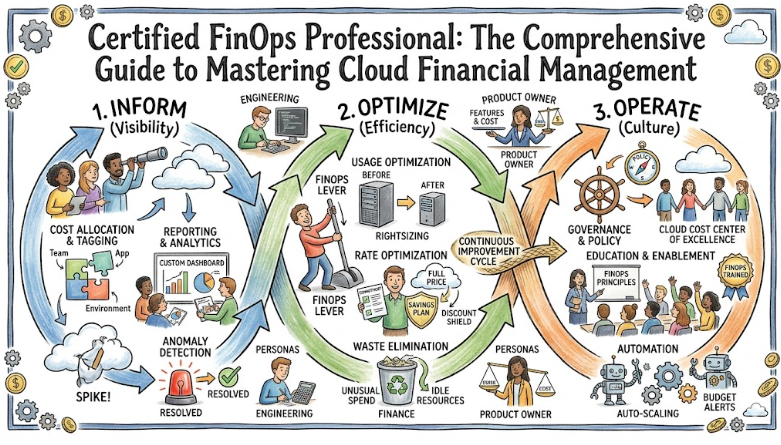
The Certified FinOps Professional is a critical accreditation for any modern engineer or manager looking to bridge the gap between cloud operations and financial accountability. As cloud environments become increasingly complex, the ability to manage costs while maintaining performance is no longer an optional skill but a core requirement for DevOps, SRE, and platform engineering teams. This guide is designed to help professionals navigate the certification landscape offered by finopsschool, providing a roadmap to achieve the Certified FinOps Professional designation. By understanding the nuances of cloud unit economics and collaborative governance, engineering leaders can make more informed career decisions that align with the shifting priorities of global enterprises.
What is the Certified FinOps Professional?
The Certified FinOps Professional is a designation that validates an individual’s expertise in the FinOps Framework, focusing on the cultural practice of cloud financial management. It exists because traditional procurement models fail in the variable-spend world of the cloud, where a single developer’s code change can result in thousands of dollars in unbudgeted costs. This certification represents a shift toward “cloud-native” finance, where engineering, finance, and business teams work in a continuous feedback loop to drive business value.
Unlike theoretical certifications, this program emphasizes real-world, production-focused learning, teaching practitioners how to implement visibility, optimization, and automation. It aligns with modern engineering workflows by integrating financial accountability into the development lifecycle, much like security was integrated through DevSecOps. For enterprises, this certification ensures that their cloud architects and managers can effectively balance speed, cost, and quality without sacrificing innovation.
Who Should Pursue Certified FinOps Professional?
The Certified FinOps Professional is primarily intended for professionals who sit at the intersection of technology and business operations. This includes DevOps Engineers, SREs, and Cloud Architects who are responsible for infrastructure and want to understand the fiscal impact of their technical decisions. Platform engineers and technical leaders who manage large-scale cloud environments will find the framework essential for building internal systems that provide cost transparency to their organizations.
Beyond the core engineering roles, managers, financial controllers, and procurement specialists also benefit significantly from this certification as it provides them with a common language to speak with technical teams. In India and across the global market, there is a massive demand for professionals who can solve “bill shock” issues. Beginners looking to enter the cloud space can use this certification to differentiate themselves, while experienced leads can use it to justify their move into senior management or specialized FinOps roles.
Why Certified FinOps Professional is Valuable and Beyond
The value of the Certified FinOps Professional lies in its direct impact on the corporate bottom line and the long-term career longevity it provides. As organizations move past the initial “cloud migration” phase and into “cloud optimization,” the focus shifts from just moving workloads to running them efficiently. This certification teaches skills that remain relevant regardless of whether a company uses AWS, Azure, or Google Cloud, as the core principles of unit economics and resource allocation are universal.
Enterprises are increasingly adopting FinOps as a standard practice, creating a stable and high-paying job market for those with certified expertise. By mastering these concepts, professionals can stay relevant despite the rapid changes in specific tooling or programming languages. The return on investment for this certification is high, as it empowers individuals to lead high-visibility cost-saving initiatives that often result in immediate and measurable business benefits.
Certified FinOps Professional Certification Overview
The Certified FinOps Professional program is delivered via the official training path at Certified FinOps Professional and is hosted on the finopsschool.com platform. This program is structured to provide a comprehensive understanding of the FinOps lifecycle: Inform, Optimize, and Operate. It moves beyond simple cost-cutting and focuses on cloud investment strategies and data-driven decision-making.
The assessment approach is practical, requiring candidates to demonstrate knowledge of how to allocate shared costs, manage commitment-based discounts, and build a culture of accountability. Ownership of cloud spend is shifted from a centralized finance department to the distributed engineering teams who actually consume the resources. This structure ensures that the certification is not just a badge but a validation of the ability to run a professional-grade FinOps practice within any organization.
Certified FinOps Professional Certification Tracks & Levels
The certification hierarchy is designed to accommodate different stages of a professional’s career, starting with a Foundation level for those new to the concept. The Certified FinOps Professional track serves as the core credential for active practitioners, while Advanced levels are available for those looking to lead enterprise-wide FinOps centers of excellence. These levels are strategically mapped to ensure a logical progression from understanding basic terminology to mastering complex multi-cloud financial engineering.
Specialization tracks allow professionals in DevOps, SRE, or Data engineering to apply FinOps principles specifically to their domains. For example, an SRE might focus on the intersection of performance metrics and cost, while a DataOps professional might focus on the high variability of Big Data and AI/ML spend. This alignment ensures that the certification supports continuous career progression, moving from individual contributor roles to strategic leadership positions.
Complete Certified FinOps Professional Certification Table
| Track | Level | Who it’s for | Prerequisites | Skills Covered | Recommended Order |
| FinOps Core | Foundation | Beginners, Managers | None | Terminology, FinOps Lifecycle, Principles | 1 |
| FinOps Core | Professional | Cloud Engineers, FinOps Practitioners | 6 Months Experience | Unit Economics, Cost Allocation, Forecasting | 2 |
| Specialist | SRE FinOps | SREs, Platform Engineers | FinOps Foundation | SLO-based Costing, Resource Rightsizing | 3 |
| Specialist | Data/AI FinOps | Data Engineers, MLOps | FinOps Foundation | Managing LLM & Big Data Costs, Usage Patterns | 3 |
| Strategy | Expert/Lead | FinOps Leaders, CTOs | Professional Level | Policy Governance, Organizational Change | 4 |
Detailed Guide for Each Certified FinOps Professional Certification
Certified FinOps Professional – Foundation
What it is
This certification validates a candidate’s understanding of the basic concepts of FinOps and the cloud financial management lifecycle. It is the entry-level credential that ensures everyone in the organization speaks the same language regarding cloud costs.
Who should take it
It is suitable for finance professionals, product owners, and junior cloud engineers who need a high-level overview of how cloud billing works. It is the best starting point for anyone new to the discipline.
Skills you’ll gain
- Understanding the 6 FinOps Principles.
- Navigating the Inform, Optimize, and Operate phases.
- Identifying the different personas in a FinOps team.
- Basic understanding of cloud billing and cost drivers.
Real-world projects you should be able to do
- Create a basic cloud cost visibility dashboard for a small team.
- Identify and label unallocated cloud resources in a test environment.
- Calculate potential savings from basic idle-resource cleanup.
Preparation plan
- 7–14 days: Review official documentation and whitepapers.
- 30 days: Complete the foundational course and practice quizzes.
- 60 days: Not typically required for this level unless balancing a heavy workload.
Common mistakes
- Focusing too much on specific cloud tool features rather than FinOps principles.
- Neglecting the cultural and organizational aspects of the framework.
Best next certification after this
- Same-track: Certified FinOps Professional – Associate.
- Cross-track: Cloud Provider Fundamentals (AWS/Azure/GCP).
- Leadership: Project Management Professional (PMP).
Certified FinOps Professional – Professional
What it is
This is the flagship certification that validates the ability to implement and manage a FinOps practice in a production environment. It proves that the practitioner can handle complex scenarios like container costing and multi-cloud billing.
Who should take it
Suitable for Cloud Engineers, FinOps Practitioners, and SREs with at least six months of hands-on experience in cloud cost management.
Skills you’ll gain
- Advanced cost allocation methods for shared services.
- Management of Savings Plans, Reserved Instances, and Spot instances.
- Building automated governance and compliance policies.
- Forecasting and budgeting for fluctuating cloud workloads.
Real-world projects you should be able to do
- Implement a tagging and label enforcement policy via Infrastructure as Code.
- Design a multi-account billing hierarchy for a large enterprise.
- Build an automated alert system for budget variances and anomalies.
Preparation plan
- 7–14 days: Intensive review of advanced optimization strategies.
- 30 days: Hands-on lab work and simulation of real-world billing data.
- 60 days: Recommended for those needing to master complex mathematical forecasting.
Common mistakes
- Relying solely on third-party tools without understanding the underlying math.
- Failing to account for the overhead of implementing complex policies.
Best next certification after this
- Same-track: Certified FinOps Professional – Expert.
- Cross-track: Certified Kubernetes Administrator (CKA).
- Leadership: MBA or Engineering Management certifications.
Choose Your Learning Path
DevOps Path
The DevOps path focuses on integrating financial feedback into the CI/CD pipeline and deployment strategies. Engineers learn how to provide immediate cost impact feedback to developers during the coding phase, rather than waiting for a monthly bill. This path emphasizes the “Operate” phase of FinOps, where automation ensures that infrastructure is both performant and cost-effective. It is ideal for those who want to build self-healing systems that optimize themselves based on budgetary constraints.
DevSecOps Path
In this path, professionals explore the intersection of security, compliance, and cost management. This involves understanding how security tools and logging impacts the cloud bill and how to optimize security spend without compromising the safety of the application. Practitioners learn to build “Golden Images” that are both secure and cost-optimized by default. This path is crucial for organizations in highly regulated industries where compliance often leads to spiraling cloud costs.
SRE Path
The SRE path bridges the gap between Site Reliability Engineering and FinOps by treating “Cost” as a service level indicator. Engineers learn to balance the reliability of a system against its cost, making data-driven decisions on when to over-provision for safety and when to scale down for efficiency. This path covers advanced topics like rightsizing based on performance metrics and managing the cost of observability. It is geared toward those managing high-scale, high-availability systems where efficiency is paramount.
AIOps Path
The AIOps path focuses on using artificial intelligence and machine learning to automate the FinOps lifecycle. Professionals learn how to implement anomaly detection algorithms to catch cost spikes in real-time and use predictive modeling for accurate forecasting. This path is technical and involves data science concepts applied to cloud billing metadata. It is the future of FinOps, where manual intervention is replaced by intelligent, automated decision-making systems.
MLOps Path
The MLOps path is specifically designed to manage the unique and often exorbitant costs associated with training and deploying machine learning models. Practitioners learn to optimize GPU usage, manage expensive data transfer costs, and choose the right instance types for different ML stages. This path is essential for organizations scaling their AI initiatives, as ML spend can quickly outpace traditional application costs. It focuses on the unit economics of a single model’s lifecycle from development to production.
DataOps Path
DataOps professionals focus on the financial management of large-scale data lakes, warehouses, and streaming platforms. This path covers the cost implications of data storage tiers, query optimization in platforms like BigQuery or Snowflake, and the cost of data egress. Given the massive volume of data in modern enterprises, this specialization is highly valued for its ability to prevent “data graveyards” that consume budgets without providing value. It aligns data engineering practices with organizational financial goals.
FinOps Path
The dedicated FinOps path is for those who want to specialize exclusively in the discipline of cloud financial management. It covers the entire lifecycle in depth, from cultural transformation to technical implementation and board-level reporting. This path prepares individuals for roles like FinOps Director or Head of Cloud Financial Management. It focuses on building the centralized FinOps Center of Excellence that supports all other engineering and business units.
Role → Recommended Certified FinOps Professional Certifications
| Role | Recommended Certifications |
| DevOps Engineer | Foundation, Professional |
| SRE | Foundation, Professional, SRE Specialist |
| Platform Engineer | Foundation, Professional, Expert |
| Cloud Engineer | Foundation, Professional |
| Security Engineer | Foundation, DevSecOps Specialist |
| Data Engineer | Foundation, DataOps Specialist |
| FinOps Practitioner | Foundation, Professional, Expert |
| Engineering Manager | Foundation, Expert |
Next Certifications to Take After Certified FinOps Professional
Same Track Progression
After achieving the professional level, the logical step is to move toward the Expert or Specialist designations. These certifications allow you to drill down into specific technical areas like Kubernetes FinOps or focus on the strategic leadership required to manage a global FinOps practice. Deep specialization ensures that you remain the go-to expert for complex cloud financial problems that standard tools cannot solve. It also prepares you for consulting roles where you advise multiple organizations on their FinOps journey.
Cross-Track Expansion
Broadening your skills into related domains like Platform Engineering or Kubernetes administration (CKA/CKAD) makes you a more versatile professional. Understanding the underlying technology (like containers) allows you to implement more effective FinOps strategies, such as bin-packing and cluster autoscaling. This cross-pollination of skills is highly valued in the industry as it allows an engineer to not only identify a cost problem but also technically implement the fix. It builds a T-shaped skill set that is resistant to market fluctuations.
Leadership & Management Track
For those looking to transition out of hands-on engineering, the management track involves certifications in ITIL, PMP, or general engineering management. These credentials, combined with a Certified FinOps Professional background, make you a formidable candidate for CTO or VP of Infrastructure roles. You will be able to demonstrate a unique ability to align technical output with business profitability, a skill that is often missing in purely technical leadership. This track focuses on people, process, and organizational change management.
Training & Certification Support Providers for Certified FinOps Professional
DevOpsSchool
DevOpsSchool is a leading provider of technical training that focuses on the practical application of DevOps and FinOps principles. Their curriculum for the Certified FinOps Professional is designed by industry veterans who bring real-world scenarios into the classroom. They offer a blend of instructor-led sessions and hands-on labs, ensuring that students do not just pass the exam but gain actionable skills. Their support system includes lifetime access to course materials and a robust community of professionals. This makes them a top choice for engineers in India and abroad looking for a structured learning environment.
Cotocus
Cotocus specializes in high-end consulting and training for cloud-native technologies, making them a strong partner for FinOps education. Their approach is deeply technical, focusing on the architectural changes required to achieve cost efficiency in the cloud. They provide customized training programs for corporate teams looking to upskill their entire engineering department simultaneously. Cotocus is known for its “learn-by-doing” philosophy, which aligns perfectly with the requirements of the Certified FinOps Professional. Their trainers are active practitioners who deal with large-scale cloud budgets daily, providing students with unique insights.
Scmgalaxy
Scmgalaxy is a well-known community and training portal that provides extensive resources for software configuration management and DevOps. Their FinOps training modules are updated frequently to reflect the latest changes in cloud provider billing and FinOps Foundation guidelines. They offer a wealth of free resources, blogs, and tutorials that supplement their formal certification programs. For professionals looking for a community-driven learning experience, Scmgalaxy provides a platform to interact with peers and experts. Their focus is on making complex technical concepts accessible to a wide audience of learners.
BestDevOps
BestDevOps focuses on providing streamlined, result-oriented training for various cloud and DevOps certifications. Their Certified FinOps Professional course is structured to help busy professionals achieve certification in a minimal timeframe without sacrificing depth. They provide comprehensive study guides, mock exams, and cheat sheets that are highly effective for exam preparation. BestDevOps is particularly useful for those who prefer a self-paced learning model but still want the support of expert mentors. Their curriculum is highly rated for its clarity and focus on the most important exam topics.
devsecopsschool.com
This provider focuses specifically on the intersection of security and development, which is a critical area for FinOps. Their training programs emphasize how to manage the costs associated with security tools, logging, and compliance auditing. They offer specialized modules that show how a Certified FinOps Professional can work with security teams to optimize the “Security Spend.” This niche focus is invaluable for professionals working in finance, healthcare, or government sectors. Their labs often involve simulated security breaches and the subsequent cost analysis of the response and recovery.
sreschool.com
SRESchool is dedicated to the discipline of Site Reliability Engineering, offering a unique perspective on FinOps. Their training highlights the trade-offs between reliability and cost, teaching students how to use FinOps data to inform SRE practices like error budgeting. The courses are highly technical and involve a lot of automation and monitoring setup. For an SRE looking to become a Certified FinOps Professional, this provider offers the most relevant and targeted content. They bridge the gap between infrastructure stability and financial health seamlessly.
aiopsschool.com
As the name suggests, this provider focuses on the application of AI in IT operations, which is a key component of advanced FinOps. Their training covers how to use machine learning for cost anomaly detection and predictive scaling. This is a forward-looking curriculum that prepares students for the next generation of automated cloud management. By learning from aiopsschool.com, a Certified FinOps Professional can stay ahead of the curve by mastering the tools that will eventually automate many manual FinOps tasks. Their courses are ideal for data-driven engineers.
dataopsschool.com
DataOpsSchool addresses the specific financial challenges of big data and analytics pipelines. Their FinOps training includes deep dives into the billing models of data warehouses like Snowflake and Databricks. They teach students how to manage the “hidden costs” of data egress and storage at scale. For data engineers and architects, this provider offers the most practical advice on how to keep data projects within budget. Their focus on the data lifecycle ensures that cost optimization is considered from ingestion to visualization.
finopsschool.com
This is the primary destination for anyone seeking the Certified FinOps Professional designation. As the specialized host for this certification, they provide the most direct and authoritative path to success. Their platform is designed to cater to all levels of expertise, from foundation to expert, with a curriculum that is strictly aligned with the official certification standards. They offer a comprehensive suite of learning tools, including video lectures, interactive labs, and an active forum. Choosing finopsschool.com ensures that you are getting the most accurate and up-to-date information available in the industry.
Frequently Asked Questions (General)
- How difficult is the Certified FinOps Professional exam?
The exam is moderately difficult and requires a solid understanding of both technical cloud concepts and financial principles. It is not just about memorization but about applying the FinOps framework to solve real-world problems. - What are the prerequisites for the professional level?
While there are no mandatory technical prerequisites, it is highly recommended to have at least six months of experience working with cloud platforms and some familiarity with the FinOps Foundation lifecycle. - How long does it take to prepare for the certification?
Most professionals spend between 30 and 60 days preparing, depending on their existing experience. This includes completing a structured course and performing hands-on labs. - Is the certification recognized globally?
Yes, the certification is recognized by major enterprises and cloud service providers worldwide as the standard for cloud financial management expertise. - Does the certification expire?
Like most technical certifications, it typically has a validity period of two to three years, after which you may need to recertify to prove your knowledge of the latest cloud billing practices. - What is the ROI of getting a Certified FinOps Professional?
Professionals often see immediate career benefits, including salary increases and access to higher-level management roles, as they can demonstrate a direct impact on company profitability. - Do I need to be a math expert to pass?
No, you do not need advanced math, but you should be comfortable with basic algebra, percentages, and data analysis to understand unit economics and forecasting. - Which cloud provider should I focus on for this certification?
The certification is cloud-agnostic, meaning the principles apply to AWS, Azure, and GCP equally. However, having experience in at least one major provider is very helpful. - Can a non-technical person pass the exam?
Yes, particularly at the Foundation level. However, the Professional level requires a deeper understanding of how cloud resources like VMs, containers, and storage are provisioned and managed. - Are there any hands-on labs in the training?
Yes, reputable providers include labs that simulate cloud billing consoles and require you to perform rightsizing and cost allocation tasks. - How does this certification compare to cloud provider-specific cost certs?
Cloud provider certs focus on specific tools (like AWS Cost Explorer), while this certification focuses on the overarching cultural and operational framework that works across any tool. - Is there a community for certified professionals?
Yes, there is a large and growing global community where practitioners share best practices, job opportunities, and the latest optimization techniques.
FAQs on Certified FinOps Professional
- What is the primary focus of the Certified FinOps Professional?
The primary focus is on building a culture of financial accountability where engineering teams take ownership of their cloud spend and drive business value through informed decision-making. - How does FinOps differ from traditional IT cost cutting?
FinOps is about “spending money to make money.” It focuses on cloud unit economics and maximizing the value of every dollar spent, rather than just blindly reducing the total bill. - What is the ‘Inform’ phase in the certification?
The Inform phase focuses on visibility and allocation. It ensures that every cent spent in the cloud can be traced back to a specific team, project, or product through tagging and mapping. - What is a ‘Unit Metric’ in FinOps?
A unit metric helps you understand the cost of a single business transaction (e.g., cost per customer login). This allows you to scale costs proportionally with business growth. - How does the certification handle shared costs?
It teaches strategies for fair allocation of costs that cannot be easily tagged, such as support fees, shared databases, or networking costs, ensuring transparency across departments. - Can this certification help with Kubernetes costs?
Yes, the professional level covers the complexities of container costing, including how to allocate the cost of a shared cluster to individual teams or microservices. - What is the role of automation in the Professional track?
Automation is key to scaling FinOps. The certification covers how to use policies and scripts to automatically shut down idle resources and enforce tagging compliance without manual intervention. - Why is the cultural aspect of the certification so important?
Because FinOps is a “team sport.” Without a cultural shift where developers care about costs, any technical optimization will only provide temporary benefits.
Final Thoughts: Is Certified FinOps Professional Worth It?
From a mentor’s perspective, the Certified FinOps Professional is one of the most practical investments you can make in your career today. We have moved past the era where cloud spend was a “black box” that finance just had to pay. Companies now demand transparency and efficiency, and there is a massive shortage of professionals who truly understand how to deliver both. This certification doesn’t just give you a title; it gives you a framework to solve one of the biggest headaches for modern CTOs. If you enjoy the intersection of technology and business strategy and want to move into a role that is both high-impact and high-visibility, this path is absolutely worth pursuing. It provides a rare combination of job security and the ability to influence the strategic direction of an organization.