




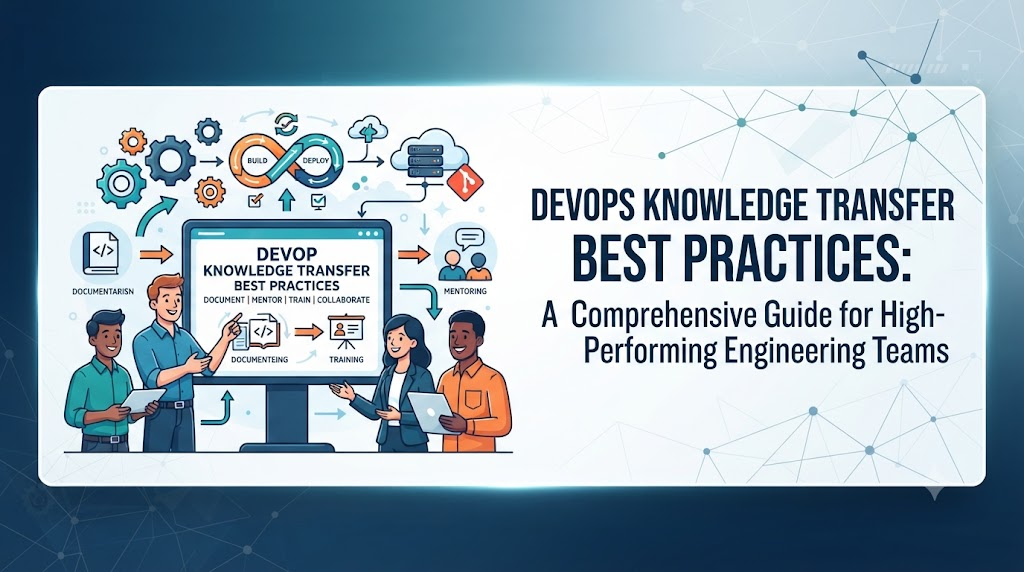
In modern software engineering, the speed and stability of a delivery pipeline rely heavily on collective intelligence. When operations, development, and security teams operate in sync, delivery velocity thrives. However, when technical insights remain locked inside the minds of a few senior team members, organizations face severe vulnerabilities. DevOps Knowledge Transfer Best Practices form the bedrock of resilient engineering cultures, mitigating the risks of operational bottlenecks, onboarding delays, and critical single points of failure.
Introduction: Why Knowledge Transfer Matters in DevOps
DevOps teams depend on shared technical knowledge to build, secure, monitor, and scale distributed cloud infrastructure. Unlike traditional IT structures where silos isolate development from operations, a true DevOps culture demands shared responsibility across the software delivery lifecycle.
When knowledge transfer fails, organizations experience severe friction. Onboarding a new engineer can stretch from weeks to months as they struggle to map undocumented pipelines or legacy cloud environments. Repeated mistakes surface because previous troubleshooting lessons were never documented. Most dangerously, teams become deeply dependent on a single “hero” engineer who holds the mental map of the production cluster. If that individual is unavailable during a critical outage, minor incidents can cascade into major business disasters. Establishing rigorous DevOps Knowledge Transfer Best Practices eliminates these risks by transforming fragile tribal knowledge into resilient, institutional assets.
What Is Knowledge Transfer in DevOps?
DevOps knowledge transfer is the systematic process of capturing, sharing, validating, and distributing technical expertise, operational procedures, architectural rationale, and troubleshooting techniques across a team or organization.
It extends far beyond dumping static PDFs into a shared drive or conducting a one-time, passive orientation presentation. True DevOps knowledge sharing is an active, continuous feedback loop. It combines living documentation, automated pipelines, pairing sessions, post-incident reviews, and collaborative workflows to ensure that every engineer has equitable access to the information required to run production environments safely and efficiently.
Why Knowledge Transfer Is Important for DevOps Teams
Implementing robust knowledge-sharing mechanisms delivers profound operational advantages across technical and organizational dimensions:
- Faster Onboarding: New hires ramp up productivity quickly when comprehensive guides, architecture overviews, and structured onboarding paths are readily available.
- Reduced Dependency on Individuals: Spreading expertise across the team ensures that departures, vacations, or sick leaves do not paralyze operations.
- Better Incident Response: When multiple engineers understand system topologies and telemetry tools, Mean Time to Resolution (MTTR) drops drastically.
- Improved Collaboration: Breaking down cognitive barriers between development, QA, and operations fosters empathy and shared ownership.
- Stronger Operational Resilience: Standardized processes and runbooks eliminate guesswork during high-pressure production deployments.
- Consistent Engineering Practices: Shared knowledge ensures teams follow uniform patterns for security, compliance, and infrastructure provisioning.
- Better Team Productivity: Engineers spend less time hunting for answers or reverse-engineering legacy scripts.
- Reduced Knowledge Silos: Open communication channels prevent specialized expertise from becoming locked within individual sub-teams.
Common Knowledge Transfer Challenges in DevOps
Despite its importance, engineering organizations frequently encounter roadblocks when attempting to implement effective DevOps knowledge management:
- Knowledge Silos: Certain teams or senior engineers hoard information intentionally or unintentionally, acting as gatekeepers.
- Lack of Documentation: Fast-paced delivery cycles often deprioritize documentation, leaving systems completely unexplained.
- Busy Senior Engineers: High-performing technical leads are often too consumed by firefighting and feature delivery to mentor others.
- Tribal Knowledge: Critical operational steps live solely in the memories of veteran team members (“run this secret command on server X before deploying”).
- Employee Turnover: When staff members leave, their unrecorded insights leave permanent gaps in team capability.
- Complex Infrastructure: Modern cloud-native ecosystems involve intricate networking, microservices, and multi-cloud patterns that are difficult to explain simply.
- Poor Onboarding Processes: Leaving new engineers to “figure things out on their own” breeds frustration and errors.
- Rapidly Changing Tools and Technologies: The constant evolution of the DevOps toolchain makes it challenging to keep learning materials current.
- Lack of Ownership: When nobody is explicitly accountable for documentation and training quality, upkeep falls by the wayside.
DevOps Knowledge Transfer Best Practices
To overcome these challenges, engineering leaders must adopt structured, repeatable practices that ingrain knowledge sharing into daily workflows.
Create Centralized and Maintainable Documentation
Documentation must be treated as a first-class citizen alongside source code. Centralize documentation in version-controlled repositories (Docs-as-Code) using Markdown. Maintain clear architecture guides, deployment guides, troubleshooting playbooks, FAQs, and operational procedures that are easy to discover and update.
Use Runbooks for Critical Operations
Runbooks provide step-by-step instructions for handling predictable operational tasks, deployments, scaling events, and common failure modes. A well-written runbook empowers junior and on-call engineers to execute complex procedures safely without escalating every routine issue.
Implement Pairing and Shadowing
Pair programming and operational shadowing bridge the gap between theory and practice. New or junior engineers should sit alongside experienced staff during live deployments, complex debugging sessions, and incident response calls to observe real-world problem-solving approaches.
Conduct Regular Knowledge-Sharing Sessions
Foster a culture of continuous learning through internal tech talks, brown-bag lunch sessions, architecture walkthroughs, and tool-focused deep dives. These forums give engineers a safe space to share recent discoveries, post-mortem insights, or experimental proofs-of-concept.
Build Cross-Training Across Teams
Prevent specialization traps by intentionally cross-training team members. Developers should gain exposure to core infrastructure and monitoring tools, operations engineers should understand application architecture, and security practitioners should immerse themselves in CI/CD automation pipelines.
Use Hands-On Learning
Passive reading is insufficient for complex technical stacks. Prioritize practical labs, sandbox environments, sandboxed troubleshooting drills, and controlled failure injection (Chaos Engineering) to build muscle memory across the team.
Document Lessons From Incidents
Treat every production outage as a learning opportunity. Conduct blameless post-incident reviews, uncover root causes, and immediately translate those lessons into updated runbooks, automated tests, or architectural improvements.
Record Important Technical Decisions
Capture the context behind major engineering pivots using Architecture Decision Records (ADRs). Documenting why a particular tool, cloud provider, or database pattern was chosen prevents future teams from reinventing the wheel or reversing sound decisions blindly.
Automate Repetitive Knowledge-Dependent Tasks
The best documentation is often executable code. By leveraging Infrastructure as Code (IaC), robust CI/CD pipelines, and automated configuration management, manual tribal knowledge is replaced by clear, version-controlled automation scripts.
Establish a Strong DevOps Onboarding Process
A standardized onboarding curriculum ensures every new hire achieves proficiency efficiently. An effective onboarding roadmap should cover:
| Onboarding Phase | Focus Areas | Key Deliverables |
| Week 1 | Access, Culture, Tooling Setup | ID provisioning, local dev environment setup, reading architecture overviews. |
| Week 2 | CI/CD & Codebases | Reviewing repositories, deploying a minor staging change, understanding release workflows. |
| Week 3 | Cloud & Infrastructure | Exploring IaC modules, observing staging environments, reviewing monitoring dashboards. |
| Week 4 | Operations & On-Call | Shadowing on-call rotations, reviewing runbooks, participating in a mock incident. |
Knowledge Transfer Through DevOps Documentation
Comprehensive documentation is the backbone of sustainable DevOps documentation strategies. Teams must document core operational domains systematically:
- System Architecture: High-level and low-level diagrams illustrating data flow, network boundaries, and service dependencies.
- Infrastructure: Network topologies, subnet layouts, VPC configurations, and IAM policies.
- Cloud Resources: Cloud provider accounts, resource naming conventions, and tagging standards.
- CI/CD Pipelines: Build stages, testing frameworks, artifact repositories, and deployment strategies (Blue/Green, Canary).
- Deployment Procedures: Step-by-step instructions for releasing code safely from staging to production.
- Monitoring Dashboards & Alerts: Guides on how to interpret APM metrics, log aggregators, and alert thresholds.
- Incident Response: Escalation matrices, communication protocols, and severity definitions.
- Security Procedures: Vulnerability scanning protocols, secret management workflows, and compliance checks.
- Backup and Recovery: Disaster recovery plans, snapshot schedules, and data restoration procedures.
- Troubleshooting Steps: Diagnostic commands and resolution paths for known failure modes.
To prevent documentation rot, tie reviews to existing engineering workflows. If a pull request modifies an infrastructure module or deployment script, the corresponding documentation update should be a mandatory part of the review checklist.
Knowledge Transfer Through CI/CD and Infrastructure as Code
Tools and engineering practices play a massive role in implicit knowledge sharing. Modern DevOps automation practices naturally broadcast operational intent:
- Git as the Single Source of Truth: All infrastructure configurations, policies, and pipeline definitions live in version-controlled repositories, allowing any engineer to inspect history, blame, and evolution.
- Infrastructure as Code (IaC): Writing infrastructure in declarative languages (such as Terraform or OpenTofu) makes resource provisioning transparent and self-documenting compared to manual cloud console clicking.
- GitOps Workflows: Utilizing GitOps models ensures that the actual state of production clusters always matches the desired state declared in version control, making operations completely visible to the entire team.
Knowledge Transfer for Kubernetes and Cloud Environments
Container orchestration platforms and multi-cloud environments introduce immense complexity, making targeted knowledge distribution essential. Organizations must actively share insights regarding:
- Kubernetes Architecture: Control plane components, worker nodes, and API machinery.
- Cluster Management: Upgrades, node pooling, and cluster lifecycle policies.
- Deployments: Manifest management using Helm, Kustomize, or GitOps operators.
- Networking: Ingress controllers, service meshes, network policies, and DNS resolution.
- Storage: Persistent volumes, storage classes, and stateful application management.
- Security: Pod security standards, role-based access control (RBAC), and container scanning.
- Cloud Infrastructure: Compute, serverless functions, load balancers, and managed databases.
- Monitoring & Scaling: Horizontal Pod Autoscalers (HPA), Cluster Autoscalers, and Prometheus metrics.
Prevent container and cloud expertise from concentrating in a single platform engineer by pairing generalist developers with infrastructure specialists during cluster management tasks.
Knowledge Transfer During Incident Management
Production incidents offer powerful real-time education opportunities. To maximize knowledge transfer during high-stress moments, teams should embrace structured protocols:
- Clear Incident Roles: Assign explicit responsibilities during an outage (e.g., Incident Commander, Communications Lead, Technical Troubleshooter) so everyone understands the workflow.
- Collaborative Triage: Utilize shared virtual war rooms and collaborative terminal sessions where junior engineers can watch senior staff diagnose complex symptoms.
- Blameless Post-Incident Reviews: Focus post-mortems strictly on system vulnerabilities, process gaps, and tooling deficiencies rather than assigning personal fault.
- Actionable Follow-ups: Convert remediation items into tracked backlog tasks and immediately update relevant runbooks to prevent recurrence.
Building a DevOps Knowledge-Sharing Culture
Tools and documentation alone cannot succeed without a collaborative organizational culture. Fostering an environment where sharing expertise is encouraged requires deliberate leadership:
- Psychological Safety: Encourage engineers to ask questions, admit mistakes, and express uncertainty without fear of professional penalty.
- Open Communication: Utilize transparent chat channels for technical discussions rather than private direct messages.
- Active Mentoring: Pair junior staff with seasoned mentors, allocating dedicated time for coaching during sprint cycles.
- Internal Communities of Practice: Create special interest groups around cloud-native tools, security, or platform engineering.
- Shared Ownership: Rotate on-call responsibilities and architecture review duties so that operational accountability is shared broadly.
Tools That Can Support DevOps Knowledge Transfer
While no single software platform solves every knowledge challenge, deploying the right mix of tools streamlines DevOps team collaboration:
- Version Control Platforms (GitHub, GitLab, Bitbucket): Essential for Docs-as-Code, code reviews, and tracking infrastructure changes.
- Documentation & Wiki Platforms (Confluence, Notion, BookStack): Ideal for organizing architecture diagrams, high-level runbooks, and onboarding guides.
- Chat & Collaboration Tools (Slack, Microsoft Teams, Mattermost): Facilitate real-time troubleshooting, alert notifications, and searchable technical discussions.
- Ticketing Systems (Jira, Linear, GitHub Issues): Track operational tasks, technical debt, and post-incident remediation items.
- CI/CD Platforms (GitHub Actions, GitLab CI, ArgoCD): Automate build and release workflows while documenting pipeline execution steps visually.
- Monitoring & Observability Platforms (Datadog, Grafana, Prometheus, New Relic): Provide unified telemetry data that serves as a shared visual language for system health.
- Infrastructure as Code Repositories: Maintain clear, executable definitions of cloud and cluster resources.
Measuring the Effectiveness of DevOps Knowledge Transfer
To ensure knowledge-sharing initiatives deliver tangible results, teams should track practical engineering metrics:
- New Employee Onboarding Time: Measure the duration required for a new hire to merge their first independent production change safely.
- Documented Critical Procedures: Track the percentage of core operational tasks covered by verified, up-to-date runbooks.
- Cross-Training Coverage: Audit how many engineers can independently handle specific operational domains (e.g., database recovery, cluster scaling).
- Dependency on Individual Engineers: Monitor whether operational escalations are distributed evenly across the team or concentrated on a few heroes.
- Incident Response Effectiveness: Observe trends in Mean Time to Detect (MTTD) and MTTR as team familiarity with systems improves.
- Documentation Freshness: Measure the frequency of documentation updates relative to code changes.
- Training Participation: Track attendance and engagement in internal tech talks and workshops.
Common Mistakes to Avoid in DevOps Knowledge Transfer
Avoid these frequent pitfalls when building your knowledge-sharing strategy:
- Writing Documentation Once and Never Updating It: Stale documentation is often worse than no documentation because it leads engineers astray.
- Depending Entirely on Senior Engineers: Overloading senior staff with mentoring responsibilities without organizational support leads to burnout.
- Treating Documentation as a One-Time Activity: Viewing knowledge transfer as an initial project phase rather than an ongoing operational habit.
- Sharing Theory Without Hands-On Practice: Expecting engineers to master complex cloud systems purely through slide decks or reading materials.
- Ignoring Lessons From Incidents: Failing to translate post-mortem discoveries into concrete runbook updates and automated checks.
- Failing to Cross-Train Teams: Permitting engineers to remain isolated within narrow functional specialties.
- Documenting Everything Without Prioritization: Spending excessive time detailing trivial configurations while ignoring high-risk production paths.
- Not Verifying Understanding: Assuming that publishing a document equates to successful knowledge absorption without practical testing.
How to Create a DevOps Knowledge Transfer Plan
Implement a systematic, repeatable framework to roll out knowledge transfer across your engineering organization:
Assess → Identify Critical Knowledge → Assign Owners → Document → Demonstrate → Practice → Validate → Review → Update
- Assess: Evaluate current team capabilities, onboarding hurdles, and existing documentation gaps.
- Identify Critical Knowledge: Pinpoint single points of failure, undocumented legacy pipelines, and complex cloud resources.
- Assign Owners: Designate specific engineers or sub-teams accountable for maintaining documentation in designated domains.
- Document: Write clear, concise runbooks, architecture overviews, and configuration guides using Markdown.
- Demonstrate: Walk team members through the documented procedures via pairing or internal workshops.
- Practice: Provide sandbox environments where engineers can execute procedures and troubleshoot simulated failures.
- Validate: Test understanding through peer code reviews, mock incident drills, and practical quizzes.
- Review: Regularly audit documentation freshness and relevance during sprint planning cycles.
- Update: Continuously refine materials as system architectures and tools evolve.
Real-World Example: DevOps Knowledge Transfer
Consider an enterprise financial technology team operating a high-traffic Kubernetes cluster. Only one senior platform engineer, Alex, understands the custom deployment pipeline and emergency certificate rotation procedure for the payment gateway.
When Alex takes a two-week vacation, an unexpected certificate expiration triggers a partial production outage. Because no runbook exists and no one else has shadowed an emergency rotation, the remaining team struggles for hours to diagnose and resolve the issue, leading to severe customer friction.
The Solution:
The engineering manager intervenes by instituting a structured DevOps knowledge transfer initiative:
- Documenting the Process: Alex documents the exact steps for certificate rotation and cluster ingress configuration in a version-controlled runbook.
- Pair Working: During the next routine maintenance window, Alex pairs with two junior SREs, walking them through the procedure step-by-step.
- Hands-On Practice: The team schedules a controlled staging drill where junior engineers execute the certificate rotation independently in a non-production cluster.
- Cross-Training & Automation: The team automates the certificate renewal process using cert-manager while ensuring multiple engineers understand the underlying architecture.
As a result, operational resilience increases exponentially, and future rotations execute seamlessly regardless of individual availability.
DevOps Knowledge Transfer Checklist
Use this practical checklist to audit your team’s knowledge-sharing readiness:
- Documentation: Core architecture diagrams and system overviews are stored in version control.
- Runbooks: Step-by-step guides exist for all high-risk operational tasks and common failure modes.
- Onboarding: A structured, multi-week onboarding roadmap is available for all new engineering hires.
- Mentoring: Formal pairing and shadowing programs are established for junior and senior staff.
- Cross-Training: Engineers regularly rotate responsibilities across development, operations, and security domains.
- Incident Reviews: Blameless post-mortems are conducted for every major outage and converted into actionable improvements.
- CI/CD: Release pipelines are fully automated and transparent to the entire engineering organization.
- Infrastructure as Code: All cloud and cluster resources are defined declaratively in version control.
- Monitoring: Centralized dashboards and telemetry tools provide shared visibility into system health.
- Security: Vulnerability management, secret handling, and compliance workflows are documented and shared.
- Cloud: Multi-cloud or cloud-native resource topologies are understood by multiple team members.
- Kubernetes: Cluster management, networking, and deployment patterns are cross-trained across the team.
- Knowledge Validation: Procedures and runbooks are tested regularly through mock drills and practical exercises.
How DevOps Training Supports Knowledge Transfer
While internal documentation and peer mentoring form the core of daily operations, external education plays a vital role in accelerating team capabilities. Structured training programs help engineering teams establish a unified technical baseline, master modern cloud-native toolchains, and adopt industry best practices quickly. Organizations looking to accelerate their capability development often partner with specialized providers like DevOpsSchool to deliver comprehensive training programs, professional certifications, and hands-on workshops tailored to real-world engineering challenges. Integrating structured external learning alongside internal knowledge-sharing initiatives ensures your teams stay ahead of rapid technological evolution.
Future of Knowledge Transfer in DevOps
As engineering practices evolve, emerging technologies are reshaping how technical knowledge is captured and shared:
- AI-Assisted Documentation: Generative AI tools automatically draft runbooks, summarize pull requests, and explain complex legacy codebases, significantly reducing manual documentation overhead.
- AIOps & Automated Insights: Advanced observability platforms analyze log streams and alert patterns to surface root causes automatically during incidents.
- Automated Runbooks: Self-healing systems and automated remediation scripts execute routine operational tasks without manual intervention, encoding operational knowledge directly into code.
- Internal Developer Platforms (IDPs): Platform engineering initiatives consolidate tooling, golden paths, and documentation into unified portals that simplify developer workflows.
- Intelligent Search: Advanced semantic search engines allow engineers to query institutional knowledge repositories conversationally to find exact troubleshooting steps instantly.
While these innovations streamline information delivery, the human elements of mentorship, psychological safety, and collaborative problem-solving remain irreplaceable.
Frequently Asked Questions
What is knowledge transfer in DevOps?
DevOps knowledge transfer is the systematic sharing of technical expertise, operational runbooks, architectural context, and troubleshooting techniques across development, operations, and security teams to eliminate single points of failure.
Why is knowledge transfer important in DevOps?
It accelerates onboarding, reduces reliance on individual “hero” engineers, improves incident response times, enhances operational resilience, and prevents critical knowledge silos from forming.
What are the best ways to transfer DevOps knowledge?
Effective methods include maintaining Docs-as-Code runbooks, pairing senior and junior engineers, conducting blameless post-incident reviews, utilizing Infrastructure as Code, and hosting regular technical workshops.
How can DevOps teams reduce knowledge silos?
By fostering open communication channels, implementing cross-training rotations, making documentation mandatory in pull requests, and encouraging shared on-call responsibilities.
How should DevOps teams document technical knowledge?
Teams should use version-controlled Markdown files (Docs-as-Code) organized logically into system architecture guides, infrastructure blueprints, deployment guides, and troubleshooting runbooks.
How can knowledge transfer improve incident response?
When multiple engineers have access to clear runbooks and shared system telemetry, troubleshooting becomes systematic rather than dependent on guessing or contacting a single expert.
How can new DevOps engineers learn existing infrastructure?
Through structured onboarding paths, architectural walkthroughs, shadowing experienced team members during deployments, and studying version-controlled IaC modules.
What role does automation play in knowledge transfer?
Automation replaces undocumented manual procedures with transparent, reproducible code through CI/CD pipelines, GitOps workflows, and Infrastructure as Code.
How can organizations measure DevOps knowledge transfer?
Metrics include onboarding time for new hires, the percentage of critical tasks covered by current runbooks, cross-training coverage, and reduced dependency on individual engineers.
How can DevOps training support knowledge sharing?
Structured external training provides teams with a shared technical foundation and practical problem-solving skills, which can be further refined through internal mentoring.
Conclusion
Effective DevOps Knowledge Transfer Best Practices are not a one-time project; they represent an ongoing cultural commitment to transparency, continuous learning, and collective ownership. By replacing fragile tribal knowledge with living documentation, automated workflows, pairing sessions, and structured incident learning, organizations build resilient engineering teams capable of scaling securely. When knowledge is shared openly across development, operations, and security, everyone wins, resulting in faster delivery, higher stability, and a thriving engineering culture.