




Introduction
In today’s hyper-competitive global market, digital transformation has shifted from a strategic advantage to a survival requirement. Organizations are no longer just building software; they are building digital experiences that define their brand, customer loyalty, and long-term viability. As customer expectations evolve toward instantaneous service and seamless digital interactions, companies must deliver high-quality software at an unprecedented pace. This is where the intersection of DevOps and business strategy becomes critical. Many leaders view digital transformation as a pure technology overhaul, but the real magic happens when you change how teams collaborate and deliver value. This is where DevOpsSchool helps organizations align their technical capabilities with business objectives. By adopting DevOps, companies remove the bottlenecks that hinder agility, enabling them to pivot, innovate, and thrive. Throughout this guide, we will explore how DevOps serves as the backbone for modern business modernization.
What Is Digital Transformation?
At its core, digital transformation is the integration of digital technology into all areas of a business, fundamentally changing how you operate and deliver value to customers. It is not just about moving servers to the cloud; it is a cultural change that requires organizations to challenge the status quo, experiment often, and get comfortable with failure.
Key pillars include:
- Business Modernization: Updating legacy systems to support modern business models.
- Technology Adoption: Utilizing cloud-native platforms, AI, and automation.
- Process Improvement: Removing manual, error-prone workflows.
- Customer Experience: Prioritizing user-centric design in every digital touchpoint.
- Continuous Innovation: Building an environment where new ideas can be tested and deployed rapidly.
What Is DevOps?
DevOps is a set of practices, tools, and a cultural philosophy that automates and integrates the processes between software development (Dev) and IT operations (Ops). It emphasizes team empowerment, cross-team communication, and technology automation.
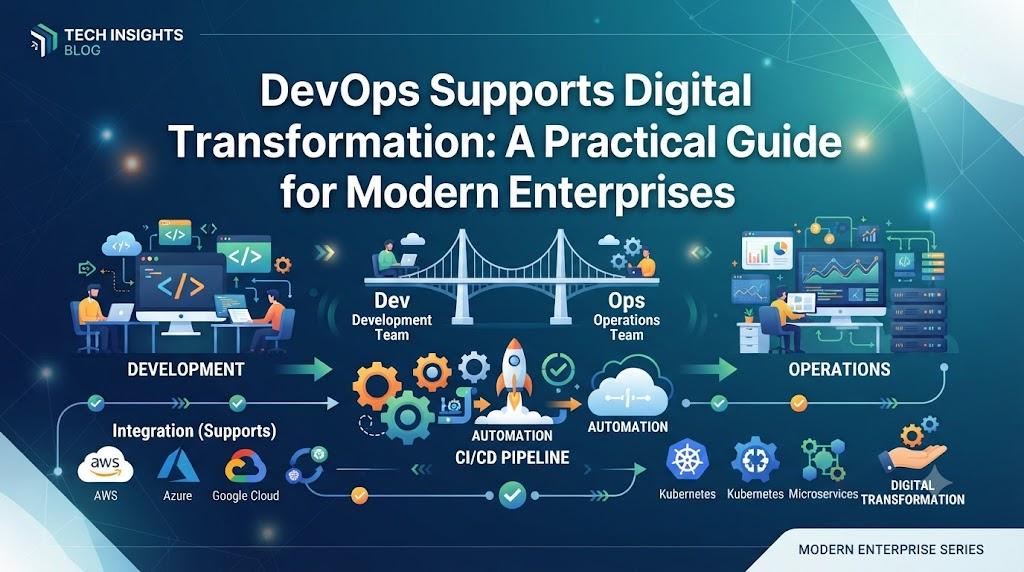
Instead of working in silos where developers throw code “over the wall” to operations, DevOps brings these teams together under a shared goal. When you integrate DevOps into a digital transformation strategy, you move away from infrequent, high-risk releases toward a model of continuous, small, and stable updates.
Why DevOps Is Essential for Digital Transformation
Digital transformation relies on speed, and DevOps is the engine that provides it. Without DevOps, digital initiatives often get bogged down by manual testing, slow provisioning, and communication gaps.
- Faster Innovation: DevOps pipelines allow features to move from concept to production in hours rather than months.
- Improved Agility: Organizations can respond to market shifts or competitive threats in real-time.
- Better Collaboration: Shared goals break down the “us versus them” mentality between departments.
- Automation-First Mindset: By automating repetitive tasks, teams focus on high-value development.
- Customer-Centricity: Rapid feedback loops ensure that the product actually solves customer problems.
How DevOps Supports Digital Transformation
| Traditional IT Approach | DevOps-Driven Digital Transformation |
| Siloed departments (Dev vs Ops) | Cross-functional, integrated teams |
| Manual deployments (high risk) | Automated, repeatable pipelines |
| Large, infrequent releases | Small, frequent, incremental updates |
| Reactive monitoring (after failure) | Proactive observability and feedback |
| Static, manual infrastructure | Dynamic Infrastructure as Code (IaC) |
| Long feedback loops | Short, continuous feedback loops |
Automation as the Foundation of Transformation
Automation is the bedrock of any successful digital transformation. In a manual environment, human error is the leading cause of service outages. By automating the software delivery lifecycle, you ensure consistency and reliability.
- Build Automation: Ensuring the code is always in a deployable state.
- Test Automation: Running regression tests automatically to prevent bugs from reaching production.
- Deployment Automation: Removing the human element from production releases to reduce downtime.
- Infrastructure Automation: Using code to provision resources, eliminating environment drift.
CI/CD and Faster Software Delivery
Continuous Integration (CI) and Continuous Delivery (CD) are the mechanisms that make speed possible. CI ensures that code changes are merged into a shared repository frequently, while CD ensures that these changes can be deployed to production at any time.
Workflow Summary:
- Developer commits code.
- Automated CI triggers unit tests.
- Build process creates a containerized artifact.
- Automated CD deploys to a staging environment.
- Automated integration tests validate functionality.
- One-click deployment to production.
Cloud-Native Technologies and DevOps
Cloud-native technologies—like containers (Docker), orchestration (Kubernetes), and serverless computing—are designed to work seamlessly with DevOps. They allow for massive scalability, self-healing architectures, and high availability, which are essential for digital transformation at scale. Moving to the cloud is only the first step; using DevOps to manage that cloud environment is what realizes the ROI.
Infrastructure as Code (IaC)
Infrastructure as Code (IaC) treats your infrastructure—servers, networks, load balancers—like software. By defining your infrastructure in files (e.g., Terraform, Ansible), you gain the ability to version control, test, and deploy your entire data center environment as easily as an application. This eliminates the “it works on my machine” problem once and for all.
DevSecOps and Secure Digital Transformation
Security is often a bottleneck in traditional IT. DevSecOps “shifts security left,” meaning it is integrated into the earliest stages of the development process rather than being an afterthought. By automating security scanning, vulnerability assessment, and compliance checks within the CI/CD pipeline, organizations can move fast without compromising on safety.
Business Benefits of DevOps for Digital Transformation
| Benefit | Business Impact |
| Faster Product Releases | Improved time-to-market and competitive edge. |
| Better Customer Satisfaction | Higher quality features delivered more reliably. |
| Improved Collaboration | Higher employee morale and retention. |
| Lower Operational Costs | Efficient resource utilization and reduced downtime. |
| Increased Scalability | Ability to grow user base without service degradation. |
Industry Use Cases
- Banking: Automating compliance audits to meet strict financial regulations.
- Healthcare: Rapid deployment of patient portals and secure health data management.
- Retail: Scaling e-commerce platforms to handle holiday traffic surges via auto-scaling.
- Government: Modernizing citizen services to provide faster, accessible web interfaces.
Common Challenges During Digital Transformation
| Challenge | Impact | Recommended Solution |
| Cultural Resistance | Stalls adoption of new ways of working. | Start small with pilot teams and show success. |
| Legacy Infrastructure | Creates technical debt and manual toil. | Use IaC to wrap legacy systems in modern wrappers. |
| Skill Gaps | Limits the potential of new tools. | Invest in continuous learning and training. |
Best Practices for Successful DevOps Adoption
- Build Cross-Functional Teams: Ensure developers and operations sit together (or collaborate digitally).
- Automate Everything: If you have to do a task twice, automate it.
- Adopt CI/CD: Make deployment a non-event.
- Invest in Monitoring: You cannot improve what you do not measure.
- Culture First: Celebrate failure as a learning opportunity.
Measuring Digital Transformation Success
| Metric | Business Value |
| Deployment Frequency | Measures how often you deliver value to users. |
| Lead Time for Changes | Measures how long it takes to go from code to production. |
| Change Failure Rate | Measures the reliability of your automated processes. |
| Mean Time to Recovery (MTTR) | Measures business resilience when things go wrong. |
Real-World Example: Enterprise Digital Transformation
Challenge: A large retail bank faced 3-month release cycles and frequent outages during updates.
Implementation: The bank shifted to a DevOps model, implementing CI/CD pipelines and IaC for their core banking applications.
Outcome: They reduced release cycles to two weeks, decreased production incidents by 60%, and improved developer productivity. The transformation enabled them to launch a mobile banking app that saw 1 million users in the first month.
Common Beginner Mistakes
- Tool Obsession: Buying expensive tools without changing the culture.
- Ignoring Feedback: Not listening to the teams doing the work.
- Over-Engineering: Trying to implement complex microservices too early.
- Security as an Afterthought: Trying to bolt on security at the end of the project.
Future of DevOps and Digital Transformation
The future is heading toward Platform Engineering—where internal platforms are built to provide a “golden path” for developers—and AI-Assisted DevOps, where machine learning optimizes pipelines and predicts failures before they occur. The goal remains the same: reducing complexity so developers can focus on innovation.
Certifications & Learning Paths
Continuous education is the only way to keep pace with the DevOps evolution. Platforms like DevOpsSchool provide structured paths.
| Certification | Best For | Skill Level | Focus Area |
| DevOps Foundation | Beginners | Entry | Concepts & Culture |
| Kubernetes CKA | Engineers | Intermediate | Orchestration |
| Terraform Associate | DevOps/Cloud | Intermediate | Infrastructure as Code |
| DevSecOps Expert | Security/Dev | Advanced | Security Automation |
Practical Digital Transformation Checklist
- Audit current manual processes and identify automation candidates.
- Establish a CI/CD pipeline for your primary application.
- Move environment configurations to Infrastructure as Code.
- Implement centralized monitoring and logging.
- Conduct a culture assessment to address team silos.
- Define and track the four key DevOps metrics (DORA metrics).
FAQs
1. How does DevOps support digital transformation?
It provides the speed, reliability, and cultural alignment necessary to execute digital strategies.
2. Why is automation important?
It eliminates human error and allows for repeatable, consistent deployments.
3. How does CI/CD improve business agility?
It allows teams to release updates on demand rather than waiting for scheduled release windows.
4. What role does cloud computing play?
It provides the elastic infrastructure required to support rapid software scaling.
5. Can small businesses benefit from DevOps?
Absolutely. DevOps practices focus on efficiency, which is vital for smaller teams.
6. How long does digital transformation take?
It is an ongoing journey, not a project with a fixed end date.
7. Which skills should teams develop?
Cloud administration, scripting, CI/CD tool management, and collaboration.
8. How should organizations get started?
Start with a single project (a “pilot”), automate its pipeline, and measure the results.
Final Thoughts
Digital transformation is not a destination; it is a way of operating. By integrating DevOps practices, your organization can move from reactive maintenance to proactive innovation. Focus on fostering a culture of collaboration, investing in automation, and continuously learning from your data. The goal is to build a foundation that supports your business growth for the next decade, not just the next quarter.