




Introduction
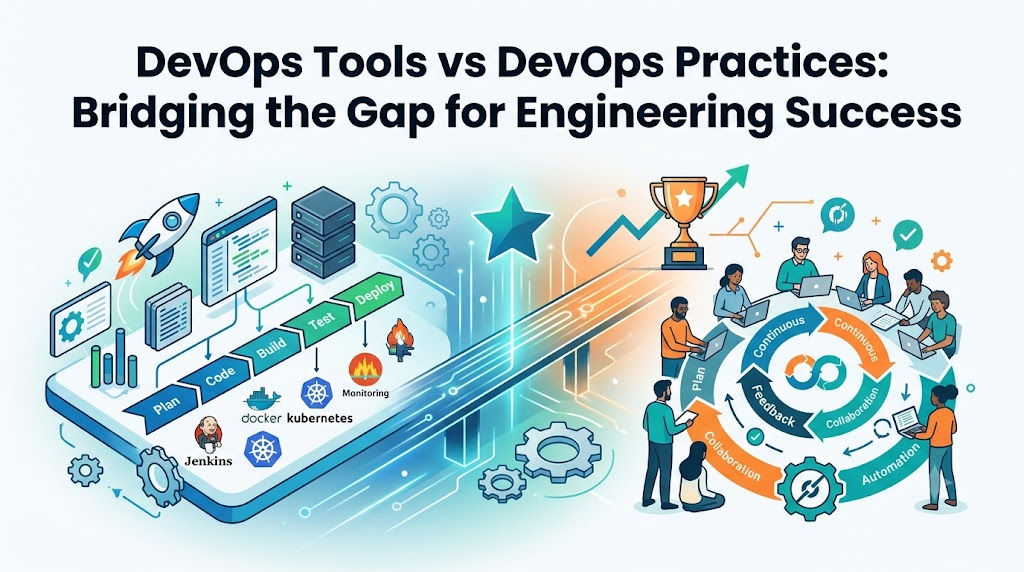
In the fast-paced world of software development, the term DevOps is frequently tossed around, often becoming synonymous with the latest software applications or infrastructure platforms. Many organizations fall into the trap of believing that purchasing a suite of expensive software or setting up an automated pipeline constitutes a full DevOps transformation. This common misunderstanding leads to significant friction, as teams often find that despite having the right technology, they still struggle with slow releases, constant outages, and internal silos.
The reality is that DevOps is not a single product or a pre-packaged solution; it is a holistic philosophy. It represents a powerful combination of organizational culture, refined operational practices, and the technical tools that enable automation. Achieving true DevOps maturity requires a deep understanding of how these components interact. Whether you are a student or a seasoned engineer, grasping the distinction between the “how” (tools) and the “why” (practices) is critical. To build a solid foundation in these concepts, many professionals turn to resources provided by DevOpsSchool, where the emphasis is placed on practical, real-world application. Understanding this balance is the first step toward building resilient systems that actually deliver value to the business.
What Is DevOps?
At its core, DevOps is a cultural and professional movement that stresses communication, collaboration, and integration between software developers and IT operations professionals. The ultimate goal is to shorten the systems development life cycle and provide continuous delivery with high software quality.
Think of it like a professional kitchen. You can buy the most advanced ovens, high-end mixers, and smart refrigeration systems—these are your tools. However, if the chefs do not communicate, if the recipes are poorly documented, or if the workflow in the kitchen is disorganized, the food will still be late and inconsistent. DevOps is the recipe and the culture of teamwork that ensures the kitchen staff works in harmony to serve excellent meals on time, using those tools to support their efforts.
What Are DevOps Tools?
DevOps tools are the technical instruments that engineering teams use to build, test, deploy, and monitor software. They are the enablers of the DevOps journey. These tools take manual, error-prone tasks and turn them into automated, repeatable processes.
If a developer needs to track changes to code, they use version control tools. If an operations team needs to deploy an application across fifty servers, they use configuration management tools. These tools exist to remove the “toil” from the daily routine, allowing engineers to focus on higher-level problem-solving rather than repetitive manual configuration.
What Are DevOps Practices?
DevOps practices are the standard operating procedures, behaviors, and cultural norms that teams adopt to improve efficiency and software quality. While tools provide the “how,” practices provide the “why” and the “what.”
For example, a common practice is “Continuous Integration,” where developers merge their code changes back to the main branch as often as possible. This is a behavior—a way of working—not just a software installation. Another practice is “Shared Responsibility,” where developers take ownership of how their code performs in production. This practice shifts the culture from “throw it over the wall to operations” to “we build it and we run it together.” Without these practices, even the most expensive tools will simply automate a chaotic process.
DevOps Tools vs DevOps Practices: Key Differences
| Feature | DevOps Tools | DevOps Practices |
| Purpose | To automate and execute tasks. | To guide behaviors and workflows. |
| Focus | Technical efficiency and speed. | Team collaboration and culture. |
| Nature | Software, platforms, and utilities. | Methods, processes, and mindset. |
| Benefits | Reduces manual toil and human error. | Improves quality, stability, and speed. |
| Challenges | Tool sprawl and high costs. | Organizational resistance and inertia. |
Common DevOps Tools and Their Roles
| Tool Category | Example Usage |
| Version Control | Managing source code changes and collaboration. |
| CI/CD | Automating testing and deployment pipelines. |
| Containers | Packaging software to run consistently everywhere. |
| Monitoring | Gaining visibility into system health and performance. |
| Infrastructure as Code | Provisioning servers through code rather than manual clicks. |
Core DevOps Practices Every Team Should Follow
Continuous Integration (CI)
This practice involves developers regularly merging their code changes into a central repository. Automated builds and tests run every time a change is submitted, catching bugs early in the development lifecycle.
Continuous Delivery (CD)
This ensures that code is always in a deployable state. It builds upon CI by automating the release process, meaning a team can deploy a new feature to production with the push of a button.
Infrastructure as Code (IaC)
IaC is the practice of managing infrastructure through machine-readable definition files rather than physical hardware configuration or interactive configuration tools. It ensures consistency across environments.
Monitoring and Feedback
DevOps is a circular process. Teams must monitor the health of their applications in production and feed that data back to the development team to improve the next iteration.
Collaboration and Communication
Tools like chat platforms and project management software only work if the culture encourages transparent communication and breaks down silos between departments.
Why Tools Alone Cannot Create DevOps Success
Many organizations suffer from “Tooling Overload.” They buy expensive enterprise automation software hoping it will magically fix their release cycles. However, if the development team does not communicate with the operations team, the tool will just help them make mistakes faster.
Consider a scenario where a company automates their deployment process but fails to implement a collaborative culture. When a deployment fails, the teams continue to blame each other rather than analyzing the incident together. The tools have provided efficiency, but the lack of shared practices means the organization remains stuck in a cycle of finger-pointing.
Real-World Example: Tool-First DevOps Adoption Failure
A mid-sized retail company decided to implement DevOps. They spent a massive portion of their budget on advanced automated testing tools and container orchestration platforms. They insisted that their staff use these tools immediately. However, they did not change their siloed reporting structure. Developers were still incentivized solely on the volume of code written, while operations were incentivized solely on system stability.
The result? The developers pushed code that the tools struggled to test, and operations blocked deployments out of fear. The tools were state-of-the-art, but because the underlying practices and culture remained unchanged, the initiative failed to improve the delivery speed and eventually led to employee burnout.
Real-World Example: Practice-Driven DevOps Success
A startup recognized their main issue was not the technology, but the lack of shared goals. Instead of buying tools first, they started by instituting “blameless post-mortems” and cross-functional “pod” structures. Developers and operations engineers sat together and defined their shared goals for reliability. Once the team had established these collaborative practices, they gradually introduced automation tools that aligned with their new workflow. Because the process was already human-centric, the tools became force multipliers for success, significantly reducing downtime.
Common Misconceptions About DevOps Tools
- Installing Jenkins means DevOps is complete: Jenkins is an automation server, not a culture. You can have Jenkins and still be working in silos.
- Kubernetes automatically creates a DevOps culture: Kubernetes is a powerful tool for orchestration, but it does not dictate how your team should collaborate.
- Automation solves every problem: If you automate a broken process, you have simply created a high-speed, automated disaster.
- DevOps is only for developers: DevOps requires deep involvement and cooperation from the operations and infrastructure teams as well.
How Beginners Should Learn DevOps
- Start with the “Why”: Learn the principles of Lean and Agile. Understand why we need to release faster and with better quality.
- Learn the Practices: Before learning how to write a YAML file for a tool, learn about version control branching strategies, testing methodologies, and deployment patterns.
- Understand the Tools: Pick one tool for each category (e.g., Git for version control, Docker for containers) and understand the problem it solves.
- Practice in Small Increments: Apply these concepts to small personal projects. Try to automate a manual process you have encountered.
Best Practices for Balancing Tools and Practices
- Focus on business goals: Always ask if a tool or practice serves the end customer.
- Improve collaboration: Use meetings and documentation to keep everyone on the same page.
- Automate gradually: Do not try to automate everything on day one. Start with the most painful, manual tasks.
- Measure outcomes: Use metrics like Lead Time for Changes and Mean Time to Recovery (MTTR) to assess your progress.
- Continuously improve: DevOps is a journey of constant iteration, not a destination.
Role of DevOpsSchool in Learning DevOps Fundamentals
Learning the nuances of DevOps requires more than just reading manuals; it requires exposure to real-world workflows and professional mentorship. DevOpsSchool provides an ecosystem designed to bridge the gap between theoretical knowledge and practical execution. Through hands-on training and a focus on the cultural aspects of DevOps, learners are prepared to handle the complexities of modern engineering environments, ensuring that they become engineers who understand the value of both technology and team dynamics.
Career Importance of Understanding Both Tools and Practices
For roles like Site Reliability Engineer (SRE), Cloud Engineer, or DevOps Consultant, technical skills are the entry ticket, but the ability to drive practices is the key to career advancement. Organizations are looking for leaders who can look at a broken workflow and see both the technical tool deficiency and the cultural process gap. Those who can navigate this intersection are the most valuable assets to any engineering team.
Industries Benefiting From DevOps Practices
- SaaS Companies: Rely on rapid delivery and high availability.
- Banking & Finance: Require high security combined with rapid feature deployment.
- Healthcare: Need to manage sensitive data while ensuring system stability.
- Telecom: Manage massive infrastructure that requires heavy automation.
- E-Commerce: Need to handle variable load and ensure zero downtime during peak sales.
- Enterprise IT: Breaking down long-standing silos to improve agility.
Future of DevOps Tools and Practices
The future of DevOps is leaning heavily into AI-assisted automation, where tools will suggest optimizations before problems occur. Platform Engineering is also emerging as a major trend, where the focus is on creating self-service developer platforms that standardize practices without stifling innovation. We are also seeing a massive shift toward DevSecOps, where security is integrated as a core practice rather than a final checklist item.
FAQs
1. What is the difference between DevOps tools and DevOps practices? Tools are the instruments (software/hardware) used for automation, while practices are the methodologies and cultural norms followed by the team.
2. Can DevOps exist without tools? Technically, you can have a DevOps culture without advanced tools, but it will be difficult to scale. Tools are essential for high-speed, large-scale delivery.
3. Are tools enough for DevOps success? No. Tools without supportive practices and a collaborative culture often lead to “faster failure” rather than success.
4. Which practice should beginners learn first? Version control and collaborative communication are the most important foundational practices.
5. What are the most common DevOps tools? Common categories include Git (Version Control), Jenkins (CI/CD), Docker/Kubernetes (Containers), and Terraform (IaC).
6. Why is culture important? Culture dictates how people react to failures and collaborate. Without a culture of trust and shared ownership, tools cannot be used effectively.
7. Is automation a tool or a practice? Automation is a practice enabled by tools. The intent to automate is the practice; the script or software you use is the tool.
8. How do teams balance both? By ensuring that every tool chosen is evaluated based on how it supports the team’s current collaborative practices and business objectives.
9. Can DevOps be used for non-software projects? Yes, the core principles of feedback loops and continuous improvement are applicable to many operational workflows outside of IT.
10. What is the biggest barrier to DevOps? Organizational inertia and the resistance to changing established silos are the biggest hurdles.
11. Do I need to be a developer to learn DevOps? While developer skills are highly beneficial, DevOps is also a natural progression for system administrators and infrastructure engineers.
12. How does DevOps improve software quality? By integrating testing into every stage of the development process (CI/CD) and fostering a culture of shared ownership.
13. What is the role of the DevOps engineer? They are the bridge between development and operations, ensuring that the right tools and practices are in place to deliver value.
14. Does DevOps mean “no more manual work”? It means minimizing repetitive, low-value manual work, allowing humans to focus on creative problem-solving.
15. Where can I find more resources on this? Explore the fundamentals and professional training paths at DevOpsSchool.
Final Thoughts
As you continue your journey in this field, remember that tools will change. The popular platforms may be replaced by something else in the coming years. However, the core practices—communication, continuous feedback, shared ownership, and the relentless drive for improvement—are timeless. Focus on mastering the underlying philosophy of how to build software in a collaborative environment. When you ground your career in solid practices, you will find that you can pick up any new tool with ease. Success in DevOps is not about who has the most tools in their stack; it is about how effectively the team uses what they have to solve problems and deliver value. Stay curious, focus on collaboration, and keep iterating.