




Introduction
Entering the world of DevOps often feels like standing in front of a tsunami. You search for how to learn DevOps and are immediately met with a bewildering array of tools: Docker, Kubernetes, Jenkins, Terraform, AWS, Ansible, Python, and the list never seems to end. Many beginners make the mistake of trying to learn everything at once, leading to a state of total overwhelm and eventual burnout.
The truth is that DevOps is not about mastering every tool under the sun; it is about understanding the philosophy of collaboration, automation, and efficiency. To succeed, you need a structured strategy that focuses on fundamentals before advanced platforms. A well-defined DevOps roadmap acts as your compass, ensuring you build a solid foundation that supports your growth into a professional role.
If you are looking for structured guidance, DevOpsSchool provides resources that can help you navigate this complex landscape. By visiting their official website, you can find comprehensive learning paths designed to bridge the gap between theoretical knowledge and practical application. Let us break down how to build a roadmap that actually works.
What Is a DevOps Roadmap?
A DevOps roadmap is a strategic, step-by-step plan that outlines the skills, tools, and practices you need to master to transition into a DevOps role. Think of it like planning a cross-country trip. You would not just get in a car and drive in random directions; you would identify your destination, map out the major checkpoints, and ensure your vehicle is ready for the terrain.
In this context, the destination is a professional DevOps engineering role. The checkpoints are the core technical competencies you must acquire. Instead of jumping straight into complex orchestration tools, a roadmap guides you from the bedrock of infrastructure—like Linux and networking—up to the specialized layers of cloud and automation.
Why You Need a DevOps Roadmap
Many beginners find themselves trapped in “tutorial hell,” where they watch endless videos on tools like Kubernetes without understanding how they fit into a real-world pipeline. This happens because they lack a sequence.
A roadmap provides:
- Focus: You know exactly what to learn next, preventing the “shiny object syndrome” of constantly chasing new, trending tools.
- Confidence: As you check off mastered skills, your confidence grows because you see tangible progress.
- Structured Growth: It ensures you build on top of fundamentals, which is crucial for troubleshooting complex system failures later in your career.
Practical Example: Imagine a learner who tries to learn Kubernetes before understanding what a process is in Linux. When a container fails to start, they will be completely lost. Conversely, a learner following a roadmap understands that the container is just a process with restricted resources, making them significantly better at debugging.
Step-by-Step DevOps Roadmap
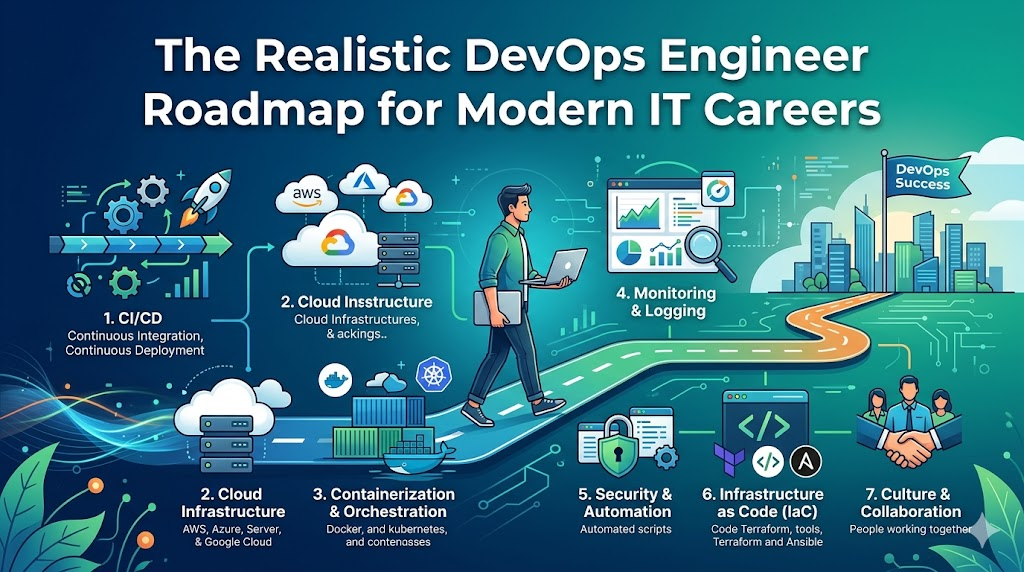
The following table outlines the logical progression for learning DevOps.
| Stage | Focus Area | Goal |
| 1 | Linux Fundamentals | Understand the OS environment |
| 2 | Networking Basics | Master how data travels |
| 3 | Git & Version Control | Learn code collaboration |
| 4 | Programming/Scripting | Automate repetitive tasks |
| 5 | CI/CD Concepts | Build automation pipelines |
| 6 | Docker & Containers | Package applications |
| 7 | Kubernetes | Orchestrate containers at scale |
| 8 | Cloud Fundamentals | Understand virtual infrastructure |
| 9 | Infrastructure as Code | Automate provisioning |
| 10 | Monitoring & Security | Ensure system health & safety |
Stage 1: Learn Linux Fundamentals
Everything in DevOps runs on Linux. You must understand the file system hierarchy, user permissions, and basic command-line utilities. Learn to navigate the terminal, manage processes, and use text editors like Vim or Nano.
Stage 2: Understand Networking Basics
You cannot build systems if you do not understand how they talk to each other. Focus on DNS, HTTP/HTTPS protocols, IP addresses, subnets, and how ports work. This is the foundation of every service you will eventually deploy.
Stage 3: Learn Git and Version Control
In the DevOps world, “everything is code.” Git is the tool that tracks changes in your code and configuration. Learn to clone repositories, create branches, merge changes, and resolve conflicts.
Stage 4: Learn Basic Scripting
Automation is the heart of DevOps. You do not need to be a software developer, but you must be able to write Bash scripts to automate simple system tasks. Python is also a highly recommended secondary language for more complex automation.
Stage 5: Understand CI/CD Concepts
Continuous Integration and Continuous Delivery (CI/CD) allow teams to release updates faster. Learn how to create a pipeline that automatically builds, tests, and deploys code. Start with simple tools like Jenkins to understand the workflow.
Stage 6: Learn Docker and Containers
Containers allow you to package an application with all its dependencies. Unlike virtual machines, containers are lightweight. Learn how to write a Dockerfile, build images, and manage container lifecycles.
Stage 7: Learn Kubernetes Fundamentals
Once you understand containers, you need to manage them at scale. Kubernetes is the industry standard for container orchestration. Learn about Pods, Deployments, Services, and how to manage a cluster. Think of it as the conductor of a symphony.
Stage 8: Learn Cloud Basics
Modern DevOps relies heavily on cloud providers like AWS, Azure, or Google Cloud. Choose one and learn its core services: Compute (EC2), Storage (S3), and Networking (VPC).
Stage 9: Infrastructure as Code (IaC)
Manual configuration is a recipe for error. Use tools like Terraform to define your infrastructure through code files. This makes your environments reproducible and version-controlled.
Stage 10: Monitoring and Security Basics
A system is not finished until you can see how it is performing. Learn to monitor logs and metrics using tools like Prometheus or Grafana. Additionally, prioritize security from the start—this is often called DevSecOps.
Why Hands-On Projects Matter
Theory is useful, but only projects prove your skills. When you build a project, you encounter real-world problems—like a connection error between a container and a database—that you cannot find in a textbook. These “in-the-trenches” moments are where true learning happens.
Beginner Scenario: Instead of just watching a video on Terraform, build a small project that deploys a web server on a cloud provider. When you get an error message, you will learn how to read documentation and troubleshoot, which is exactly what a senior engineer does every day.
Real-World Example: Learner Without Roadmap
A learner named Alex decides to learn “DevOps.” They start by watching a random video on Kubernetes on Monday, switch to AWS certification prep on Tuesday, and try to write complex Go code on Wednesday. By Friday, they feel discouraged because nothing is working and they have no coherent skill set. They are “tool-rich” but “knowledge-poor.”
Real-World Example: Learner Following Structured Roadmap
Sarah follows a roadmap. She spends two weeks mastering Linux commands. She feels confident. She then moves to Git, then Bash scripting. By the time she reaches Docker, she already understands how processes work, making the concept of a container instantly intuitive. She builds a mini-project in each stage, creating a portfolio that proves she knows what she is doing.
Common Mistakes Beginners Make
- Learning too many tools at once: Master one tool before moving to the next.
- Ignoring Linux basics: You cannot master DevOps if you are uncomfortable in the terminal.
- Skipping projects: Certificates are nice, but practical experience is what recruiters look for.
- Focusing only on the “How” and not the “Why”: Understand the problem a tool solves before you learn the tool itself.
Best Practices for Building Your DevOps Roadmap
- Learn fundamentals first: Never skip Linux and Networking.
- Practice daily: Even 30 minutes of terminal time is better than a 5-hour binge once a week.
- Build mini-projects: At every stage, create something.
- Track your progress: Keep a document or a repository of what you have learned.
- Stay consistent: DevOps is a marathon, not a sprint.
Role of DevOpsSchool in Building DevOps Skills
DevOpsSchool supports learners by providing a structured learning ecosystem that emphasizes practical exposure. Rather than just theory, the focus is on understanding the “why” behind CI/CD pipelines, containerization, and automation. By following a guided path on their official website, learners can gain the hands-on experience necessary to handle real-world scenarios and understand the integration of various tools in a production environment.
Career Opportunities After Learning DevOps
Following a structured roadmap opens doors to several high-demand roles:
- DevOps Engineer: Managing pipelines and infrastructure.
- Cloud Engineer: Focusing on cloud resource architecture.
- Site Reliability Engineer (SRE): Ensuring system uptime and performance.
- Platform Engineer: Building internal developer platforms.
- Automation Engineer: Specializing in CI/CD and process efficiency.
Industries such as Finance, E-commerce, Telecom, and Healthcare rely heavily on DevOps professionals to maintain their digital infrastructure.
Future of DevOps Careers
The landscape is shifting toward AI-assisted DevOps, where automation tools help predict system failures before they happen. Cloud-native engineering and Platform Engineering are also becoming standard. The core skill of a DevOps engineer will always be the ability to automate complex problems, regardless of how the tools evolve.
FAQs
- What is a DevOps roadmap? It is a step-by-step learning path to gain the skills needed for a DevOps role.
- Can beginners learn DevOps? Yes, by starting with fundamentals like Linux and networking.
- Is Linux mandatory? Absolutely. It is the language of servers and cloud computing.
- Should I learn Docker before Kubernetes? Yes, understand how to build a container first before you learn how to orchestrate many.
- Do I need coding skills? You need scripting skills (Bash/Python) to automate tasks.
- How long does DevOps learning take? It depends on your effort, but a solid foundation usually takes 6–12 months of consistent study.
- Are certifications enough? No, you need projects and hands-on experience to back up your certifications.
- Which cloud platform should I learn? Pick one (AWS, Azure, or GCP); the concepts are transferable.
- What is the most important skill? Problem-solving and the ability to learn new technologies.
- Do I need to be a developer? No, but you need to understand the development lifecycle.
- What is CI/CD? It is a method to frequently deliver apps to customers by introducing automation.
- Is DevOps just about tools? No, it is a culture of collaboration between Dev and Ops.
- How do I start? Pick a roadmap and start with Linux.
- Is it difficult? It can be, but it becomes manageable if you follow a step-by-step path.
- What is the first tool I should learn? Start with the Linux command line.
Final Thoughts
Building your career in DevOps is not about racing to learn the latest tool. It is about building a deep, fundamental understanding of how systems work. Start with Linux, master your networking basics, and build projects that force you to solve actual problems. Consistency and hands-on practice are your greatest assets. Do not get distracted by the noise of new tools; follow your roadmap, trust the process, and you will eventually find yourself ready for a professional role.