




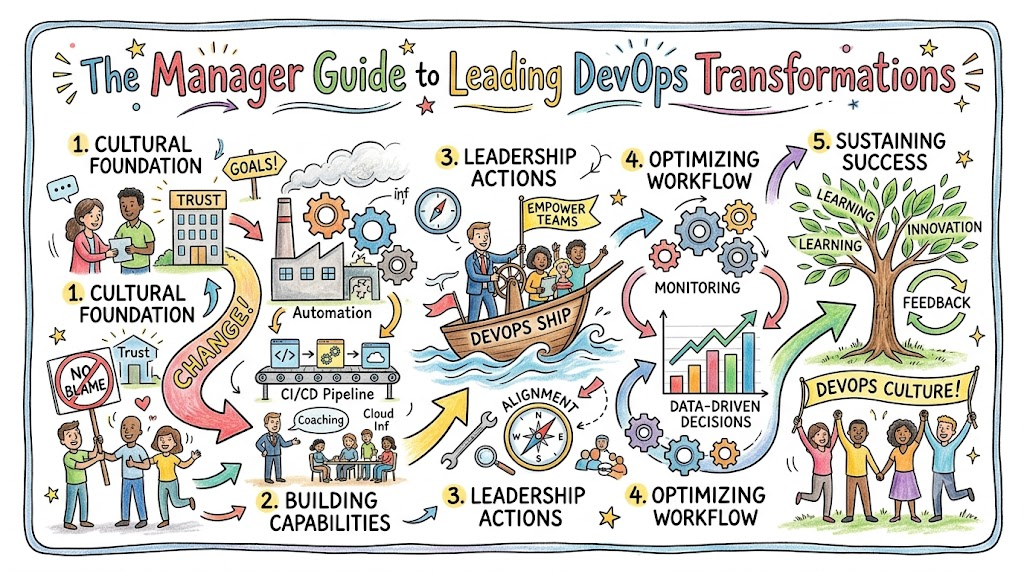
Introduction
In the current landscape of software development, the pressure to deliver features faster while maintaining system stability is immense. We live in an era where software is the primary interface between a business and its customers. If your engineering team is slow, your business is slow. If your team is struggling with frequent outages and broken features, your customer trust diminishes. This is where DevOps becomes a critical business imperative rather than just an IT buzzword.
Many leaders mistakenly view DevOps as a technical challenge—something to be solved by hiring engineers or purchasing the latest automation tools. However, in my twenty years of leading transformation initiatives, I have observed that the most successful implementations are those driven by informed leadership. DevOps is fundamentally a management and cultural transformation.
If you are a manager, CTO, or business leader, understanding how to shepherd this transition is vital. You cannot outsource leadership, and you certainly cannot outsource the cultural shift required for DevOps success. To gain a deeper understanding of the core principles and practical applications of this methodology, I highly recommend exploring resources at DevOpsSchool. Their approach to providing structured, real-world guidance is an excellent starting point for any leader looking to bridge the gap between business strategy and technical execution.
What DevOps Really Means for Managers
At its core, DevOps is the union of people, processes, and technology to continuously provide value to customers. For a manager, it is helpful to think of DevOps not as a department or a specific toolset, but as a philosophy of removing friction.
Think of a traditional software development organization like a relay race where one runner (development) hands the baton to the next runner (operations). In the traditional model, they often do not even speak the same language. The developers want to push new code quickly, while operations want to keep the system stable and unchanged. DevOps breaks down this wall.
It means developers understand the infrastructure their code runs on, and operations staff understand the code they are supporting. It is about shared ownership. When a manager focuses on DevOps, they are focusing on creating an environment where “we” succeed or fail together, rather than pointing fingers across departmental silos.
Why Managers Matter in DevOps Success
You might think that if the engineers are the ones writing the code and the systems administrators are managing the servers, your role is peripheral. That is a dangerous assumption. Engineering teams are often constrained by the organizational structure you create.
If you reward developers only for writing new features and reward operations only for uptime, you have created a structural conflict. DevOps requires management to:
- Resource Allocation: Ensure that time is allocated for technical debt and automation, not just new features.
- Team Alignment: Break down the walls between departments to foster communication.
- Removing Blockers: When a team is stuck because of a legacy process, you are the one who can remove that obstacle.
- Encouraging Collaboration: You set the tone for whether the team operates as a collective unit or as disparate silos.
Your influence on the culture and the organizational structure is the single biggest predictor of whether a DevOps transformation succeeds or fails.
Common DevOps Misconceptions Managers Have
One of the biggest hurdles I encounter when coaching leadership teams is the weight of misconceptions. Let us clarify the reality versus the myths.
| Misconception | Reality |
| DevOps is just automation | Automation is a tool, not the goal. DevOps is about flow and culture. |
| DevOps replaces operations teams | It changes what they do. They move from manual tasks to building platforms. |
| DevOps is only for large tech companies | DevOps is for any business that relies on software to deliver value. |
| Tools alone solve the problems | If you automate a broken process, you just get broken results faster. |
| DevOps is a destination | It is a continuous journey of improvement, not a project with a start and end date. |
| DevOps means no process | It means better, leaner, and more collaborative processes. |
How DevOps Changes Software Delivery
In a pre-DevOps world, software deployment was a “big bang” event. Teams would work for months on features, followed by a massive, high-risk release day often involving late nights and manual checklists.
DevOps changes this dynamic to a model of continuous, small releases. By breaking large projects into smaller chunks, managers see value delivered much sooner. This creates a feedback loop:
- Faster Releases: You get to market faster.
- Continuous Feedback: If a feature does not work, you know immediately, not after six months of development.
- Better Quality: Smaller, more frequent updates are easier to test and fix if they break.
For a manager, this means you are no longer managing high-stakes release days; you are managing a steady, predictable flow of value.
DevOps Culture: What Managers Need to Understand
Culture is the most difficult part of DevOps, yet it is the most important. Many managers focus on the “pipeline” (the tools) and ignore the “people” (the culture).
Breaking silos is the first step. You must move away from the mindset where Development says, “I wrote the code, it is Ops’ problem now,” and Operations says, “The code is buggy, it is Dev’s problem.”
In a healthy DevOps culture, everyone is responsible for the product. This requires a learning mindset. When an outage occurs, the question should not be “Who broke it?” but “How did our system allow this to happen, and how can we prevent it in the future?” This fosters psychological safety, where engineers feel comfortable reporting issues early rather than hiding them.
Role of Automation in DevOps
Automation is the engine of DevOps. It removes the human element from repetitive, error-prone tasks. For management, understanding automation is not about knowing how to write scripts, but about understanding what to prioritize.
Managers should support:
- CI/CD Pipelines: These are the highways that move code from a developer’s laptop to the customer.
- Automated Testing: This ensures that every new change does not break existing functionality.
- Infrastructure as Code: This allows operations teams to manage servers and networks with the same speed and reliability as software code.
When you invest in automation, you are buying your team time—time they can spend on innovation rather than maintenance.
Metrics Every Manager Should Understand
You cannot improve what you do not measure. However, vanity metrics (like “number of lines of code written”) are useless. You need to focus on flow and stability metrics, often referred to as DORA metrics.
| Metric | Meaning |
| Deployment Frequency | How often does your team successfully release to production? |
| Lead Time for Changes | How long does it take from code commit to running in production? |
| Change Failure Rate | What percentage of deployments cause a failure in production? |
| Mean Time to Recovery (MTTR) | How quickly can you restore service when a failure occurs? |
These metrics provide a balanced view of speed versus quality. If your deployment frequency is high but your change failure rate is also high, your team is moving too fast without enough quality control.
How Managers Should Support DevOps Teams
Your role is to be an enabler, not a micromanager. Here is how you can support your teams effectively:
- Encourage Experimentation: Create a safe space where teams can try new things. Failure is often a necessary step toward innovation.
- Reduce Blame: When things go wrong, focus on fixing the system, not punishing the person.
- Invest in Skills: Technologies change rapidly. Ensure your team has the budget and time for training.
- Support Automation: When a team asks for time to build automation tools, grant it. Do not force them to continue doing manual work in the name of “hitting a deadline.”
Common Management Mistakes During DevOps Adoption
Even with the best intentions, managers often fall into traps. Here is what to avoid:
- Forcing Rapid Change: Do not try to change everything overnight. Start with one pilot team, prove the value, and then scale.
- Ignoring Culture: You cannot buy DevOps at a store. If you hire the best engineers but keep the same toxic management style, you will fail.
- Measuring Wrong KPIs: If you measure developers on “features completed” and Ops on “stability,” you will never get them to work together. Align their incentives.
- Tool-First Thinking: Buying an expensive tool will not fix a communication problem. Fix the communication first.
Real-World Example: DevOps Failure Due to Leadership
I once consulted for a mid-sized financial firm that mandated a “DevOps transformation.” The CTO bought an expensive suite of automation tools and told the teams, “Use these.” There was no training, no cultural shift, and no change to the incentives. The developers continued to throw code over the wall, and the operations team was overwhelmed by the new tools they didn’t understand. The project was abandoned within six months because the leadership focused on the technology and neglected the human and process elements.
Real-World Example: Successful DevOps Leadership
Conversely, I worked with a SaaS startup that approached the transition differently. The leadership team started by creating a cross-functional “pod” that included both developers and operations engineers. They gave them a single objective: reduce deployment time by 50% in three months. The manager removed all obstacles, gave them the autonomy to choose their tools, and supported their need for training. Because the focus was on the business outcome (speed) and the team was empowered, they not only met the goal but improved the team’s overall morale.
Best Practices for Managers Leading DevOps
If you are beginning your journey, follow these steps:
- Start Small: Pick one project or one team.
- Focus on Business Goals: Do not do DevOps for the sake of DevOps. Do it to serve the customer better.
- Measure Progress Realistically: Use the metrics mentioned earlier.
- Communicate Constantly: Make sure the entire organization understands why this shift is happening.
- Actionable Checklist for Managers:
- Have I clearly defined the business goals for this transition?
- Is the team empowered to choose the right tools for their tasks?
- Have I removed obstacles that prevent cross-team communication?
- Are we tracking DORA metrics?
- Am I rewarding collaboration over individual heroism?
Role of DevOpsSchool in DevOps Leadership Learning
Leadership in this domain requires more than just high-level concepts; it requires a grasp of the workflows that your teams are implementing. DevOpsSchool serves as a vital bridge for managers who need to speak the language of engineering. By gaining practical exposure to how CI/CD pipelines work and understanding the realities of modern deployment, leaders can make more informed decisions about resource allocation and strategy. They offer a learning environment that demystifies the technical complexity, allowing managers to focus on what matters most: leading their teams toward high-performance delivery.
Industries Benefiting From DevOps Leadership
DevOps is no longer confined to the tech sector.
- Banking & Finance: Needed for security and compliance combined with speed.
- SaaS Companies: Essential for rapid feature iteration and customer feedback loops.
- Healthcare: Vital for managing data securely while providing timely updates.
- E-Commerce: Critical for maintaining uptime during peak sales periods.
- Telecom: Necessary for managing complex, distributed infrastructure.
- Enterprise IT: Crucial for modernizing legacy applications and maintaining competitiveness.
Future of DevOps Leadership
The future of DevOps leadership will be defined by three major trends:
- AI-Assisted Operations: Managers will need to oversee systems where AI helps detect and fix outages automatically.
- Platform Engineering: Instead of just DevOps, leaders will focus on building internal platforms that make it easy for developers to self-service infrastructure.
- Security-Driven Leadership: Security will no longer be a final step; it will be integrated into every stage of the development process (DevSecOps).
FAQs
- What is DevOps for managers?It is an organizational shift that integrates development and operations to improve product delivery speed, quality, and collaboration, driven by leadership support.
- Do managers need technical skills to lead DevOps?You do not need to be a coder, but you must understand the concepts of CI/CD, automation, and infrastructure to make informed business decisions.
- What metrics matter most for managers?Focus on the four DORA metrics: Deployment Frequency, Lead Time for Changes, Change Failure Rate, and Mean Time to Recovery.
- Is DevOps only for IT teams?No, it is a business strategy. It requires alignment between product, business, development, and operations stakeholders.
- How can managers support DevOps teams?By removing organizational bottlenecks, promoting a blameless culture, and prioritizing time for technical improvements alongside feature work.
- Why do DevOps projects fail?Usually because leadership treats it as a purely technical project, ignoring the necessary cultural shift and team alignment.
- Is automation expensive for startups?It is more expensive to not automate. The cost of manual error and slow delivery is far higher than the investment in automated tools.
- Can startups use DevOps?Startups are actually the best place for DevOps because they can build it into their culture from day one.
- What is the first step in DevOps transformation?Assess your current culture. Identify the biggest bottleneck in your delivery process and start there.
- How long does a DevOps transformation take?It is a continuous process. You should see incremental improvements within the first few months, but cultural change takes time.
- Should I hire a “DevOps Engineer”?You can, but be careful. DevOps is a culture, not a role. Use such roles to facilitate collaboration, not to build a new silo.
- How does DevOps improve security?By incorporating security checks into the automated pipeline, vulnerabilities are caught earlier and fixed faster.
- What is a “Blame-Free” culture?It is a management environment where mistakes are treated as learning opportunities to improve the system rather than reasons to punish individuals.
- How do I manage resistance to change?Show the “what is in it for them.” Explain how DevOps reduces the “firefighting” stress for employees and allows them to do more creative work.
- Does DevOps require cloud computing?While it is easier with cloud infrastructure, DevOps principles apply to on-premise setups as well.
Final Thoughts
Leading a DevOps transformation is one of the most rewarding challenges a manager can undertake. It is not just about changing how you build software; it is about changing how your organization thinks.
As a leader, your most important contribution is not the tool you choose or the specific script you write. It is the environment you cultivate. When you foster a culture of transparency, shared responsibility, and continuous learning, the technology will naturally fall into place.
Remember that DevOps is not a race with a finish line. It is a commitment to getting better every single day. Start small, focus on the flow of value, and ensure your team feels supported in their mission. Real transformation happens when leadership stops commanding and starts enabling.y.