




Introduction
In the current enterprise landscape, software is no longer just a supporting tool for corporate operations; it is the core engine of corporate strategy. Organizations across every vertical, from financial services to supply chain logistics, compete on their ability to translate a business concept into functioning software running securely in production. The speed at which this transition occurs determines whether an enterprise captures a shifting market opportunity or loses ground to more agile competitors.
For decades, organizations have been constrained by legacy software delivery patterns that treat application development and infrastructure operations as separate, isolated practices. This systemic separation creates structural operational handoffs, communication gaps, and extended verification phases. As a result, valuable software updates often spend weeks or months idling in queue environments, awaiting manual verification, security auditing, and infrastructure readiness. The cost of this delay is measurable in lost revenue, diminished competitive advantage, and reduced engineering morale.
To address these delivery bottlenecks, modern engineering organizations utilize DevOps as a core framework. DevOps fundamentally restructures how software is conceptualized, built, verified, deployed, and sustained. By unifying development teams, operations specialists, and security personnel into integrated, cross-functional units, DevOps eliminates traditional engineering silos.
Achieving this level of continuous delivery requires targeted professional development and practical engineering training. Platforms such as DevOpsSchool provide structured educational frameworks designed to help teams master the specific tooling, automation strategies, and cultural frameworks necessary to reduce cycle times. Through comprehensive training programs, organizations can transition from fragmented, manual workflows to highly automated, continuous delivery operations.
This comprehensive guide analyzes the functional mechanics of how a DevOps transformation directly optimizes software delivery speeds. We will evaluate the structural bottlenecks within traditional IT architectures, explore the technical components of automated pipelines, identify key operational metrics, and outline the exact strategies required to achieve sustainable, high-velocity software deployments.
What Is Time to Market in Software Development?
Time to market in software development represents the total elapsed time from the initial conception of a software feature, update, or product to the exact moment it becomes functional, secure, and available to end users in a production environment. TTM is not merely an engineering metric; it is an economic indicator of an enterprise’s operational efficiency.
From a technical perspective, TTM spans several distinct lifecycle phases:
- Requirements Gathering and Product Management: Defining the scope and business objectives of the proposed feature.
- Architecture and Design: Mapping out the systemic dependencies, data schemas, and structural patterns.
- Active Software Development: Writing the application logic, code blocks, and integration components.
- Quality Assurance and Security Auditing: Validating that the code functions correctly and complies with safety protocols.
- Release Management and Deployment Operations: Moving the validated code package into the live infrastructure.
- Post-Deployment Feedback: Observing initial system performance and collecting direct user telemetry.
To understand this concept clearly, consider a physical manufacturing analogy. In a traditional automobile assembly factory, raw materials are processed through highly organized, predictable production stages. If the factory uses an unoptimized layout where components must be manually transported between distant buildings, and where inspections are performed only at the final stage of assembly, the entire manufacturing cycle slows down. If a defect is discovered during the final quality check, the automobile must be entirely disassembled, stalling the throughput of the entire production floor.
In software engineering, code that has been written but not yet deployed to production behaves exactly like uncompleted inventory sitting on a factory floor. It represents an expenditure of capital and engineering hours that yields zero active business value. The longer this code remains stuck in testing queues, staging environments, or approval cycles, the more its potential market value depreciates. A high TTM means the business is consistently operating behind the market cycle, responding to consumer demands months after those demands have shifted.
Conversely, optimizing TTM means shrinking the timeline between code commit and production deployment. When an enterprise reduces this cycle, it changes how it handles business risk. Instead of making massive, speculative software bets every six months, the enterprise can execute small, continuous product hypotheses every single day. This rapid operational feedback loop forms the foundation of modern digital business agility.
Why Traditional IT Slows Down Time to Market
To appreciate why DevOps is essential for accelerating delivery speed, we must first analyze the structural engineering failures embedded within traditional IT management. For years, the IT sector operated under a deeply bifurcated model: the development organization was separate from the operations organization. This structural division created systemic bottlenecks.
The Structural Wall of Confusion
In a conventional IT department, development teams are measured and incentivized based on change volume and velocity. Their primary objective is to build new features, fix bugs, and push out modifications as quickly as possible. Operations teams, conversely, are measured on infrastructure availability, uptime, and system predictability. Because change is the primary driver of production instability, operations teams are naturally incentivized to resist frequent code deployments.
This structural misalignment results in what enterprise architects call the “wall of confusion.” Developers complete a software package and hand it off to the operations team for deployment. Because the operations engineers had zero visibility into how the application code was constructed, and because the developers have minimal understanding of the production environment’s underlying constraints, the handoff introduces immediate friction. When the deployment inevitably encounters environmental failures, the teams often blame one another, extending troubleshooting timelines and delaying the release.
Ticket-Driven Infrastructure and Bureaucracy
Traditional IT relies heavily on ticket-driven operations. If a software engineering team requires a new database instance, an updated firewall rule, or a block of virtualized storage to test their application, they must submit a formal ticket to a centralized infrastructure queue. This request is reviewed, approved, and manually executed by an infrastructure specialist who is concurrently managing hundreds of similar requests.
This ticket-driven workflow introduces major compounding delays. A request that takes minutes to physically configure can sit in an operational queue for days or weeks. If the configuration requires further clarification, the ticket is sent back, restarting the cycle.
Furthermore, traditional release management often mandates a centralized Change Advisory Board (CAB). The CAB meets on a periodic basis (e.g., bi-weekly or monthly) to manually review every single planned production modification across the entire enterprise. This manual governance process assumes that bureaucratic oversight can prevent production outages. In practice, it creates massive release packages, as weeks of unrelated software modifications accumulate into a single deployment payload. These large payloads drastically increase release complexity and enhance the probability of a major system failure.
Configuration Drift and Environmental Disparity
In non-DevOps environments, infrastructure environments (Development, Testing, Staging, and Production) are typically provisioned and maintained manually by different engineering teams. Over time, these environments diverge significantly in terms of operating system patch levels, library versions, network topologies, and access permissions—a phenomenon known as configuration drift.
When a software application is validated successfully in a dedicated development environment, there is no guarantee it will behave identically in production. A minor discrepancy in an underlying system library or a subtle difference in security group configurations can cause severe application failures during a live release. Identifying, debugging, and rectifying these environment-specific bugs in the middle of a deployment window adds massive delays to the software delivery cycle.
Problems That Delay Software Releases
The following structured table maps the specific problems found in traditional IT environments directly to their measurable operational impacts on software delivery speed.
| Problem | Impact on Delivery |
| Manual Deployments | Multi-hour or multi-day release windows executed via complex, error-prone manual runbooks; highly dependent on specific personnel. |
| Environment Disparities | Frequent code failures in production caused by hidden configuration differences between testing and staging systems. |
| Siloed Communication | Misalignment between development and operations teams that extends troubleshooting times and lengthens deployment cycles. |
| Late-Stage Defect Discovery | Postponing quality and security testing until the end of the lifecycle, forcing costly architectural rewrites late in the process. |
| Ticket-Driven Operations | Engineering teams face extended delays waiting for centralized infrastructure groups to manually provision basic resources. |
| Large Batch Releases | Bundling months of code changes into a single release package, significantly increasing deployment risk and rollback complexity. |
| Flaky Automation Frameworks | Outdated or unreliable automated test suites that yield false positives/negatives, forcing teams back to slow manual validation. |
| Manual Change Advisory Boards | Extended administrative approval workflows that stall fully validated code packages from reaching production environments. |
How DevOps Reduces Time to Market
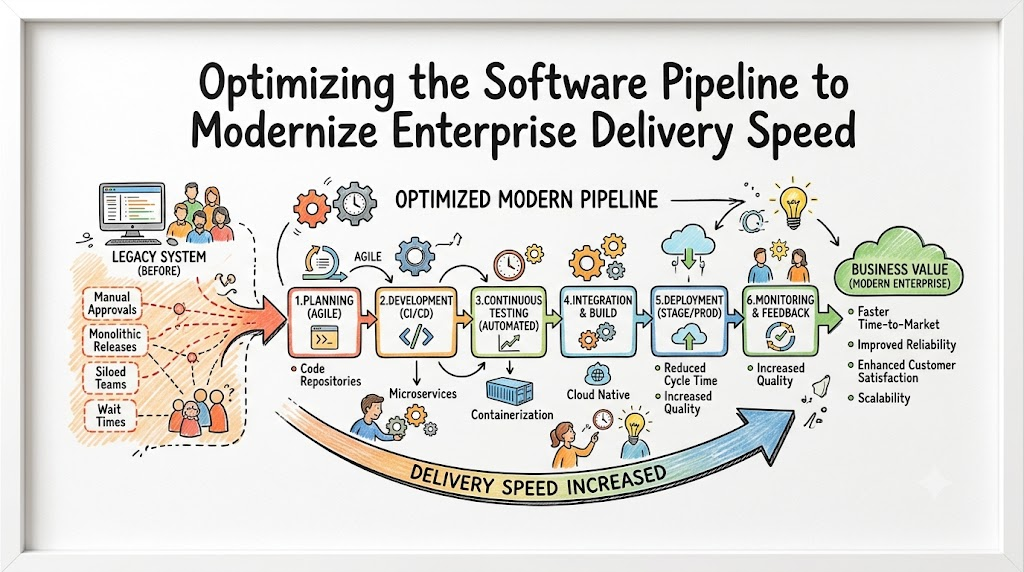
DevOps solves these systemic delays by redesigning the software lifecycle around a unified, continuous loop. Instead of passing software packages over organizational walls, DevOps introduces an end-to-end delivery pipeline that automates code validation, environment provisioning, and deployment tracking.
The Core Continuous Delivery Pipeline Workflow
To see how DevOps accelerates software delivery, let us trace the path of a code modification through a modern automated pipeline:
[Developer Commit]
       │
       ▼
[Automated Build & Unit Tests]
       │
       ▼
[Static Analysis & Security Scanning]
       │
       ▼
[Automated Artifact Archival]
       │
       ▼
[Dynamic Dynamic Environment Provisioning (IaC)]
       │
       ▼
[Automated Integration & Functional Testing]
       │
       ▼
[Continuous Deployment to Production]
Phase 1: Continuous Integration and Automated Build
The workflow begins when a software engineer pushes a code modification to a centralized version control system (such as Git). The commit automatically triggers an orchestration server (e.g., Jenkins, GitLab CI, or GitHub Actions). The automation server immediately pulls the updated source code, compiles the application components, resolves external dependencies, and executes a comprehensive suite of unit tests. This entire process finishes in minutes. If a compilation error occurs or a unit test fails, the pipeline halts immediately, notifying the developer to fix the issue while the context is fresh.
Phase 2: Static Analysis and Security Scanning
Once the build passes, the code automatically enters static analysis pipelines (such as SonarQube) and automated software composition analysis tools. These utilities evaluate the code layout for structural quality, technical debt, and known security vulnerabilities within open-source dependencies. By running these checks automatically during every single code commit, security and compliance are addressed continuously, rather than during a frantic review right before production launch.
Phase 3: Automated Artifact Archival
Upon successful completion of validation checks, the pipeline compiles the application into an immutable artifact, such as a Docker container image or a versioned package file. This artifact is cryptographically signed and stored within a secure container registry or artifact repository. This ensures that the exact same binary package validated during testing is ultimately deployed to production, eliminating any variance introduced by recompilation.
Phase 4: Dynamic Environment Provisioning
The pipeline uses Infrastructure as Code (IaC) templates to programmatically provision a transient testing environment that mirrors production architecture. This setup includes matching network routing, database schemas, and security access controls. Because this environment is built automatically from source-controlled code templates, configuration drift is functionally impossible.
Phase 5: Automated Integration and Functional Testing
With the application deployed into the fresh staging environment, the pipeline executes automated integration tests, end-to-end user journey simulations, and performance benchmarks. These automated tests run systematically across multiple virtual browsers and device profiles, compressing days of traditional manual QA into minutes of automated execution.
Phase 6: Continuous Deployment to Production
If all validation gates are satisfied, the pipeline initiates an automated deployment to the production environment using advanced release strategies like blue-green deployments or canary rollouts. If any production performance metrics drop or error rates spike, automated monitoring systems instantly trigger a rollback to the previous stable state, reducing system downtime.
This integrated approach changes the fundamental dynamics of software development. By breaking down large, risky releases into a stream of small, verified changes, organizations can deploy software confidently, repeatedly, and at a fraction of traditional cycle times.
Key DevOps Practices That Improve Speed
The acceleration of software delivery is achieved through a combination of engineering practices that replace manual, fragmented operations with automated, repeatable systems.
| Practice | Impact on Speed |
| Continuous Integration (CI) | Code changes are integrated and validated automatically multiple times a day, catching integration bugs early and avoiding long merge conflicts. |
| Infrastructure as Code (IaC) | Programmatic management of infrastructure using code templates, enabling instant, automated environment creation and preventing configuration drift. |
| Automated Testing | Running unit, integration, and security tests automatically within the pipeline, removing QA bottlenecks and accelerating feedback loops. |
| Continuous Deployment (CD) | Fully automating the deployment pipeline so that every validated code change is pushed directly to production without manual engineering overhead. |
| Observability and Monitoring | Real-time tracking of application telemetry and user behavior, allowing teams to instantly identify and resolve production incidents. |
| Trunk-Based Development | Developers merge short-lived feature branches into a primary main branch daily, avoiding complex multi-week branch merges. |
| Microservices Architecture | Decoupling large applications into independent services, allowing teams to deploy individual components without updating the entire system. |
Role of Automation in Faster Delivery
Automation is the foundation of high-velocity DevOps engineering. Without automation, even the most collaborative organizational culture will stall due to human operational constraints. Manual processes are fundamentally unscalable, prone to human error, and difficult to repeat consistently.
Consider the process of setting up a multi-tier enterprise web application environment manually. A systems engineer must log into a cloud service console, provision virtual machines, configure network firewalls, install necessary runtime dependencies, set up database permissions, and configure local logging agents. Even with detailed documentation, this manual process leaves room for errors: a single misconfigured IP address, a missing software patch, or an incorrect permission flag can break the entire stack. Troubleshooting these configuration errors adds significant troubleshooting time to the release schedule.
DevOps automation replaces these manual steps with declarative, version-controlled scripts and templates. When infrastructure is managed via code (using tools like Terraform, OpenTofu, or Ansible), the entire infrastructure footprint is defined in text files stored within a version control system. This approach brings several major advantages:
- Elimination of Human Error: Automated systems execute commands exactly as scripted, ensuring completely predictable outcomes every time.
- Guaranteed Repeatability: Environments can be created, destroyed, and recreated instantly. A testing environment built at 2:00 AM matches the production environment built three months prior.
- Rapid Scale-Out: If application traffic spikes, automated systems can provision additional computing clusters and load balancers instantly, without manual intervention.
- Auditable Governance: Because configuration changes are managed via code repositories, every update leaves a clear audit trail showing who made the modification, what changed, and why.
By automating the mundane, repetitive tasks of the software lifecycle—such as environment builds, basic testing, and deployment formatting—organizations free up their engineers to focus on building features. This shift directly optimizes delivery pipelines and reduces time to market.
Role of CI/CD in Reducing Time to Market
Continuous Integration (CI) and Continuous Delivery/Deployment (CD) represent the technical engine that drives a high-velocity DevOps organization. They transform software delivery from a series of disjointed, episodic projects into a continuous pipeline.
Continuous Integration Mechanics
In traditional software development models, engineers work on isolated feature branches for weeks or months. When the time comes to merge these long-lived branches back into the main branch, teams encounter what engineers call “merge hell.” Code paths have diverged so severely that resolving conflicts requires days of manual reconciliation, frequently introducing new defects into the codebase.
Continuous Integration systematically prevents this issue. CI requires developers to merge their code modifications back into the central main branch multiple times a day. Every single merge event triggers an automated build and test pipeline.
This approach offers two primary speed advantages:
- Immediate Feedback Loops: If a developer introduces a code regression, the automated test suite catches it within minutes. The developer can fix the issue immediately, while the logic is fresh in their mind, rather than weeks later during a dedicated QA phase.
- Minimized Integration Risk: Because changes are merged in small, frequent increments, conflict resolution is straightforward, keeping the main branch in a deployable state.
Continuous Delivery and Deployment Mechanics
While CI ensures that code is structurally sound and integrated, Continuous Delivery ensures that the code is always ready for a production release. Continuous Deployment takes this a step further by automating the actual production launch without requiring human intervention.
Traditional Delivery Model:
[Code Dev] ──> [Manual Merge] ──> [Manual QA Phase] ──> [CAB Approval] ──> [Manual Release Window]
(Total Cycle Time: Weeks to Months)

Modern DevOps CI/CD Model:
[Code Dev] ──> [Auto CI Build & Test] ──> [Auto IaC Staging] ──> [Auto Canary Deployment]
(Total Cycle Time: Minutes to Hours)
To achieve this level of delivery speed safely, modern CD pipelines use sophisticated deployment strategies that minimize blast radius and protect the user experience:
- Blue-Green Deployments: The operations team maintains two identical production environments. The “Blue” environment runs the active production traffic, while the new version is deployed to the “Green” environment. Once the Green environment passes final validation, the network load balancer routes traffic to it instantly. If an issue is discovered, traffic routes back to Blue immediately, resulting in near-zero downtime.
- Canary Rollouts: The CD pipeline deploys the new application update to a small fraction of production servers (e.g., 2% of instances). The system monitors real-time error rates, latency metrics, and user feedback from this small group. If the application performs correctly, the update scales out to the remaining infrastructure automatically. If error rates spike, the canary instance is isolated, protecting the vast majority of users from the bug.
By utilizing these automated deployment strategies, organizations remove the fear and administrative overhead from software releases, allowing teams to ship updates safely and frequently.
Role of Collaboration in DevOps Speed
While automation and CI/CD pipelines provide the necessary technical tooling, DevOps is fundamentally a cultural transformation. High-performance tooling will fail if the underlying organization remains siloed, defensive, and fragmented. Reducing time to market requires restructuring how teams interact, communicate, and share operational responsibility.
Breaking Down the Organizational Silos
In a traditional IT model, teams operate within functional silos: Frontend, Backend, Database, Quality Assurance, Security, and System Operations. Each group has its own independent leadership, distinct priorities, and insular communication channels. When a software feature requires modifications across all these areas, it moves slowly from silo to silo, picking up delays at every handoff.
DevOps replaces this fragmented structure with cross-functional product teams. A single DevOps product team includes software developers, QA automation engineers, security specialists, and site reliability engineers (SREs) working together toward a common goal: delivering a specific business capability to production safely and quickly.
This model enhances delivery velocity in several ways:
- Elimination of Queue Delays: Because all necessary skills live within the same team, internal handoffs are handled immediately through direct collaboration, rather than waiting in external ticket queues.
- Shared Technical Context: Developers gain immediate insight into infrastructure realities, leading them to write code that is more resilient and operationally sound. Simultaneously, operations engineers participate in design sessions, helping shape the system architecture for easier scalability.
- Faster Technical Decision-Making: Cross-functional teams can make local technical choices quickly without navigating multiple layers of corporate bureaucracy, dramatically shortening design and development timelines.
Blameless Culture and Continuous Learning
Speed requires psychological safety. If an organization punishes engineers whenever a deployment encounters a bug or causes an outage, the engineering team will naturally slow down. They will implement excessive validation checks, request extensive manual approvals, and avoid taking the calculated risks necessary for rapid innovation.
DevOps fosters a blameless culture, particularly during post-incident reviews. When a production issue occurs, the team does not look for an individual to blame. Instead, they focus on understanding the systemic vulnerabilities that allowed the failure to occur. They ask questions like: Why did our automated test suites fail to catch this defect? How can we improve our monitoring systems to detect this issue faster next time? This continuous improvement loop ensures that the delivery pipeline becomes more stable and resilient over time.
Real-World Example: Slow Delivery Without DevOps
To understand the practical impact of these concepts, let us look at a real-world scenario detailing the operations of a legacy retail enterprise, “Global Retail Systems,” operating without a DevOps model.
Global Retail Systems managed its digital commerce application as a monolithic software stack. The company followed a strict quarterly release cadence. Software development teams spent two months writing code for new features, promotional systems, and inventory updates in isolated feature branches.
At the end of the development cycle, engineers spent an entire week trying to merge their code into a single staging branch. This process routinely sparked massive merge conflicts that required manual intervention and broke existing application features.
Once merged, the application package was handed over to a separate QA team for manual regression testing. Because the testing environment was configured manually and differed from production, the QA engineers regularly hit environmental bugs that developers could not replicate on their local machines. This validation phase regularly dragged on for three to four weeks.
Following QA sign-off, the release payload had to be formally presented to the corporate Change Advisory Board for approval. The CAB required comprehensive documentation detailing every single modification, code diff, and manual rollback plan. This review process added another week of administrative delay.
Legacy Release Timeline:
[2 Months Code Dev] ──> [1 Week Merge Hell] ──> [4 Weeks Manual QA] ──> [1 Week CAB Review] ──> [High-Risk Weekend Release]
(Total Time to Market: ~14 Weeks)
The actual deployment window was scheduled for a weekend at 1:00 AM to minimize user disruption. A team of eight operations engineers and database administrators executed a 40-page manual runbook step by step. During one deployment, an engineer missed a critical step on page 14 regarding a database schema migration. The application began throwing critical errors, stalling customer checkouts.
Because there was no automated rollback mechanism, the team spent five hours manually reverting changes, ultimately missing the release window entirely. The company wasted months of work, missed a major holiday promotional cycle, and delayed valuable features from reaching customers.
Real-World Example: Fast Delivery With DevOps
Now, let us examine how that same organization looks after executing a comprehensive DevOps transformation.
Global Retail Systems broke down its monolithic application into decoupled microservices, with each service managed by a dedicated, cross-functional engineering team. The manual runbooks and siloed workflows were replaced by an automated delivery pipeline built on modern CI/CD principles.
When an engineer needs to add a new promotional feature, they write the code in a short-lived branch and submit a pull request. The version control system instantly runs an automated pipeline that builds the service container, runs a suite of unit tests, conducts static code analysis, and completes security scanning in under eight minutes.
Modern DevOps Timeline:
[Short-Lived Dev Branch] ──> [8-Minute Automated Pipeline Validate] ──> [Automated Canary Release]
(Total Time to Market: < 1 Day)
Once the code passes automated checks, it is reviewed by another engineer and merged into the main branch. The production pipeline automatically packages the service into an immutable container image and handles a canary rollout to the production environment, routing just 5% of customer traffic to the updated code.
Automated monitoring tools track key system indicators, including error rates, API latency, and customer checkout conversion metrics. If any deviations occur, the system automatically routes traffic back to the previous container version within seconds. If the metrics remain healthy, the pipeline automatically scales the deployment across the entire infrastructure footprint within an hour.
With this model, Global Retail Systems can ship software modifications to production multiple times a day. The enterprise can deploy a new feature, monitor consumer response, and optimize code iteratively based on real user data. Time to market dropped from months to hours, operational risk was minimized, and system stability increased significantly.
Metrics That Show Improved Time to Market
In a data-driven engineering culture, progress must be quantified. The DevOps movement relies on specific, industry-standard metrics to measure software delivery speed and operational reliability. The primary benchmarks are the DORA (DevOps Research and Assessment) metrics, which evaluate both velocity and stability.
| Metric | Metric Type | Meaning | High-Performance Standard |
| Lead Time for Changes | Velocity | The total time it takes for a code commit to successfully journey from initial write to running in production. | Less than one hour |
| Deployment Frequency | Velocity | How often an organization successfully deploys code updates to the production environment. | Multiple deployments per day (On-Demand) |
| Change Failure Rate | Stability | The percentage of production deployments that result in system degradation or require immediate rollbacks/hotfixes. | Less than 15% |
| Mean Time to Recovery (MTTR) | Stability | The average time it takes to restore service after a production outage or critical system degradation occurs. | Less than one hour |
Evaluating the Velocity Metrics
Lead Time for Changes
This metric measures the velocity of your engineering pipeline. A long lead time indicates structural bottlenecks, such as slow manual testing phases, inefficient approval processes, or long operational queues. Minimizing Lead Time for Changes allows an organization to respond to market shifts or critical customer requests quickly.
Deployment Frequency
This metric tracks how often value is shipped to production. High deployment frequency shows that teams are breaking down features into small, low-risk changes that move through the pipeline quickly. It moves the organization away from high-risk batch releases toward a smooth, continuous flow of software delivery.
Evaluating the Stability Metrics
Change Failure Rate
Speed should not come at the expense of quality. The Change Failure Rate monitors code health by tracking how many releases cause production issues. A high failure rate indicates that automated test configurations or staging environments are failing to catch defects before they reach production.
Mean Time to Recovery (MTTR)
In modern complex architectures, minor system incidents are inevitable. High-performing DevOps organizations do not assume perfection; instead, they optimize for rapid recovery. By utilizing automated monitoring tools, quick rollback mechanisms, and automated deployment architectures, teams can restore production services quickly, minimizing impact on the business.
Common Mistakes That Prevent Faster Delivery
Many organizations initiate a DevOps transformation but fail to see a significant reduction in time to market. This shortfall usually happens because the teams fall into predictable anti-patterns that undermine the efficiency of their pipelines.
An Actionable Transformation Checklist
To ensure your DevOps initiatives successfully accelerate delivery speed, evaluate your teams against this checklist of common pitfalls:
- Avoid the Dedicated “DevOps Team” Silo: Do not simply create a new isolated group and call them the “DevOps Team.” This mistake merely adds another organizational handoff, forcing development and operations teams to channel requests through a third silo, which increases delays.
- Do Not Automate Defective Processes: Avoid writing automation scripts for a broken, fundamentally disorganized manual process. If your release pipeline requires twelve manual signature approvals due to complex internal policies, automating the code delivery tool won’t fix the underlying administrative delay. You must optimize the process flow before writing the automation code.
- Prevent Overengineered Architecture: Ensure teams do not build overly complex deployment pipelines too early. Implementing highly advanced service meshes, multi-region Kubernetes configurations, and intricate branching strategies before your team masters basic CI/CD foundations creates unnecessary complexity and slows down execution.
- Address Cultural Resistance to Change: Do not treat DevOps purely as a tooling upgrade. If your organization maintains a rigid hierarchy where failure is punished and teams operate with a defensive mindset, deploying tools like Jenkins or Terraform will not improve your delivery velocity. Cultural buy-in must accompany technical tooling.
- Maintain Optimized Test Suites: Watch out for “flaky” automated test suites that periodically fail due to environment timing issues rather than actual code defects. When engineers lose faith in automated test outputs, they ignore pipeline alerts and revert to manual verification, stalling the delivery cycle.
Best Practices to Reduce Time to Market Using DevOps
To successfully minimize time to market and maximize engineering agility, organizations should follow a structured, step-by-step roadmap tailored to continuous optimization.
Step 1: Start Small with Continuous Integration
Do not attempt to overhaul your entire enterprise infrastructure overnight. Begin by establishing a reliable Continuous Integration workflow for a single, non-critical application service. Focus on ensuring developers merge code to the main branch daily, and automate the compilation and unit testing phases until the process is fast and reliable.
Step 2: Transition from Manual Infrastructure to Code Templates
Identify your most frequent environment provisioning bottlenecks. Replace manual infrastructure management with declarative code templates using tools like Terraform or OpenTofu. Store these templates in version control alongside your application code, allowing teams to provision identical, automated staging environments on demand.
Step 3: Shift Security Testing to the Left
Integrate automated security auditing, static code analysis, and open-source dependency scanning directly into the early stages of your CI pipeline. Catching code vulnerabilities and licensing compliance issues during development prevents costly last-minute architectural changes right before production launch.
Step 4: Optimize and Maintain Automated Test Suites
A fast pipeline requires optimized testing. Group your test suites logically: run lightning-fast unit tests on every single commit, and relegate heavier end-to-end integration tests and load generation tools to scheduled nightly runs or secondary pipeline gates. Continually prune and optimize test scripts to prevent pipeline runtime bloat.
Step 5: Implement Feature Flags to Separate Deployments from Releases
Decouple the technical act of deploying code from the business act of launching a feature to users. By using feature flags, engineers can safely deploy fully validated code into the production environment in an inactive state. Product management teams can then activate the feature for specific user segments via a configuration toggle when the business is ready.
Practical Engineering Checklist
- Ensure main branch build times remain under ten minutes.
- Enforce a strict policy that no manual adjustments are made to production servers.
- Require code reviews for all infrastructure modifications.
- Automate deployment rollbacks based on live production monitoring thresholds.
- Track and display DORA metrics on public engineering dashboards to drive continuous improvement.
Role of DevOpsSchool in Learning DevOps Speed Practices
Navigating a transition from traditional siloed IT operations to a high-velocity DevOps delivery model requires a thorough understanding of advanced engineering practices and cultural frameworks. The primary blocker for most corporate transformations is not a lack of available software tools, but a gap in hands-on engineering skills and architectural knowledge. Engineers must understand how to construct scalable, secure pipelines, while managers need to know how to track delivery performance accurately.
DevOpsSchool addresses this knowledge gap by providing hands-on, practical training programs designed to build real-world competency. The educational programs skip theoretical abstractions and focus directly on the real-world methodologies needed to accelerate software delivery and reduce time to market.
Key areas covered in their training programs include:
- Advanced CI/CD Architecture: Learning how to build automated pipelines using tools like Jenkins, GitLab CI, and GitHub Actions, ensuring smooth code delivery from development to production.
- Infrastructure as Code Mastery: Gaining practical experience with tools like Terraform and Ansible to programmatically build, scale, and maintain identical enterprise infrastructure environments.
- Containerization and Orchestration ecosystems: Mastering Docker and Kubernetes architectures to package applications into light, portable, and easily deployable units.
- Site Reliability Engineering and Observability: Learning how to set up real-time monitoring and alerting systems using tools like Prometheus, Grafana, and ELK stacks to maintain system stability during fast deployments.
By focusing on real-world engineering scenarios, practical lab sessions, and modern delivery frameworks, the educational ecosystem helps individuals and enterprise engineering teams build the technical skills necessary to eliminate operational bottlenecks, establish automated pipelines, and drive business value.
Business Impact of Faster Time to Market
Optimizing software delivery velocity yields significant advantages that extend far beyond the IT department, directly impacting an enterprise’s financial performance and market positioning.
                  ┌───────────────────────────────┐
                  │ Accelerated Time to Market     │
                  └───────────────┬───────────────┘
                                  │
         ┌────────────────────────┼────────────────────────┐
         ▼                        ▼                        ▼
┌─────────────────┐      ┌─────────────────┐      ┌─────────────────┐
│ Competitive     │      │ Capital         │      │ Customer        │
│ Advantage       │      │ Optimization    │      │ Experience      │
├─────────────────┤      ├─────────────────┤      ├─────────────────┤
│ First-to-market │      │ Reduced sunk    │      │ Rapid bug fixes │
│ updates and     │      │ inventory; faster│      │ and continuous  │
│ features.       │      │ ROI on features.│      │ value delivery. │
└─────────────────┘      └─────────────────┘      └─────────────────┘
Capturing Market share and Competitive Advantage
In industries driven by rapid consumer innovation, the company that launches a new digital feature first typically captures the majority of early market share. If a competitor takes six months to release a matching application update that your team can deploy in a week, your business can adapt to consumer preferences in real time, leaving competitors in a defensive position.
Optimizing Capital Efficiency and Accelerated ROI
As previously discussed, unreleased application code represents capital tied up in development that is yielding zero return on investment. By minimizing lead time for changes, DevOps helps organizations realize the financial value of their engineering work almost immediately. Development costs are quickly converted into active business assets that drive transaction volumes, optimize operations, or attract new user signups.
Enhancing Customer Experience and Satisfaction
Modern software users expect continuous application improvement. They have little tolerance for unresolved system bugs, outdated user interfaces, or extended system downtime. A high-velocity deployment pipeline allows an enterprise to address user complaints, patch security flaws, and release usability updates within hours of discovery, showing users that the company is attentive to their needs.
Cultivating an Innovative, High-Performance Culture
When engineers are trapped in slow, bureaucratic deployment workflows, spending their energy managing manual documentation and firefighting complex releases, morale suffers. Conversely, high-velocity automation environments empower engineers to see their work running in production safely and quickly. This fast feedback loop increases employee engagement, encourages creative product experimentation, and helps attract top-tier engineering talent.
Industries Benefiting from DevOps Speed
The drive to minimize time to market spans nearly every industry sector, as digital transformation turns traditional business models into software-powered operations.
SaaS (Software as a Service) Companies
For SaaS providers, delivery velocity is the primary product metric. Operating in a highly saturated market, SaaS enterprises rely on continuous feature experimentation, rapid A/B testing, and constant user optimization. DevOps allows these organizations to deploy updates multiple times a day without impacting subscription availability, turning software updates into a continuous value engine.
Banking, Financial Services, and Insurance (BFSI)
The financial sector operates under tight regulatory oversight, strict data security mandates, and high transactional availability standards. Historically, these constraints led to slow, conservative release cycles.
Modern financial institutions use DevOps to automate compliance checking and audit log creation directly within their CI/CD pipelines. This integration allows them to launch secure mobile banking updates, adjust algorithmic fraud prevention models, and deploy digital lending features rapidly, while maintaining audit readiness and systemic safety.
E-Commerce Platforms
E-Commerce companies operate in a fast-moving retail environment where customer conversion rates depend on system availability and user experience. During high-traffic events like Black Friday or regional shopping holidays, these platforms must adapt quickly.
DevOps pipelines allow e-commerce engineering teams to deploy hotfixes, adjust checkout workflows, and scale underlying infrastructure resources smoothly, avoiding site crashes and protecting transaction revenue.
Healthcare and Medical Technologies
In digital health, including telemedicine platforms and hospital management software, time to market directly impacts patient delivery systems. DevOps helps medical technology firms update patient monitoring portals, optimize data collection tools, and patch security vulnerabilities quickly, while validating HIPAA and regulatory compliance requirements automatically within the delivery pipeline.
Telecommunications
With the rollout of 5G networks and edge computing systems, telecommunications providers operate complex software-defined networks. DevOps methodologies allow telecom enterprises to deploy containerized network functions, optimize billing systems, and manage infrastructure components reliably, minimizing configuration errors across widely distributed environments.
Future of DevOps and Delivery Speed
As enterprise environments scale in complexity, DevOps engineering practices continue to evolve, incorporating new strategies designed to further accelerate software delivery speed.
GitOps and Declarative Cloud Native Architectures
GitOps represents the next stage of infrastructure automation, particularly within cloud-native and Kubernetes environments. In a GitOps framework, the desired state of the entire production ecosystem is defined declaratively within a Git repository.
Automated operators running inside the infrastructure continuously compare the live system state with the source-controlled configuration code. If any drift is discovered, the operators automatically remediate the environment, ensuring fast, visible, and self-healing deployments.
Platform Engineering and Internal Developer Platforms (IDPs)
As cloud infrastructure options expand, forcing developers to manage configurations across multiple providers can create cognitive overload, ultimately slowing down software production. To streamline this process, modern organizations are embracing Platform Engineering.
Dedicated platform teams build an Internal Developer Platform (IDP)—a curated self-service portal that encapsulates underlying infrastructure details. A software developer can use the IDP to provision a verified database, set up a CI/CD pipeline, and allocate an execution cluster via a single button or command, removing manual engineering steps and accelerating delivery velocity.
Shift-Left Security Integration (DevSecOps)
Postponing security audits until the end of a release cycle remains a frequent driver of software launch delays. The future of delivery speed relies on deep DevSecOps integration—embedding automated security analysis, cloud compliance checks, and container vulnerability scanning directly into the earliest phases of code development. Catching structural security issues early allows organizations to maintain speed while protecting data integrity.
FAQs (Frequently Asked Questions)
What is time to market in software engineering?
Time to market represents the complete elapsed time from the initial conceptualization of a software feature or product to the exact moment it is securely deployed into a live production environment and delivering active business value to end users.
How does DevOps directly reduce time to market?
DevOps improves delivery speed by breaking down traditional silos between development and operations teams, automating the entire software build, test, and deployment pipeline, and replacing slow manual approvals with automated validation gates.
Does automation sacrifice software quality for deployment speed?
No. DevOps automation improves both speed and quality. By running comprehensive unit, integration, and security tests automatically on every code commit, bugs are identified and resolved early, preventing production defects far more reliably than manual quality assurance testing.
What is the role of CI/CD in optimizing software delivery speed?
Continuous Integration ensures that developer code modifications are integrated and validated multiple times a day, avoiding long merge conflicts. Continuous Delivery automates the deployment process, ensuring that validated code is always in a deployable state for production.
Is DevOps adoption only relevant for large enterprise organizations?
Small companies and startups benefit significantly from DevOps practices. Automating infrastructure management and code delivery workflows allows small teams to optimize resources, pivot quickly based on user feedback, and scale systems efficiently without hiring large operations groups.
What are the DORA metrics, and why do they matter for business value?
DORA metrics consist of four key indicators: Lead Time for Changes, Deployment Frequency, Change Failure Rate, and Mean Time to Recovery. They provide a clear framework for measuring both engineering velocity and systemic stability, allowing leadership to track transformation progress.
How do feature flags help reduce software release risk?
Feature flags allow engineering teams to separate the technical deployment of code from the business release of a feature. Code can be pushed to production in an inactive state, allowing product managers to activate the feature for specific user segments via a configuration toggle later.
What is configuration drift, and how does DevOps prevent it?
Configuration drift happens when testing, staging, and production environments diverge over time due to manual modifications. DevOps prevents this drift by using Infrastructure as Code templates to automatically build and maintain identical environments programmatically.
What tools are typically used to build a modern DevOps pipeline?
Common tools include Git for version control; Jenkins, GitLab CI, or GitHub Actions for pipeline orchestration; SonarQube for static analysis; Docker for containerization; Terraform or OpenTofu for Infrastructure as Code; and Prometheus and Grafana for monitoring.
How does a cross-functional team structure improve software delivery?
Cross-functional teams group developers, QA engineers, security specialists, and operations personnel together. This integration eliminates the delay of ticket queues and organizational handoffs, enabling rapid technical decision-making.
What is trunk-based development, and how does it prevent delays?
Trunk-based development is a practice where engineers merge short-lived feature branches into a central main branch daily. This avoids long branch lifetimes, minimizing complex merge conflicts and ensuring the codebase remains deployable.
Can old legacy applications be moved into a DevOps model?
Yes. While monolithic systems require deliberate architectural planning, you can implement DevOps principles by automating the build process, introducing containerization layers, and breaking components down into modular services over time.
What is the primary cause of failed corporate DevOps initiatives?
DevOps transformations usually fail due to cultural resistance, treating DevOps purely as a tooling upgrade while maintaining siloed organizational structures, and forcing rigid hierarchies that punish failure.
How does DevSecOps help prevent late-stage product deployment delays?
DevSecOps shifts security auditing to the left by integrating automated security scans, vulnerability analysis, and compliance checking directly into the early phases of the CI/CD pipeline, catching risks well before production.
How do modern training programs accelerate team DevOps adoption?
Structured training programs provide engineering teams with hands-on labs, real-world case scenarios, and direct mentorship, bridging corporate knowledge gaps and helping teams master the skills needed to build fast, automated pipelines.
Final Thoughts
Minimizing time to market is a core economic requirement for modern enterprises. Organizations that rely on fragmented communication models, manual infrastructure management, and slow deployment processes face significant competitive disadvantages. These legacy patterns create unnecessary friction, drive up operational costs, and delay software innovations from reaching customers.
DevOps provides a clear roadmap out of these systemic delays. By aligning development and operations priorities around shared business goals, automating the delivery lifecycle through robust CI/CD pipelines, and adopting declarative Infrastructure as Code frameworks, companies can convert software delivery from a high-risk project into a continuous stream of value.
However, achieving sustainable deployment velocity requires moving beyond simple technology upgrades. True optimization demands a commitment to cultural evolution, a focus on data-driven DORA metrics, and a dedication to continuous engineering education. When an enterprise replaces manual workflows with automated systems and supports its engineering talent with practical, real-world skills, it builds a responsive operational foundation capable of navigating changing market conditions.