




Introduction
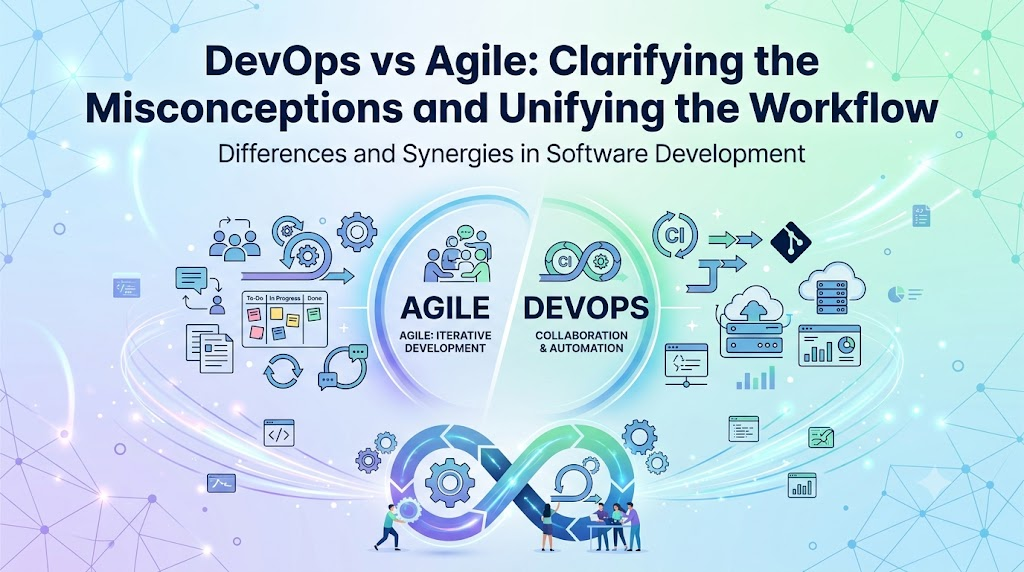
In today’s fast-paced digital economy, software development organizations face the dual challenge of accelerating feature delivery while maintaining absolute system stability. Historically, this tension created friction between fast-moving developers and risk-averse operations teams. Over the past two decades, two revolutionary movements emerged to solve these exact hurdles: Agile, which transforms how teams plan and build software iteratively, and DevOps, which extends collaboration across development, operations, and security through automation and continuous delivery. While people often confuse the two or view them as interchangeable, understanding their true relationship is crucial for modern engineering teams. When combined, Agile methodology and DevOps practices create a seamless workflow that eliminates deployment bottlenecks, accelerates time-to-market, and dramatically improves software quality—a journey made accessible through expert training and comprehensive programs at DevOpsSchool.
What Is Agile?
Definition of Agile
Agile is a mindset, methodology, and iterative approach to software development that emphasizes incremental progress, flexibility, collaboration, and rapid feedback. Rather than delivering an entire software product in one massive release after months of planning, Agile breaks work down into small, consumable chunks called iterations or sprints, typically lasting two to four weeks.
The Agile Manifesto
At the heart of Agile lies the Agile Manifesto, established in 2001 by a group of software practitioners. It prioritizes:
- Individuals and interactions over processes and tools
- Working software over comprehensive documentation
- Customer collaboration over contract negotiation
- Responding to change over following a plan
Core Principles and Practices
Agile frameworks rely heavily on transparency, inspection, and adaptation. Key elements include:
- Iterative Development: Building software in small, working increments so stakeholders can review progress continuously.
- Customer Collaboration: Involving customers, product owners, and end-users throughout the development lifecycle rather than only at the beginning and end.
- Continuous Feedback: Gathering user and stakeholder insights during every sprint to pivot or refine features early.
Popular Agile Frameworks
- Scrum: A structured framework featuring defined roles (Product Owner, Scrum Master, Developers) and time-boxed events like Sprint Planning, Daily Standups, Sprint Reviews, and Retrospectives.
- Kanban: A visual workflow method that focuses on limiting work in progress (WIP), maximizing efficiency, and managing flow using a physical or digital board.
Beginner Example: Imagine a team building a mobile banking app. Instead of spending nine months building every feature before letting customers log in, an Agile team releases a basic login and balance-check screen in sprint one. They collect user feedback immediately, discover users want biometric login, and prioritize that feature for sprint two.
What Is DevOps?
Definition of DevOps
DevOps is a cultural philosophy, set of practices, and automation strategy that unifies software development (Dev) and IT operations (Ops). Its primary objective is to shorten the systems development life cycle while delivering features, fixes, and updates continuously with high security and reliability.
Collaboration and Shared Responsibility
In traditional organizations, developers wrote code and handed it over a metaphorical wall to operations engineers who managed servers and deployment. If things broke, finger-pointing ensued. DevOps dismantles this silo. Developers and operations professionals share accountability for the software from conception through production deployment and monitoring.
Automation, CI/CD, and Monitoring
DevOps relies on technical automation to eliminate manual toil:
- CI/CD Pipelines: Automatically building, testing, and packaging code changes as soon as they are committed to version control.
- Infrastructure as Code (IaC): Managing and provisioning computing infrastructure through code configuration files rather than manual server setup.
- Continuous Monitoring: Tracking application performance, logs, and system health in real-time to detect and resolve anomalies before they impact users.
How DevOps Extends Agile
While Agile optimizes the planning and building phases of software creation, DevOps extends that momentum beyond the developer’s laptop. It takes the working software produced in Agile sprints and automates the path to production, ensuring that rapid development does not collide with operational bottlenecks.
Evolution of Agile and DevOps
To truly appreciate why both methodologies matter, it helps to examine how software delivery evolved over time.
The Traditional Era: Waterfall
For decades, software development followed the Waterfall model. Requirements were gathered exhaustively, followed by months of design, coding, testing, and a final deployment. This linear approach caused massive delays if requirements changed mid-project, and bugs discovered at the end were costly to fix.
The Agile Revolution
In the 2000s, Agile emerged to fix the rigidity of Waterfall. By introducing short feedback loops and iterative delivery, teams could adapt to changing business needs. However, as release frequencies increased from yearly to bi-weekly, operations teams struggled to manually deploy code across staging and production environments.
The Birth of DevOps
Around 2009, the DevOps movement was born to solve the deployment bottleneck. By combining cloud computing, automation scripts, containerization tools like Docker, and cultural shifts, organizations learned how to ship code safely every single day.
| Era | Primary Focus | Deployment Frequency | Main Bottleneck |
| Waterfall | Documentation and rigid planning | Months to years | Late discovery of defects and changing requirements |
| Agile | Iterative development and customer feedback | Weeks to months | Manual release processes and operations handoffs |
| DevOps | Continuous delivery, automation, and stability | Multiple times per day | Cultural resistance and legacy infrastructure |
DevOps vs Agile: Key Differences
While Agile and DevOps share common DNA, they address different parts of the software delivery lifecycle.
| Feature | Agile | DevOps |
| Primary Objective | Manage project workflow and maximize business value through iterative development | Automate and optimize the software delivery pipeline from code commit to production |
| Focus Area | Software development, requirements management, and team collaboration | Infrastructure, deployment automation, CI/CD, and system reliability |
| Team Structure | Cross-functional Scrum or Kanban teams | Shared responsibility between development, operations, and security |
| Delivery Approach | Incremental feature delivery in time-boxed sprints | Continuous delivery and deployment upon passing automated checks |
| Automation | Optional (focuses more on human collaboration and ceremonies) | Mandatory (relies heavily on CI/CD tools, IaC, and automated testing) |
| Customer Feedback | Gathered during sprint reviews and user acceptance testing | Gathered continuously via production monitoring, telemetry, and error tracking |
| Deployment Frequency | End of each sprint or release milestone | Continuous (multiple times daily) |
| Monitoring | Focuses on feature usage and user satisfaction metrics | Focuses on uptime, latency, error rates, and infrastructure health |
| Security | Addressed during design and testing phases | Integrated early across the entire pipeline (DevSecOps) |
| Success Metrics | Sprint velocity, backlog refinement, customer satisfaction | Lead time, deployment frequency, MTTR, change failure rate |
Practical Scenario: How They Differ in Action
Consider an e-commerce platform updating its checkout page. An Agile approach ensures the product owner, UI designers, and developers break the checkout redesign into small user stories, prioritizing guest checkout first in a two-week sprint. A DevOps approach ensures that once the developer writes the guest checkout code, automated testing scripts validate the code, containers package it, and deployment tools push it to production without human intervention.
Similarities Between DevOps and Agile
Despite their structural differences, Agile and DevOps are ideological siblings. They share foundational principles that make them natural partners:
- Collaboration: Both frameworks tear down organizational silos, encouraging open communication between business stakeholders, developers, and testers.
- Continuous Improvement: Neither approach believes in a “done and forgotten” mindset. Both encourage regular retrospectives and telemetry analysis to find ways to work smarter.
- Customer-Centric Approach: Both are designed to deliver maximum value to end-users as quickly and reliably as possible.
- Incremental Development: Breaking massive monolithic tasks into smaller, manageable chunks is central to both philosophies.
- Rapid Feedback Loops: Whether through a sprint review or an automated monitoring alert, both systems rely on fast feedback to guide future actions.
Workplace Scenario: A software team holding a retrospective might discuss a recent production outage. An Agile mindset helps them re-prioritize their backlog to include bug fixes, while a DevOps mindset helps them automate regression testing so that specific bug can never reach production again.
How DevOps and Agile Work Together
Agile and DevOps do not compete; they complement each other across different stages of the software delivery lifecycle.
1. Agile Builds the Product Right
Agile provides the framework for discovering what features to build, managing the product backlog, and ensuring that development aligns with user needs through iterative sprints.
2. DevOps Delivers the Product Fast
DevOps provides the technical mechanisms—CI/CD pipelines, automated testing, containerization, and monitoring—to get those Agile increments safely into production.
3. Continuous Collaboration
Agile squads work closely with operations and security engineers during sprint planning. Operations teams inform developers of infrastructure constraints early, preventing deployment surprises at the end of a sprint.
4. Faster Feedback
Agile provides qualitative feedback from stakeholders during sprint reviews, while DevOps provides quantitative telemetry from production monitoring. Combined, teams gain a 360-degree view of product performance.
5. Shared Responsibility
Developers, testers, Scrum Masters, and operations engineers share a common goal: delivering stable, high-value software smoothly and sustainably.
Practical Example: During sprint planning, an Agile team plans to release a new recommendation engine. Because they practice DevOps, the team writes automated deployment scripts alongside the application code. At the end of the sprint, the CI/CD pipeline deploys the feature automatically, and production monitoring metrics confirm increased user engagement immediately.
Benefits of Combining Agile with DevOps
| Benefit | Business Impact |
| Faster Releases | Accelerates time-to-market by removing manual deployment bottlenecks between sprints |
| Higher Software Quality | Combines user feedback from Agile with rigorous automated testing in DevOps |
| Better Collaboration | Eliminates finger-pointing between development, QA, and operations teams |
| Reduced Deployment Risks | Small, frequent releases lower the blast radius of potential bugs |
| Improved Customer Satisfaction | Rapid feature delivery and high system uptime keep end-users happy |
| Increased Automation | Reduces repetitive manual tasks, allowing engineers to focus on innovation |
| Continuous Innovation | Empowers teams to experiment, measure, and iterate safely |
Common Myths About DevOps and Agile
Myth 1: DevOps Replaces Agile
Reality: DevOps does not replace Agile. Agile manages how software is planned and developed, while DevOps manages how software is built, tested, and deployed. They operate in different layers of the delivery lifecycle.
Myth 2: Agile Requires DevOps
Reality: A team can practice Agile without DevOps by releasing software manually at the end of every sprint. However, without DevOps automation, release cycles remain slow and prone to human error.
Myth 3: DevOps Is Only Automation
Reality: While tools and automation are critical, DevOps is fundamentally a cultural shift focused on collaboration, shared responsibility, and breaking down organizational silos.
Myth 4: Agile Is Only Scrum
Reality: Scrum is just one popular framework within Agile. Other frameworks, such as Kanban, Lean, and Extreme Programming (XP), are equally valid Agile approaches.
Myth 5: DevOps Is Only for Large Organizations
Reality: Startups and small enterprises benefit immensely from DevOps and Agile, as automation allows lean teams to punch above their weight class and scale efficiently.
Challenges When Combining Agile and DevOps
Adopting both methodologies is a rewarding journey, but organizations often encounter common hurdles:
- Cultural Resistance: Employees comfortable with traditional silos may resist cross-functional collaboration.
- Legacy Systems: Monolithic legacy applications make automated CI/CD pipelines difficult to implement.
- Tool Fragmentation: Adopting too many disconnected tools can create operational confusion.
- Limited Automation Skills: Teams may lack the technical expertise required to build robust automated testing and deployment pipelines.
- Communication Gaps: Misalignment between business goals and technical execution can slow down progress.
- Lack of Leadership Support: Transformation fails without executive buy-in and cultural sponsorship.
Practical Solutions
To overcome these challenges, organizations should start small with a pilot project, invest in continuous training, foster a blameless post-mortem culture, and modernize legacy architectures incrementally through microservices or modular refactoring.
Best Practices for Successful Agile and DevOps Adoption
Build Cross-Functional Teams
Ensure that every team includes developers, QA engineers, operations specialists, and security experts working toward shared objectives.
Automate CI/CD
Invest in robust automated testing and deployment pipelines to eliminate manual handoffs and human error.
Encourage Continuous Learning
Provide ongoing training and mentorship opportunities for team members to upskill in modern tools and agile frameworks.
Strengthen Communication
Implement daily standups, retrospectives, and transparent ticketing systems to keep all stakeholders aligned.
Monitor Performance Metrics
Track both Agile metrics (velocity, lead time) and DevOps metrics (deployment frequency, MTTR) to measure progress objectively.
Promote Shared Ownership
Hold the entire team accountable for both feature delivery and production stability.
Integrate Security Early (DevSecOps)
Incorporate security scanning and compliance checks into the earliest stages of the development pipeline.
Agile and DevOps Tools
| Category | Purpose | Example Tools |
| Project Management | Track backlog, sprint planning, and task workflows | Jira, Trello, Asana |
| Version Control | Manage source code history and collaboration | Git, GitHub, GitLab |
| CI/CD | Automate build, test, and deployment pipelines | Jenkins, GitLab CI, GitHub Actions |
| Testing | Validate code quality and catch bugs early | Selenium, JUnit, SonarQube |
| Monitoring | Track system performance, logs, and uptime | Prometheus, Grafana, Datadog |
| Collaboration | Facilitate team communication and documentation | Slack, Confluence, Microsoft Teams |
| Containerization | Package applications for consistent execution | Docker, Kubernetes |
| Infrastructure as Code | Provision and manage cloud infrastructure programmatically | Terraform, Ansible, AWS CloudFormation |
Real-World Example: Agile and DevOps in Action
Imagine a thriving online retail company preparing for a major holiday flash sale.
- Sprint Planning: During an Agile sprint planning meeting, the product owner and development team outline user stories for a new real-time inventory counter.
- Development: Developers write code in small increments, committing changes to a shared Git repository multiple times a day.
- Automated Testing: Each code commit triggers an automated CI pipeline that runs unit tests, integration tests, and security scans.
- CI/CD Validation: Once tests pass successfully, the code is packaged into a Docker container and automatically deployed to a staging environment.
- Infrastructure Deployment: Infrastructure as Code (IaC) tools provision additional cloud servers automatically to handle expected traffic spikes.
- Production & Monitoring: The feature is released to production via a canary deployment. Real-time monitoring tools track latency and error rates.
- Feedback Loop: Customer engagement data and error telemetry feed back into the product backlog, guiding the team’s priorities for the next sprint.
Measuring Success
To ensure your Agile and DevOps transformation is delivering tangible results, track these key metrics:
| Metric | Why It Matters |
| Sprint Velocity | Measures the amount of work an Agile team successfully completes during a sprint |
| Deployment Frequency | Measures how often new code is successfully deployed to production |
| Lead Time for Changes | Measures the time it takes for a code commit to reach production |
| Change Failure Rate | Measures the percentage of deployments that cause a production failure |
| Mean Time to Recovery (MTTR) | Measures how quickly a team recovers from a production incident |
| Customer Satisfaction (CSAT) | Measures how well the delivered software meets end-user expectations |
| Defect Escape Rate | Tracks bugs discovered by users in production versus those caught during testing |
Continuous improvement requires regular review of these metrics during sprint retrospectives and executive operational reviews.
How DevOpsSchool Helps Professionals Learn Agile and DevOps
Mastering Agile methodologies and DevOps practices requires a blend of theoretical understanding and hands-on technical execution. Organizations and individuals looking to accelerate their career growth or transform their engineering teams often seek structured, expert-led guidance.
Programs provided by DevOpsSchool offer comprehensive learning pathways covering:
- Industry-Focused Training: Curriculum designed by seasoned enterprise architects and Agile coaches with decades of real-world experience.
- Hands-On Projects: Practical labs focusing on building real-world CI/CD pipelines, container orchestration, and cloud infrastructure.
- CI/CD Implementation: Step-by-step guidance on automating software delivery workflows from code commit to production.
- Cloud-Native Technologies: Deep dives into modern tools like Docker, Kubernetes, Terraform, and GitOps.
- Agile and DevOps Best Practices: Practical strategies for fostering cross-functional collaboration, cultural transformation, and continuous improvement.
- Career-Focused Mentoring: Guidance to help developers, system administrators, and project managers transition smoothly into high-demand DevOps and Agile roles.
Future of Agile and DevOps
As software engineering continues to evolve, several key trends are shaping the future of Agile and DevOps:
- AI-Assisted Software Delivery: Artificial intelligence and machine learning are automating code generation, predictive testing, and intelligent incident remediation.
- Platform Engineering: Internal developer platforms (IDPs) are emerging to reduce cognitive load on developers by providing self-service deployment infrastructure.
- DevSecOps Integration: Security is shifting even further left, becoming an automated, native component of every Agile user story and CI/CD pipeline.
- GitOps: Using Git repositories as the single source of truth for declarative infrastructure and application deployments.
- Cloud-Native Development: Deeper adoption of serverless architectures, microservices, and ephemeral environments.
- Value Stream Management (VSM): Analyzing and optimizing the entire software delivery lifecycle from business idea to customer value delivery.
- Continuous Experimentation: Combining feature flags and telemetry to test product hypotheses directly with live users.
FAQs
What is the difference between Agile and DevOps?
Agile is an iterative software development methodology focused on project planning, team collaboration, and delivering value in small increments. DevOps is a cultural and technical practice focused on automating the software delivery pipeline, infrastructure management, and operations to release code continuously and reliably.
Can Agile exist without DevOps?
Yes. An Agile team can plan sprints, build features iteratively, and release software manually at the end of each sprint. However, without DevOps automation, release cycles remain slow and manual.
Does DevOps replace Agile?
No. DevOps does not replace Agile. They complement each other. Agile handles the planning and development side of software engineering, while DevOps handles the build, test, release, and operational side.
Why do organizations use both Agile and DevOps?
Using both allows organizations to discover the right features to build quickly (Agile) while deploying those features to production safely and automatically (DevOps), resulting in faster time-to-market and higher software quality.
How does CI/CD support Agile development?
CI/CD automates the testing and deployment of code written during Agile sprints, ensuring that working software can be shipped to production at a moment’s notice without manual bottlenecks.
Which comes first: Agile or DevOps?
Many organizations adopt Agile first to fix team collaboration and planning bottlenecks, followed by DevOps to automate the technical delivery pipeline. However, adopting them simultaneously or iteratively yields the best results.
Is Scrum part of DevOps?
No. Scrum is an Agile project management framework, whereas DevOps is a delivery and operational culture. However, Scrum teams often collaborate closely with DevOps engineers during sprint planning.
How can beginners learn Agile and DevOps together?
Beginners can start by learning core Agile concepts like Scrum and Kanban, mastering version control with Git, learning CI/CD fundamentals, and taking structured, hands-on training programs offered by expert platforms like DevOpsSchool.
What are the core pillars of DevOps?
The core pillars of DevOps are Culture, Automation, Lean, Measurement, and Sharing (often remembered by the acronym CAMS).
What metrics matter most in DevOps and Agile?
Key metrics include deployment frequency, lead time for changes, mean time to recovery (MTTR), change failure rate, and sprint velocity.
How does DevSecOps fit into Agile and DevOps?
DevSecOps integrates security practices into every phase of the Agile and DevOps lifecycle, ensuring that security checks happen continuously rather than as a final bottleneck.
What is Infrastructure as Code (IaC)?
IaC is the practice of managing and provisioning computing infrastructure through machine-readable configuration files rather than manual physical hardware setup.
How do retrospectives help in Agile and DevOps?
Retrospectives allow teams to reflect on what went well, what went wrong, and how to improve their processes, fostering continuous learning.
Why is cultural change harder than tool adoption?
Tools can be installed overnight, but changing human habits, breaking down departmental silos, and fostering psychological safety takes time and leadership commitment.
How do feature flags enhance continuous delivery?
Feature flags allow developers to deploy new features to production safely while keeping them hidden from end-users until they are ready to be enabled.
Final Thoughts
The journey toward modern software excellence requires more than just adopting the newest tools or following rigid frameworks. It requires a fundamental commitment to collaboration, continuous learning, and customer focus. Agile methodology provides the structure to build the right product through iterative feedback and adaptive planning, while DevOps practices provide the technical muscle to deliver that product safely and rapidly through automation and continuous integration.
By combining Agile and DevOps, organizations bridge the historic gap between development and operations. Teams gain the agility to respond to changing market demands and the operational stability to run mission-critical systems with confidence. Success does not happen overnight, but by fostering a culture of shared responsibility and investing in continuous improvement, engineering teams can build a resilient foundation for sustainable, high-quality software delivery.