




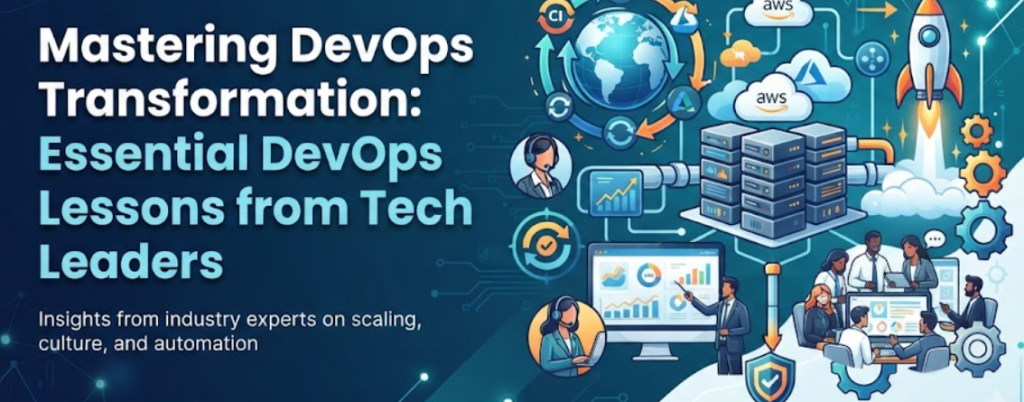
Successful engineering organizations rarely achieve high performance simply by adopting new tools. When an enterprise introduces modern containerization, continuous integration pipelines, and cloud platforms yet continues to struggle with slow releases, siloed teams, frequent production incidents, and security blind spots, the root cause usually points to a leadership gap.
Technology leadership dictates how software is built, shipped, secured, and operated. Effective DevOps leadership goes beyond purchasing software licenses or mandating tool usage; it shapes organizational culture, establishes psychological safety, removes administrative friction, and aligns engineering outcomes with business value.
What Can Tech Leaders Teach Us About DevOps?
DevOps is fundamentally an operational philosophy and cultural movement rather than a simple technical toolset. Seasoned engineering leaders understand that sustainable agility requires bridging the gap between development and operations through intentional design. They demonstrate that technical decision-making must be coupled with rigorous risk management, cross-functional collaboration, and a deep commitment to customer satisfaction.
Lesson 1 — Culture Comes Before Tools
Organizations often fall into the trap of assuming that purchasing enterprise DevOps tooling automatically creates a DevOps culture. Real collaboration, shared ownership, trust, and transparency cannot be installed via software packages.
Leaders foster cultural change by encouraging cross-functional teams to own services from inception through production retirement. When developers share on-call responsibilities with operations engineers, mutual empathy grows, eliminating the traditional “throw it over the wall” mentality.
Lesson 2 — Automate Repetitive Work
Effective leaders identify repetitive engineering tasks and champion automation to reduce toil. Automation should solve meaningful operational problems rather than exist merely for its own sake. Key areas for targeted automation include:
- Continuous integration and continuous delivery (CI/CD) pipelines
- Automated unit, integration, and security testing
- Infrastructure provisioning via code
- Configuration management and drift detection
- Telemetry gathering and operational alerting workflows
Lesson 3 — Make Software Delivery Faster and Safer
Speed without safety results in catastrophic production failures, while safety without speed leads to market irrelevance. Technology leaders balance speed, quality, reliability, and security by implementing smaller batch sizes, automated quality gates, robust continuous delivery mechanisms, and automated rollbacks that mitigate human error during deployments.
Lesson 4 — Break Down Organizational Silos
Traditional hierarchical structures frequently create friction between development, quality assurance, security, infrastructure, and product teams. DevOps-oriented leaders dismantle these barriers by establishing shared metrics, cross-functional squads, and open communication channels. When teams share the same objectives, internal friction drops and time-to-market accelerates.
Lesson 5 — Build a Culture of Continuous Improvement
High-performing engineering organizations regularly examine what worked, what failed, where bottlenecks exist, and how engineers experienced the development lifecycle. Leaders institutionalize this through structured retrospectives, post-incident reviews, and rapid feedback loops. The emphasis remains firmly on continuous process improvement rather than assigning personal blame.
Lesson 6 — Measure Outcomes, Not Just Activity
A common leadership misstep is measuring DevOps success by tracking superficial activity, such as the number of commits, deployment scripts, or Jira tickets closed. Mature leaders track meaningful flow and stability metrics that reflect real engineering health:
- Deployment Frequency: How often code successfully reaches production.
- Lead Time for Changes: The duration required for a commit to run in production.
- Change Failure Rate: The percentage of deployments causing a failure in production.
- Mean Time to Recovery (MTTR): How quickly an organization recovers from an outage.
Lesson 7 — Treat Reliability as a Product Feature
Reliability is not an afterthought handled exclusively by operations teams; it is a core feature of software quality. Leaders influence reliability investment by prioritizing system availability, architectural resilience, performance tuning, and disciplined incident management alongside functional feature development.
Lesson 8 — Learn from Failure
Production outages and system degradation provide invaluable engineering lessons. Blameless postmortems shift the organizational focus away from finding someone to blame and toward discovering why the system allowed the failure to occur in the first place. Root-cause analysis leads to preventive architectural safeguards.
Lesson 9 — Security Should Be Part of DevOps
Treating security as a final-stage approval gate before release introduces severe delivery bottlenecks and expensive rework. Modern technology leaders integrate security throughout the software delivery lifecycle (often referred to as DevSecOps), embedding automated dependency scanning, secure coding practices, secrets management, and compliance checks directly into CI/CD pipelines.
Lesson 10 — Give Developers Better Engineering Platforms
Developer experience directly influences engineering velocity and staff retention. Platform engineering teams build internal developer platforms that provide self-service environments, standardized pipelines, reusable infrastructure templates, and comprehensive documentation, significantly reducing unnecessary cognitive load for product developers.
Lesson 11 — Standardize Where It Helps, Allow Flexibility Where It Matters
Balancing standardization with engineering autonomy is a delicate leadership task. While common deployment practices, security standards, and golden paths prevent chaos, excessive administrative standardization can stifle innovation. Leaders establish guardrails that guide teams toward secure, reliable patterns while preserving room for creative problem-solving.
Lesson 12 — Make Observability a Leadership Priority
Comprehensive observability goes beyond collecting server logs; it provides deep insight into system behavior through integrated logs, metrics, and distributed traces. Leaders support observability initiatives so teams can understand real-time service health, identify anomalous behavior early, and evaluate direct user impact during incidents.
Lesson 13 — Design for Failure
Resilience-oriented engineering assumes that hardware will fail, networks will partition, and third-party dependencies will experience outages. Resilient systems incorporate redundancy, fault tolerance, graceful degradation, and rigorous failure injection testing to ensure applications remain stable under duress.
Lesson 14 — Encourage Small and Reversible Changes
Deploying massive monolithic updates once a quarter carries immense operational risk. Leaders encourage breaking work into smaller pull requests combined with feature flags, canary releases, and blue-green deployments. Progressive delivery allows teams to validate code changes against a small subset of traffic before full rollout.
Lesson 15 — Customer Experience Should Guide DevOps Decisions
Technical metrics must ultimately support customer value and business objectives. Technology leaders ensure that engineering improvements directly correlate with application availability, lower defect rates, faster response times, and an overall superior end-user experience.
Lessons from Different Types of Tech Leaders
| Leadership Role | Primary Focus Area | Key Strategic Contribution |
| Engineering Leaders | Code quality & team growth | Balancing feature delivery with technical debt reduction. |
| CTOs | Architecture & alignment | Connecting technical capabilities to long-term business goals. |
| SRE Leaders | Reliability & automation | Establishing error budgets, SLOs, and blameless learning loops. |
| Platform Leaders | Developer productivity | Building internal self-service platforms and golden paths. |
Practical DevOps Lessons for Engineering Managers
- Set Clear Priorities: Protect engineering teams from constant context-switching by defining clear strategic objectives.
- Remove Organizational Blockers: Actively clear cross-departmental hurdles to keep engineering flows moving.
- Create Psychological Safety: Encourage transparent reporting of errors and near-misses without fear of retribution.
- Invest in Technical Debt: Allocate dedicated sprint capacity for refactoring and platform modernization.
Practical DevOps Lessons for Engineers
- Learn Core Automation: Master infrastructure scripting and pipeline configuration alongside application code.
- Understand Distributed Systems: Build working knowledge of cloud networking, container orchestration, and storage concepts.
- Master Troubleshooting: Cultivate systematic debugging skills using modern monitoring and tracing tools.
- Communicate Clearly: Recognize that technical excellence must be paired with crisp written and verbal communication.
DevOps Leadership vs. Traditional IT Management
| Area | Traditional Approach | DevOps-Oriented Leadership |
| Team Structure | Functional silos (Dev, QA, Ops) | Cross-functional, product-aligned teams |
| Ownership | Departmental handoffs | End-to-end shared accountability |
| Releases | Infrequent, high-risk big bangs | Frequent, automated, small batches |
| Automation | Ad-hoc or manual execution | First-class engineering requirement |
| Testing | Late-stage QA phase | Shift-left, continuous automated testing |
| Security | Gated compliance review at the end | Embedded DevSecOps across lifecycle |
| Incident Response | Finger-pointing and blame | Blameless postmortems and learning |
How Leaders Can Start a DevOps Transformation
- Understand the Current State: Map out the exact value stream from code commit to production deployment.
- Identify Major Bottlenecks: Pinpoint where manual approvals, testing delays, or infrastructure wait times slow delivery.
- Define Goals: Align engineering improvements with measurable business and reliability targets.
- Improve Collaboration: Form cross-functional pods sharing common operational goals.
- Automate High-Value Processes: Target manual deployment steps and repetitive configuration tasks first.
- Introduce CI/CD: Establish reliable build and automated testing pipelines.
- Integrate Security: Shift security scans left into early development stages.
- Strengthen Observability: Implement unified logging, metrics, and tracing.
- Measure Outcomes: Track flow and stability metrics to guide continuous improvement.
Common Leadership Mistakes in DevOps
- Treating DevOps as a Tool Purchase: Buying software licenses without changing team structures or workflows.
- Measuring Teams Solely by Commit Count: Incentivizing quantity over quality and stability.
- Ignoring Developer Experience: Overloading engineers with bureaucratic processes and cumbersome tooling.
- Automating Broken Processes: Codifying inefficient manual steps instead of redesigning the workflow first.
How to Build a High-Performing DevOps Culture
Building a high-performing culture requires leaders to model the behaviors they wish to see. Trust, transparency, psychological safety, and continuous learning are reinforced when leaders openly discuss their own operational mistakes, reward collaborative problem-solving, and invest heavily in internal knowledge sharing.
How Tech Leaders Balance Speed, Risk, and Quality
Effective decision-making requires evaluating trade-offs across speed, security, reliability, cost, and customer experience. Leaders avoid optimizing exclusively for release velocity, instead establishing clear service level objectives (SLOs) that dictate when to slow down delivery to address technical debt or security vulnerabilities.
Role of Data in DevOps Leadership
Data-driven leadership relies on gathering metrics across delivery performance, cloud costs, security vulnerabilities, and incident trends. Mature leaders use this telemetry as conversational context for coaching and architectural refinement rather than weaponizing numbers for individual punishment.
Practical Example: A DevOps Transformation Led by Engineering Leadership
An enterprise financial software team struggled with manual releases that took two days, frequent production outages, and deep friction between development and infrastructure groups.
The engineering leadership team initiated a targeted transformation by forming cross-functional squads, introducing automated CI/CD pipelines, defining infrastructure as code scripts, and instituting blameless post-incident reviews. Within six months, lead time dropped from days to minutes, deployment frequency increased significantly, and production stability improved dramatically because teams caught issues earlier through automated testing and unified observability.
Role of DevOpsSchool
Navigating modern technical and cultural shifts requires structured guidance and practical skill development. Professionals seeking to deepen their expertise in continuous integration, containerization, cloud infrastructure, site reliability engineering, and security practices can explore structured programs offered by DevOpsSchool. Comprehensive learning paths help engineering teams master foundational principles and advanced operational strategies.
Future Lessons for DevOps Leaders
As the technology landscape evolves, leaders must prepare for emerging paradigms such as platform engineering, AI-assisted software development, advanced cloud-native architectures, and robust software supply-chain security. The core leadership challenge will remain unchanged: harnessing new technology while keeping human collaboration, reliability, and security at the center of engineering strategy.
Frequently Asked Questions
What can tech leaders teach us about DevOps?
Tech leaders demonstrate that DevOps succeeds through cultural alignment, cross-functional collaboration, and strategic automation rather than simple tool adoption.
Why is leadership important in DevOps transformation?
Leaders remove organizational blockers, establish psychological safety, align technical goals with business value, and guide sustainable cultural shifts.
What is the most important DevOps leadership lesson?
Culture and collaboration must precede tool implementation; tools amplify existing organizational behaviors.
How can leaders build a DevOps culture?
By encouraging shared ownership, transparency, blameless post-incident reviews, and continuous learning across cross-functional teams.
How should DevOps leaders measure success?
By tracking stability and flow outcomes like deployment frequency, lead time, change failure rate, and mean time to recovery rather than superficial activity.
How can leaders balance speed and reliability?
By establishing clear error budgets, automated quality gates, progressive delivery methods, and a disciplined approach to technical debt.
Final Thoughts
DevOps is fundamentally more than technology. Leadership shapes engineering culture, automation should solve meaningful problems, collaboration is essential, and reliability and security must be built directly into the delivery pipeline.
The strongest DevOps lesson from effective technology leadership is that sustainable transformation comes from combining the right technology with the right culture, processes, leadership decisions, and continuous learning.