




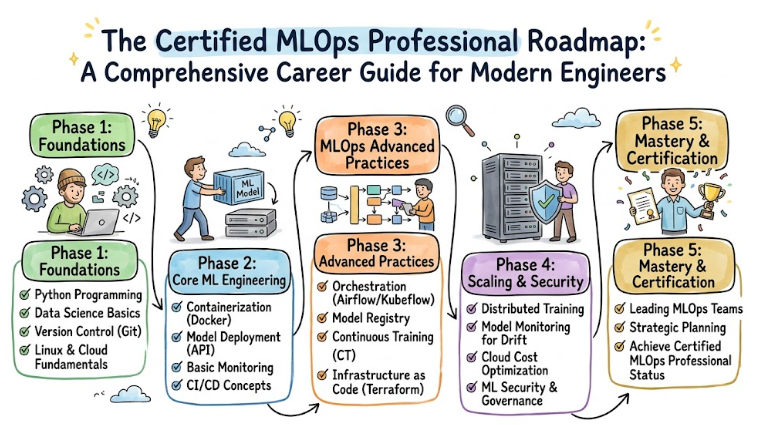
Introduction
The modern engineering landscape is shifting rapidly toward automated intelligence. The Certified MLOps Professional designation has emerged as a critical benchmark for engineers who need to bridge the gap between experimental data science and robust, production-ready machine learning systems. This guide is designed for professionals navigating the complexities of DevOps, cloud-native architecture, and platform engineering who want to master the lifecycle of machine learning.
Whether you are an SRE looking to manage model drift or a software engineer tasked with building scalable AI pipelines, understanding this certification path is vital. At AIOps School, the focus is on moving beyond theoretical models and into the realm of high-availability, automated deployment. This comprehensive guide will help you evaluate how this certification fits into your career trajectory and provide a clear roadmap for your professional development.
What is the Certified MLOps Professional?
The Certified MLOps Professional represents a rigorous validation of an engineer’s ability to operationalize machine learning. It exists because the industry has realized that while building a model is a data science task, maintaining that model in production is an engineering challenge. This certification focuses on the intersection of data engineering, machine learning, and DevOps practices.
Unlike academic courses that focus on mathematics and algorithm design, this program emphasizes real-world, production-focused learning. It aligns with modern engineering workflows by treating machine learning models as software artifacts. This means applying version control, automated testing, and continuous integration to the entire machine learning pipeline, ensuring that enterprises can rely on their AI investments.
Who Should Pursue Certified MLOps Professional?
This certification is specifically designed for technical professionals who sit at the crossroads of development and operations. Systems engineers, SREs, and cloud architects will find it invaluable as they are increasingly asked to support AI workloads. Security professionals will benefit by learning how to secure the machine learning supply chain, while data engineers can use it to streamline their data delivery pipelines.
For beginners, it provides a structured entry point into a specialized and high-paying field. Experienced DevOps engineers can use it to pivot into the high-growth AI sector. Furthermore, engineering managers and technical leaders should pursue this knowledge to better understand the resource requirements and operational risks associated with deploying machine learning at an enterprise scale, both in India and globally.
Why Certified MLOps Professional is Valuable Today and Beyond
The demand for MLOps expertise is skyrocketing as companies move past the “pilot” phase of AI and into full-scale production. Organizations are realizing that without operational excellence, AI projects fail to deliver value. This certification ensures longevity in your career because it focuses on the principles of automation and reliability, which remain constant even as specific tools and frameworks evolve.
Enterprise adoption of AI requires a workforce that understands how to manage technical debt in machine learning systems. By earning this certification, professionals demonstrate that they can mitigate risks like model decay and data leakage. The return on time and career investment is significant, as it positions individuals for leadership roles in platform engineering and AI infrastructure management.
Certified MLOps Professional Certification Overview
The program is delivered via the official training portal and hosted on the primary website for the certification provider. It is structured to provide a logical progression from basic operational concepts to complex architectural patterns. The assessment approach is practical, requiring candidates to demonstrate their competence through rigorous testing that reflects actual workplace scenarios.
Ownership of the certification remains with the professional body, ensuring that the curriculum is updated to reflect the latest industry shifts. The structure is designed to be flexible enough for working professionals while maintaining a high standard of technical depth. It bridges the gap between traditional IT operations and the specialized needs of the data science community.
Certified MLOps Professional Certification Tracks & Levels
The certification is divided into three distinct levels: Foundation, Professional, and Advanced. The Foundation level introduces the core vocabulary and concepts of MLOps, making it ideal for those new to the field. The Professional level, which is the core of this guide, focuses on building and maintaining end-to-end pipelines using industry-standard tools.
Advanced levels and specialization tracks allow engineers to dive deeper into specific domains like FinOps for AI or MLOps Security. These tracks align with career progression, allowing an engineer to grow from a contributor to an architect. By following these levels, a professional can systematically build a portfolio of skills that covers every aspect of the machine learning lifecycle.
Complete Certified MLOps Professional Certification Table
| Track | Level | Who it’s for | Prerequisites | Skills Covered | Recommended Order |
| Core MLOps | Foundation | Beginners, Managers | Basic IT knowledge | MLOps Terminology, Principles | 1 |
| Core MLOps | Professional | DevOps, Data Engineers | Linux, Python basics | CI/CD for ML, Monitoring | 2 |
| Core MLOps | Advanced | Senior Architects | Professional Cert | Scaling, Multi-cloud MLOps | 3 |
| Infrastructure | Specialist | SREs, Platform Engineers | Cloud experience | K8s for ML, GPU Orchestration | 2 (Parallel) |
| Governance | Specialist | Security, Compliance | Professional Cert | Model Auditing, Bias Detection | 3 (Parallel) |
Detailed Guide for Each Certified MLOps Professional Certification
Certified MLOps Professional – Foundation
What it is
This certification validates a candidate’s understanding of the fundamental principles of MLOps. It ensures that the learner understands the difference between traditional software and machine learning systems.
Who should take it
It is suitable for project managers, junior developers, and stakeholders who need to communicate effectively with technical AI teams. No deep coding experience is required at this stage.
Skills you’ll gain
- Understanding the MLOps lifecycle phases.
- Knowledge of data versioning concepts.
- Familiarity with model deployment strategies.
- Grasp of collaboration between data scientists and engineers.
Real-world projects you should be able to do
- Define an MLOps roadmap for a small team.
- Identify bottlenecks in a manual machine learning workflow.
Preparation plan
- 7-14 Days: Focus on terminology and the core MLOps manifesto.
- 30 Days: Review case studies of successful MLOps implementations.
- 60 Days: Not required for this level unless combined with Professional.
Common mistakes
- Overcomplicating the technical requirements.
- Ignoring the cultural shifts required for MLOps success.
Best next certification after this
- Same-track option: Certified MLOps Professional (Core).
- Cross-track option: DataOps Foundation.
- Leadership option: AI Strategy for Managers.
Certified MLOps Professional – Professional
What it is
This is the flagship certification that validates the ability to build and manage automated ML pipelines. It proves that an engineer can handle the “Ops” part of Machine Learning in a production environment.
Who should take it
Intermediate DevOps engineers, Data engineers, and SREs who are responsible for the uptime and performance of machine learning applications.
Skills you’ll gain
- Implementing CI/CD pipelines specifically for ML models.
- Automating model training and validation.
- Monitoring model performance and data drift in real-time.
- Containerizing ML workloads using Docker and Kubernetes.
Real-world projects you should be able to do
- Build an automated pipeline that retrains a model when data drift is detected.
- Deploy a model using Canary or Blue-Green deployment patterns.
Preparation plan
- 7-14 Days: Intensive review of toolchains (MLflow, Kubeflow, etc.).
- 30 Days: Hands-on lab work building end-to-end pipelines.
- 60 Days: Full simulation of production failure scenarios and recovery.
Common mistakes
- Focusing too much on the model and not enough on the data pipeline.
- Neglecting the importance of logging and observability.
Best next certification after this
- Same-track option: Advanced MLOps Architect.
- Cross-track option: DevSecOps Professional.
- Leadership option: Principal MLOps Engineer Path.
Certified MLOps Professional – Advanced
What it is
This level validates expertise in designing complex, large-scale AI infrastructures. It covers multi-region deployments, high-availability clusters, and complex governance frameworks.
Who should take it
Senior engineers and architects who are responsible for the entire AI platform of an enterprise. It requires significant hands-on experience in the field.
Skills you’ll gain
- Designing distributed training architectures.
- Managing multi-tenant ML platforms.
- Implementing advanced security and compliance for AI.
- Optimizing cloud costs for massive AI workloads.
Real-world projects you should be able to do
- Architect a global model serving infrastructure with low latency.
- Design a federated learning system for privacy-sensitive data.
Preparation plan
- 7-14 Days: Deep dive into architectural whitepapers and benchmarks.
- 30 Days: Implementation of complex, multi-tool integrations.
- 60 Days: Strategic planning for enterprise-wide MLOps adoption.
Common mistakes
- Underestimating the cost of data egress and storage.
- Designing “ivory tower” architectures that are too difficult for teams to use.
Best next certification after this
- Same-track option: MLOps Research Fellow.
- Cross-track option: FinOps Certified Practitioner.
- Leadership option: Chief Data Officer (CDO) Track.
Choose Your Learning Path
DevOps Path
Engineers following this path focus on extending their existing CI/CD knowledge to machine learning. They learn how to treat models as code and manage the unique versioning requirements of ML. The goal is to make model releases as boring and predictable as standard software releases. This path bridges the gap between traditional app-dev and the data science laboratory.
DevSecOps Path
This path emphasizes the security of the machine learning pipeline. Candidates learn about adversarial attacks on models, data poisoning, and securing the supply chain of open-source libraries. It is critical for industries like finance and healthcare where data privacy and model integrity are paramount. It ensures that the speed of MLOps does not come at the cost of security.
SRE Path
The SRE path focuses on the reliability and observability of machine learning systems. It involves defining SLIs and SLOs for model performance and building automated systems to handle production outages. Engineers on this path work on making ML systems “self-healing” through automated rollback and retraining triggers. It is the ultimate path for those who care about uptime and performance.
AIOps Path
AIOps focuses on using machine learning to improve IT operations themselves. Professionals on this path learn how to implement ML models that predict system failures, automate root cause analysis, and manage log anomalies. It is a meta-approach where ML is used to manage the very infrastructure that might be running other ML models. This is highly valuable for large-scale enterprise environments.
MLOps Path
The dedicated MLOps path is the most direct route to becoming a specialist. It covers the entire lifecycle from data ingestion to model decommissioning. It focuses on the specific tools like MLflow, DVC, and Kubeflow that define the current state of the art. This path is ideal for those who want to be the primary architect of an organization’s machine learning capabilities.
DataOps Path
DataOps is the foundation upon which successful MLOps is built. This path focuses on the reliability, quality, and speed of data delivery. Without high-quality data, MLOps cannot succeed, so this track teaches engineers how to build automated data pipelines that are versioned and tested. It is essential for ensuring that the “Data” in Data Science is always production-ready.
FinOps Path
As AI workloads consume massive amounts of GPU and cloud resources, FinOps has become essential. This path teaches engineers how to monitor and optimize the costs associated with machine learning. It covers right-sizing clusters, choosing between spot and reserved instances, and attributing AI costs to specific business units. It ensures that the AI initiative remains financially sustainable for the business.
Role → Recommended Certified MLOps Professional Certifications
| Role | Recommended Certifications |
| DevOps Engineer | MLOps Foundation, MLOps Professional |
| SRE | MLOps Professional, SRE Foundation |
| Platform Engineer | MLOps Professional, Kubernetes Specialist |
| Cloud Engineer | MLOps Foundation, Cloud Architect Certs |
| Security Engineer | MLOps Foundation, DevSecOps Specialist |
| Data Engineer | DataOps Professional, MLOps Professional |
| FinOps Practitioner | FinOps Foundation, MLOps Foundation |
| Engineering Manager | MLOps Foundation, AI Strategy |
Next Certifications to Take After Certified MLOps Professional
Same Track Progression
Deep specialization within the MLOps domain involves moving toward architectural or research-based certifications. Once the Professional level is mastered, the next step is typically an Advanced Architect certification. This allows an individual to move from managing a single pipeline to designing the entire platform strategy for a global organization, focusing on high-level orchestration and long-term sustainability.
Cross-Track Expansion
Broadening your skill set is essential in the multidisciplinary world of AI. After MLOps, many professionals choose to pursue DevSecOps or DataOps certifications. Understanding how to secure the pipeline or how to ensure the quality of the incoming data makes you a much more versatile engineer. This cross-pollination of skills is what distinguishes a senior engineer from a specialist.
Leadership & Management Track
For those looking to move into management, transitioning toward leadership certifications is the logical next step. This involves moving away from the technical implementation and toward team building, budget management, and strategic alignment. Understanding MLOps provides the technical credibility needed to lead high-performing engineering teams and make informed decisions about technology investments.
Training & Certification Support Providers for Certified MLOps Professional
DevOpsSchool
DevOpsSchool is a leading provider of technical training that focuses heavily on the practical application of DevOps and MLOps tools. They offer comprehensive bootcamps and certification prep courses that are designed by industry veterans. Their curriculum is known for being hands-on, ensuring that students spend more time in labs than in lectures. They provide excellent support for both individual learners and corporate teams looking to upskill their entire workforce in modern automation practices.
Cotocus
Cotocus specializes in providing high-end technical consulting and training services with a focus on cloud-native technologies. They have a strong reputation for delivering deep-dive sessions on Kubernetes, MLOps, and site reliability engineering. Their approach is very much centered on solving real-world architectural challenges. Cotocus is often the preferred choice for enterprises looking for bespoke training solutions that align with their specific internal technology stacks and operational goals.
Scmgalaxy
Scmgalaxy is a massive community and knowledge hub that has been supporting the DevOps community for over a decade. They offer a wealth of free resources, tutorials, and structured training programs covering the entire software development lifecycle. Their certification support is particularly strong for those looking for community-driven insights and practical troubleshooting tips. They bridge the gap between formal education and the daily realities of being a working engineer in a fast-paced environment.
BestDevOps
BestDevOps focuses on curating the highest quality training materials for modern infrastructure roles. They provide a streamlined learning experience that filters out the noise and focuses on the most relevant tools and practices. Their MLOps training programs are designed to be concise yet thorough, making them ideal for busy professionals who need to gain new skills quickly. They emphasize the “Best Practices” aspect of engineering, ensuring that students learn the right way to build systems.
devsecopsschool.com
This provider is the go-to resource for engineers who want to integrate security into their MLOps and DevOps workflows. They provide specialized training that covers everything from container security to automated compliance. Their curriculum is essential for anyone working in regulated industries. By focusing on the “Sec” part of the equation, they help engineers build systems that are not only fast and reliable but also resilient against modern security threats.
sreschool.com
SRESchool focuses exclusively on the principles of Site Reliability Engineering. Their training programs are essential for MLOps professionals who want to understand how to maintain high availability for AI services. They teach the mathematical and operational aspects of reliability, including error budgets and incident response. Their courses are highly technical and are designed for engineers who are responsible for the production health of complex, distributed machine learning systems.
aiopsschool.com
AIOpsSchool is a specialized platform dedicated to the intersection of Artificial Intelligence and IT Operations. They provide the most direct support for the MLOps certification path, offering tailored courses that cover the full spectrum of AI operationalization. Their trainers are often practicing experts who bring fresh insights from the field. This platform is ideal for those who want to stay at the absolute forefront of how AI is changing the way we manage technology.
dataopsschool.com
DataOpsSchool addresses the critical need for better data management in the age of AI. They provide training on how to build automated, versioned, and high-quality data pipelines. Since data is the fuel for machine learning, their courses are a perfect complement to any MLOps certification. They teach engineers how to treat data as code, applying the same rigor to data engineering that is traditionally applied to software development.
finopsschool.com
FinOpsSchool is dedicated to the growing field of cloud financial management. As machine learning costs can quickly spiral out of control, their training is vital for senior MLOps engineers and managers. They teach how to build a culture of financial accountability in engineering teams. Their courses provide the tools and frameworks needed to monitor, manage, and optimize the costs of running massive machine learning workloads in the cloud.
Frequently Asked Questions (General)
- How difficult is the certification exam?
The exam is moderately difficult and requires a solid understanding of both DevOps principles and machine learning lifecycles. It is designed to test practical knowledge rather than just rote memorization of facts. - What are the prerequisites for the professional level?
You should have a basic understanding of Linux, Python programming, and general cloud concepts. Familiarity with Docker and basic CI/CD concepts is highly recommended before starting. - How long does it take to prepare?
Most working professionals spend between 30 to 60 days preparing, depending on their existing background in DevOps or data science. - Is there a requirement to renew the certification?
Yes, like most professional certifications, it typically requires renewal every two to three years to ensure your skills remain current with evolving technology. - Does the certification focus on a specific cloud provider like AWS or Azure?
No, the certification is designed to be cloud-agnostic, focusing on the principles and tools that can be applied across any major cloud platform or on-premises environment. - What is the typical ROI for this certification?
Professionals often see significant salary increases and access to more senior roles in platform engineering and AI infrastructure. - Can I skip the Foundation level?
If you have significant experience in DevOps or Data Science, you may be able to jump straight to the Professional level, but the Foundation level is recommended for a complete understanding. - Are there hands-on labs included in the training?
Yes, the most effective training providers include extensive hands-on labs where you build and deploy actual machine learning pipelines. - How does this differ from a Data Science certification?
Data science certifications focus on building models and statistics. This certification focuses on the engineering required to run those models in production. - Is the certification recognized globally?
Yes, the principles taught in the program are based on industry standards used by global tech leaders. - What tools will I learn to use?
You will typically work with tools like Git, Docker, Kubernetes, MLflow, Jenkins or GitHub Actions, and various monitoring platforms. - Is this certification suitable for managers?
The Foundation level is excellent for managers, while the Professional level is better suited for those who will be doing hands-on technical work.
FAQs on Certified MLOps Professional
- What exactly is the difference between MLOps and AIOps in this context?
MLOps focuses on the lifecycle of a machine learning model, from data to production. AIOps refers to using machine learning to improve IT operations. - Does this certification cover the mathematical aspects of Machine Learning?
Only at a high level. The focus is on the operational infrastructure, not on designing new mathematical algorithms or deep learning architectures. - How does MLOps handle “Model Drift”?
The certification teaches you how to build automated monitoring systems that detect when a model’s performance drops and trigger a retraining pipeline. - Is Kubernetes a mandatory part of the curriculum?
While not the only way to deploy models, Kubernetes is a core component of the Professional level due to its dominance in container orchestration. - How does MLOps address data privacy?
The curriculum includes practices for data versioning and access control, ensuring that sensitive data is handled securely throughout the ML lifecycle. - Can I use this certification to transition from a traditional SRE role?
Absolutely. It is one of the most common and successful transition paths for SREs looking to specialize in AI systems. - Does the program cover “Feature Stores”?
Yes, understanding how to manage and serve features consistently between training and production is a key part of the Professional track. - Is this certification useful for small startups?
Yes, because it teaches you how to automate processes early, preventing technical debt from crippling the startup as it scales.
Final Thoughts: Is Certified MLOps Professional Worth It?
From the perspective of a mentor who has seen various “hype cycles” in the industry, MLOps is not a passing trend. It is the natural evolution of software engineering in an age where data-driven logic is replacing hard-coded rules. Earning the Certified MLOps Professional credential is a significant commitment, but it is one that pays off by making you a critical asset to any modern organization.
The reality of today’s market is that companies are desperate for engineers who can actually get AI to work reliably in production. If you enjoy the challenge of building complex, automated systems and want to be at the forefront of the AI revolution, this certification is worth your time. It provides a structured path to mastery in a field that can often feel chaotic and overwhelming. Focus on the labs, understand the “why” behind the automation, and you will find yourself in high demand for years to come.