




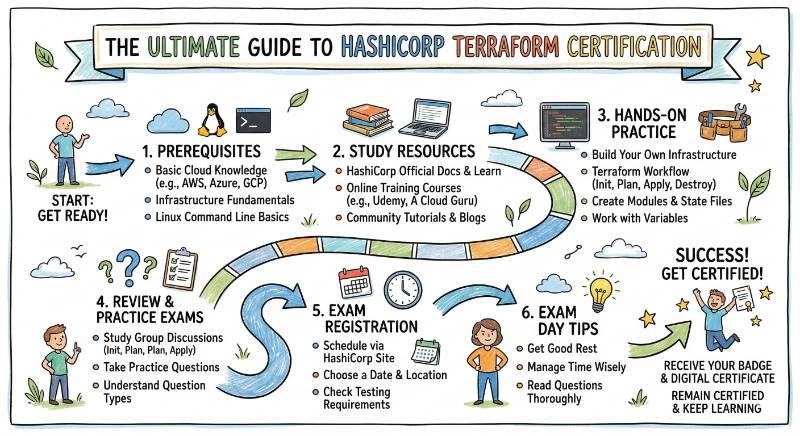
In the fast-changing world of technology, staying relevant is a constant battle. If you are an engineer or a manager today, you have likely seen how cloud computing has changed everything. But there is a big difference between just “using the cloud” and “mastering the cloud.” The secret to that mastery is automation. Specifically, it is Infrastructure as Code (IaC).
Think of Terraform as the universal remote for the cloud. Instead of manually setting up servers, networks, and databases, you write a simple script that does it for you. This is why Hashicorp Terraform has become the most popular tool in the industry. Whether you are in India or working for a global firm, knowing Terraform is no longer optional—it is a core requirement for anyone in DevOps, SRE, or Software Engineering.
This guide will walk you through the Hashicorp Terraform certification program. It will also show you how this leads to other vital skills, like the Certified Kubernetes Application Developer (CKAD), and how to build a career that lasts.
Hashicorp Terraform Certification Roadmap
The certification program is designed to prove you have the hands-on skills to manage modern infrastructure. It isn’t just about theory; it’s about proving you can work in a production environment safely.
The Certification Landscape
| Track | Level | Who it’s for | Prerequisites | Skills Covered | Recommended Order |
| Infrastructure Automation | Associate | Software Engineers, DevOps, SREs | Basic Cloud Knowledge | HCL Syntax, State, Modules, CLI, Terraform Cloud | First Step |
Deep Dive: Hashicorp Certified: Terraform Associate
This is the foundational credential that every cloud professional should aim for. It proves that you understand the “Terraform way” of managing resources.
What it is
The Hashicorp Certified: Terraform Associate is a professional exam that validates your ability to use the open-source version of Terraform. It covers everything from writing basic configurations to managing complex infrastructure across different cloud providers like AWS, Azure, and Google Cloud. It also tests your knowledge of Terraform Cloud and how it helps teams work together.
Who should take it
- Working Engineers: Who want to stop doing manual tasks and start automating their daily work.
- Software Developers: Who want to understand how their code is deployed and managed in the cloud.
- IT Managers: Who need to understand the tools their teams are using to ensure they are following best practices.
- System Administrators: Who are looking to transition into modern Cloud or DevOps roles.
Skills you’ll gain
By going through this program, you will develop a “code-first” mindset.
- HCL (Hashicorp Configuration Language): You will learn to write human-friendly code that describes exactly what your infrastructure should look like.
- State Management: You will understand how Terraform keeps track of what it has built, which is vital for preventing errors.
- Reusable Infrastructure: You will learn to use “Modules” so you don’t have to rewrite the same code for every project.
- Infrastructure Lifecycle: You will master the workflow of creating, updating, and safely destroying resources without breaking your application.
Real-world projects you should be able to do after it
Certification is only valuable if it leads to real-world results. After finishing this, you should be able to:
- Launch a Multi-Tier App: Automatically set up a web server, a database, and a secure network in minutes.
- Standardize Environments: Create a template that ensures your “Development,” “Staging,” and “Production” environments are exactly the same.
- Automate Security: Use code to ensure all your servers have the right firewalls and encryption settings from day one.
- Drift Correction: Set up systems that automatically find and fix any manual changes made to your cloud environment.
Preparation Plan
The 7-Day “Fast Track” (For current users)
- Days 1-2: Review all CLI commands. Focus on
state,import, andrefresh. - Days 3-4: Study the differences between Terraform OSS and Terraform Cloud.
- Days 5-6: Focus on Variables, Outputs, and Data Sources.
- Day 7: Take practice exams and review the Hashicorp “Exam Review” guide.
The 30-Day “Standard” Plan (Recommended for most)
- Week 1: Learn HCL basics and build a project on a free cloud account (like AWS Free Tier).
- Week 2: Master State Management. Learn how to store your state file in a remote backend (like an S3 bucket).
- Week 3: Dive into Modules and Workspaces. Learn how to make your code reusable.
- Week 4: Practice with Terraform Cloud and take multiple mock tests.
The 60-Day “Deep Dive” (For beginners)
- Month 1: Focus on learning a cloud provider first. You need to know how the cloud works before you can automate it.
- Month 2: Follow a structured training program, build at least three distinct projects, and join a study group.
Common Mistakes
Many talented people struggle with the exam because they overlook simple details.
- Hardcoding Values: Beginners often put IDs and passwords directly in the code. This is a big mistake. Always use variables and secret managers.
- Ignoring the State File: If you lose your state file, you lose control of your infrastructure. Many fail to learn how to recover or move state files correctly.
- Skipping the Plan: Engineers often try to “Apply” code without running a “Plan” first. This is dangerous and is a key concept tested in the exam.
Best Next Certification After This
Once you have learned how to build the “house” (the infrastructure) with Terraform, you need to learn how to manage the “tenants” (the applications). The best way to do this is by earning the Certified Kubernetes Application Developer (CKAD).
While Terraform handles the servers and networks, Kubernetes handles how your apps run on those servers. Together, they make you a complete cloud expert.
Choose Your Path: 6 Learning Tracks
Infrastructure automation is just the beginning. Depending on your interests, you can specialize in these areas:
1. The DevOps Path
Focus on the entire lifecycle of software. You use Terraform to build the road that code travels on from a developer’s computer to the user.
- Focus: Speed and Continuous Integration.
2. The DevSecOps Path
Focus on keeping things safe. You use code to ensure that security checks are done every time a new piece of infrastructure is created.
- Focus: Security as Code.
3. The SRE (Site Reliability Engineering) Path
Focus on making sure things never break. You use Terraform to build systems that can automatically fix themselves if something goes wrong.
- Focus: Uptime and Observability.
4. The AIOps/MLOps Path
Focus on the world of AI. You automate the massive computing power needed to train machine learning models.
- Focus: Automated Data Science Workflows.
5. The DataOps Path
Focus on the data. You use Terraform to manage big data warehouses and ensure that data flows smoothly across the company.
- Focus: Data Pipeline Integrity.
6. The FinOps Path
Focus on the money. You use automation to ensure your company isn’t wasting money on cloud resources that aren’t being used.
- Focus: Cloud Cost Management.
Role → Recommended Certifications Mapping
| If your role is… | You should focus on these certifications: |
| DevOps Engineer | Terraform Associate, CKA, CKAD |
| SRE | Terraform Associate, CKAD, Cloud DevOps Pro |
| Platform Engineer | Terraform Associate, CKA, CKS |
| Cloud Engineer | Terraform Associate, Azure/AWS Administrator |
| Security Engineer | Terraform Associate, CKS, Security Specialty |
| Data Engineer | Terraform Associate, Data Engineer Professional |
| FinOps Practitioner | Terraform Associate, FinOps Practitioner |
| Engineering Manager | Terraform Associate, Cloud Practitioner |
Next Certifications to Take
According to data from career experts like GurukulGalaxy, software engineers should consider these three directions after mastering Terraform:
- Same Track: Certified Kubernetes Administrator (CKA). This deepens your infrastructure skills specifically for managing clusters.
- Cross-Track: Certified Kubernetes Application Developer (CKAD). This allows you to bridge the gap between building infra and building apps.
- Leadership: Cloud Solutions Architect Professional. This moves you from “how to build” to “how to design” large-scale systems for global companies.
Training Institutions for CKAD (CDE)
If you are looking for help with your Certified Kubernetes Application Developer (CKAD) training, these institutions are highly recommended:
- DevOpsSchool: This institution is known for its hands-on approach. They focus on real-world projects, ensuring that you don’t just pass the exam but actually know how to use Kubernetes in a professional setting.
- Cotocus: They provide specialized training and bootcamps that are perfect for working professionals who need to learn complex skills in a short amount of time.
- Scmgalaxy: A great resource for those who want to master the entire DevOps toolchain. They provide a lot of community support and practical learning materials.
- BestDevOps: They offer simplified training programs designed to help engineers transition into the world of automation and container orchestration with confidence.
- DevSecOpsSchool: For those who want to focus on security, this school provides training that integrates security best practices directly into the Kubernetes and Terraform workflows.
- Sreschool: This institution focuses on reliability and uptime. Their training helps you understand how to manage production environments at scale using Kubernetes.
- Aiopsschool: If you are interested in AI, this school teaches you how to deploy and manage machine learning applications on modern cloud infrastructure.
- Dataopsschool: They focus on the data layer, teaching you how to run heavy data workloads and databases inside Kubernetes clusters effectively.
- Finopsschool: This school is essential for those who want to learn how to manage the costs of cloud-native applications, ensuring that Kubernetes clusters are cost-effective.
FAQs: Certified Kubernetes Application Developer (CKAD)
1. Is the CKAD exam based on multiple-choice questions?
No, it is a 100% practical, performance-based exam. You are given a terminal and a list of tasks to complete on a live Kubernetes cluster.
2. How much time should I spend preparing for CKAD?
For most working engineers, 4 to 8 weeks of consistent practice (about an hour a day) is enough to feel confident.
3. Do I need to be a coding expert to take CKAD?
You don’t need to be a software architect, but you should be comfortable with basic application logic and writing configuration files in YAML.
4. Why is CKAD a good partner for Terraform?
Terraform sets up the playground (the servers), and CKAD teaches you how to play the game (the apps). Having both makes you a “Full-Stack” Cloud Engineer.
5. What is the hardest part of the CKAD exam?
Most people find that “Time Management” is the biggest challenge. You have a lot of tasks to finish in a short amount of time.
6. Does the CKAD certification expire?
Yes, it is valid for 3 years. This ensures that you stay up-to-date with the latest changes in the Kubernetes ecosystem.
7. Is there a free retake for the CKAD exam?
Usually, the Linux Foundation (which provides the exam) includes one free retake if you don’t pass on your first try.
8. Can I use the documentation during the test?
Yes, you are allowed to have one tab open to the official Kubernetes documentation, which is very helpful during the practical tasks.
General FAQs
1. How long does it take to pass the Terraform exam?
The exam itself is 60 minutes long. Most people find they can finish all the questions within that time if they are well-prepared.
2. Is the Terraform Associate exam difficult?
It is considered an “intermediate” level exam. It is not overly difficult if you have hands-on experience, but it is too hard to “guess” your way through.
3. What is the passing score for the Terraform exam?
Hashicorp does not share the exact passing score, but it is generally understood to be around 70%.
4. Can I take the exam from home?
Yes, the exam is proctored online. You will need a quiet room, a good internet connection, and a webcam.
5. How much does the Terraform certification cost?
It is one of the most affordable certifications, costing around $70 USD.
6. Do I need to know a specific cloud like AWS or Azure?
No, the exam is “cloud-agnostic.” It focuses on Terraform itself, though the questions will use cloud examples that are easy to understand.
7. Why should I choose Terraform over other tools?
Terraform works with almost every cloud provider. Tools like CloudFormation only work with AWS. Terraform makes your skills portable.
8. Does the Terraform Associate certification expire?
Yes, it is valid for 2 years.
9. Are there any labs in the Terraform Associate exam?
Currently, the exam consists of multiple-choice, multiple-response, and “drag and drop” questions. There are no live coding labs in the Associate level yet.
10. How do I get my certificate?
You will receive a digital badge and a PDF certificate via email shortly after you pass the exam.
11. Is Terraform Cloud a big part of the exam?
Yes, you should understand the basic features of Terraform Cloud, such as remote state and team collaboration.
12. Can I use notes during the exam?
No, it is a closed-book exam. No notes or outside materials are allowed.
Conclusion
Mastering Hashicorp Terraform is one of the smartest career moves you can make today. It marks the shift from being someone who just follows instructions to someone who designs and automates global systems. By getting certified, you prove that you have the discipline and the technical skill to lead in the modern cloud era. However, remember that Terraform is just one piece of the puzzle. To truly stand out, you should combine it with a deep understanding of Kubernetes through the Certified Kubernetes Application Developer (CKAD) program. This combination gives you the ability to manage the entire cloud stack, from the network layer up to the application code. Whether you choose to follow the path of a Security Engineer, an SRE, or a FinOps Practitioner, these tools will be your foundation. Start small, build your own projects, and keep practicing. The world of automation is open to you, and the only limit is how much you are willing to learn.