




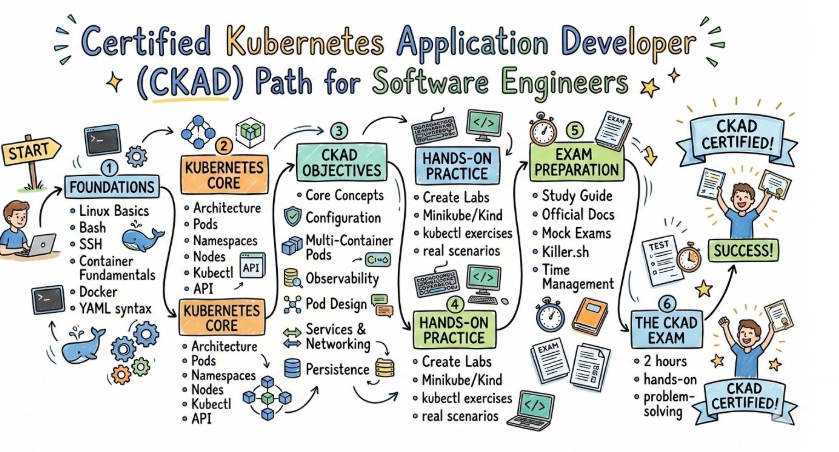
The world of software development has changed. In the past, we wrote code and someone else worried about where it ran. Today, that gap has closed. If you want to build modern software, you have to understand the platform beneath it. Kubernetes has become that platform. It is the engine that runs almost every major application in the world today.
I often speak with engineers and managers who are looking for the best way to prove their skills. My advice is always the same: get the Certified Kubernetes Application Developer (CKAD) credential. This is not a test where you just memorize facts. It is a practical test of what you can actually do. You sit in front of a terminal and solve real problems.
This guide is for engineers and leaders who want to understand why this certification matters and how to pass it. We will look at the career paths it opens and how to prepare effectively.
Global Certification Roadmap: Where You Stand
Before we look at the CKAD, it is helpful to see how it fits into the bigger picture of tech certifications. This table helps you plan your next steps.
| Track | Level | Who it’s for | Prerequisites | Skills Covered | Recommended Order |
| Cloud Basics | Entry | New Learners / Managers | None | Cloud concepts, Container basics | 1 |
| K8s Application | Professional | Software Engineers | Docker Basics | App Design, Pods, Services | 2 |
| K8s Admin | Professional | SREs / Ops Engineers | Linux Skills | Cluster setup, Networking | 3 |
| K8s Security | Specialist | Security Pros | CKA Cert | Hardening, Safe supply chain | 4 |
| Infrastructure | Associate | DevOps Engineers | General Cloud | Terraform, Automation | 5 |
| Management | Foundation | Engineering Leads | Work Experience | DevOps Culture, Metrics | 6 |
The Heart of the Matter: The CKAD Program
The CKAD is the industry standard for anyone who writes code that runs in a container. It focuses on the parts of Kubernetes that a developer needs to know every single day.
What it is
The Certified Kubernetes Application Developer (CKAD) is a performance-based test from the Cloud Native Computing Foundation (CNCF). You get two hours to solve real tasks in a live command-line environment. It proves that you can build, configure, and expose applications on a Kubernetes cluster. It is respected because you cannot fake your way through it; you have to know how to use the tool.
Who should take it
This is for Software Engineers, Application Developers, and DevOps professionals. It is also very helpful for Engineering Managers. When a manager understands how the platform works, they can set better goals for their team and understand the technical challenges their engineers face.
Skills you’ll gain
Preparing for the CKAD changes how you think about your code. You stop worrying about servers and start thinking about distributed systems.
- Design and Build: You will learn to create Pods and use patterns like sidecars to add features to your apps without changing the main code.
- Deployment Management: You will learn how to update your software without any downtime and how to use Helm to manage your installs.
- System Health: You will gain the skills to set up health checks so Kubernetes can fix your app automatically if it stops working.
- Configuration: You will learn to keep settings and passwords safe by using ConfigMaps and Secrets.
- Networking: You will learn how to let different parts of your app talk to each other safely.
Real-world projects you should be able to do after it
After you finish your training and pass the exam, you will be able to handle major tasks in a professional environment.
- Building Self-Healing Systems: You can set up apps that automatically restart if they crash, keeping your service online.
- Safe Configuration: You will know how to manage passwords and API keys without ever putting them in your source code.
- Smooth Updates: You will be able to push new versions of your code while users are still active, with no interruptions.
- Securing Traffic: You can write rules that control exactly which parts of your system are allowed to talk to each other.
- Managing Resources: You will be able to tell Kubernetes exactly how much memory and CPU your app needs so the whole system stays stable.
Preparation plan (7–14 days / 30 days / 60 days)
The time you need to study depends on how much you already know about Kubernetes.
The 14-Day Sprint (For Regular Users)
If you use Kubernetes every day at work, you just need to focus on the exam format.
- Week 1: Go through the syllabus and find any topics you don’t use often, like Network Policies.
- Week 2: Practice using only the command line. Take mock exams to get used to the two-hour time limit.
The 30-Day Plan (For Software Engineers)
This is the best path if you know containers (Docker) but are new to Kubernetes.
- Days 1-10: Learn the basics like Pods, Deployments, and Services.
- Days 11-20: Focus on advanced topics like Ingress, Storage, and Security.
- Days 21-30: Take mock exams every day. Focus on speed and accuracy.
The 60-Day Foundation (For Beginners)
If you are new to the world of containers, take your time to build a solid base.
- Month 1: Focus on Linux commands and Docker. You must understand how a container works before you can manage it with Kubernetes.
- Month 2: Follow the 30-day plan above. Spend a lot of time on hands-on labs for every new thing you learn.
Common mistakes
Many people fail because they don’t manage their time well, not because they don’t know the technology.
- Writing YAML from scratch: This takes way too long. Use commands to generate the files for you.
- Getting stuck on one task: If a question is too hard, skip it and move on. You need a 66% to pass, not a perfect score.
- Working in the wrong place: Always make sure you are on the right cluster and in the right namespace.
- Typos: One wrong space in a configuration file can cause a failure. Always check your work before you move to the next task.
Choose Your Path: 6 Career Directions
Kubernetes is the foundation for almost every modern role in tech. Once you have your CKAD, you can specialize in one of these six areas.
1. DevOps
Focus on making software delivery smooth. You will build automated systems that take code from a developer’s laptop all the way to production safely and quickly.
2. DevSecOps
Focus on security. You will learn how to protect the code and the infrastructure at every step, making sure that speed does not lead to safety risks.
3. SRE (Site Reliability Engineering)
Focus on keeping the lights on. You will use software to manage systems, making sure they are always available and performing well for users.
4. AIOps/MLOps
Focus on the future. You will learn how to run and scale AI and machine learning models on Kubernetes clusters.
5. DataOps
Focus on data. You will work on automating the systems that move and process data, ensuring that teams always have the information they need.
6. FinOps
Focus on the business. You will learn how to manage cloud costs, making sure the company gets the most value from the money it spends on technology.
Role → Recommended Certifications
Here is a simple guide to which certifications fit different job roles.
| Your Role | Core Certification | Recommended Next Step |
| Software Engineer | CKAD | Cloud Associate |
| DevOps Engineer | CKA | Terraform Associate |
| SRE | CKA | CKAD |
| Platform Engineer | CKA | CKS |
| Security Engineer | CKS | DevSecOps Foundation |
| Data Engineer | DataOps Foundation | CKAD |
| FinOps Pro | FinOps Certified | Cloud Basics |
| Engineering Manager | Cloud Basics | CKAD |
What to take next?
Once you have your CKAD, you have three great options to keep growing.
- Deepen Your Skills: Take the CKA (Administrator) exam to learn how to manage the clusters where your apps live.
- Broaden Your Skills: Learn Terraform. This helps you manage the servers and networks that Kubernetes runs on.
- Lead Your Team: Look into the DevOps Foundation. This focuses on the culture and people side of modern engineering.
Top Training Institutions for CKAD Success
If you want help to pass your exam and learn the skills properly, these organizations are excellent choices.
- DevOpsSchool: This school provides deep, hands-on training led by experts. They focus on real skills that you can use at work immediately. They are highly recommended for those who want a practical learning experience.
- Scmgalaxy: A long-standing provider that focuses on how to manage code and software. Their training is very practical and covers the entire lifecycle of development.
- Cotocus: They offer specialized technical training for corporate teams. They are a great choice if you want your whole engineering department to reach a high standard together.
- BestDevOps: They focus on result-oriented training. Their courses are designed to help you build the speed and accuracy you need for the CKAD exam.
- devsecopsschool: This institution focuses on combining security with development. It is a perfect choice for those who want to build secure apps from the start.
- sreschool: Their training is built around the principles of reliability. You will learn how to ensure your applications are always stable and easy to monitor.
- aiopsschool: Ideal if you want to work with AI. They teach you how to handle the specific challenges of running machine learning on a cluster.
- dataopsschool: They focus on the data side of engineering. You will learn how to manage large-scale data systems and pipelines.
- finopsschool: This is a unique resource for learning the financial side of the cloud. It helps engineers and managers understand how to save money on cloud resources.
Career Strategic FAQs: Questions for Leaders
1. How hard is the CKAD exam?
It is a challenging exam because it is not multiple-choice. You must show that you can actually solve problems in a real environment.
2. How much time should my team spend studying?
A typical software engineer should plan for about 30 days of study. This includes learning the concepts and practicing with the command line.
3. Are there prerequisites for the exam?
No formal ones, but your team should know Linux and have a basic understanding of containers before they start.
4. Is CKAD or CKA better for my developers?
CKAD is better for developers. CKA is better for the people who manage the infrastructure. Most senior teams benefit from having both.
5. Is this certification recognized globally?
Yes. It is the industry standard for Kubernetes skills and is respected by major tech companies all over the world.
6. Can mock exams replace real training?
No. Mock exams help with speed, but real training ensures your team understands the “why” behind what they are doing.
7. Is the certification tied to one cloud provider?
No, it is vendor-neutral. The skills will work on AWS, Azure, Google Cloud, or your own local servers.
8. How long does the certification last?
It is valid for two years. This helps ensure that engineers stay up to date with the fast changes in technology.
9. What happens if an engineer fails?
The exam fee includes one free retake. This is a great way to learn what the exam is like without too much pressure on the first try.
10. How does this benefit an Engineering Manager?
It gives you the technical depth to lead your team effectively. You will understand what is possible and how to set realistic goals for cloud projects.
11. Can documentation be used during the test?
Yes, candidates can look at the official Kubernetes documentation. This makes the exam more like a real workday where you look things up when needed.
12. Should we focus on YAML or commands?
Focus on commands for the exam because they are much faster. In the real world, you will use YAML, but speed is key during the test.
Practical FAQs: Questions About the CKAD Exam
1. Where do I find the official registration info?
The official site is here: CKAD Official URL. The training is provided by DevOpsSchool.
2. How long is the exam?
The exam lasts for two hours and is done entirely in a browser-based terminal.
3. What score do I need to pass?
You need a score of 66% to earn your certification.
4. Can I take the exam from home?
Yes, it is a remote-proctored exam. You just need a quiet room, a webcam, and a stable internet connection.
5. When do I get the results?
Results are typically emailed to you within 24 to 48 hours after you finish the exam.
6. Do I need to know how to set up a cluster?
No, the CKAD assumes the cluster is already running. You just need to know how to deploy applications to it.
7. Can I use my own computer?
Yes, you can use your own laptop as long as it meets the basic technical requirements for the proctoring software.
8. Is there a way to save time during the exam?
Yes, always set up a few basic shortcuts, like alias k=kubectl, as soon as you start the terminal.
Conclusion
The shift toward cloud-native software is not just a trend; it is the new standard for how we build and ship code. Mastering Kubernetes is no longer an optional skill for software engineers who want to stay at the top of their field. The Certified Kubernetes Application Developer (CKAD) program offers a clear and practical way to prove you have these essential skills. It is a challenging journey, but it builds the technical strength and confidence you need to lead in a modern engineering environment. Whether you are an individual looking to advance your career or a leader looking to build a high-performing team, investing in this certification is a strategic move that pays off in higher quality code and more reliable systems. Start your journey today, find a solid training partner, and become a master of the modern cloud.