




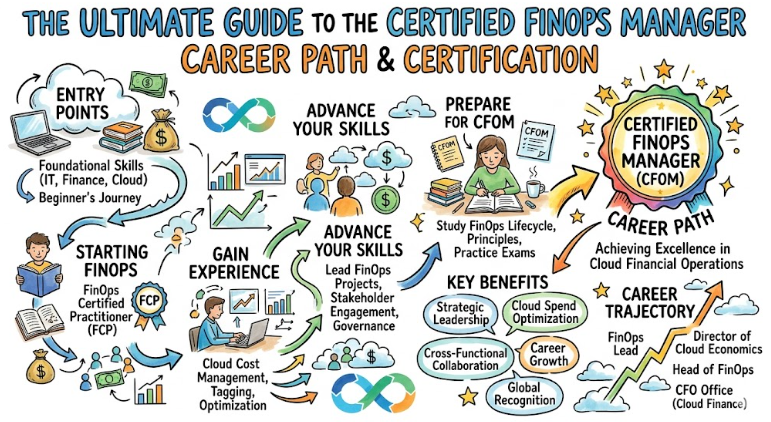
The Certified FinOps Manager certification is the definitive credential for engineering, finance, and operations professionals aiming to master cloud financial management and optimize infrastructure costs at an enterprise scale. Hosted by finopsschool, this comprehensive guide is designed for cloud architects, SREs, and engineering managers who need to align cloud spending with business value while avoiding the common pitfalls of uncontrolled infrastructure scaling. Navigating cloud costs has become as critical as managing uptime and security, making this certification essential for professionals looking to bridge the gap between engineering decisions and financial accountability. By understanding the core principles of unit economics, cost allocation, and automated governance, professionals can elevate their careers and make high-impact strategic decisions that directly benefit their organizations.
What is the Certified FinOps Manager?
The Certified FinOps Manager credential is a specialized professional standard that validates an individual’s ability to govern, optimize, and forecast cloud infrastructure costs within modern enterprise environments. It exists to solve the growing disconnect between technical engineering teams who provision cloud resources and finance teams who manage the budgets. Rather than focusing purely on abstract financial theory, this certification emphasizes real-world, production-focused learning, teaching practitioners how to implement tagging strategies, utilize cost anomaly detection, and build automated remediation pipelines. It perfectly aligns with modern engineering workflows by integrating financial accountability directly into the continuous integration and continuous deployment lifecycles, ensuring that cost efficiency becomes a shared responsibility across all technical departments.
Who Should Pursue Certified FinOps Manager?
This certification is highly beneficial for a diverse range of technical and financial roles, particularly engineering managers, cloud architects, Site Reliability Engineers, and dedicated FinOps practitioners. Beginners transitioning into cloud management will find it provides a structured framework for understanding infrastructure economics, while experienced engineers will gain the necessary tools to architect cost-effective systems at a massive scale. Furthermore, security and data professionals who manage resource-intensive workloads will discover practical strategies to optimize their massive compute and storage footprints. Given the global surge in cloud adoption, coupled with India’s rapidly expanding tech ecosystem prioritizing cost-optimized product development, the concepts covered here hold immense relevance for tech professionals seeking global leadership roles.
Why Certified FinOps Manager is Valuable Today and Beyond
As organizations continue to scale their cloud footprints, the demand for professionals who can strategically manage and optimize these complex environments has never been higher. Enterprise adoption of FinOps practices is rapidly transitioning from an optional luxury to a mandatory operational requirement to prevent cloud waste. Achieving the Certified FinOps Manager status helps professionals stay relevant despite the constant evolution of specific cloud providers or tooling, as the underlying principles of unit economics and financial governance remain universal. The return on the time invested in this certification is substantial, often leading to roles with higher strategic influence, improved compensation, and the ability to drive undeniable, measurable value within any engineering organization.
Certified FinOps Manager Certification Overview
The comprehensive learning program for this credential is fundamentally structured to bridge the gap between theoretical knowledge and practical application. The core curriculum is delivered via the official Certified FinOps Manager course and is securely hosted on the finopsschool.com platform for global accessibility. The certification is divided into progressive levels, beginning with foundational principles and advancing toward highly complex, enterprise-level optimization strategies. Assessments are rigorously designed to test real-world scenarios, ensuring that every credential holder possesses the hands-on capability to audit architectures, negotiate vendor contracts, and build resilient, cost-aware engineering cultures.
Certified FinOps Manager Certification Tracks & Levels
The certification journey is structured into three distinct tiers: Foundation, Professional, and Advanced Leadership, ensuring a logical progression for professionals at any stage of their career. The Foundation level establishes the core vocabulary and basic optimization principles, making it ideal for those new to cloud financial management. The Professional track dives deeply into technical implementation, specifically targeting DevOps, SRE, and FinOps practitioners who need to automate cost governance and integrate it into existing pipelines. Finally, the Advanced Leadership level focuses on organizational transformation, teaching engineering leaders how to build FinOps cultures, define key performance indicators, and align overarching business objectives with technical execution.
Complete Certified FinOps Manager Certification Table
| Track | Level | Who it’s for | Prerequisites | Skills Covered | Recommended Order |
| Core FinOps | Foundation | Cloud beginners, Finance teams | Basic cloud knowledge | Cloud pricing models, Billing fundamentals, Tagging basics | 1 |
| Technical FinOps | Professional | Cloud Architects, DevOps, SREs | Foundation Cert, Cloud Exp | Automation, Anomaly detection, Waste remediation | 2 |
| FinOps Leadership | Advanced | Engineering Managers, Directors | Professional Cert | Cultural transformation, Vendor negotiation, Forecasting | 3 |
Detailed Guide for Each Certified FinOps Manager Certification
Certified FinOps Manager – Foundation
What it is
This entry-level certification validates a fundamental understanding of cloud financial management principles. It ensures the candidate comprehends core terminology, pricing models, and the basic lifecycle of cloud resource provisioning and billing.
Who should take it
This is perfectly suited for junior cloud engineers, financial analysts transitioning to tech, and product managers. It is intended for those who need a baseline understanding of how cloud spending impacts overall business profitability.
Skills you’ll gain
- Understanding of major cloud provider pricing structures.
- Ability to read and interpret complex cloud billing reports.
- Knowledge of basic resource tagging and allocation strategies.
- Familiarity with the FinOps lifecycle phases: Inform, Optimize, and Operate.
Real-world projects you should be able to do
- Categorizing raw cloud spending data into departmental chargebacks.
- Setting up basic billing alerts and budget thresholds in cloud consoles.
- Identifying unattached or orphaned storage volumes for deletion.
Preparation plan
A 7 to 14 days plan involves reading foundational whitepapers and familiarizing oneself with cloud billing dashboards. A 30 days strategy includes taking foundational practice exams and mapping out a sample budget. A 60 days plan is rarely needed for this level but would involve deep dives into multiple cloud providers’ pricing calculators.
Common mistakes
Candidates often memorize terminology without understanding how billing works in a live cloud console. Many also fail to grasp the difference between CAPEX and OPEX in cloud environments.
Best next certification after this
- Same-track option: Certified FinOps Manager Professional.
- Cross-track option: AWS Certified Cloud Practitioner or Azure Fundamentals.
- Leadership option: ITIL Foundation for broader service management context.
Certified FinOps Manager – Professional
What it is
This intermediate-to-advanced credential focuses on the technical execution of cost optimization strategies. It validates the ability to integrate financial governance directly into infrastructure as code and automated deployment pipelines.
Who should take it
Targeted directly at DevOps engineers, Site Reliability Engineers, and dedicated cloud architects. Candidates should have active experience provisioning resources and writing automation scripts in production environments.
Skills you’ll gain
- Designing and enforcing complex, multi-account tagging architectures.
- Implementing automated cost anomaly detection and alerting systems.
- Utilizing right-sizing metrics to optimize compute and database instances.
- Managing commitment-based discounts like Reserved Instances and Savings Plans.
Real-world projects you should be able to do
- Building a serverless function to automatically shut down non-production environments after hours.
- Developing a dashboard that correlates application performance metrics with unit costs.
- Automating the purchase and modification of compute savings plans via API.
Preparation plan
The 7 to 14 days sprint requires intensive review of automation scripts and optimization APIs. A 30 days approach involves hands-on lab work, building automated governance policies in a sandbox environment. The 60 days comprehensive plan is best, allowing time to implement a full FinOps lifecycle project from reporting to automated remediation.
Common mistakes
Engineers often over-focus on the technical automation while ignoring the human communication aspect required to get teams to adopt optimizations. Another mistake is ignoring data transfer costs, which can become significant at scale.
Best next certification after this
- Same-track option: Certified FinOps Manager Advanced Leadership.
- Cross-track option: Certified Kubernetes Administrator.
- Leadership option: Agile Scrum Master.
Certified FinOps Manager – Advanced Leadership
What it is
This pinnacle certification validates an individual’s capability to drive cultural change, manage massive cloud budgets, and negotiate enterprise agreements. It focuses on the strategic alignment of engineering output with corporate financial goals.
Who should take it
Engineering directors, VP of Engineering, Chief Technology Officers, and Lead FinOps Practitioners. It is designed for those who make high-level strategic decisions rather than daily technical implementations.
Skills you’ll gain
- Advanced capacity planning and long-term cloud cost forecasting.
- Vendor negotiation tactics for enterprise discount programs.
- Frameworks for driving behavioral change and financial accountability in engineering teams.
- Developing custom unit economic metrics tied directly to business KPIs.
Real-world projects you should be able to do
- Drafting and executing a multi-year cloud financial strategy and migration budget.
- Structuring a FinOps Center of Excellence within a massive global enterprise.
- Negotiating custom terms and private pricing with major cloud service providers.
Preparation plan
A 7 to 14 days review focuses on leadership frameworks and financial modeling principles. The 30 days plan includes studying real-world enterprise case studies and forecasting models. The 60 days strategy involves active mentoring, networking with other leaders, and developing a comprehensive mock enterprise strategy.
Common mistakes
Candidates sometimes fail to connect technical metrics with actual business drivers, such as cost per transaction or cost per customer. Many also underestimate the difficulty of driving cultural change across disparate engineering silos.
Best next certification after this
- Same-track option: Continuous learning through industry executive roundtables.
- Cross-track option: Executive data management or cybersecurity leadership certifications.
- Leadership option: Advanced executive business management courses.
Choose Your Learning Path
DevOps Path
Professionals on the DevOps path must integrate financial accountability directly into their CI/CD pipelines. This involves shifting cost considerations to the left, ensuring that infrastructure as code templates are evaluated for financial impact before deployment. By mastering the Certified FinOps Manager principles, DevOps engineers can automate budget enforcement and prevent costly misconfigurations from reaching production environments. Ultimately, this path transforms engineers from mere resource provisioners into strategic partners who actively protect the company’s bottom line.
DevSecOps Path
The DevSecOps path naturally extends to include financial security and risk management alongside traditional cybersecurity protocols. Practitioners must learn to identify the financial risks associated with security vulnerabilities, such as the potential cost of a distributed denial-of-service attack inflating bandwidth bills. Incorporating the Certified FinOps Manager methodologies allows these professionals to build secure environments that are also inherently cost-optimized. This dual focus ensures that compliance and security mandates do not lead to uncontrolled or untracked infrastructure spending.
SRE Path
Site Reliability Engineers are tasked with balancing system availability against operational costs, making FinOps a critical component of their role. This path focuses on defining Service Level Objectives that account for the financial cost of achieving an extra nine of reliability. Through the Certified FinOps Manager curriculum, SREs learn to right-size highly available architectures without sacrificing performance. This ensures that redundancy and disaster recovery plans are financially sustainable over the long term.
AIOps Path
Artificial Intelligence for IT Operations relies heavily on massive datasets and intensive compute power, which can quickly drain budgets if left unmanaged. Professionals on this path must learn to apply FinOps principles to the infrastructure that supports automated operations and monitoring tools. The Certified FinOps Manager strategies help AIOps practitioners evaluate the return on investment for various observability platforms. By doing so, they ensure that the cost of monitoring does not exceed the value of the operational insights gained.
MLOps Path
Machine Learning Operations present unique financial challenges due to the high costs associated with GPU instances and massive data storage requirements. This specialized path focuses on optimizing model training cycles, managing the lifecycle of machine learning data, and selecting the most cost-effective compute shapes. The Certified FinOps Manager framework provides MLOps engineers with the skills to track the unit economics of deploying specific models into production. This is essential for ensuring that artificial intelligence initiatives remain profitable as they scale.
DataOps Path
DataOps professionals manage the pipelines that move, transform, and store vast amounts of enterprise data across various cloud environments. This path emphasizes the optimization of data warehousing, query processing costs, and long-term archival storage strategies. By applying the Certified FinOps Manager methodologies, DataOps engineers can implement data lifecycle management policies that automatically transition unused data to cheaper storage tiers. This significantly reduces the financial burden of maintaining massive data lakes while preserving accessibility for analytics.
FinOps Path
This is the dedicated path for professionals whose primary responsibility is governing and optimizing cloud expenditure across the entire organization. It involves mastering all aspects of the FinOps lifecycle, from granular cost allocation to complex commitment discount management. Practitioners on this path leverage the comprehensive knowledge from the Certified FinOps Manager program to build robust reporting dashboards and drive a culture of financial accountability. They act as the vital bridge between engineering, finance, and executive leadership teams.
Role -> Recommended Certified FinOps Manager Certifications
| Role | Recommended Certifications |
| DevOps Engineer | Certified FinOps Manager Professional |
| SRE | Certified FinOps Manager Professional, Advanced Leadership |
| Platform Engineer | Certified FinOps Manager Professional |
| Cloud Engineer | Certified FinOps Manager Foundation, Professional |
| Security Engineer | Certified FinOps Manager Foundation |
| Data Engineer | Certified FinOps Manager Professional |
| FinOps Practitioner | All Certified FinOps Manager Levels |
| Engineering Manager | Certified FinOps Manager Advanced Leadership |
Next Certifications to Take After Certified FinOps Manager
Same Track Progression
After achieving mastery in initial levels, professionals should seek deep specialization by pursuing advanced iterations of cloud financial management credentials. This involves staying updated with the latest updates to provider billing APIs, serverless optimization techniques, and new commitment discount structures. Continuous progression within this track ensures that practitioners remain at the forefront of the industry’s evolving best practices for cost governance.
Cross-Track Expansion
To maximize operational impact, credential holders should broaden their skill sets by exploring complementary technical disciplines. Earning specialized certifications in container orchestration, such as Kubernetes, or massive data processing frameworks allows practitioners to apply their financial governance skills to highly complex architectures. This cross-track expansion creates hybrid professionals who can seamlessly architect systems that are both technically cutting-edge and fiercely cost-effective.
Leadership & Management Track
For those aiming to transition fully into strategic leadership roles, pursuing credentials in project management, enterprise architecture, or even a formal business degree is highly recommended. The focus shifts from managing cloud instances to managing large-scale teams, driving cultural transformations, and aligning IT expenditure directly with corporate revenue goals. This track prepares individuals for executive positions where technical understanding must be paired with exceptional business acumen.
Training & Certification Support Providers for Certified FinOps Manager
DevOpsSchool
DevOpsSchool has established itself as a premier destination for mastering modern software delivery and infrastructure management methodologies. They provide highly structured, real-world training environments that perfectly complement the core concepts of cloud financial governance and infrastructure optimization. Their curriculum is strictly designed by working industry veterans who understand the practical challenges of balancing deployment speed with strict cost controls. Students benefit from an immersive learning experience that bridges the gap between theoretical knowledge and hands-on, production-grade implementation. By focusing on the intersection of automation and resource efficiency, DevOpsSchool equips its candidates with the holistic skills required to lead complex engineering initiatives and drive systemic improvements across large-scale enterprise environments.
Cotocus
Cotocus stands out in the technical training landscape through its rigorous focus on cloud-native consulting and specialized workforce development. They provide targeted enablement programs that help organizations and individuals master the intricacies of modern infrastructure, including the critical aspects of capacity planning and resource allocation. Their learning modules emphasize practical problem-solving, guiding professionals through simulated enterprise scenarios where technical architecture directly impacts financial outcomes. Cotocus leverages deep industry expertise to ensure that learners not only understand how to provision cloud environments but also how to govern them effectively. This approach makes them an excellent support system for professionals looking to build a robust foundation in cloud economics and scalable operational practices.
Scmgalaxy
Scmgalaxy is a highly respected knowledge hub and community-driven training platform dedicated to software configuration management and modern operational practices. They offer comprehensive resources that deeply explore the automation, continuous integration, and infrastructure as code practices essential for effective cloud management. Their training philosophy emphasizes community learning and open-source tooling, providing professionals with accessible, high-quality guidance on architecting resilient systems. By integrating financial awareness into their technical tutorials, Scmgalaxy helps engineers understand the monetary impact of configuration drifts and inefficient pipelines. Their extensive repository of articles, forums, and structured courses makes them a vital resource for practitioners looking to refine their technical skills while embracing broader operational and cost-efficiency standards.
BestDevOps
BestDevOps provides specialized educational tracks that focus intensely on bridging the operational silos between software development and IT operations. Their training methodology heavily incorporates the principles of resource optimization, ensuring that engineers are taught to build scalable systems with a continuous awareness of underlying infrastructure costs. They offer practical lab environments where learners can experiment with deployment strategies and immediately see the simulated financial impact of their architectural choices. BestDevOps excels at breaking down complex concepts like automated governance and performance tuning into digestible, actionable lessons. This practical focus ensures that graduates are fully prepared to implement sophisticated optimization strategies and drive cultural alignment within high-performing technical teams.
devsecopsschool.com
devsecopsschool.com focuses exclusively on the critical integration of security practices into the continuous delivery lifecycle, advocating for robust protection without compromising deployment velocity. Their comprehensive training programs highlight how security vulnerabilities and compliance failures can lead to massive, unexpected operational costs. By weaving financial risk management into their security curriculum, they provide professionals with a unique perspective on cost-aware architecture. Learners are trained to build automated security gates that prevent expensive misconfigurations from reaching production, thereby protecting both the organization’s data and its budget. devsecopsschool.com is the ideal training provider for engineers who want to master the intersection of cloud security, risk mitigation, and overarching infrastructural cost optimization.
sreschool.com
sreschool.com is dedicated to cultivating top-tier Site Reliability Engineers by focusing deeply on system architecture, observability, and performance optimization. Their training programs emphasize the importance of defining highly accurate Service Level Objectives and understanding the direct financial implications of engineering for high availability. They teach professionals how to meticulously balance the cost of redundancy with the business value of uptime. Through advanced scenario-based learning, sreschool.com ensures that engineers can right-size production environments, optimize network traffic routing, and implement efficient incident response protocols. This focused approach makes them an invaluable partner for professionals seeking to master the delicate equilibrium between extreme reliability and strict financial governance in the cloud.
aiopsschool.com
aiopsschool.com pioneers training in the rapidly growing field of artificial intelligence for IT operations, focusing on utilizing machine learning to automate infrastructure management. Their specialized courses teach professionals how to deploy intelligent observability platforms that can automatically detect inefficiencies and predict resource bottlenecks before they cause financial strain. The curriculum emphasizes the optimization of massive data pipelines and the cost-effective management of the intensive compute power required for artificial intelligence workloads. By integrating cloud economic principles into advanced operational analytics, aiopsschool.com provides engineers with the foresight needed to manage complex, automated environments. They are a crucial resource for teams looking to leverage artificial intelligence without losing control of their operational expenditure.
dataopsschool.com
dataopsschool.com offers focused educational pathways for managing the complexities of enterprise-scale data engineering and analytics pipelines. Their training deeply explores the mechanics of efficient data warehousing, cost-effective query optimization, and the automated lifecycle management of massive datasets. They understand that storing and processing petabytes of information can quickly become a financial liability if not governed correctly. Therefore, their curriculum seamlessly integrates strategies for intelligent data tiering and resource allocation, ensuring that engineers can deliver high-speed analytics without uncontrolled budget overruns. dataopsschool.com equips professionals with the specialized knowledge required to build robust data architectures that are both incredibly performant and strictly financially optimized.
finopsschool.com
finopsschool.com is the premier, authoritative destination for comprehensive training and certification in cloud financial management. They provide the definitive curriculum for mastering the nuanced disciplines of cost allocation, anomaly detection, and enterprise-wide technical budget governance. Their highly specialized programs are built specifically to bridge the communication and knowledge gaps between engineering teams, financial departments, and executive leadership. Through rigorous, real-world scenario training, they ensure professionals can architect automated cost controls and negotiate complex vendor commitments. As the central hub for this discipline, finopsschool.com is absolutely indispensable for any professional committed to optimizing cloud investments and driving a sustainable, cost-aware engineering culture across modern enterprise organizations.
Frequently Asked Questions
- What fundamental problem does cloud financial management solve?
It addresses the challenge of decentralized cloud spending where engineering teams provision resources instantly, often leading to massive, untracked financial waste and budget overruns.
- Do I need a background in corporate finance to understand this domain?
No, a traditional finance background is not required; the focus is primarily on engineering practices, cloud billing mechanics, and infrastructure optimization rather than accounting.
- How long does it generally take to master these core concepts?
Most dedicated tech professionals can grasp the foundational concepts within a few weeks, though mastering advanced enterprise automation strategies can take several months of hands-on practice.
- Is coding knowledge strictly necessary for this career path?
While basic concepts can be understood without coding, practical implementation requires scripting skills and infrastructure as code knowledge to intelligently automate cost controls.
- How does this discipline differ from traditional IT procurement?
Traditional procurement involves long approval cycles for physical hardware, whereas modern cloud management deals with real-time, variable consumption of virtual resources by distributed engineering teams.
- Can these methodologies be applied to on-premises data centers?
While specifically designed for the variable spending models of public clouds, many of the cultural principles and resource allocation strategies can be adapted to improve efficiency in on-premises environments.
- Does focusing on cost slow down software deployment velocity?
When implemented correctly through automated guardrails and continuous integration pipelines, it actually improves velocity by removing manual budget approvals and preventing massive architectural rework later.
- What are the most common tools used in this operational field?
Professionals commonly utilize native cloud tools alongside third-party platforms, automation scripts, and custom business intelligence dashboards built on robust enterprise data lakes.
- How frequently should an organization review its infrastructure spending?
Reviews should transition from monthly manual audits to continuous, automated monitoring, with daily anomaly detection alerts and weekly alignment meetings for large engineering departments.
- Why do engineering teams often resist adopting these optimization practices?
Resistance typically stems from a fear that strict financial governance will restrict their freedom to experiment, slow down their development cycles, or force them to use inadequate resources.
- What is the concept of a unit metric in this context?
A unit metric ties cloud expenditure directly to a specific business outcome, such as the cost per customer transaction, rather than just looking at the total monthly server bill.
- How does managing commitment discounts like reserved instances work?
It involves analyzing historical usage patterns to confidently commit to baseline compute levels in exchange for significant hourly rate discounts from the cloud provider, minimizing on-demand costs.
FAQs on Certified FinOps Manager
- What specific skills does the Certified FinOps Manager credential validate?
The credential rigorously validates an individual’s ability to seamlessly integrate financial accountability into modern cloud engineering workflows. It tests practical competencies such as designing complex multi-account tagging structures, writing automation scripts to terminate idle resources, and configuring real-time anomaly detection alerts. Furthermore, it ensures candidates can intelligently read intricate billing reports, calculate exact unit economics for specific applications, and confidently negotiate enterprise discount programs with major cloud providers. Ultimately, it proves a professional can architect highly scalable systems that are both technically resilient and strictly aligned with corporate budget constraints.
- How does the Certified FinOps Manager differ from standard cloud architect certifications?
Standard cloud architect certifications primarily focus on technical design, high availability, security protocols, and system performance. They teach you how to build robust systems but often treat cost as a secondary concern. The Certified FinOps Manager credential explicitly flips this paradigm, placing financial governance and unit economics at the absolute forefront of system design. It teaches professionals how to build automated guardrails that prevent expensive misconfigurations, manage commitment-based discount portfolios, and foster a collaborative culture between technical engineering teams and corporate finance departments to ensure maximum return on cloud investments.
- What is the recommended career level for pursuing the professional tier of this certification?
The professional tier is aggressively targeted at mid-level to senior practitioners who already possess hands-on experience provisioning and managing infrastructure within a public cloud environment. Ideal candidates include established Site Reliability Engineers, seasoned DevOps practitioners, and cloud architects who have previously grappled with the complexities of variable cloud billing. Before attempting this rigorous tier, candidates should be comfortable working with infrastructure as code, understanding basic data analytics, and communicating complex technical constraints to non-technical business stakeholders, ensuring they can implement cost optimization strategies at a massive enterprise scale.
- How does acquiring the Certified FinOps Manager impact a professional’s salary potential?
Acquiring this specialized credential frequently leads to significant compensation increases, as the skills acquired have a direct, measurable, and immediate impact on an organization’s bottom line. Professionals who can confidently demonstrate their ability to reduce a massive monthly cloud bill by millions of dollars become invaluable assets to executive leadership. This proven capability to prevent financial waste while maintaining technical innovation often justifies rapid promotions into strategic architectural roles, directorships, and specialized leadership positions, commanding top-tier salaries in a highly competitive global technology market focused on operational efficiency.
- Can the Certified FinOps Manager principles be applied universally across different cloud providers?
Yes, the core philosophies and architectural methodologies taught within the program are inherently vendor-neutral and designed to be universally applicable. While specific dashboard navigation and exact billing terminologies may vary between cloud providers, the fundamental concepts remain identical. Strategies concerning accurate cost allocation, behavioral modification techniques, effective tagging taxonomies, and the utilization of custom business metrics can be seamlessly adapted across any major cloud vendor or complex multi-cloud environment, making the certification highly versatile and globally relevant for modern enterprise engineering.
- What is the typical daily routine for someone holding a Certified FinOps Manager role?
A typical day involves a dynamic blend of technical execution, data analysis, and cross-departmental communication. Mornings might be spent reviewing automated anomaly detection alerts, investigating unexpected spikes in data transfer costs, and adjusting serverless compute limits. The afternoon often involves analyzing complex data warehouse queries to build customized dashboards that map cloud usage to specific product features. Additionally, managers will regularly meet with various engineering teams to review their upcoming deployment architectures, ensuring that proper cost-saving mechanisms, like auto-scaling groups and lifecycle policies, are properly implemented before production launch.
- Are there any specific prerequisites required before starting the foundation level?
The foundation level of this credential intentionally demands very few strict technical prerequisites, making it highly accessible. However, candidates will benefit immensely from possessing a rudimentary understanding of basic cloud computing concepts, such as the difference between virtual machines, object storage, and serverless architectures. A basic grasp of standard corporate budgeting processes and an understanding of the fundamental differences between capital expenditure and operational expenditure are also helpful. The introductory materials are designed to quickly bridge any existing knowledge gaps, providing a solid baseline for both technical engineers and incoming finance professionals.
- How frequently is the curriculum for the Certified FinOps Manager updated?
The curriculum undergoes continuous, rigorous review and periodic updates to ensure it accurately reflects the incredibly rapid evolution of the cloud computing landscape. As major cloud service providers constantly introduce novel pricing models, entirely new compute instances, and altered enterprise discount structures, the certification materials are quickly adapted to encompass these critical changes. This relentless commitment to current industry standards guarantees that credential holders are consistently learning the most modern, effective, and production-ready strategies for maximizing cloud efficiency, rather than studying outdated methodologies that no longer apply to contemporary deployments.
Final Thoughts: Is Certified FinOps Manager Worth It?
Deciding to pursue the Certified FinOps Manager credential is fundamentally about choosing to expand your impact beyond pure code and infrastructure. In my experience working with massive distributed systems, the engineers who truly stand out are the ones who understand how their technical decisions affect the company’s financial health. This certification is absolutely worth the effort if you want to transition from simply keeping the servers running to actively driving strategic business value. It equips you with a rare, highly sought-after skill set that forces both engineering and finance teams to listen to your recommendations. If you are serious about advancing into architectural leadership or management roles, mastering the art of cloud financial governance is no longer just an impressive resume addition; it is a mandatory operational requirement for the modern technical landscape.