




Introduction
The rise of cloud-native ecosystems has transformed how organizations manage infrastructure, but it has also introduced significant financial complexity. The Certified FinOps Engineer is a professional validation designed to bridge the gap between cloud engineering and financial accountability. This guide is crafted for DevOps, SRE, and platform engineers who need to move beyond simply deploying resources to optimizing the unit economics of their cloud environments. By following this roadmap, professionals can transition from being cost-blind builders to value-driven architects, ensuring that every dollar spent on finopsschool principles translates into measurable business growth.
What is the Certified FinOps Engineer?
The Certified FinOps Engineer represents a shift in how engineering teams interact with cloud billing and resource management. It is a technical certification that moves beyond theoretical cost-saving tips to focus on the mechanical and architectural changes required for real-time cost visibility. It exists because modern enterprises require engineers who can automate cost anomalies, rightsizing, and commitment-based discounts within the CI/CD pipeline. This certification aligns with production-focused workflows by treating “Cost” as a first-class operational metric, similar to performance or security.
Who Should Pursue Certified FinOps Engineer?
This certification is specifically designed for technical practitioners such as DevOps engineers, Site Reliability Engineers (SREs), and Cloud Architects who have direct control over infrastructure. It is equally beneficial for Security and Data engineers who manage high-consumption workloads and need to understand the financial implications of their architectural choices. In the global market, including India’s massive tech sector, managers and technical leaders are also pursuing this to build more sustainable, profitable engineering departments. Even beginners with a strong cloud foundation find this valuable for standing out in a crowded job market.
Why Certified FinOps Engineer is Valuable and Beyond
As organizations move past initial cloud migration and into the optimization phase, the demand for engineers who understand cloud economics has skyrocketed. The Certified FinOps Engineer provides long-term career longevity because it focuses on a universal problem—waste—that persists regardless of which cloud provider or tool is currently in vogue. It offers a significant return on investment by positioning an engineer as a strategic partner to the finance team, rather than just a cost center. Enterprise adoption of FinOps ensures that this skillset will remain a requirement for senior and principal-level engineering roles.
Certified FinOps Engineer Certification Overview
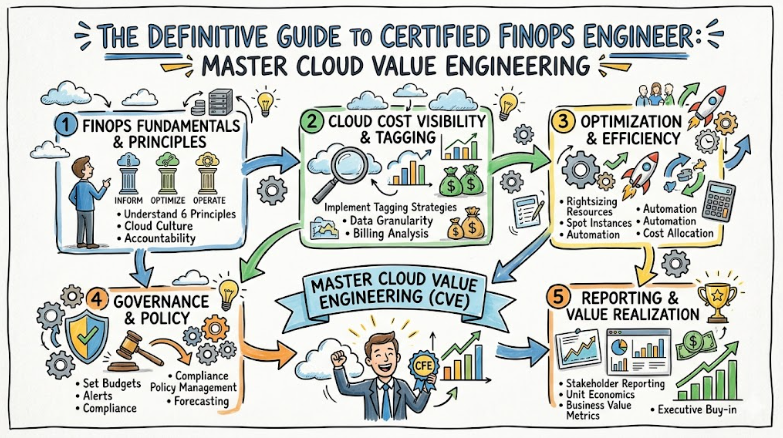
The program is delivered via the official curriculum and is hosted on the platform provided by finopsschool.com. It utilizes a multi-tiered assessment approach that combines conceptual knowledge with practical, hands-on scenarios designed to simulate real-world billing environments. The certification structure focuses on the “Inform, Optimize, and Operate” phases of the FinOps framework, ensuring that engineers own the lifecycle of their cloud spend. By emphasizing ownership, the program teaches engineers how to integrate financial data directly into their existing technical monitoring and alerting stacks.
Certified FinOps Engineer Certification Tracks & Levels
The certification path is divided into foundational, professional, and advanced tiers to accommodate different career stages. The foundation level introduces the core vocabulary and concepts, while the professional level dives deep into the engineering tactics of automation and architectural optimization. Specialized tracks allow engineers to focus on specific domains like FinOps for Containers, FinOps for Data Science, or FinOps for Multi-Cloud environments. These levels are designed to align with career progression, moving from individual contributor tasks to organizational-wide financial strategy.
Complete Certified FinOps Engineer Certification Table
| Track | Level | Who it’s for | Prerequisites | Skills Covered | Recommended Order |
| Core Engineering | Foundation | Junior Engineers / Analysts | Basic Cloud Knowledge | Vocabulary, Lifecycle, Reporting | 1 |
| Technical Automation | Professional | DevOps / SRE / Architects | 2+ Years Cloud Experience | Rightsizing, Tagging, Automation | 2 |
| Strategy & Leadership | Advanced | Engineering Managers / Leads | Professional Certification | Unit Economics, Cultural Change | 3 |
| Containerized FinOps | Specialist | Kubernetes / Platform Engineers | Professional Certification | Pod-level Costing, Bin-Packing | 4 |
Detailed Guide for Each Certified FinOps Engineer Certification
Certified FinOps Engineer – Associate
What it is
This certification validates a baseline understanding of the FinOps framework and the ability to navigate cloud billing consoles. It ensures the candidate understands the fundamental differences between CapEx and OpEx.
Who should take it
It is suitable for entry-level cloud engineers, finance analysts working with tech teams, and procurement specialists who want to understand the technical side of cloud spending.
Skills you’ll gain
- Mastery of the FinOps lifecycle: Inform, Optimize, Operate.
- Ability to identify common cloud waste areas like orphaned disks and idle instances.
- Understanding of cloud pricing models including On-Demand, Spot, and Reserved instances.
Real-world projects you should be able to do
- Create a basic cloud cost dashboard using native cloud provider tools.
- Generate a monthly report identifying the top three areas of waste in a development environment.
Preparation plan
- 7–14 Days: Focus on learning the official FinOps terminology and core principles.
- 30 Days: Review case studies of successful FinOps implementations in medium-sized enterprises.
- 60 Days: Not typically required for this level, but useful for those with zero cloud experience.
Common mistakes
- Focusing too much on specific cloud tools rather than the overarching FinOps framework.
- Neglecting the cultural and collaborative aspects of the “Operate” phase.
Best next certification after this
- Same-track option: Certified FinOps Engineer – Professional
- Cross-track option: Cloud Practitioner (AWS/Azure/GCP)
- Leadership option: FinOps Practitioner
Certified FinOps Engineer – Professional
What it is
The Professional level validates the technical ability to implement automation and architectural changes that drive down costs. It proves you can integrate FinOps into the engineering DNA of a company.
Who should take it
This is meant for senior DevOps engineers, SREs, and Cloud Architects who are responsible for large-scale infrastructure and automated deployment pipelines.
Skills you’ll gain
- Implementation of automated “Janitor” scripts to decommission unused resources.
- Advanced tagging strategies and enforcement using Infrastructure as Code (IaC).
- Developing unit metrics to measure cost per customer or cost per transaction.
Real-world projects you should be able to do
- Build a serverless function that alerts teams when a specific project exceeds its daily budget.
- Refactor a legacy application architecture to utilize Spot instances or Graviton-based chips.
Preparation plan
- 7–14 Days: Deep dive into advanced pricing APIs and Cost Explorer features.
- 30 Days: Build lab environments to test auto-scaling and rightsizing automation scripts.
- 60 Days: Conduct a mock “Cloud Bill Audit” to identify complex optimization opportunities.
Common mistakes
- Failing to understand the trade-offs between performance, reliability, and cost.
- Implementing aggressive automation that breaks production workloads without proper testing.
Best next certification after this
- Same-track option: Certified FinOps Engineer – Expert
- Cross-track option: Certified Kubernetes Administrator (CKA)
- Leadership option: Engineering Manager track
Choose Your Learning Path
DevOps Path
In this path, the focus is on integrating financial guardrails into the CI/CD pipeline. Engineers learn to treat cost as a build-breaking metric, ensuring that inefficient code or infrastructure definitions never reach production. This involves using tools to estimate pull request costs before they are merged.
DevSecOps Path
The security path emphasizes the overlap between cost and risk, such as identifying crypto-jacking through cost anomalies. It teaches engineers how to manage the costs of security tooling and logging without compromising the organization’s defensive posture.
SRE Path
SREs focus on the intersection of Service Level Objectives (SLOs) and cost. This path teaches how to balance reliability with budget, ensuring that the “error budget” and the “financial budget” are managed in tandem to prevent over-provisioning for unnecessary nines of availability.
AIOps Path
This path leverages machine learning to predict future spend and identify subtle anomalies that human analysts might miss. It focuses on using data-driven insights to automate the optimization of complex, dynamic cloud environments.
MLOps Path
MLOps professionals learn to manage the unique and often massive costs associated with GPU clusters and model training. This path covers strategies for data versioning and model deployment that minimize expensive compute cycles.
DataOps Path
Data engineers focus on the cost of storage and data egress. This path teaches how to optimize data pipelines, choose the right storage tiers (Hot vs. Cold), and manage the financial impact of large-scale big data processing.
FinOps Path
This is the pure-play path for those wanting to become FinOps practitioners. It focuses on the cultural shift, organizational alignment, and the creation of a centralized FinOps center of excellence to drive efficiency across all departments.
Role → Recommended Certified FinOps Engineer Certifications
| Role | Recommended Certifications |
| DevOps Engineer | Professional FinOps Engineer, Specialist in IaC Costing |
| SRE | Professional FinOps Engineer, SLO-Cost Specialist |
| Platform Engineer | Advanced FinOps Engineer, Container Specialist |
| Cloud Engineer | Associate FinOps Engineer, Professional Level |
| Security Engineer | Associate FinOps Engineer, Security-Cost Specialist |
| Data Engineer | Professional FinOps Engineer, Data-Cost Specialist |
| FinOps Practitioner | Foundation, Professional, and Expert Levels |
| Engineering Manager | Associate FinOps Engineer, Advanced Strategy |
Next Certifications to Take After Certified FinOps Engineer
Same Track Progression
After completing the initial levels, engineers should seek out Expert-level designations that focus on multi-cloud strategy and global enterprise scale. This involves mastering the nuances of different cloud providers’ billing engines and creating unified reporting structures. It often leads to roles like Head of Cloud Optimization or FinOps Architect.
Cross-Track Expansion
Broadening your skills into Kubernetes (CKA) or specific Cloud Architect paths (AWS Solutions Architect) allows you to apply FinOps principles more effectively. Understanding the underlying technology deeply makes it easier to spot architectural inefficiencies that lead to high costs. This creates a highly versatile “T-shaped” professional profile.
Leadership & Management Track
For those moving into management, certifications in ITIL, PMP, or specialized engineering leadership programs are the logical next step. Combining FinOps expertise with management training prepares you to lead entire engineering organizations with a focus on profitability and operational excellence. This is the path to becoming a CTO or VP of Engineering.
Training & Certification Support Providers for Certified FinOps Engineer
DevOpsSchool
This provider offers extensive resources for engineers looking to integrate FinOps into their DevOps workflows. Their training programs focus on practical, hands-on labs that simulate real enterprise cloud bills. They provide mentorship from industry experts who have managed multi-million dollar cloud budgets.
Cotocus
Focused on specialized cloud consulting and training, this organization helps professionals master the technical implementation of cost-saving measures. They emphasize automation and the use of open-source tools to monitor and manage cloud spend effectively within a modern technical stack.
Scmgalaxy
A community-driven platform that provides a wealth of knowledge on software configuration management and its financial impact. Their training modules often cover the intersection of build engineering and cost, helping engineers optimize their pipelines for both speed and economy.
BestDevOps
This provider specializes in curriculum that aligns with industry best practices for high-performing engineering teams. Their FinOps training is geared towards senior professionals who need to implement large-scale changes and drive cultural shifts within their organizations.
devsecopsschool.com
This platform focuses on the critical link between security, operations, and finance. They offer courses that teach how to maintain a high-security posture while optimizing the costs of security infrastructure and monitoring tools in a cloud-native world.
sreschool.com
Dedicated to the principles of Site Reliability Engineering, this provider offers training on how to manage the “Cost of Reliability.” Their FinOps modules help SREs build cost-aware systems that maintain high availability without unnecessary financial waste.
aiopsschool.com
This organization explores the future of operations through artificial intelligence. Their FinOps training includes using AI and machine learning to automate cost forecasting, anomaly detection, and complex resource optimization in dynamic environments.
dataopsschool.com
Focused on the needs of data professionals, this platform provides guidance on managing the financial aspects of large-scale data platforms. They cover everything from storage tiering to the cost-efficient design of ETL/ELT pipelines.
finopsschool.com
As a primary destination for cloud financial management education, this platform offers a comprehensive suite of certifications and resources. It serves as a central hub for engineers and managers looking to master the FinOps framework and drive business value through cloud efficiency.
Frequently Asked Questions (General)
- How difficult is the Certified FinOps Engineer exam compared to other cloud certifications?
The exam is moderately difficult as it requires both technical cloud knowledge and an understanding of financial concepts. It is comparable to a professional-level Cloud Architect exam but with a specific focus on cost metrics. - Do I need to be a math expert to pass this certification?
No, advanced math is not required, but you should be comfortable with percentages, basic algebra for unit economics, and interpreting complex billing data tables and charts. - Is there a prerequisite for the Professional level certification?
While not always strictly enforced, having an Associate level or at least two years of direct cloud engineering experience is highly recommended to succeed at the Professional level. - How long does the certification remain valid?
Typically, the certification is valid for two years. Given the rapid pace of change in cloud pricing and services, staying current through recertification or continuing education is essential. - Will this certification help me get a salary increase?
Many organizations are prioritizing cloud cost management, and professionals with these validated skills often see higher salary offers and better leverage during performance reviews. - Can I take the exam online, or do I need to go to a testing center?
The exam is generally available through online proctored platforms, allowing you to take it from any location that meets the technical and environmental requirements. - How much time should I dedicate to studying if I am working full-time?
Most professionals find that 4–6 hours a week over a period of two months is sufficient to thoroughly understand the material and pass the professional-level exam. - Does this certification focus only on AWS?
No, the core principles of FinOps are cloud-agnostic. While examples may use specific providers, the skills are applicable to AWS, Azure, Google Cloud, and even private cloud environments. - Are there any coding requirements for the technical track?
Yes, for the Professional and Expert levels, you should be comfortable with scripting languages like Python or Bash and understanding Infrastructure as Code like Terraform or CloudFormation. - Is the FinOps framework recognized globally?
Yes, the framework is the industry standard for cloud financial management and is used by thousands of companies worldwide, from startups to Fortune 500 enterprises. - How does this certification differ from a standard Cloud Architect certification?
A Cloud Architect focuses on how to build a system for performance and scale, while a FinOps Engineer focuses on how to build that same system for maximum financial efficiency. - What is the most important skill learned in this program?
The most valuable skill is the ability to communicate technical infrastructure decisions in terms of business value and financial impact to stakeholders outside of engineering.
FAQs on Certified FinOps Engineer
- What specific tools will I learn to use in this certification?
You will learn to navigate native billing tools like AWS Cost Explorer, Azure Cost Management, and Google Cloud Billing. Additionally, you will be introduced to open-source tools like KubeCost and various cloud-native APIs for automated data retrieval and resource tagging. - How does the Certified FinOps Engineer handle multi-cloud environments?
The certification teaches a unified approach to data normalization. You will learn how to take disparate billing files from different providers and merge them into a single, cohesive reporting structure that allows for clear cross-cloud comparisons and strategy. - Does this certification cover container and Kubernetes costs?
Yes, the advanced levels specifically address the complexities of shared resources in Kubernetes. You will learn how to attribute pod-level costs to specific teams or projects, which is one of the most challenging aspects of modern cloud finance. - Will I learn about commitment-based discounts like RIs and Savings Plans?
Absolutely. A core part of the curriculum involves understanding how to analyze usage patterns to make informed decisions about long-term commitments, balancing the need for flexibility with the desire for maximum discounts. - How is “Unit Economics” applied in the context of this certification?
You will learn to move beyond total spend and look at metrics like “cost per active user” or “cost per checkout.” This allows the business to understand if cloud costs are scaling linearly with revenue or if there are inefficiencies. - Is there a focus on automated governance?
Yes, the technical tracks emphasize “Policy as Code.” You will learn how to write and implement policies that automatically prevent the deployment of non-compliant, expensive resources, effectively building financial guardrails into your infrastructure. - How does this certification address the “Cultural Shift” of FinOps?
It provides frameworks for breaking down silos between engineering, finance, and procurement. You will learn how to lead meetings and create reporting structures that foster shared accountability for cloud spend across the entire organization. - What is the role of tagging and labeling in the exam?
Tagging is a fundamental topic. You will be tested on your ability to design and enforce a tagging schema that ensures 100% cost allocation, allowing every dollar spent to be traced back to a specific owner or project.
Final Thoughts: Is Certified FinOps Engineer Worth It?
In the current landscape of cloud computing, being “cloud-capable” is no longer enough; you must be “cloud-efficient.” The Certified FinOps Engineer is a high-value investment for any technical professional who wants to elevate their role from a tactical implementer to a strategic advisor. It provides a rare combination of technical depth and business acumen that is in high demand across the industry. If you want to ensure your skills remain relevant as companies transition from growth-at-all-costs to sustainable innovation, this certification is a logical and practical step forward. It is not about spending less; it is about making sure that every cent you spend drives the most possible value for your organization.